Expository Writing
Credits to Stanford University and Purdue University. Resources in this
presentation were retrieved from http://www.stanford.edu/~arnetha/expowrite/info.html
and http://owl.english.purdue.edu/owl/resource/685/02/ on November 1, 2011.


Mr. Edward Jay M. Quinto
English for Academic Purposes 1
What is Expository Writing?
Exposition is a type of oral or written
 discourse that is used to
 explain, describe, give information or
 inform.
The expository essay is a genre of essay
 that requires the student to investigate an
 idea, evaluate evidence, expound on the
 idea, and set forth an argument concerning
 that idea in a clear and concise manner.
The creator of an expository text can not
 assume that the reader or listener has
 prior knowledge or prior understanding of
 the topic that is being discussed.
One important point to keep in mind for the
 author is to try to use words that clearly
 show what they are talking about rather
 then blatantly telling the reader what is
 being discussed.
The Five-Paragraph Essay
A common method for writing an expository
 essay is the five-paragraph approach. This
 is, however, by no means the only formula
 for writing such essays. If it sounds
 straightforward, that is because it is; in
 fact, the method consists of:
  1. an introductory paragraph
  2. three evidentiary body paragraphs
  3. a conclusion
The structure of the expository essay
is held together by the following:
 A clear, concise, and defined thesis statement
  that occurs in the first paragraph of the essay.
 Clear and logical transitions between the
  introduction, body, and conclusion.
 Body paragraphs that include evidential support.
Evidential support (whether
 factual, logical, statistical, or anecdotal).
A bit of creativity!
A conclusion that does not simply restate the
 thesis, but readdresses it in light of the evidence
 provided.
What are some Expository
Organizational Patterns?
 Since clarity requires strong
 organization, one of the most important
 mechanisms that can be used to improve
 our skills in exposition is to provide
 directions to improve the organization of
 the text. This directions are called
 organizational patterns.
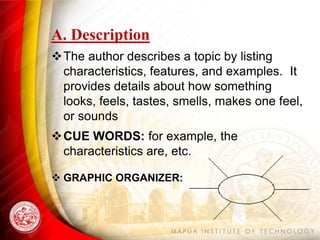
A. Description
The author describes a topic by listing
 characteristics, features, and examples. It
 provides details about how something
 looks, feels, tastes, smells, makes one feel,
 or sounds
CUE WORDS: for example, the
 characteristics are, etc.

 GRAPHIC ORGANIZER:
SAMPLE PASSAGE:
 The Olympic symbol consists of five interlocking
  rings. The rings represent the five continents -
  Africa, Asia, Europe, North America and South
  America - from which athletes come to compete
  in the games. The rings are colored black
  blue, green, red, and yellow. At least one of
  these colors is found in the flag of every country
  sending athletes to compete in the Olympic
  games.
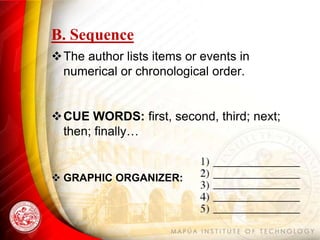
B. Sequence
The author lists items or events in
 numerical or chronological order.


CUE WORDS: first, second, third; next;
 then; finally…


 GRAPHIC ORGANIZER:
SAMPLE PASSAGE:
 The Olympic games began as athletic festivals to
  honor the Greek gods. The most important festival
  was held in the valley of Olympia to honor Zeus, the
  king of the gods. It was this festival that became the
  Olympic games in 776 B.C. These games were
  ended in A.D. 394 by the Roman Emperor who ruled
  Greece. No Olympic games were held for more than
  1,500 years. Then the modern Olympics began in
  1896. Almost 300 male athletes competed in the first
  modern Olympics In the games held in 1900, female
  athletes were allowed to compete. The games have
  continued every four years since 1896 except during
  World War II, and they will most likely continue for
  many years to come.
C. Comparison & Contrast
The author explains how two or more
 things are alike and/or how they are
 different.

CUE WORDS: different; in contrast; alike;
same as; on the other hand…


 GRAPHIC ORGANIZER:
SAMPLE PASSAGE:
 The modern Olympics is very unlike the ancient
  Olympic games. Individual events are different. While
  there were no swimming races in the ancient
  games, for example, there were chariot races. There
  were no female contestants and all athletes
  competed in the nude. Of course, the ancient and
  modern Olympics are also alike in many ways. Some
  events, such as the javelin and discus throws, are
  the      same.     Some     people       say     that
  cheating, professionalism, and nationalism in the
  modern games are a disgrace to the Olympic
  tradition. But according to the ancient Greek
  writers,    there    were    many        cases     of
  cheating, nationalism, and professionalism in their
  Olympics too.
D. Cause and Effect
The author lists one or more causes and
the resulting effect or effects.


CUE WORDS: reasons why; if...then; as a
result; therefore; because…
 GRAPHIC ORGANIZER:
SAMPLE PASSAGE:
 There are several reasons why so many people
  attend the Olympic games or watch them on
  television. One reason is tradition. The name
  Olympics and the torch and flame remind people of
  the ancient games. People can escape the
  ordinariness of daily life by attending or watching the
  Olympics. They like to identify with someone else's
  individual sacrifice and accomplishment. National
  pride is another reason, and an athlete's or a team's
  hard earned victory becomes a nation's victory.
  There are national medal counts and people keep
  track of how many medals their country's athletes
  have won.
E. Problem and Solution
The author states a problem and lists one or more
solutions for the problem. A variation of this pattern is
the question- and-answer format in which the author
poses a question and then answers it.


CUE WORDS: problem is; dilemma is; puzzle
is solved; question... answer…

 GRAPHIC ORGANIZER:
SAMPLE PASSAGE:
 One problem with the modern Olympics is that it has
 become very big and expensive to operate. The city or
 country that hosts the games often loses a lot of money. A
 stadium, pools, and playing fields must be built for the
 athletic events and housing is needed for the athletes
 who come from around the world. And all of these
 facilities are used for only 2 weeks! In 1984, Los Angeles
 solved these problems by charging a fee for companies
 who wanted to be official sponsors of the games.
 Companies like McDonald's paid a lot of money to be part
 of the Olympics. Many buildings that were already built in
 the Los Angeles area were also used. The Coliseum
 where the 1932 games were held was used again and
 many colleges and universities in the area became
 playing and living sites.
MQA Writing is a Take-Home Test!
   Write a five-paragraph expository essay about my
  fan, Drew Barrymore herself, using only the details
you were able to take down during the listening task.

   Label the sentences and paragraphs (using a red
     pen) so as to show the structure of your essay.
                         (Refer to slides 4 and 5.)

   Come up with a snappy title, one that catches
             the reader’s attention, and write the
  organizational pattern you used below the title.

Expository writing

  • 1.
    Expository Writing Credits toStanford University and Purdue University. Resources in this presentation were retrieved from http://www.stanford.edu/~arnetha/expowrite/info.html and http://owl.english.purdue.edu/owl/resource/685/02/ on November 1, 2011. Mr. Edward Jay M. Quinto English for Academic Purposes 1
  • 2.
    What is ExpositoryWriting? Exposition is a type of oral or written discourse that is used to explain, describe, give information or inform. The expository essay is a genre of essay that requires the student to investigate an idea, evaluate evidence, expound on the idea, and set forth an argument concerning that idea in a clear and concise manner.
  • 3.
    The creator ofan expository text can not assume that the reader or listener has prior knowledge or prior understanding of the topic that is being discussed. One important point to keep in mind for the author is to try to use words that clearly show what they are talking about rather then blatantly telling the reader what is being discussed.
  • 4.
    The Five-Paragraph Essay Acommon method for writing an expository essay is the five-paragraph approach. This is, however, by no means the only formula for writing such essays. If it sounds straightforward, that is because it is; in fact, the method consists of: 1. an introductory paragraph 2. three evidentiary body paragraphs 3. a conclusion
  • 5.
    The structure ofthe expository essay is held together by the following:  A clear, concise, and defined thesis statement that occurs in the first paragraph of the essay.  Clear and logical transitions between the introduction, body, and conclusion.  Body paragraphs that include evidential support. Evidential support (whether factual, logical, statistical, or anecdotal). A bit of creativity! A conclusion that does not simply restate the thesis, but readdresses it in light of the evidence provided.
  • 6.
    What are someExpository Organizational Patterns?  Since clarity requires strong organization, one of the most important mechanisms that can be used to improve our skills in exposition is to provide directions to improve the organization of the text. This directions are called organizational patterns.
  • 7.
    A. Description The authordescribes a topic by listing characteristics, features, and examples. It provides details about how something looks, feels, tastes, smells, makes one feel, or sounds CUE WORDS: for example, the characteristics are, etc.  GRAPHIC ORGANIZER:
  • 8.
    SAMPLE PASSAGE: TheOlympic symbol consists of five interlocking rings. The rings represent the five continents - Africa, Asia, Europe, North America and South America - from which athletes come to compete in the games. The rings are colored black blue, green, red, and yellow. At least one of these colors is found in the flag of every country sending athletes to compete in the Olympic games.
  • 9.
    B. Sequence The authorlists items or events in numerical or chronological order. CUE WORDS: first, second, third; next; then; finally…  GRAPHIC ORGANIZER:
  • 10.
    SAMPLE PASSAGE: TheOlympic games began as athletic festivals to honor the Greek gods. The most important festival was held in the valley of Olympia to honor Zeus, the king of the gods. It was this festival that became the Olympic games in 776 B.C. These games were ended in A.D. 394 by the Roman Emperor who ruled Greece. No Olympic games were held for more than 1,500 years. Then the modern Olympics began in 1896. Almost 300 male athletes competed in the first modern Olympics In the games held in 1900, female athletes were allowed to compete. The games have continued every four years since 1896 except during World War II, and they will most likely continue for many years to come.
  • 11.
    C. Comparison &Contrast The author explains how two or more things are alike and/or how they are different. CUE WORDS: different; in contrast; alike; same as; on the other hand…  GRAPHIC ORGANIZER:
  • 12.
    SAMPLE PASSAGE: Themodern Olympics is very unlike the ancient Olympic games. Individual events are different. While there were no swimming races in the ancient games, for example, there were chariot races. There were no female contestants and all athletes competed in the nude. Of course, the ancient and modern Olympics are also alike in many ways. Some events, such as the javelin and discus throws, are the same. Some people say that cheating, professionalism, and nationalism in the modern games are a disgrace to the Olympic tradition. But according to the ancient Greek writers, there were many cases of cheating, nationalism, and professionalism in their Olympics too.
  • 13.
    D. Cause andEffect The author lists one or more causes and the resulting effect or effects. CUE WORDS: reasons why; if...then; as a result; therefore; because…  GRAPHIC ORGANIZER:
  • 14.
    SAMPLE PASSAGE: Thereare several reasons why so many people attend the Olympic games or watch them on television. One reason is tradition. The name Olympics and the torch and flame remind people of the ancient games. People can escape the ordinariness of daily life by attending or watching the Olympics. They like to identify with someone else's individual sacrifice and accomplishment. National pride is another reason, and an athlete's or a team's hard earned victory becomes a nation's victory. There are national medal counts and people keep track of how many medals their country's athletes have won.
  • 15.
    E. Problem andSolution The author states a problem and lists one or more solutions for the problem. A variation of this pattern is the question- and-answer format in which the author poses a question and then answers it. CUE WORDS: problem is; dilemma is; puzzle is solved; question... answer…  GRAPHIC ORGANIZER:
  • 16.
    SAMPLE PASSAGE: Oneproblem with the modern Olympics is that it has become very big and expensive to operate. The city or country that hosts the games often loses a lot of money. A stadium, pools, and playing fields must be built for the athletic events and housing is needed for the athletes who come from around the world. And all of these facilities are used for only 2 weeks! In 1984, Los Angeles solved these problems by charging a fee for companies who wanted to be official sponsors of the games. Companies like McDonald's paid a lot of money to be part of the Olympics. Many buildings that were already built in the Los Angeles area were also used. The Coliseum where the 1932 games were held was used again and many colleges and universities in the area became playing and living sites.
  • 17.
    MQA Writing isa Take-Home Test! Write a five-paragraph expository essay about my fan, Drew Barrymore herself, using only the details you were able to take down during the listening task. Label the sentences and paragraphs (using a red pen) so as to show the structure of your essay. (Refer to slides 4 and 5.) Come up with a snappy title, one that catches the reader’s attention, and write the organizational pattern you used below the title.