1
Rhetoric
 Rhetoric is the art of
persuasion, which along with
grammar and logic, is one of
the three ancient arts of
discourse. Rhetoric aims to
study the capacities of writers
or speakers needed to inform,
persuade, or motivate
particular audiences in specific
situations.
2
What is Invention?
 “Invention” is about coming up with a good
idea, or having something useful to say to
your audience. The word “invention” in
English actually comes from the Latin
term “invenire,” which, roughly translated,
means “to find.” When you’re in the
invention stage, you’re considering what
your audience needs to know and why
they need to know it.
3
What is Arrangement
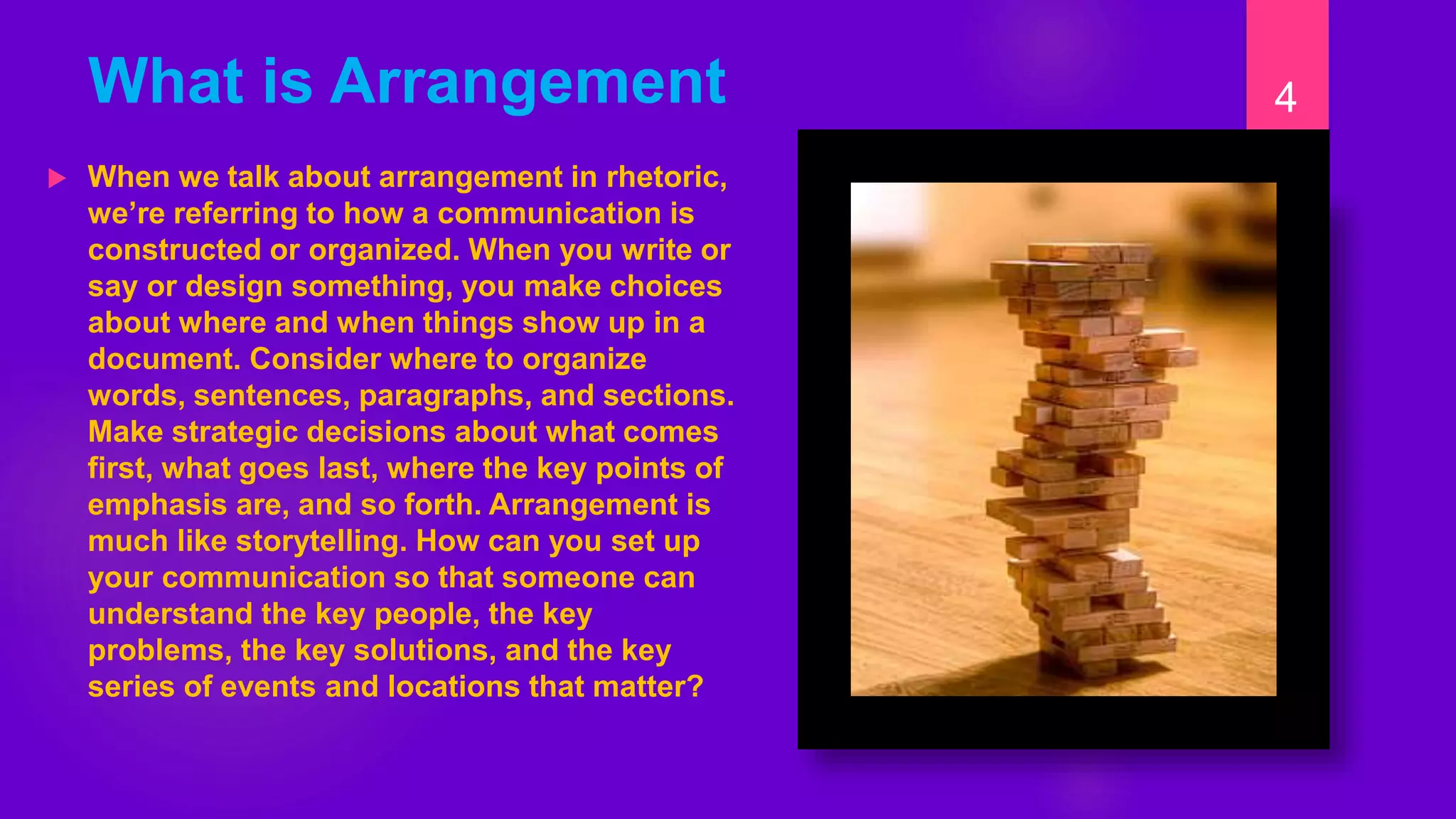
 When we talk about arrangement in rhetoric,
we’re referring to how a communication is
constructed or organized. When you write or
say or design something, you make choices
about where and when things show up in a
document. Consider where to organize
words, sentences, paragraphs, and sections.
Make strategic decisions about what comes
first, what goes last, where the key points of
emphasis are, and so forth. Arrangement is
much like storytelling. How can you set up
your communication so that someone can
understand the key people, the key
problems, the key solutions, and the key
series of events and locations that matter?
4
What is Arrangement
 There are many ways (endless, in fact) to
arrangement documents, but many
speeches, reports, and common
communication platforms follow similar
arrangement styles. A proposal, for example,
will often start with an introduction; provide
a problem statement; give research, proof,
or facts that support the thesis; show the
results of the research; and offer a proposed
idea. Depending on your communication
piece, consider if there are conventions or
paradigms that you should follow. Then
strategically modify where necessary to give
appropriate emphasis.
5
What is Style
 Style is the fun, artistic part of
communication. When we talk about
style in rhetoric, we are referring to the
choices you make to impact an
audience. What words will you choose?
What phrases and stories will you tell?
What will be your pace? Will you
use figures of speech or other linguistic
devices to enhance understanding and
appeal? Style is usually aligned with
the rhetorical appeal pathos because
style will often affect the emotions and
reactions of your audience.
6
What is Memory?
 Memory, when originally
conceived as one of the five
canons, made reference to
memorizing a speech. Good
orators, it was believed,
would have their speech so
well memorized that they
could give it without
hesitation. Memory required
speakers to develop
mnemonic devices to help
them remember what they
would say next.
7
What is Memory?
However, memory is much more
than memorization and, in fact, for
most speeches of today,
memorizing a speech isn’t usually
considered a good idea. When we
refer to memory in rhetoric, we
mean that a speaker or
communicator should know as
much as possible about a topic
before presenting so that, should
an occasion arise to improvise or
answer questions, you would
know the topic so well that you
could respond with accuracy and
professionalism.
8
What is Delivery ?
 As you might infer from the Greek definition
of delivery, “pronuntiatio,” delivery is, in
part, about pronunciation. As a broader
concept in presenting information, delivery
is about the way in which you give a speech
or present a communication piece.
 So, in speech, delivery is about your eye
contact, posture, professionalism, the way
you dress, confidence, body language, and
so forth.
 But delivery can be applied to any
communication piece. The delivery of your
resume, for example, might be seen in the
paper you choose, the quality of the print
job, and even the way you fold it or deliver it
when you give it to an employer.
9
(Lincoln delivering the famous “Gettysburg Address”)
What is Elocution?
 Elocution basically means the
way something is said. The vocabulary,
sentence structure, and expressions used
will affect the reader’s perception of the
ideas. Again, Memory (as mentioned
before) is critical because the power of
expressive language will be a function of
the great database of language in the
brain. However, we can promote greater
facility by using imitation and exercise.
10
“Idhar se Aloo, Udhar se Sona!!!”
What is Elocution?
 Rubrics or checklists can stretch a person to
use words in ways they might not naturally
use them, and by the requirement to include
such things as an adjective clause, a participle
opener, or a simile, students will be
challenged to use words, expressions, and
devices beyond their everyday habits.
 Of course any checklist should start small and
grow slowly so that the challenge is not
overwhelming, and the trainer should give as
much help as needed, offering suggestions for
appropriate words, rephrasing awkward
clauses, demonstrating devices again and
again. Practicing with a simple “style
checklist” will effectively strengthen elocution
skills in younger students.
11
Define
 Definition (describe to your audience through definitions and classifications)
 Division (separating your subject matter into its parts or whole, or breaking down into
subjects)
 Comparison (showing similarities and differences of your topic with that of another or showing
the degree to which your topic does or does not do something)
 Relationship (describing things like cause and effect; antecedent and consequence;
contraries; and contradictions)
 Circumstances (determining what might be possible or impossible according to your topic or
what the past might have to say about the future)
 Testimony (using other accounts to describe your topic, considering things like eye-witness
accounts, authority figure explanations, rumors, oaths, documents, law, supernatural
considerations, precedents, and so forth)
 Notation and Conjugates (addressing your topic in terms of language and its relationship to
language)
12
Conclusion:
 Rhetoric is not the evil sophists’ science, nor the liberal art to be reserved for the upper
school. By understanding the Five Canons, we can see how each of these fundamental
components can be cultivated in learners, who will thereby be blessed with a lifelong
aptitude for effective writing and speaking—hopefully communicating the truth winsomely
and persuasively in a world that so desperately needs it.
13
THANK YOU14
UPCOMING..
CONNECT WITH CAPTIVE AUDIENCE

The five canons of Rhetoric

  • 1.
  • 2.
    Rhetoric  Rhetoric isthe art of persuasion, which along with grammar and logic, is one of the three ancient arts of discourse. Rhetoric aims to study the capacities of writers or speakers needed to inform, persuade, or motivate particular audiences in specific situations. 2
  • 3.
    What is Invention? “Invention” is about coming up with a good idea, or having something useful to say to your audience. The word “invention” in English actually comes from the Latin term “invenire,” which, roughly translated, means “to find.” When you’re in the invention stage, you’re considering what your audience needs to know and why they need to know it. 3
  • 4.
    What is Arrangement When we talk about arrangement in rhetoric, we’re referring to how a communication is constructed or organized. When you write or say or design something, you make choices about where and when things show up in a document. Consider where to organize words, sentences, paragraphs, and sections. Make strategic decisions about what comes first, what goes last, where the key points of emphasis are, and so forth. Arrangement is much like storytelling. How can you set up your communication so that someone can understand the key people, the key problems, the key solutions, and the key series of events and locations that matter? 4
  • 5.
    What is Arrangement There are many ways (endless, in fact) to arrangement documents, but many speeches, reports, and common communication platforms follow similar arrangement styles. A proposal, for example, will often start with an introduction; provide a problem statement; give research, proof, or facts that support the thesis; show the results of the research; and offer a proposed idea. Depending on your communication piece, consider if there are conventions or paradigms that you should follow. Then strategically modify where necessary to give appropriate emphasis. 5
  • 6.
    What is Style Style is the fun, artistic part of communication. When we talk about style in rhetoric, we are referring to the choices you make to impact an audience. What words will you choose? What phrases and stories will you tell? What will be your pace? Will you use figures of speech or other linguistic devices to enhance understanding and appeal? Style is usually aligned with the rhetorical appeal pathos because style will often affect the emotions and reactions of your audience. 6
  • 7.
    What is Memory? Memory, when originally conceived as one of the five canons, made reference to memorizing a speech. Good orators, it was believed, would have their speech so well memorized that they could give it without hesitation. Memory required speakers to develop mnemonic devices to help them remember what they would say next. 7
  • 8.
    What is Memory? However,memory is much more than memorization and, in fact, for most speeches of today, memorizing a speech isn’t usually considered a good idea. When we refer to memory in rhetoric, we mean that a speaker or communicator should know as much as possible about a topic before presenting so that, should an occasion arise to improvise or answer questions, you would know the topic so well that you could respond with accuracy and professionalism. 8
  • 9.
    What is Delivery?  As you might infer from the Greek definition of delivery, “pronuntiatio,” delivery is, in part, about pronunciation. As a broader concept in presenting information, delivery is about the way in which you give a speech or present a communication piece.  So, in speech, delivery is about your eye contact, posture, professionalism, the way you dress, confidence, body language, and so forth.  But delivery can be applied to any communication piece. The delivery of your resume, for example, might be seen in the paper you choose, the quality of the print job, and even the way you fold it or deliver it when you give it to an employer. 9 (Lincoln delivering the famous “Gettysburg Address”)
  • 10.
    What is Elocution? Elocution basically means the way something is said. The vocabulary, sentence structure, and expressions used will affect the reader’s perception of the ideas. Again, Memory (as mentioned before) is critical because the power of expressive language will be a function of the great database of language in the brain. However, we can promote greater facility by using imitation and exercise. 10 “Idhar se Aloo, Udhar se Sona!!!”
  • 11.
    What is Elocution? Rubrics or checklists can stretch a person to use words in ways they might not naturally use them, and by the requirement to include such things as an adjective clause, a participle opener, or a simile, students will be challenged to use words, expressions, and devices beyond their everyday habits.  Of course any checklist should start small and grow slowly so that the challenge is not overwhelming, and the trainer should give as much help as needed, offering suggestions for appropriate words, rephrasing awkward clauses, demonstrating devices again and again. Practicing with a simple “style checklist” will effectively strengthen elocution skills in younger students. 11
  • 12.
    Define  Definition (describeto your audience through definitions and classifications)  Division (separating your subject matter into its parts or whole, or breaking down into subjects)  Comparison (showing similarities and differences of your topic with that of another or showing the degree to which your topic does or does not do something)  Relationship (describing things like cause and effect; antecedent and consequence; contraries; and contradictions)  Circumstances (determining what might be possible or impossible according to your topic or what the past might have to say about the future)  Testimony (using other accounts to describe your topic, considering things like eye-witness accounts, authority figure explanations, rumors, oaths, documents, law, supernatural considerations, precedents, and so forth)  Notation and Conjugates (addressing your topic in terms of language and its relationship to language) 12
  • 13.
    Conclusion:  Rhetoric isnot the evil sophists’ science, nor the liberal art to be reserved for the upper school. By understanding the Five Canons, we can see how each of these fundamental components can be cultivated in learners, who will thereby be blessed with a lifelong aptitude for effective writing and speaking—hopefully communicating the truth winsomely and persuasively in a world that so desperately needs it. 13
  • 14.