


THE USE OF
POWERPOINT
PRESENTATION
Brief History
of
 Originally designed for the Macintosh computer.
 "Presenter", was the old name of PowerPoint.
 Robert Gaskins was the original developer of
the PowerPoint.
 It was also being developed by Dennis
Austin and Thomas of Forethought, Inc.
 1987- the year when it was renamed into
PowerPoint.
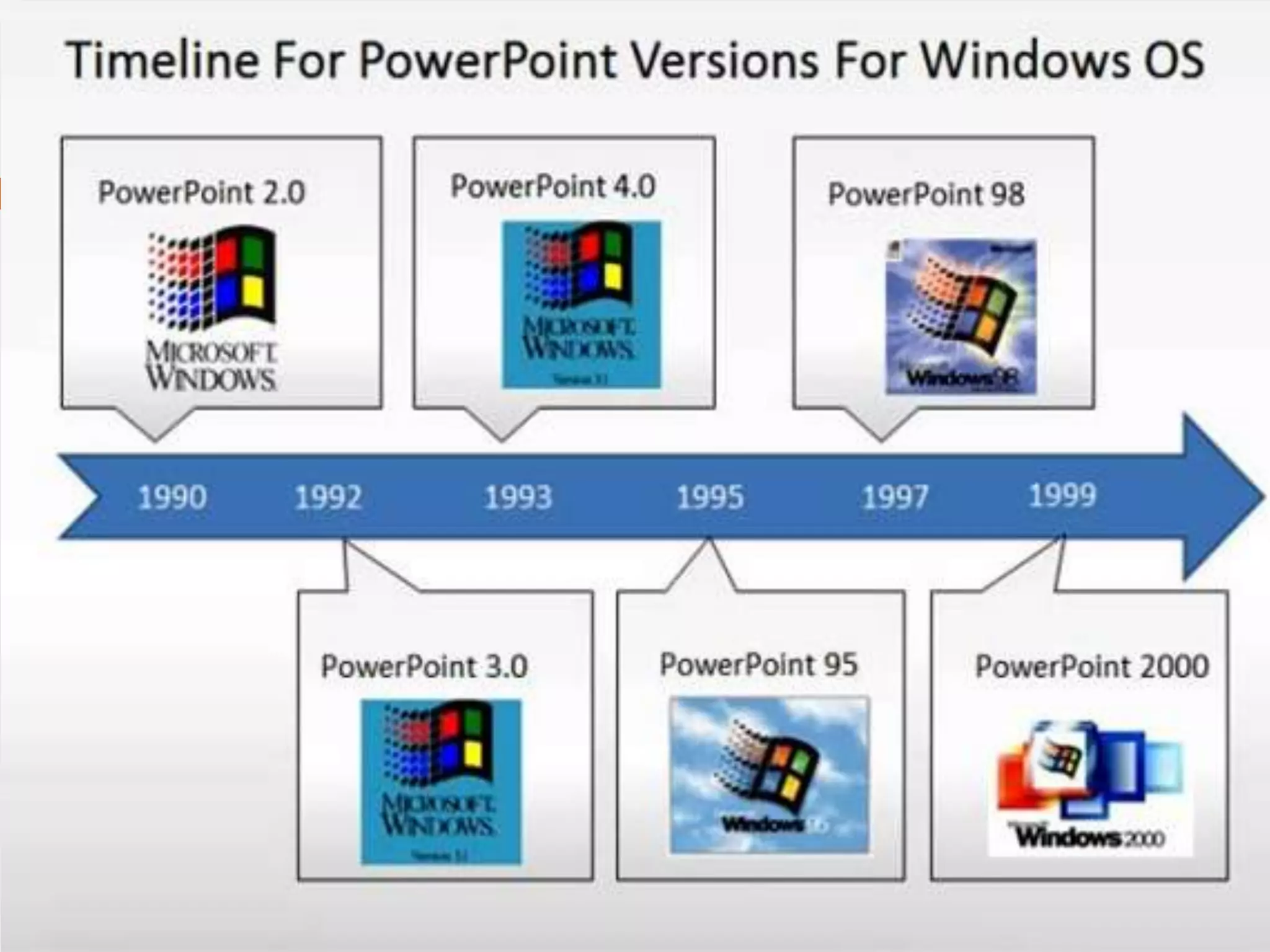
 PowerPoint was officially launched on May 22,
1990, the same day that Microsoft released
WHAT IS
POWERPOINT?
BASIC FEATURES OF
POWERPOINT
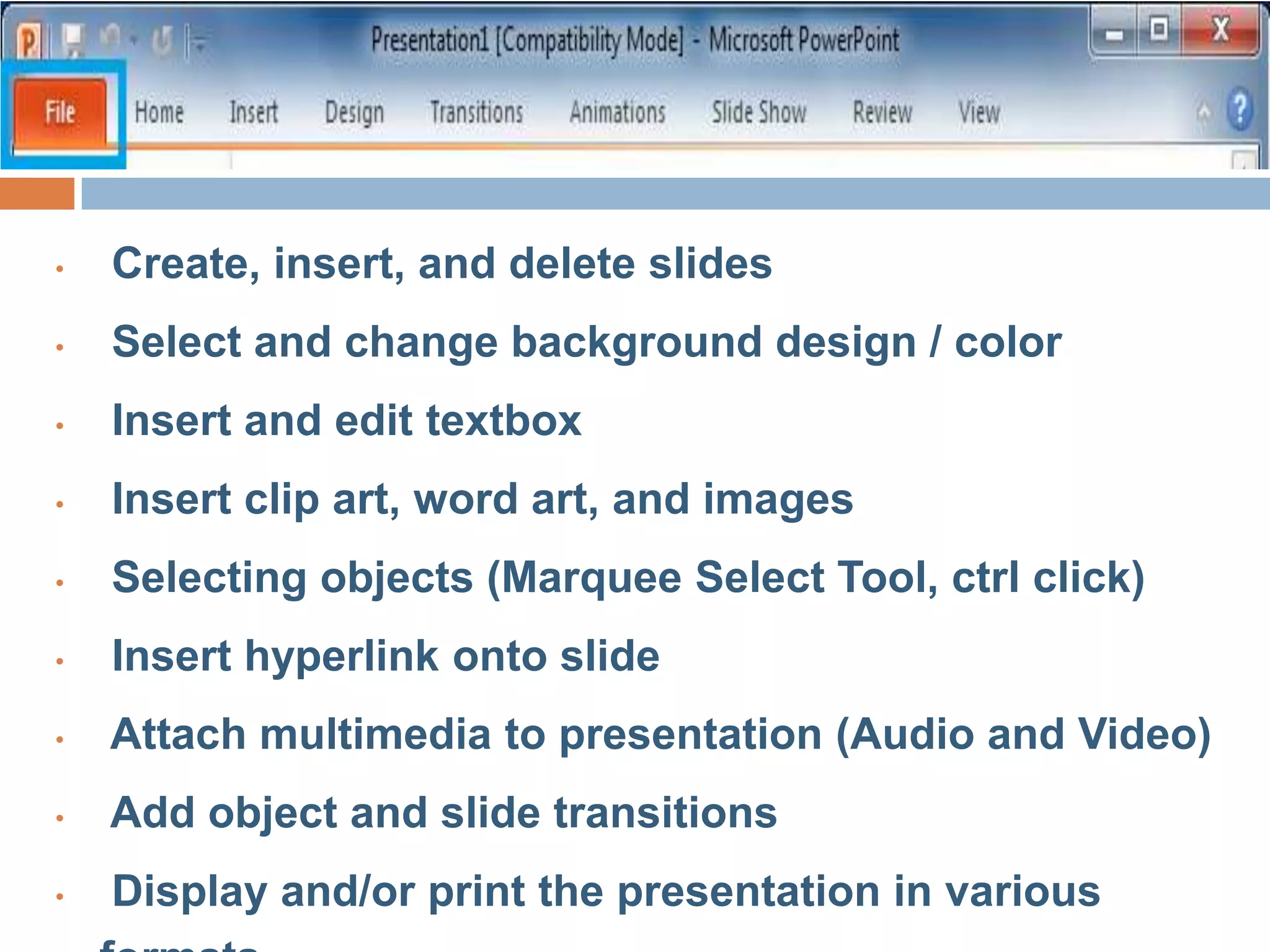
• Create, insert, and delete slides
• Select and change background design / color
• Insert and edit textbox
• Insert clip art, word art, and images
• Selecting objects (Marquee Select Tool, ctrl click)
• Insert hyperlink onto slide
• Attach multimedia to presentation (Audio and Video)
• Add object and slide transitions
• Display and/or print the presentation in various
HOW CAN IT BE USED
IN THE CLASSROOM?
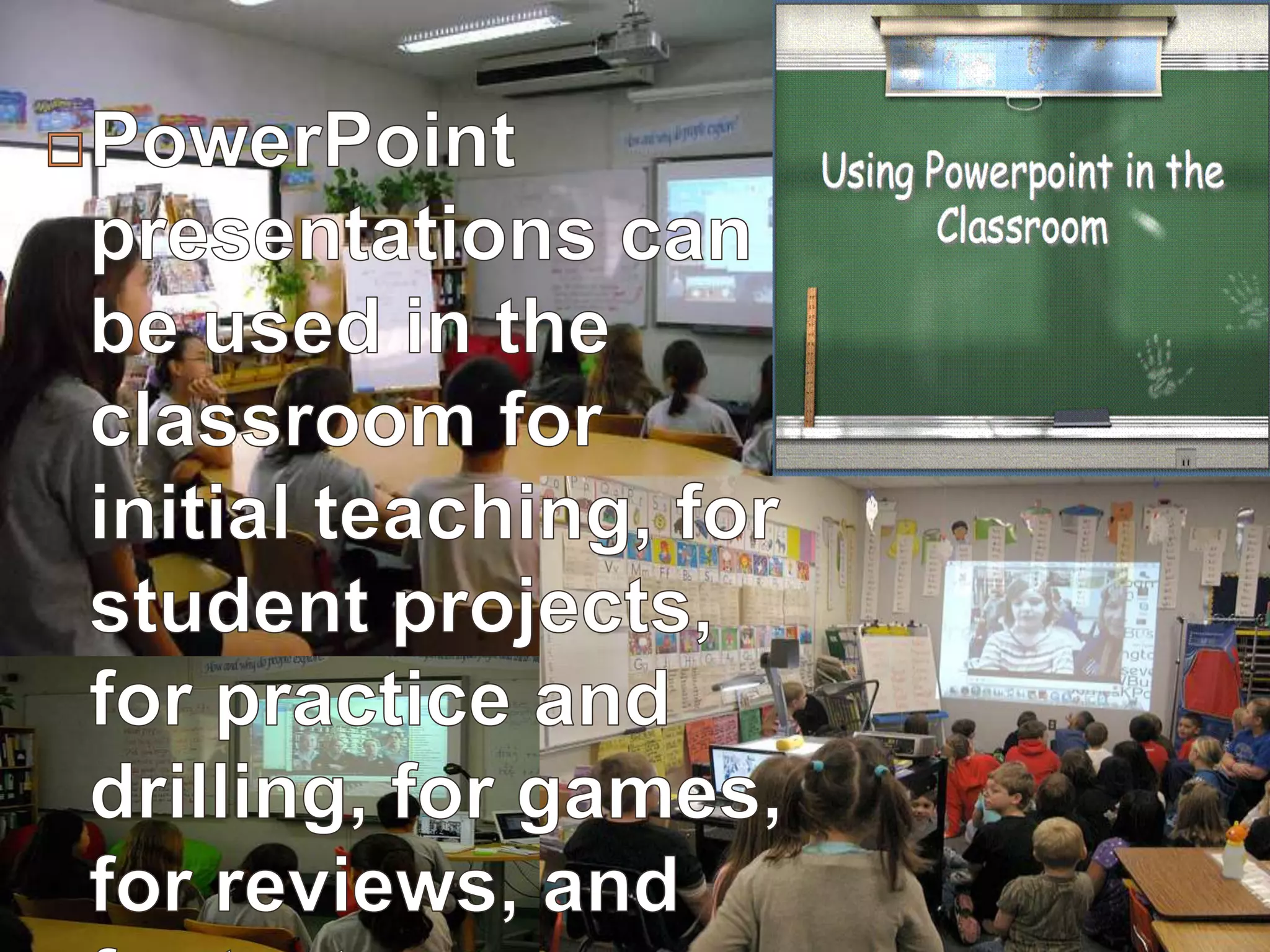
 PowerPoint saves time and energy once the
presentation has been created, is easy to
update and can be modified for other
courses.
 PowerPoint is portable and can be easily
shared with students and colleagues.
 PowerPoint supports multimedia such as
video, audio, images and animation.
IN
Benefits for STUDENTS …
 This format is attractive to students, and it appeals
to students' diverse learning styles, such as visual,
auditory, kinesthetic, and creative by employing
multimedia methods, such as sounds, images,
color, action, design, and so on.
 It has a spell-check function, which blackboards do
not have.
 PowerPoint assists collaborative learning in
group projects by involving every student in
the learning and teaching processes. It
empowers students to be in charge of their
own learning, and offers them opportunities
to demonstrate their work.
 Students who are absent from class can go
through the content by watching PowerPoint
presentations, allowing them to learn at
home and not fall behind. Sounds and
Benefits for TEACHERS…
 Teachers can use PowerPoint presentations to
enhance the effectiveness of classroom instruction
in many ways and in every subject area.
 PowerPoint can enrich the information in a lesson,
and make the presentation more organized and
flexible.
 Main points can be emphasized by using graphics,
animation and sound.
 PowerPoint can be used for content review.
 The greatest advantage of using
PowerPoint in the classroom is that
teachers can modify lessons and use them
over and over again. Therefore, teachers
save time on handing out instructional
material, writing on blackboard, repeated
speech and so on.
 Teacher-centered. Students often respond better when
instructors have designed sessions for greater
classroom interaction, such as the use of student
response clickers, designing PowerPoint to facilitate
case studies, or use the slides as a replacement for
paper worksheets.
 Lack of feedback. PowerPoint-based lectures tell you
nothing about student learning. Design them to include
opportunities for feedback (not simply asking if there
are questions, but more actively quizzing your
students). This often takes the form of listing
 Student inactivity. Slide shows do little to model
how students should interact with the material on
their own. Include student activities or
demonstrations to overcome this, either before or
after the slideshow presentation.
 Potentially reductive. PowerPoint was designed to
promote simple persuasive arguments. Design for
critical engagement, not just for exposure to a
“point.”
 Presentation graphics should be about learning,
not about presentation.
 PowerPoint presentations should help students
organize their notes, not just “be” the notes. This
is a particular danger with students who grew up
accustomed to receiving PowerPoint notes to
study from. Some may require convincing that
notes should be taken beyond what is already on
the slides.
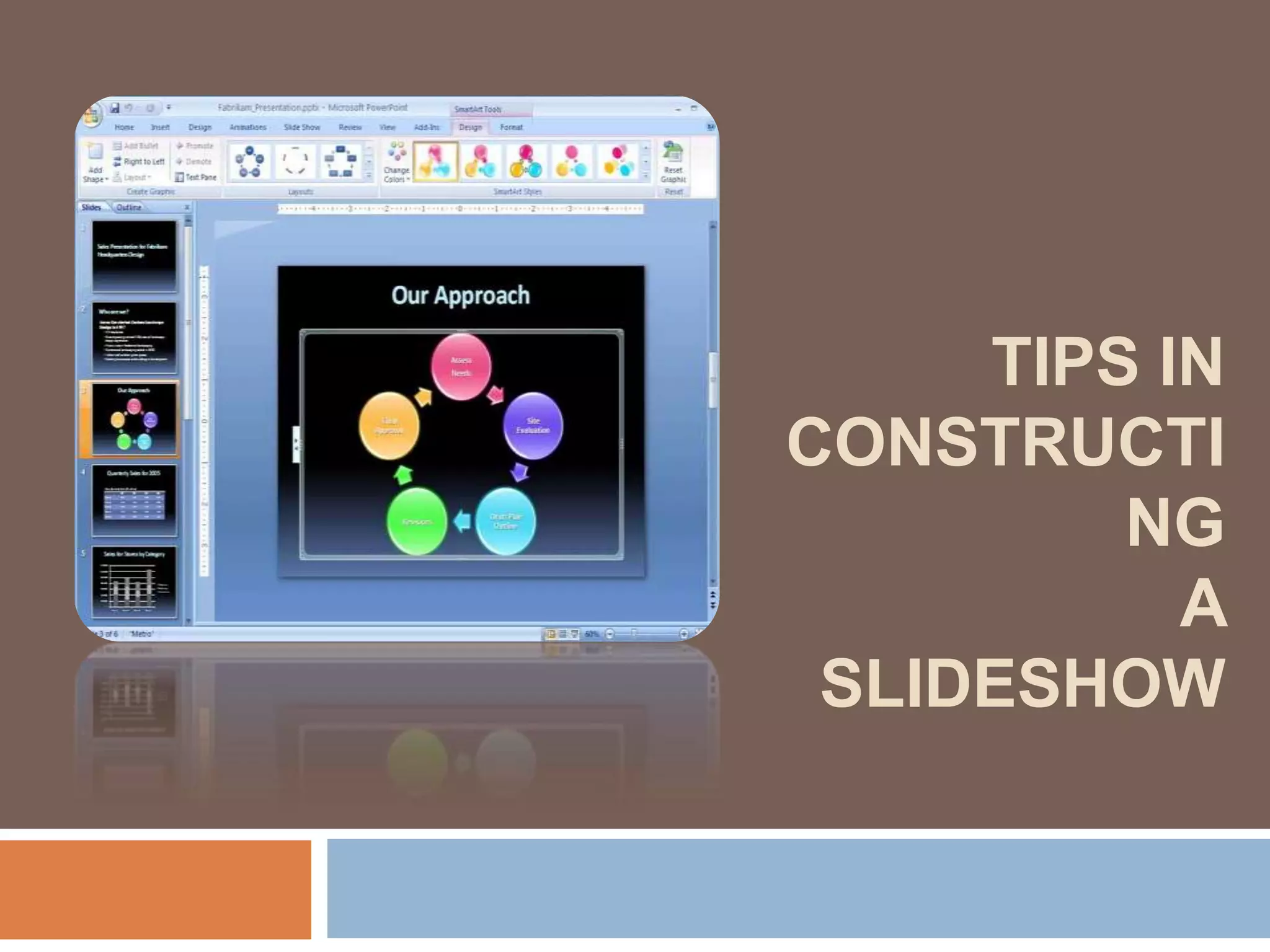
TIPS IN
CONSTRUCTI
NG
A
SLIDESHOW
 Text size: text must be clearly readable from the
back of the room. Too much text or too small a font
will be difficult to read.
 Avoid too much text: one common suggestion is to
adhere to the 6x6 rule (no more than six words per
line, and no more than six lines per slide). The
"Takahasi Method" goes so far as to recommend
enormous text and nothing else on the slide, not
even pictures, perhaps as little as just one word on
each slide.
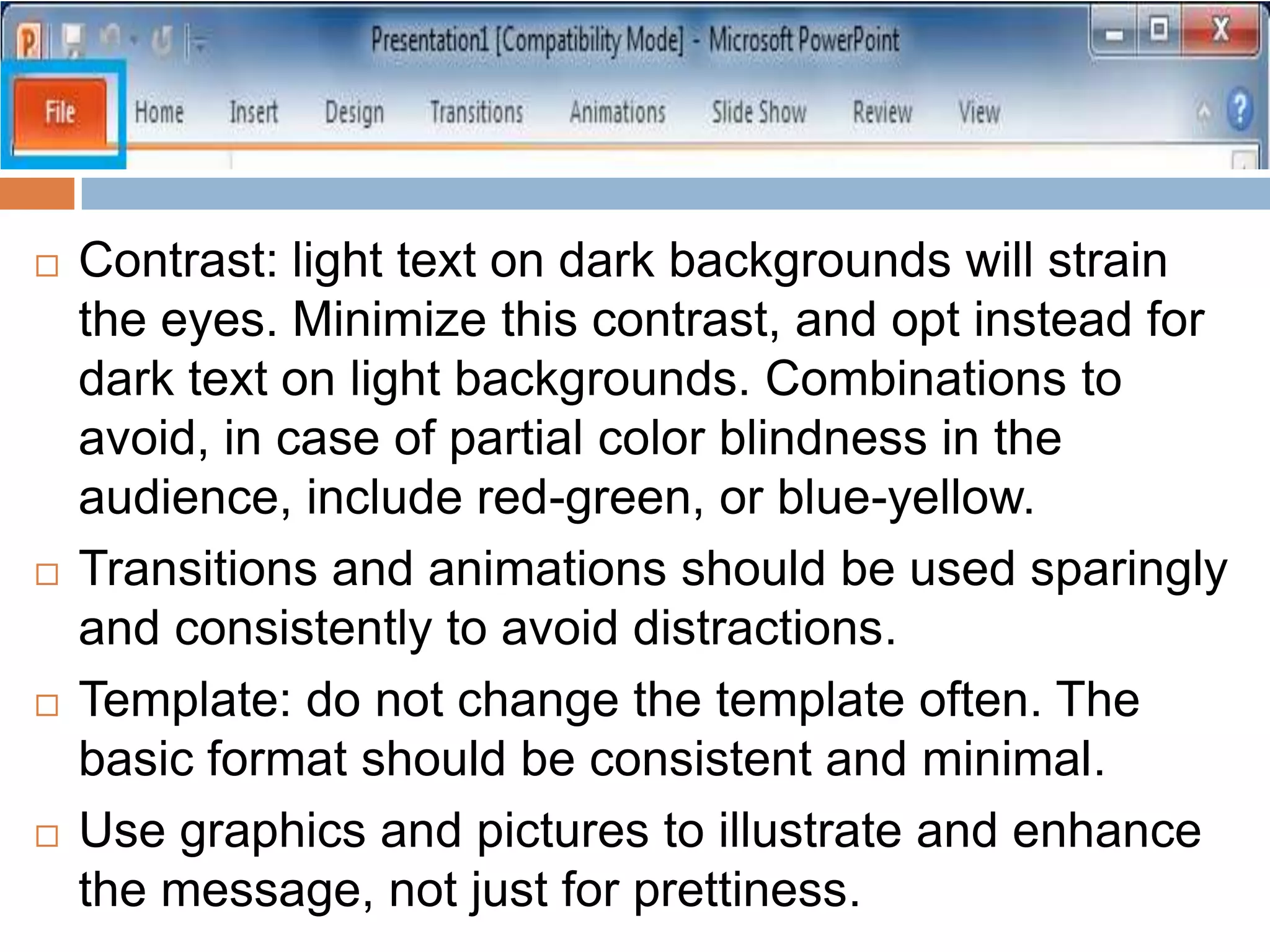
 Contrast: light text on dark backgrounds will strain
the eyes. Minimize this contrast, and opt instead for
dark text on light backgrounds. Combinations to
avoid, in case of partial color blindness in the
audience, include red-green, or blue-yellow.
 Transitions and animations should be used sparingly
and consistently to avoid distractions.
 Template: do not change the template often. The
basic format should be consistent and minimal.
 Use graphics and pictures to illustrate and enhance
the message, not just for prettiness.
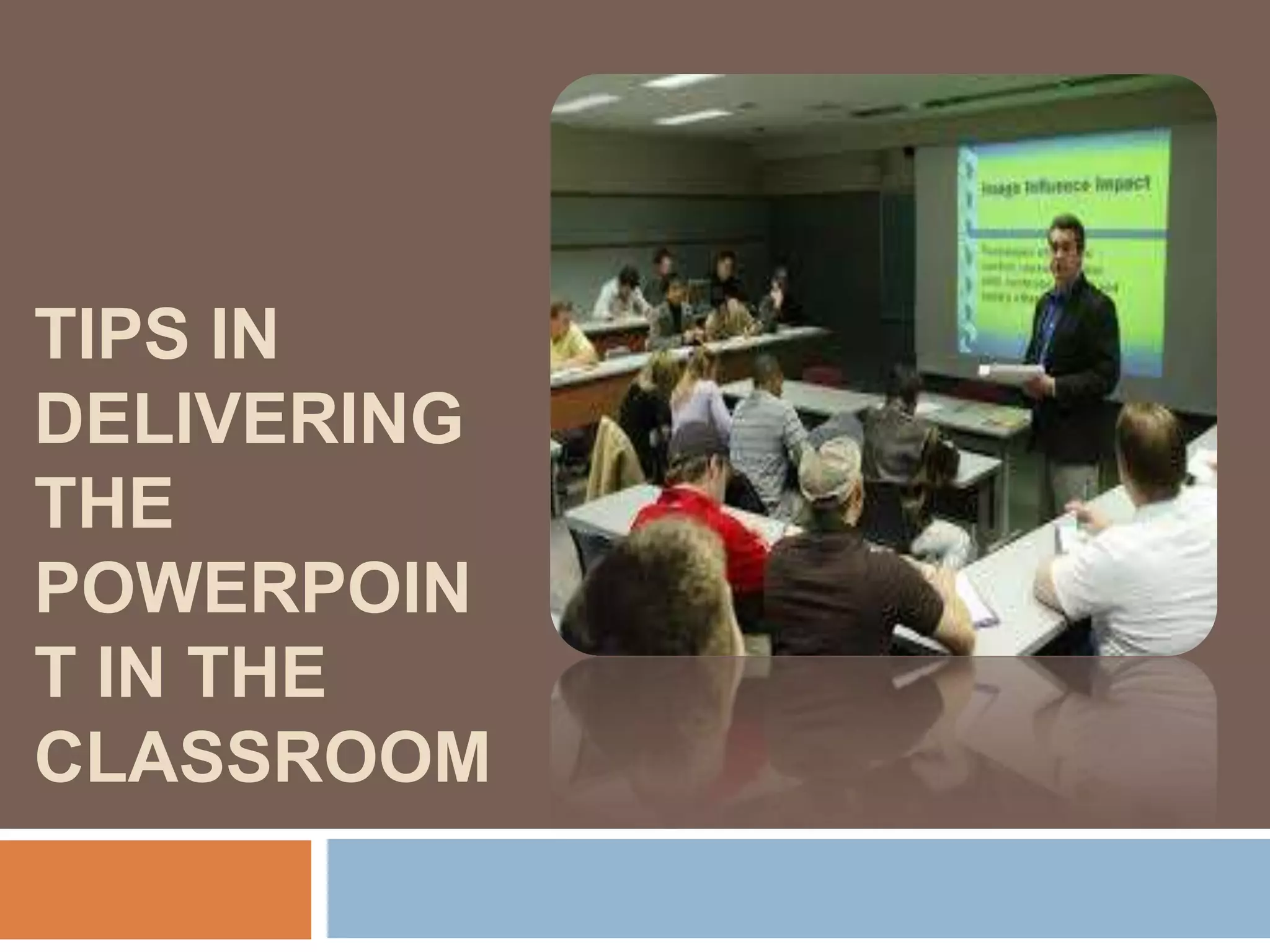
TIPS IN
DELIVERING
THE
POWERPOIN
T IN THE
CLASSROOM
 Avoid reading: if your slides contain lengthy
text, lecture "around" the material rather than
reading it directly.
 Dark screen: an effective trick to focus
attention on you and your words is to
temporarily darken the screen, which can be
accomplished by clicking the "B" button on the
keyboard. Hitting "B" again will toggle the
screen back to your presentation.
 Navigate slides smoothly: the left-mouse
click advances to the next slide, but it's more
cumbersome to right-click to move back one
slide. The keyboard's arrow keys work more
smoothly to go forward and backward in the
presentation. Also, if you know the number of
a particular slide, you can simply type that
number, followed by the ENTER key, to jump
directly to that slide.
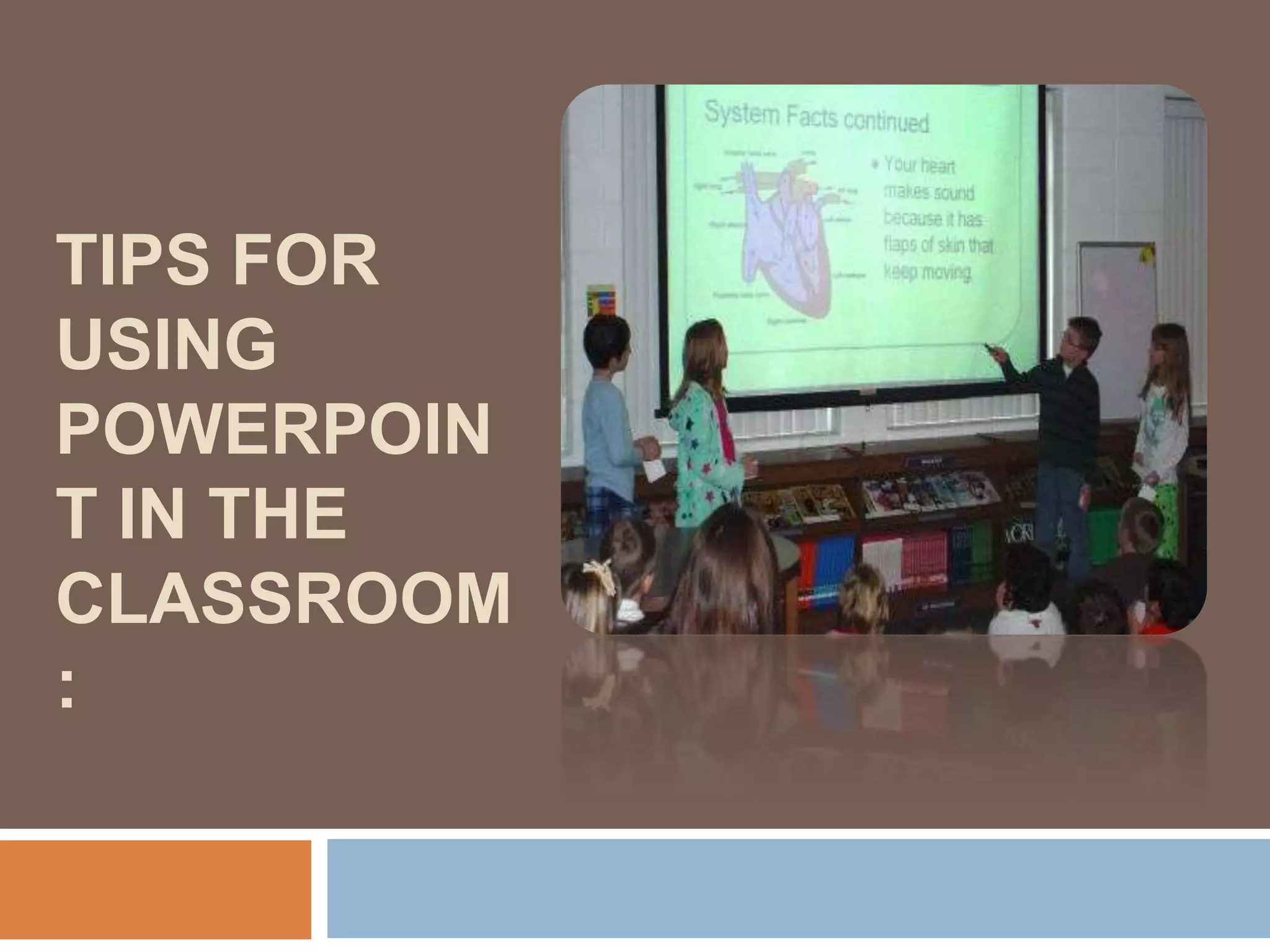
TIPS FOR
USING
POWERPOIN
T IN THE
CLASSROOM
:
 Teachers need to set up a clear set
of objectives for the lesson;
 There should never be too much
text nor too many images on a
slide;
 Slides need to reinforce the key
points, and the teacher explains
the rest (one should never merely
 The slide style shouldn’t be too busy to
distract the students’ attention;
 The contrast between the background
and the letters/images needs to be
sharp;
 Always have a back-up plan, since
computers can crash, networks can go
down, and numerous other
technological glitches can happen.
1. http://www.fctl.ucf.edu/teachingandlearningresources/Tec
hnology/PowerPoint/index.php
2. http://earthholisticeducation.webs.com/powerpoint.htm
3. http://www.niu.edu/facdev/resources/guide/technology/tea
ching_with_powerpoint.pdf
4. http://www.slideshare.net/indy_augustine/slide-25480738
5. http://www.free-power-point-
templates.com/articles/history-of-powerpoint-the-
amazing-facts-you-did-not-know/
6. http://office.microsoft.com/en-ca/support/what-is-
powerpoint-HA010265950.aspx
THANK YOU
FOR
LISTENING!

Nature of powerpoint

  • 1.
  • 2.
    Brief History of  Originallydesigned for the Macintosh computer.  "Presenter", was the old name of PowerPoint.  Robert Gaskins was the original developer of the PowerPoint.  It was also being developed by Dennis Austin and Thomas of Forethought, Inc.  1987- the year when it was renamed into PowerPoint.  PowerPoint was officially launched on May 22, 1990, the same day that Microsoft released
  • 5.
  • 7.
  • 8.
    • Create, insert,and delete slides • Select and change background design / color • Insert and edit textbox • Insert clip art, word art, and images • Selecting objects (Marquee Select Tool, ctrl click) • Insert hyperlink onto slide • Attach multimedia to presentation (Audio and Video) • Add object and slide transitions • Display and/or print the presentation in various
  • 9.
    HOW CAN ITBE USED IN THE CLASSROOM?
  • 11.
     PowerPoint savestime and energy once the presentation has been created, is easy to update and can be modified for other courses.  PowerPoint is portable and can be easily shared with students and colleagues.  PowerPoint supports multimedia such as video, audio, images and animation.
  • 13.
  • 14.
    Benefits for STUDENTS…  This format is attractive to students, and it appeals to students' diverse learning styles, such as visual, auditory, kinesthetic, and creative by employing multimedia methods, such as sounds, images, color, action, design, and so on.  It has a spell-check function, which blackboards do not have.
  • 15.
     PowerPoint assistscollaborative learning in group projects by involving every student in the learning and teaching processes. It empowers students to be in charge of their own learning, and offers them opportunities to demonstrate their work.  Students who are absent from class can go through the content by watching PowerPoint presentations, allowing them to learn at home and not fall behind. Sounds and
  • 16.
    Benefits for TEACHERS… Teachers can use PowerPoint presentations to enhance the effectiveness of classroom instruction in many ways and in every subject area.  PowerPoint can enrich the information in a lesson, and make the presentation more organized and flexible.  Main points can be emphasized by using graphics, animation and sound.  PowerPoint can be used for content review.
  • 17.
     The greatestadvantage of using PowerPoint in the classroom is that teachers can modify lessons and use them over and over again. Therefore, teachers save time on handing out instructional material, writing on blackboard, repeated speech and so on.
  • 18.
     Teacher-centered. Studentsoften respond better when instructors have designed sessions for greater classroom interaction, such as the use of student response clickers, designing PowerPoint to facilitate case studies, or use the slides as a replacement for paper worksheets.  Lack of feedback. PowerPoint-based lectures tell you nothing about student learning. Design them to include opportunities for feedback (not simply asking if there are questions, but more actively quizzing your students). This often takes the form of listing
  • 19.
     Student inactivity.Slide shows do little to model how students should interact with the material on their own. Include student activities or demonstrations to overcome this, either before or after the slideshow presentation.  Potentially reductive. PowerPoint was designed to promote simple persuasive arguments. Design for critical engagement, not just for exposure to a “point.”
  • 20.
     Presentation graphicsshould be about learning, not about presentation.  PowerPoint presentations should help students organize their notes, not just “be” the notes. This is a particular danger with students who grew up accustomed to receiving PowerPoint notes to study from. Some may require convincing that notes should be taken beyond what is already on the slides.
  • 21.
  • 22.
     Text size:text must be clearly readable from the back of the room. Too much text or too small a font will be difficult to read.  Avoid too much text: one common suggestion is to adhere to the 6x6 rule (no more than six words per line, and no more than six lines per slide). The "Takahasi Method" goes so far as to recommend enormous text and nothing else on the slide, not even pictures, perhaps as little as just one word on each slide.
  • 23.
     Contrast: lighttext on dark backgrounds will strain the eyes. Minimize this contrast, and opt instead for dark text on light backgrounds. Combinations to avoid, in case of partial color blindness in the audience, include red-green, or blue-yellow.  Transitions and animations should be used sparingly and consistently to avoid distractions.  Template: do not change the template often. The basic format should be consistent and minimal.  Use graphics and pictures to illustrate and enhance the message, not just for prettiness.
  • 24.
  • 25.
     Avoid reading:if your slides contain lengthy text, lecture "around" the material rather than reading it directly.  Dark screen: an effective trick to focus attention on you and your words is to temporarily darken the screen, which can be accomplished by clicking the "B" button on the keyboard. Hitting "B" again will toggle the screen back to your presentation.
  • 26.
     Navigate slidessmoothly: the left-mouse click advances to the next slide, but it's more cumbersome to right-click to move back one slide. The keyboard's arrow keys work more smoothly to go forward and backward in the presentation. Also, if you know the number of a particular slide, you can simply type that number, followed by the ENTER key, to jump directly to that slide.
  • 27.
  • 28.
     Teachers needto set up a clear set of objectives for the lesson;  There should never be too much text nor too many images on a slide;  Slides need to reinforce the key points, and the teacher explains the rest (one should never merely
  • 29.
     The slidestyle shouldn’t be too busy to distract the students’ attention;  The contrast between the background and the letters/images needs to be sharp;  Always have a back-up plan, since computers can crash, networks can go down, and numerous other technological glitches can happen.
  • 30.
    1. http://www.fctl.ucf.edu/teachingandlearningresources/Tec hnology/PowerPoint/index.php 2. http://earthholisticeducation.webs.com/powerpoint.htm 3.http://www.niu.edu/facdev/resources/guide/technology/tea ching_with_powerpoint.pdf 4. http://www.slideshare.net/indy_augustine/slide-25480738 5. http://www.free-power-point- templates.com/articles/history-of-powerpoint-the- amazing-facts-you-did-not-know/ 6. http://office.microsoft.com/en-ca/support/what-is- powerpoint-HA010265950.aspx
  • 31.