Active Revision Techniques
Student Teachers


In groups, instruct students to prepare a short (5-10
mins) lesson summarising a topic, including
resources and activities (the preparation makes a
good homework).



Groups should deliver the lessons either as wholeclass lessons or by splitting up and visiting each of
the other groups individually.



Students should aim to make their lessons creative
and memorable.
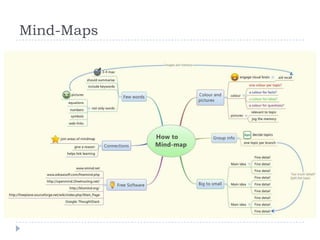
Mind-Maps
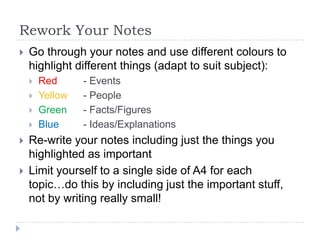
Rework Your Notes


Go through your notes and use different colours to
highlight different things (adapt to suit subject):








Red
Yellow
Green
Blue

- Events
- People
- Facts/Figures
- Ideas/Explanations

Re-write your notes including just the things you
highlighted as important
Limit yourself to a single side of A4 for each
topic…do this by including just the important stuff,
not by writing really small!
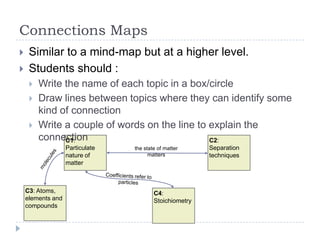
Connections Maps



Similar to a mind-map but at a higher level.
Students should :




Write the name of each topic in a box/circle
Draw lines between topics where they can identify some
kind of connection
Write a couple of words on the line to explain the
connection
C1:
C2:
Particulate
nature of
matter

C3: Atoms,
elements and
compounds

the state of matter
matters

C4:
Stoichiometry

Separation
techniques
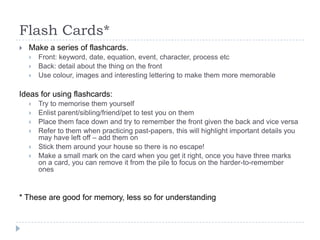
Flash Cards*


Make a series of flashcards.




Front: keyword, date, equation, event, character, process etc
Back: detail about the thing on the front
Use colour, images and interesting lettering to make them more memorable

Ideas for using flashcards:







Try to memorise them yourself
Enlist parent/sibling/friend/pet to test you on them
Place them face down and try to remember the front given the back and vice versa
Refer to them when practicing past-papers, this will highlight important details you
may have left off – add them on
Stick them around your house so there is no escape!
Make a small mark on the card when you get it right, once you have three marks
on a card, you can remove it from the pile to focus on the harder-to-remember
ones

* These are good for memory, less so for understanding
Games








Word Association: with a partner, player A starts with a
keyword related to the subject, player B then says a
related word. If a player hesitates, strays off subject or
the word is not related, they lose a point.
Dominoes: on a series of cards draw a line down the
middle to split them in half. Write a series of pairs of
ideas (question/answer, date/event etc) on separate
halves of the cards. Use these to play dominoes by
matching up the pairs
Pictionary: students take it in turns to draw a
concept/idea/event and their friends have to guess it.
Could be done with plasticine if you don’t mind a trip to
the surreal.
Taboo: students take turns to describe
concepts/ideas/events but without being able to use
certain key words
Graphic Organisers


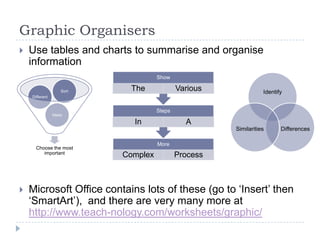
Use tables and charts to summarise and organise
information
Show
Sort

The

Various

Identify

Different

Steps

Ideas

In

A
Similarities

Choose the most
important



Differences

More

Complex

Process

Microsoft Office contains lots of these (go to ‘Insert’ then
‘SmartArt’), and there are very many more at
http://www.teach-nology.com/worksheets/graphic/
Marketplace









In groups, assign each group one of a series of topics or
sub-topics to work on.
Each group gets 30 minutes to produce a poster
summarising everything important about that (sub)topic,
making use of all available resources.
Posters are placed around the classroom and one
member of each group stays with the poster to present it
whilst the others tour the other groups’ posters learning
as much as they can.
The students are given a challenging set of exam
questions focussed on the topics addressed in the
posters and must work in their groups to answer them.
Go through the answers and debrief any areas of
difficulty.
Tennis


Split class into two



Each half of the class writes 10 short and difficult questions on
a topic



You may need to model this
You may want a rule to prevent the class genius from writing all
the questions on a team



The first team serves by asking a question, the second team
returns by answering correctly and asking one of their own



A point is scored when the opponent fails to return the
question



The team that scored the point gets the privilege of serving
Mnemonics


Mnemonics are tools to help you remember a list of
keywords/steps in a process/sequence of events etc



For example the planets (plus Pluto-the-Unloved):



My Very Energetic Mouse Jumped Straight Up Neptune’s
Pyjamas
Mercury, Venus, Earth, Mars, Jupiter, Saturn, Uranus, Neptune,
Pluto



Develop your own to help you memorise lists of things
you are struggling with.



Humour and absurdity can help make them more
memorable

Active Revision Techniques

  • 1.
  • 2.
    Student Teachers  In groups,instruct students to prepare a short (5-10 mins) lesson summarising a topic, including resources and activities (the preparation makes a good homework).  Groups should deliver the lessons either as wholeclass lessons or by splitting up and visiting each of the other groups individually.  Students should aim to make their lessons creative and memorable.
  • 3.
  • 4.
    Rework Your Notes  Gothrough your notes and use different colours to highlight different things (adapt to suit subject):       Red Yellow Green Blue - Events - People - Facts/Figures - Ideas/Explanations Re-write your notes including just the things you highlighted as important Limit yourself to a single side of A4 for each topic…do this by including just the important stuff, not by writing really small!
  • 5.
    Connections Maps   Similar toa mind-map but at a higher level. Students should :    Write the name of each topic in a box/circle Draw lines between topics where they can identify some kind of connection Write a couple of words on the line to explain the connection C1: C2: Particulate nature of matter C3: Atoms, elements and compounds the state of matter matters C4: Stoichiometry Separation techniques
  • 6.
    Flash Cards*  Make aseries of flashcards.    Front: keyword, date, equation, event, character, process etc Back: detail about the thing on the front Use colour, images and interesting lettering to make them more memorable Ideas for using flashcards:       Try to memorise them yourself Enlist parent/sibling/friend/pet to test you on them Place them face down and try to remember the front given the back and vice versa Refer to them when practicing past-papers, this will highlight important details you may have left off – add them on Stick them around your house so there is no escape! Make a small mark on the card when you get it right, once you have three marks on a card, you can remove it from the pile to focus on the harder-to-remember ones * These are good for memory, less so for understanding
  • 7.
    Games     Word Association: witha partner, player A starts with a keyword related to the subject, player B then says a related word. If a player hesitates, strays off subject or the word is not related, they lose a point. Dominoes: on a series of cards draw a line down the middle to split them in half. Write a series of pairs of ideas (question/answer, date/event etc) on separate halves of the cards. Use these to play dominoes by matching up the pairs Pictionary: students take it in turns to draw a concept/idea/event and their friends have to guess it. Could be done with plasticine if you don’t mind a trip to the surreal. Taboo: students take turns to describe concepts/ideas/events but without being able to use certain key words
  • 8.
    Graphic Organisers  Use tablesand charts to summarise and organise information Show Sort The Various Identify Different Steps Ideas In A Similarities Choose the most important  Differences More Complex Process Microsoft Office contains lots of these (go to ‘Insert’ then ‘SmartArt’), and there are very many more at http://www.teach-nology.com/worksheets/graphic/
  • 9.
    Marketplace      In groups, assigneach group one of a series of topics or sub-topics to work on. Each group gets 30 minutes to produce a poster summarising everything important about that (sub)topic, making use of all available resources. Posters are placed around the classroom and one member of each group stays with the poster to present it whilst the others tour the other groups’ posters learning as much as they can. The students are given a challenging set of exam questions focussed on the topics addressed in the posters and must work in their groups to answer them. Go through the answers and debrief any areas of difficulty.
  • 10.
    Tennis  Split class intotwo  Each half of the class writes 10 short and difficult questions on a topic   You may need to model this You may want a rule to prevent the class genius from writing all the questions on a team  The first team serves by asking a question, the second team returns by answering correctly and asking one of their own  A point is scored when the opponent fails to return the question  The team that scored the point gets the privilege of serving
  • 11.
    Mnemonics  Mnemonics are toolsto help you remember a list of keywords/steps in a process/sequence of events etc  For example the planets (plus Pluto-the-Unloved):   My Very Energetic Mouse Jumped Straight Up Neptune’s Pyjamas Mercury, Venus, Earth, Mars, Jupiter, Saturn, Uranus, Neptune, Pluto  Develop your own to help you memorise lists of things you are struggling with.  Humour and absurdity can help make them more memorable