


11
Dr. C.V. Suresh Babu
based
LEARNING
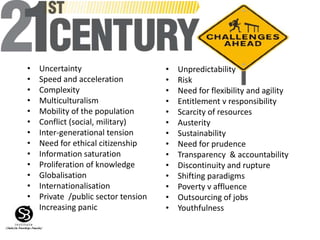
• Uncertainty
• Speed and acceleration
• Complexity
• Multiculturalism
• Mobility of the population
• Conflict (social, military)
• Inter-generational tension
• Need for ethical citizenship
• Information saturation
• Proliferation of knowledge
• Globalisation
• Internationalisation
• Private /public sector tension
• Increasing panic
• Unpredictability
• Risk
• Need for flexibility and agility
• Entitlement v responsibility
• Scarcity of resources
• Austerity
• Sustainability
• Need for prudence
• Transparency & accountability
• Discontinuity and rupture
• Shifting paradigms
• Poverty v affluence
• Outsourcing of jobs
• Youthfulness
3
• to create capable independent learners
• to create competent researchers
• to increase the circumstances in which teaching and
research have occasion to meet….
• Increase the skills of staff to teach emphasizing the
construction of knowledge by students rather than the
imparting of knowledge by instructors......
• Ensure that students experience the process of artistic and
scientific productivity.
4
5
6
8
9
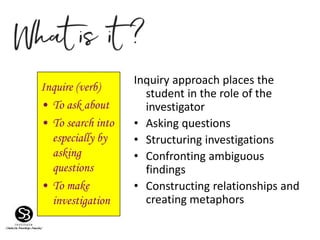
Inquire (verb)
• To ask about
• To search into
especially by
asking
questions
• To make
investigation
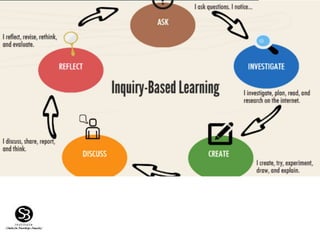
Inquiry approach places the
student in the role of the
investigator
• Asking questions
• Structuring investigations
• Confronting ambiguous
findings
• Constructing relationships and
creating metaphors
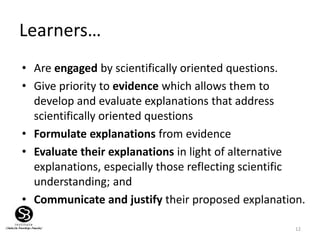
Learners…
12
• Are engaged by scientifically oriented questions.
• Give priority to evidence which allows them to
develop and evaluate explanations that address
scientifically oriented questions
• Formulate explanations from evidence
• Evaluate their explanations in light of alternative
explanations, especially those reflecting scientific
understanding; and
• Communicate and justify their proposed explanation.
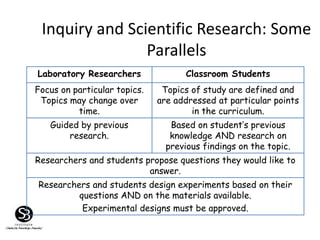
Inquiry and Scientific Research: Some
Parallels
Laboratory Researchers Classroom Students
Focus on particular topics.
Topics may change over
time.
Topics of study are defined and
are addressed at particular points
in the curriculum.
Guided by previous
research.
Based on student’s previous
knowledge AND research on
previous findings on the topic.
Researchers and students propose questions they would like to
answer.
Researchers and students design experiments based on their
questions AND on the materials available.
Experimental designs must be approved.
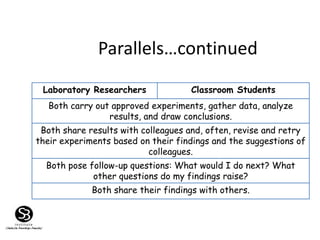
Parallels…continued
Laboratory Researchers Classroom Students
Both carry out approved experiments, gather data, analyze
results, and draw conclusions.
Both share results with colleagues and, often, revise and retry
their experiments based on their findings and the suggestions of
colleagues.
Both pose follow-up questions: What would I do next? What
other questions do my findings raise?
Both share their findings with others.
How do you do it?
• Consider ways to facilitate learning rather than
dispensing knowledge
• Expand & hone your questioning skills
• Inquiry is NOT a “free for all”
– Educator sets the focus and parameters
– Students generate questions within this framework
– Students design investigations given basic methods
and materials
Traditional Approach
• Introduce content verbally and via readings
• Use “cookbook” labs to illustrate and “verify” what
was presented
• Complete chapter problems and/or structured
activity to practice using new content
• Evaluate -> primarily content acquisition
17
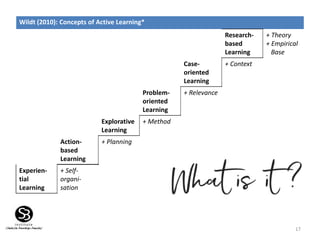
Wildt (2010): Concepts of Active Learning*
Research-
based
Learning
+ Theory
+ Empirical
Base
Case-
oriented
Learning
+ Context
Problem-
oriented
Learning
+ Relevance
Explorative
Learning
+ Method
Action-
based
Learning
+ Planning
Experien-
tial
Learning
+ Self-
organi-
sation
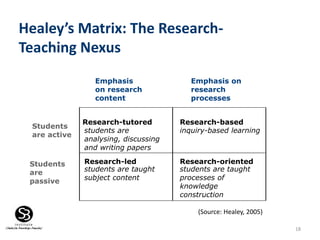
Healey’s Matrix: The Research-
Teaching Nexus
Research-basedResearch-tutored
Research-led
students are taught
processes of
knowledge
construction
students are
analysing, discussing
and writing papers
inquiry-based learning
Research-oriented
students are taught
subject content
Students
are active
Students
are
passive
Emphasis on
research
processes
Emphasis
on research
content
(Source: Healey, 2005)
18
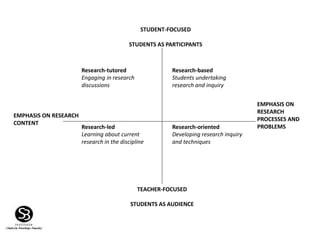
Research-tutored
Engaging in research
discussions
Research-based
Students undertaking
research and inquiry
Research-led
Learning about current
research in the discipline
Research-oriented
Developing research inquiry
and techniques
EMPHASIS ON RESEARCH
CONTENT
EMPHASIS ON
RESEARCH
PROCESSES AND
PROBLEMS
TEACHER-FOCUSED
STUDENTS AS AUDIENCE
STUDENT-FOCUSED
STUDENTS AS PARTICIPANTS
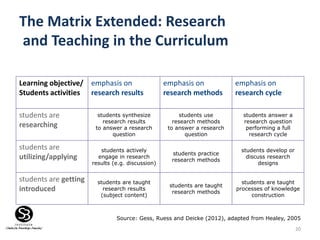
The Matrix Extended: Research
and Teaching in the Curriculum
Learning objective/
Students activities
emphasis on
research results
emphasis on
research methods
emphasis on
research cycle
students are
researching
students synthesize
research results
to answer a research
question
students use
research methods
to answer a research
question
students answer a
research question
performing a full
research cycle
students are
utilizing/applying
students actively
engage in research
results (e.g. discussion)
students practice
research methods
students develop or
discuss research
designs
students are getting
introduced
students are taught
research results
(subject content)
students are taught
research methods
students are taught
processes of knowledge
construction
Source: Gess, Ruess and Deicke (2012), adapted from Healey, 2005
20
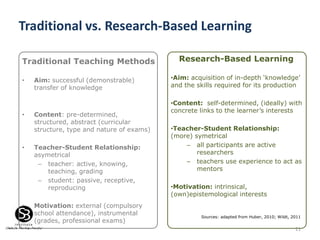
Traditional vs. Research-Based Learning
Traditional Teaching Methods
• Aim: successful (demonstrable)
transfer of knowledge
• Content: pre-determined,
structured, abstract (curricular
structure, type and nature of exams)
• Teacher-Student Relationship:
asymetrical
– teacher: active, knowing,
teaching, grading
– student: passive, receptive,
reproducing
• Motivation: external (compulsory
school attendance), instrumental
(grades, professional exams)
Research-Based Learning
•Aim: acquisition of in-depth ‘knowledge’
and the skills required for its production
•Content: self-determined, (ideally) with
concrete links to the learner’s interests
•Teacher-Student Relationship:
(more) symetrical
– all participants are active
researchers
– teachers use experience to act as
mentors
•Motivation: intrinsical,
(own)epistemological interests
Sources: adapted from Huber, 2010; Wildt, 2011
21
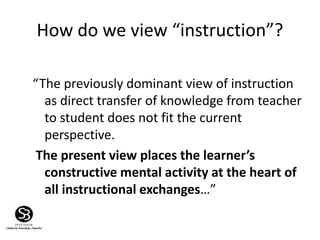
How do we view “instruction”?
“The previously dominant view of instruction
as direct transfer of knowledge from teacher
to student does not fit the current
perspective.
The present view places the learner’s
constructive mental activity at the heart of
all instructional exchanges…”
“…This does not mean that students are left
to discover everything for themselves, nor
that what they discover and how they
choose to describe and account for it are
left solely to them…
Structured Discovery
24
26
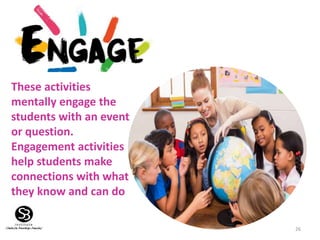
These activities
mentally engage the
students with an event
or question.
Engagement activities
help students make
connections with what
they know and can do
27
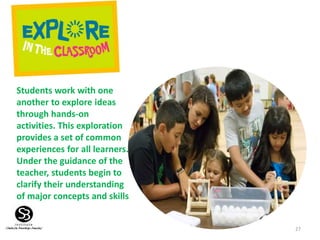
Students work with one
another to explore ideas
through hands-on
activities. This exploration
provides a set of common
experiences for all learners.
Under the guidance of the
teacher, students begin to
clarify their understanding
of major concepts and skills
28
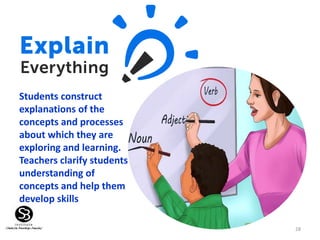
Students construct
explanations of the
concepts and processes
about which they are
exploring and learning.
Teachers clarify students
understanding of
concepts and help them
develop skills
29
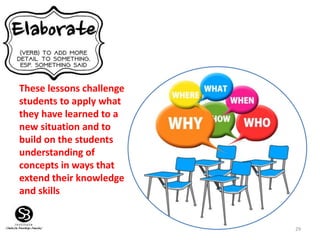
These lessons challenge
students to apply what
they have learned to a
new situation and to
build on the students
understanding of
concepts in ways that
extend their knowledge
and skills
30
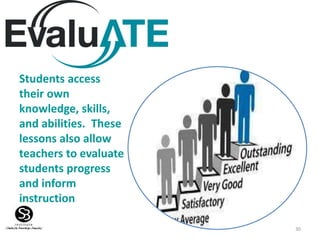
Students access
their own
knowledge, skills,
and abilities. These
lessons also allow
teachers to evaluate
students progress
and inform
instruction
31
9/24/2019 Dr. C.V. Suresh Babu 32
9840237456
anniyappapublications@yahoo.com
https://sites.google.com/site/anniyappa/
http://www.facebook.com/anniyappa
https://twitter.com/anniyappa
Dr.C.V.Suresh Babu 's Classes
(Centre for Knowledge
Transfer)

Research based learning

  • 1.
    11 Dr. C.V. SureshBabu based LEARNING
  • 2.
    • Uncertainty • Speedand acceleration • Complexity • Multiculturalism • Mobility of the population • Conflict (social, military) • Inter-generational tension • Need for ethical citizenship • Information saturation • Proliferation of knowledge • Globalisation • Internationalisation • Private /public sector tension • Increasing panic • Unpredictability • Risk • Need for flexibility and agility • Entitlement v responsibility • Scarcity of resources • Austerity • Sustainability • Need for prudence • Transparency & accountability • Discontinuity and rupture • Shifting paradigms • Poverty v affluence • Outsourcing of jobs • Youthfulness
  • 3.
    3 • to createcapable independent learners • to create competent researchers • to increase the circumstances in which teaching and research have occasion to meet…. • Increase the skills of staff to teach emphasizing the construction of knowledge by students rather than the imparting of knowledge by instructors...... • Ensure that students experience the process of artistic and scientific productivity.
  • 4.
  • 5.
  • 6.
  • 8.
  • 9.
  • 11.
    Inquire (verb) • Toask about • To search into especially by asking questions • To make investigation Inquiry approach places the student in the role of the investigator • Asking questions • Structuring investigations • Confronting ambiguous findings • Constructing relationships and creating metaphors
  • 12.
    Learners… 12 • Are engagedby scientifically oriented questions. • Give priority to evidence which allows them to develop and evaluate explanations that address scientifically oriented questions • Formulate explanations from evidence • Evaluate their explanations in light of alternative explanations, especially those reflecting scientific understanding; and • Communicate and justify their proposed explanation.
  • 13.
    Inquiry and ScientificResearch: Some Parallels Laboratory Researchers Classroom Students Focus on particular topics. Topics may change over time. Topics of study are defined and are addressed at particular points in the curriculum. Guided by previous research. Based on student’s previous knowledge AND research on previous findings on the topic. Researchers and students propose questions they would like to answer. Researchers and students design experiments based on their questions AND on the materials available. Experimental designs must be approved.
  • 14.
    Parallels…continued Laboratory Researchers ClassroomStudents Both carry out approved experiments, gather data, analyze results, and draw conclusions. Both share results with colleagues and, often, revise and retry their experiments based on their findings and the suggestions of colleagues. Both pose follow-up questions: What would I do next? What other questions do my findings raise? Both share their findings with others.
  • 15.
    How do youdo it? • Consider ways to facilitate learning rather than dispensing knowledge • Expand & hone your questioning skills • Inquiry is NOT a “free for all” – Educator sets the focus and parameters – Students generate questions within this framework – Students design investigations given basic methods and materials
  • 16.
    Traditional Approach • Introducecontent verbally and via readings • Use “cookbook” labs to illustrate and “verify” what was presented • Complete chapter problems and/or structured activity to practice using new content • Evaluate -> primarily content acquisition
  • 17.
    17 Wildt (2010): Conceptsof Active Learning* Research- based Learning + Theory + Empirical Base Case- oriented Learning + Context Problem- oriented Learning + Relevance Explorative Learning + Method Action- based Learning + Planning Experien- tial Learning + Self- organi- sation
  • 18.
    Healey’s Matrix: TheResearch- Teaching Nexus Research-basedResearch-tutored Research-led students are taught processes of knowledge construction students are analysing, discussing and writing papers inquiry-based learning Research-oriented students are taught subject content Students are active Students are passive Emphasis on research processes Emphasis on research content (Source: Healey, 2005) 18
  • 19.
    Research-tutored Engaging in research discussions Research-based Studentsundertaking research and inquiry Research-led Learning about current research in the discipline Research-oriented Developing research inquiry and techniques EMPHASIS ON RESEARCH CONTENT EMPHASIS ON RESEARCH PROCESSES AND PROBLEMS TEACHER-FOCUSED STUDENTS AS AUDIENCE STUDENT-FOCUSED STUDENTS AS PARTICIPANTS
  • 20.
    The Matrix Extended:Research and Teaching in the Curriculum Learning objective/ Students activities emphasis on research results emphasis on research methods emphasis on research cycle students are researching students synthesize research results to answer a research question students use research methods to answer a research question students answer a research question performing a full research cycle students are utilizing/applying students actively engage in research results (e.g. discussion) students practice research methods students develop or discuss research designs students are getting introduced students are taught research results (subject content) students are taught research methods students are taught processes of knowledge construction Source: Gess, Ruess and Deicke (2012), adapted from Healey, 2005 20
  • 21.
    Traditional vs. Research-BasedLearning Traditional Teaching Methods • Aim: successful (demonstrable) transfer of knowledge • Content: pre-determined, structured, abstract (curricular structure, type and nature of exams) • Teacher-Student Relationship: asymetrical – teacher: active, knowing, teaching, grading – student: passive, receptive, reproducing • Motivation: external (compulsory school attendance), instrumental (grades, professional exams) Research-Based Learning •Aim: acquisition of in-depth ‘knowledge’ and the skills required for its production •Content: self-determined, (ideally) with concrete links to the learner’s interests •Teacher-Student Relationship: (more) symetrical – all participants are active researchers – teachers use experience to act as mentors •Motivation: intrinsical, (own)epistemological interests Sources: adapted from Huber, 2010; Wildt, 2011 21
  • 22.
    How do weview “instruction”? “The previously dominant view of instruction as direct transfer of knowledge from teacher to student does not fit the current perspective. The present view places the learner’s constructive mental activity at the heart of all instructional exchanges…”
  • 23.
    “…This does notmean that students are left to discover everything for themselves, nor that what they discover and how they choose to describe and account for it are left solely to them… Structured Discovery
  • 24.
  • 26.
    26 These activities mentally engagethe students with an event or question. Engagement activities help students make connections with what they know and can do
  • 27.
    27 Students work withone another to explore ideas through hands-on activities. This exploration provides a set of common experiences for all learners. Under the guidance of the teacher, students begin to clarify their understanding of major concepts and skills
  • 28.
    28 Students construct explanations ofthe concepts and processes about which they are exploring and learning. Teachers clarify students understanding of concepts and help them develop skills
  • 29.
    29 These lessons challenge studentsto apply what they have learned to a new situation and to build on the students understanding of concepts in ways that extend their knowledge and skills
  • 30.
    30 Students access their own knowledge,skills, and abilities. These lessons also allow teachers to evaluate students progress and inform instruction
  • 31.
  • 32.
    9/24/2019 Dr. C.V.Suresh Babu 32 9840237456 anniyappapublications@yahoo.com https://sites.google.com/site/anniyappa/ http://www.facebook.com/anniyappa https://twitter.com/anniyappa Dr.C.V.Suresh Babu 's Classes (Centre for Knowledge Transfer)