Contents
What isReverse Engineering (RE)?
Why do we need Reverse Engineering?
Scope and Tasks of Reverse Engineering
Different Approaches
RE tools
Conclusions
3.
What is Reverse
Engineering?
You have an unexpected case:
• You finished one course project using Java
• Your program runs OK
• But, by accident, you delete the java file
• How to hand in your project?
4.
What is Reverse
Engineering?
You have an unexpected case:
• You finished one course project using Java
• Your program runs OK
• But, by accident, you delete the java file
• How to hand in your project?
Reverse Engineering
5.
What is Reverse
Engineering?
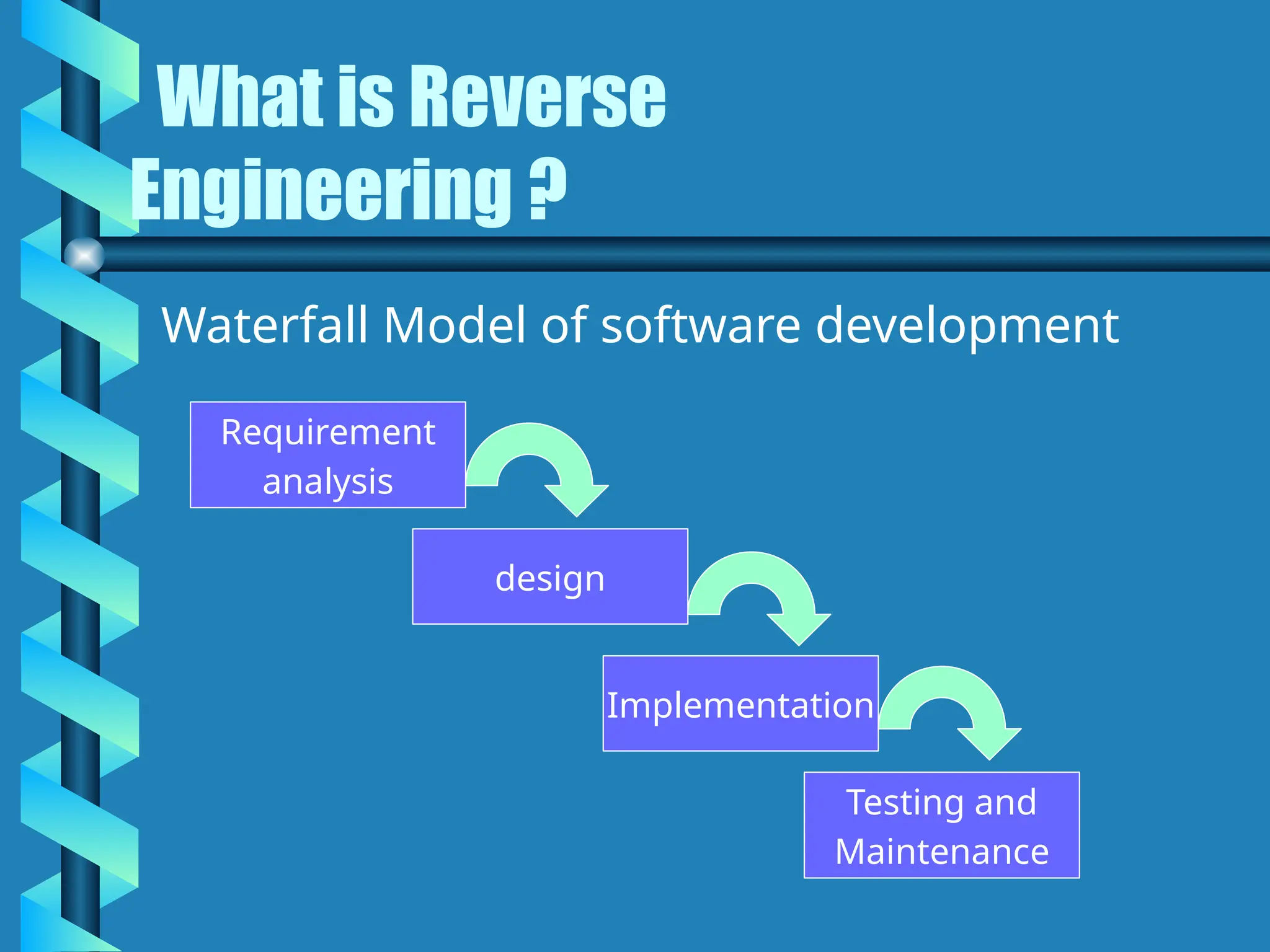
Waterfall Model of software development
Requirement
analysis
design
Implementation
Testing and
Maintenance
What is Reverse
Engineering?
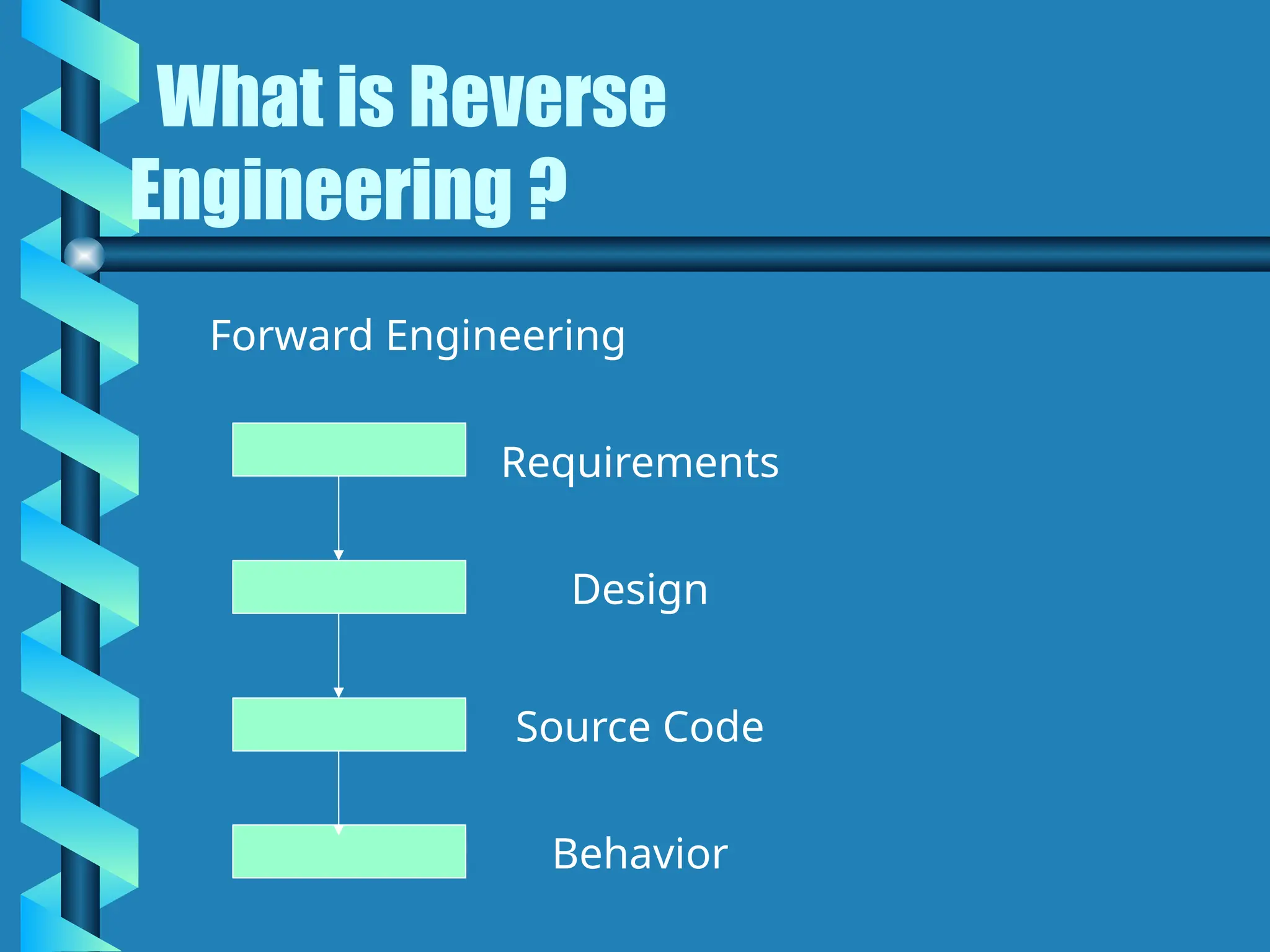
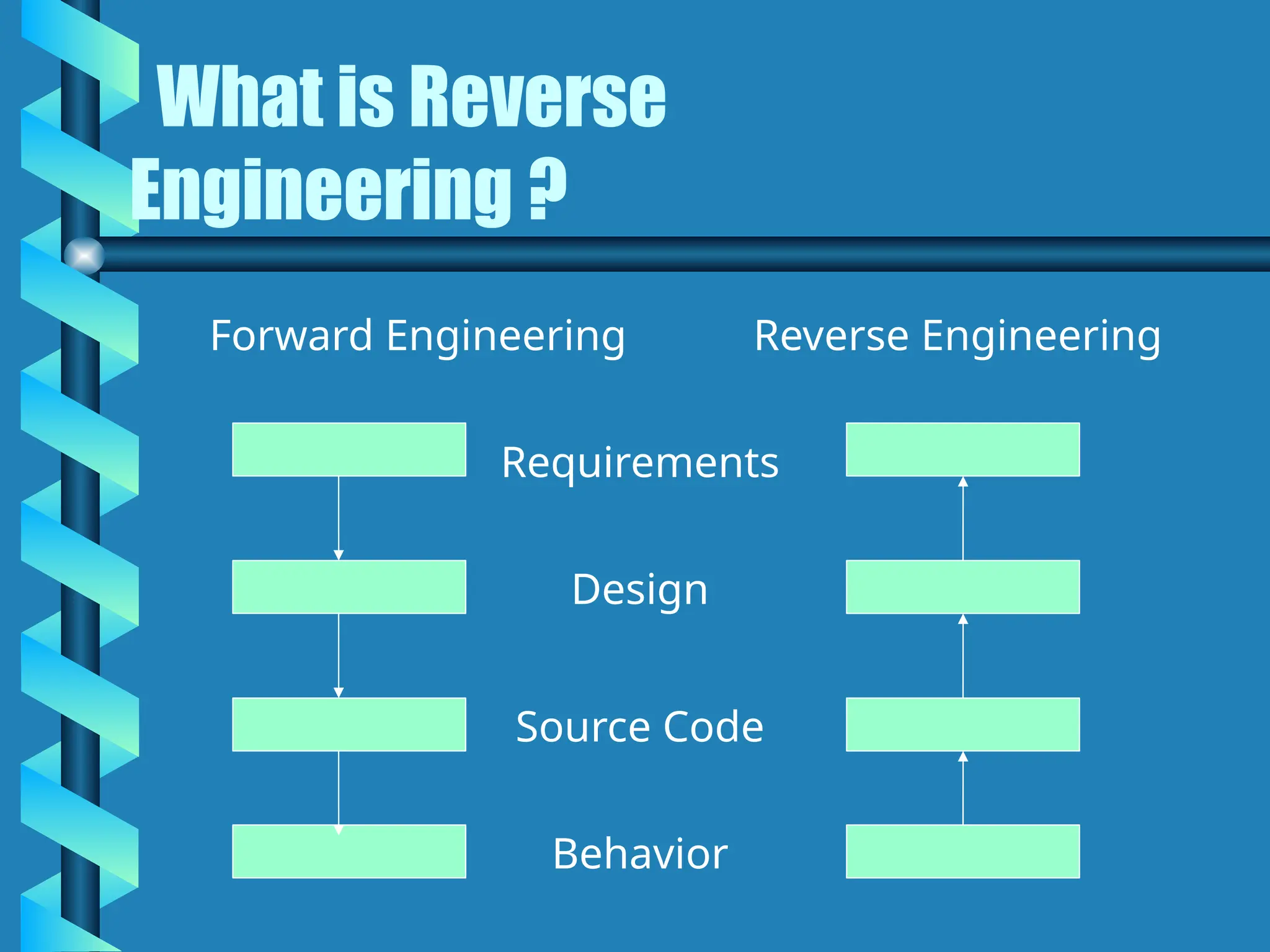
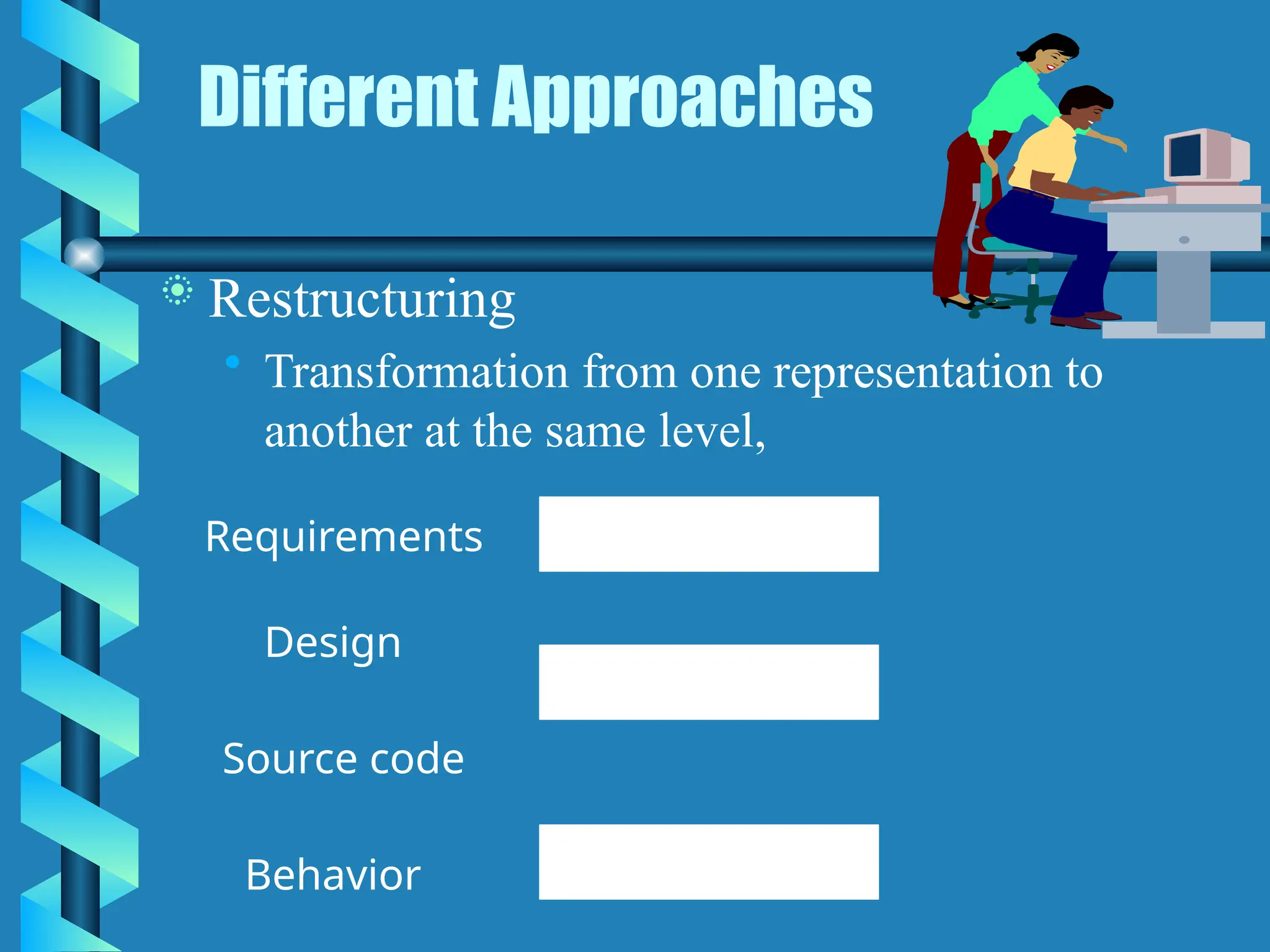
Forward Engineering Reverse Engineering
Requirements
Design
Source Code
Behavior
8.
What is Reverse
Engineering?
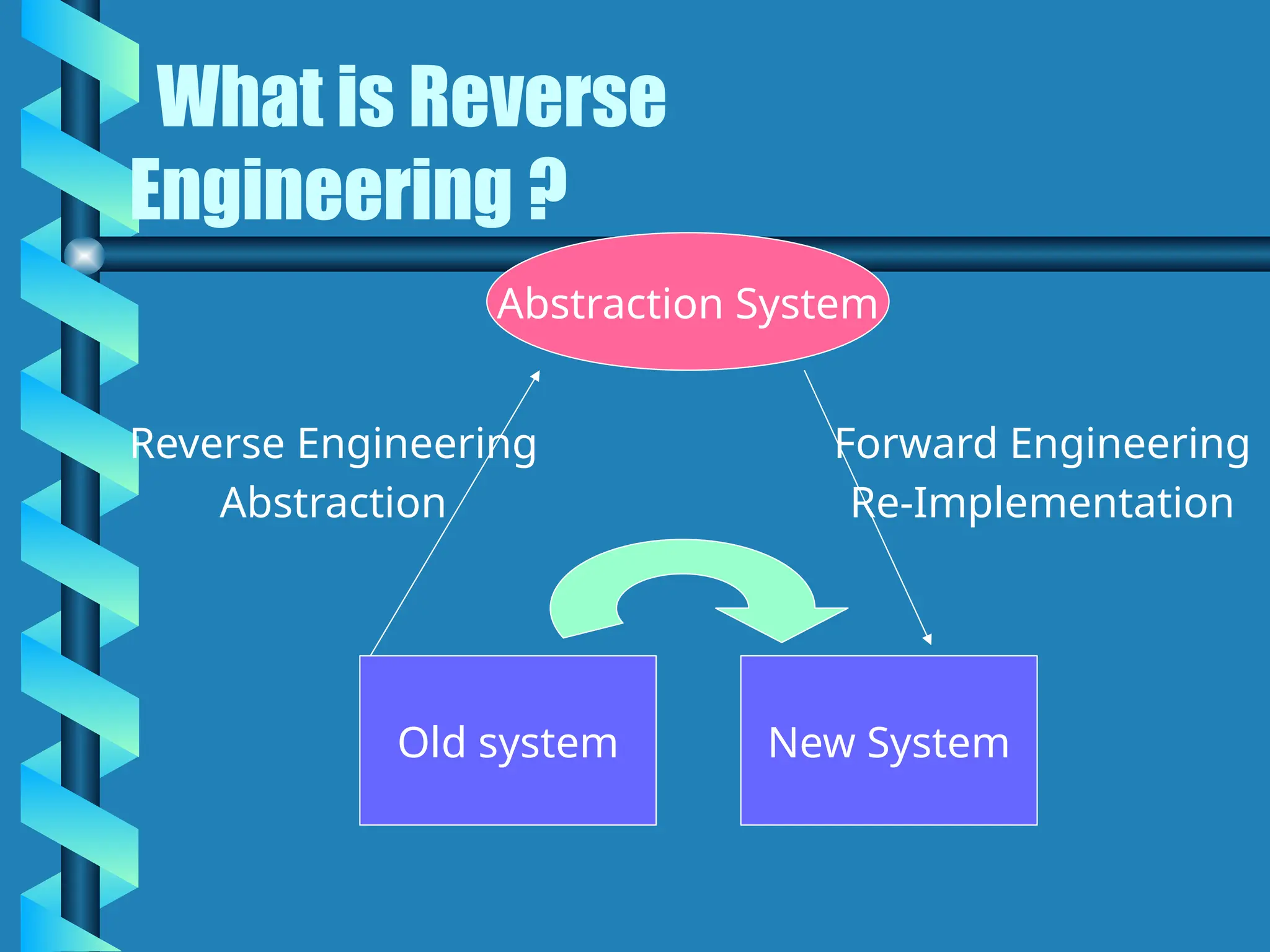
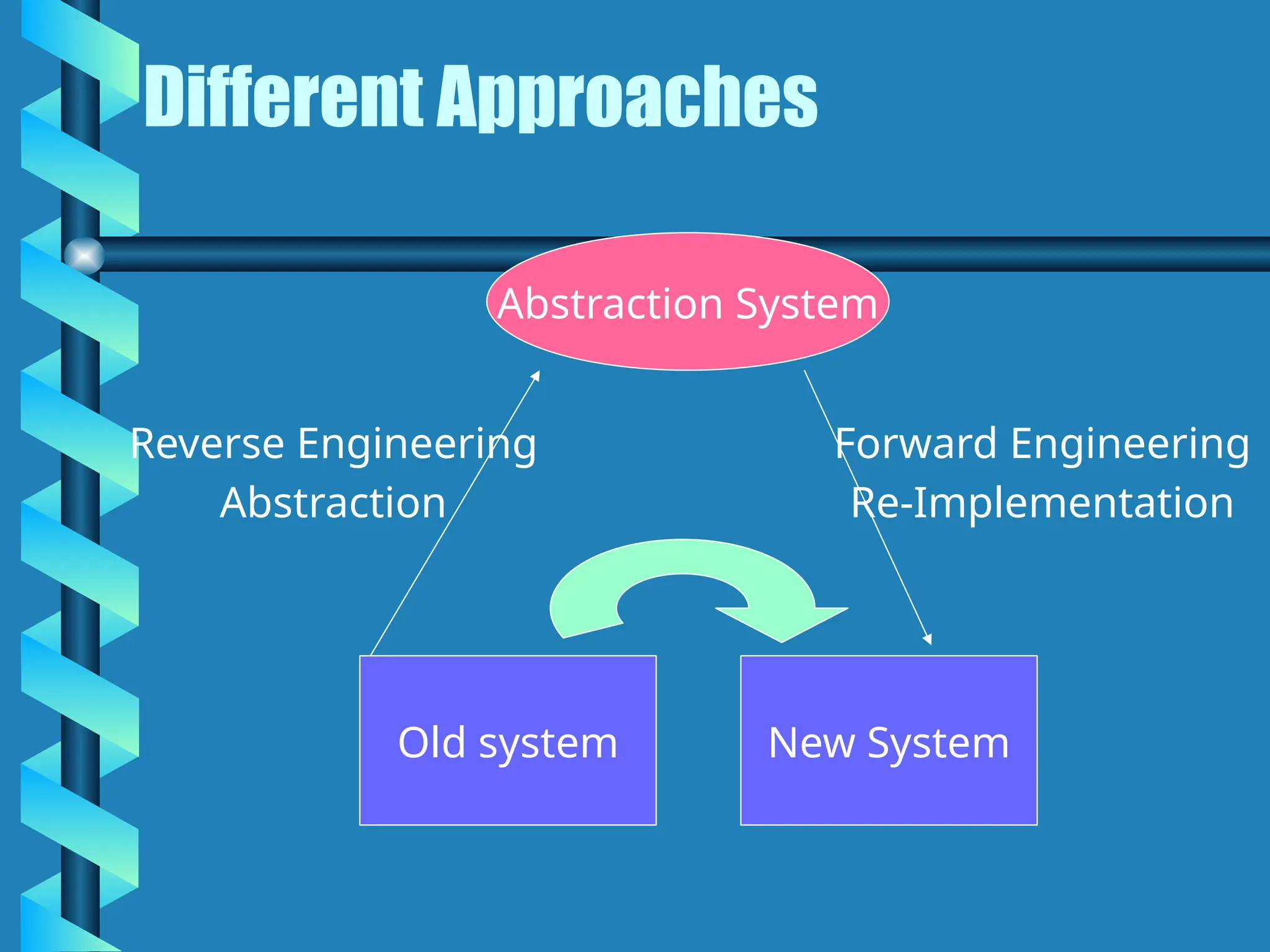
Abstraction System
Old system New System
Forward Engineering
Re-Implementation
Reverse Engineering
Abstraction
9.
What is ReverseEngineering?
RE encompasses any activity that is done to
determine how a product works, to learn the
ideas and technology that were used in
developing that product.
RE can be done at many levels
RE generally belongs to Software
Maintenance
10.
The Early Daysof RE
Law of Software Revolution (Lehman, 1980)
Fundamental strategies for program
comprehension (Brooks, 1983)
Taxonomy of Reverse Engineering
(Chikofsky&Cross, 1990)
WCRE (Working Conference on R.E., 1990)
IWPC (Int. Workshop on Program
Comprehension)
11.
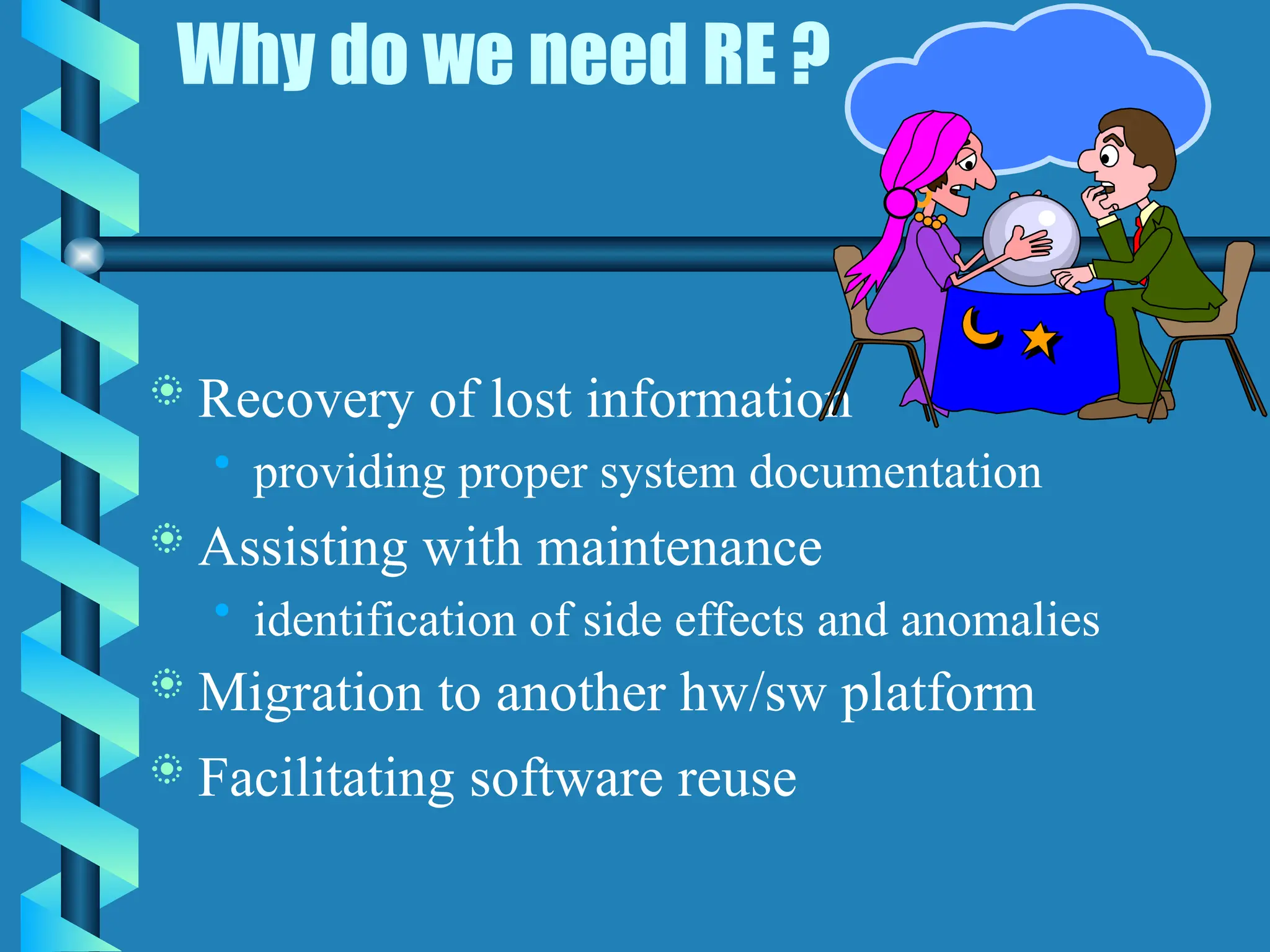
Why do weneed RE ?
Recovery of lost information
• providing proper system documentation
Assisting with maintenance
• identification of side effects and anomalies
Migration to another hw/sw platform
Facilitating software reuse
Difficulties of Reverse
Engineering
Gap between problem
/solution domain
Gap between concrete
and abstract
Gap between coherency/disintegration
Gap between hierarchical/associational
14.
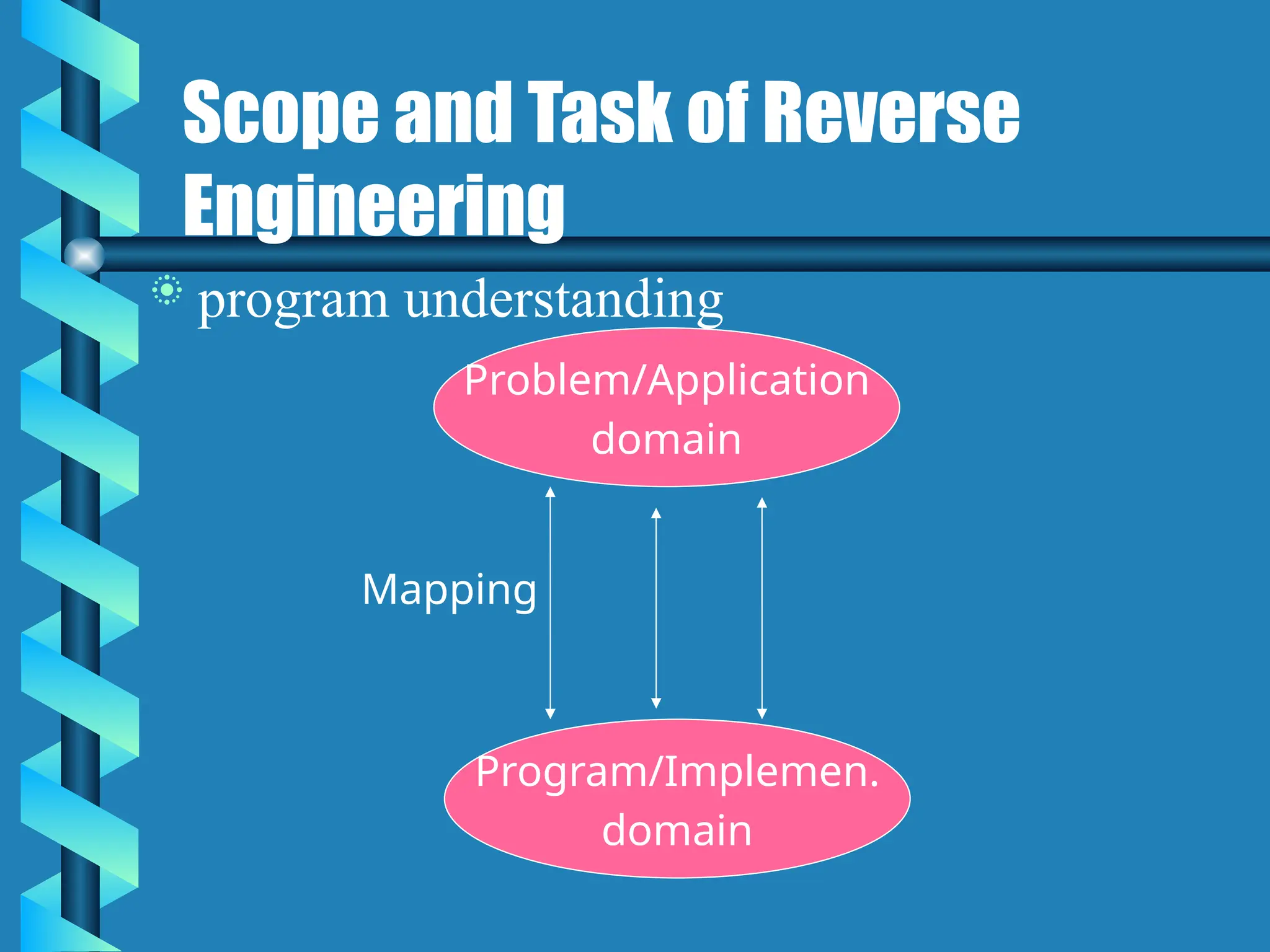
Scope and Taskof Reverse
Engineering
program understanding
Problem/Application
domain
Program/Implemen.
domain
Mapping
15.
Scope and Taskof Reverse
Engineering
Redocumentation and/or document
generation
Recovery of design approach and design
details at any level of abstraction
Identifying reusable components and
components that need restructuring
Recovering business rules
Understanding high-level system
description.
16.
Discovery of Abstraction
Discovery of abstraction in large system
• maintenance purpose
• evolution purpose
• reengineering purpose
17.
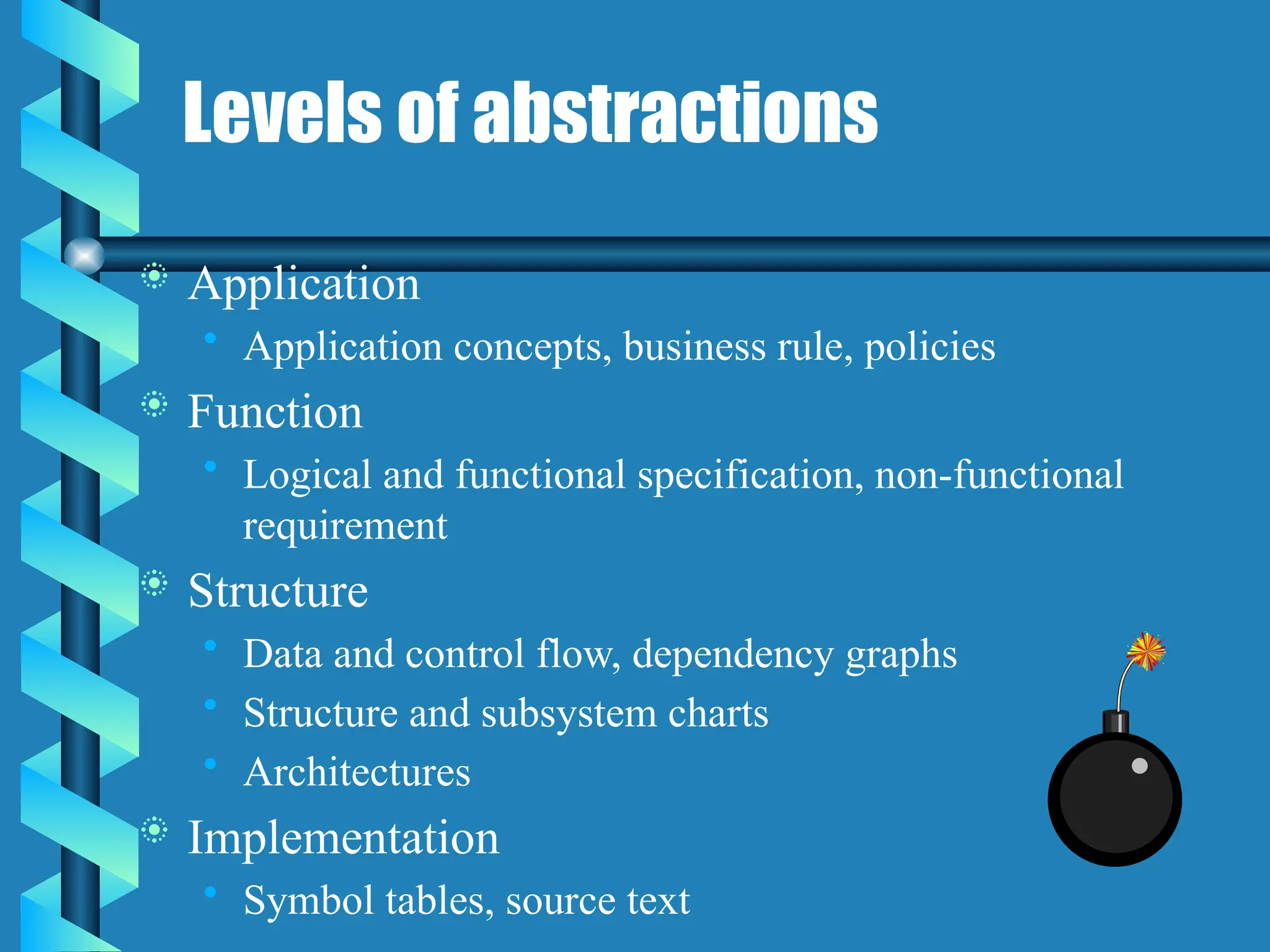
Levels of abstractions
Application
• Application concepts, business rule, policies
Function
• Logical and functional specification, non-functional
requirement
Structure
• Data and control flow, dependency graphs
• Structure and subsystem charts
• Architectures
Implementation
• Symbol tables, source text
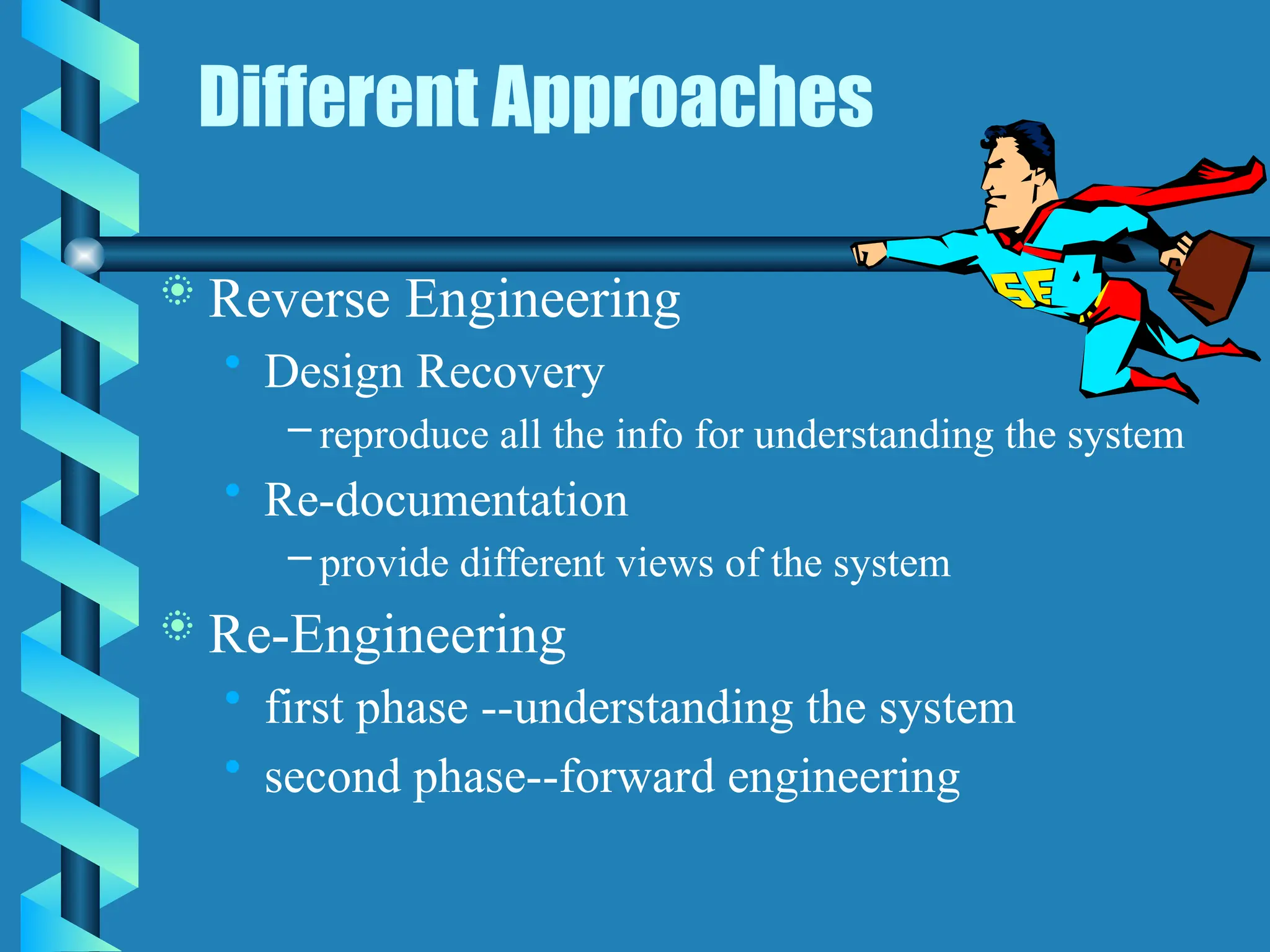
Different Approaches
ReverseEngineering
• Design Recovery
– reproduce all the info for understanding the system
• Re-documentation
– provide different views of the system
Re-Engineering
• first phase --understanding the system
• second phase--forward engineering
Example--Java Decompiler
Howto recover bytecode from .class file
under Unix/Win with JDK?
% javap -c <filename>
% javap -help (to see the options)
Java Decompilers
• ”ClassCracker” http://www.pcug.org.au/~mayon/
• “DeCafe Pro" from DeCafe, France at
http://decafe.hypermart.net/index.htm
• “SourceAgain" from Ahpah corp at http://www.ahpah.com
Example--Java Decompiler
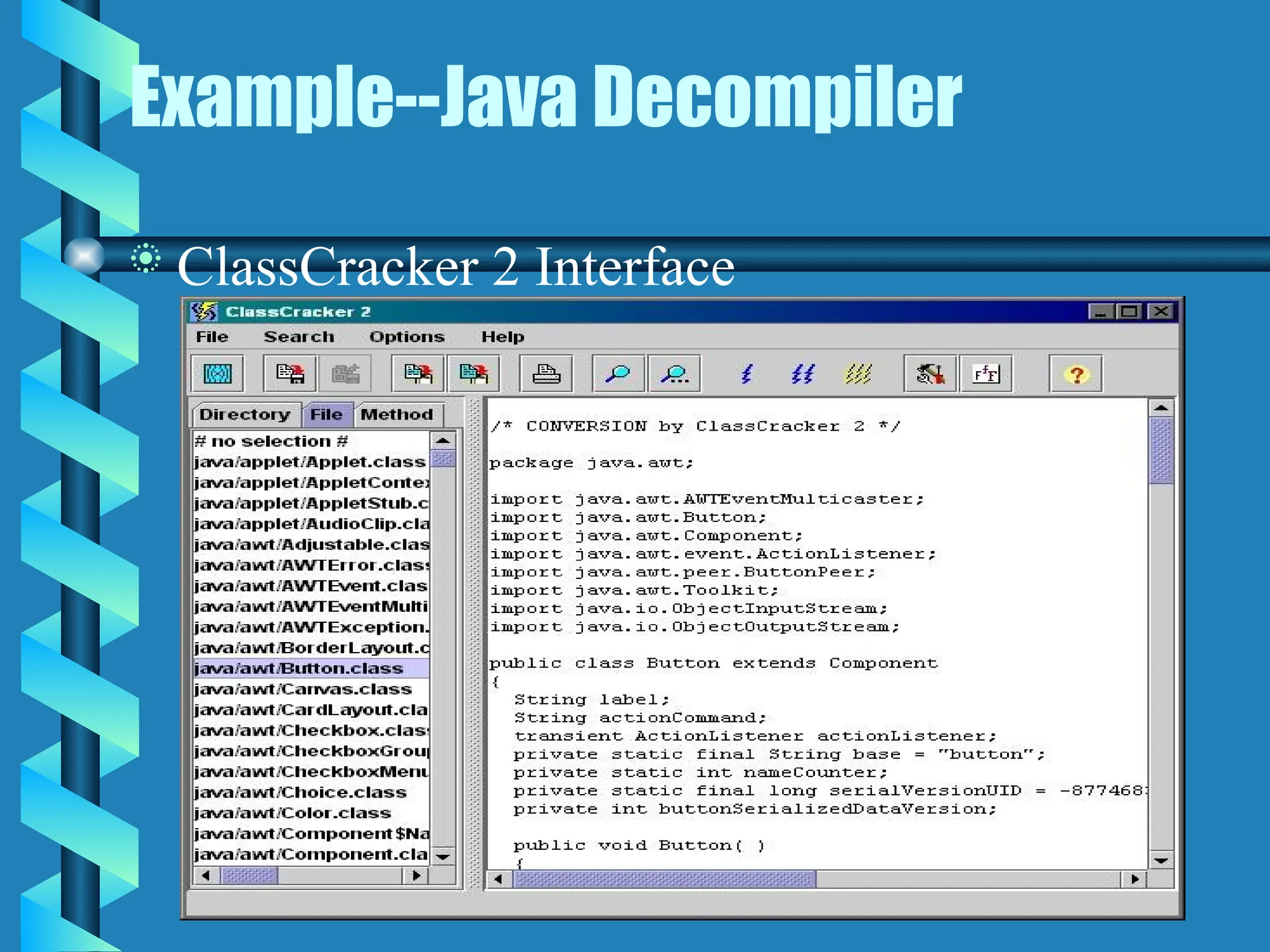
Componentsof ClassCracker 2
• Java decompiler
– retrieves Java source code from Java class files
• Java disassembler
– produces Java Assembly Code
• A Java class file viewer
– displays Java class file structures.
25.
Example--Java Decompiler
Featuresof ClassCracker 2
• User visual interface.
• Can decompile class files within zip or jar files.
• Conversion mode (JAVA, JASM or JDUMP) is
selectable
• A Batc Mode allows multiple class files to be
decompiled simultaneously
• more…...
26.
Example--Java Decompiler
ClassCracker2 System Requirements
• All platform (Window/Linus/Unix)
• JDK /JRE
Do not believe it?
• From myClass_origin.class ==>myClass.java
• % javac myClass.java (==>myClass.class)
• % diff myClass.class myClass_origin.class
27.
Example--Java Decompiler
ClassCracker2.0--want to try it?
• Free download at
http://www.pcug.org.au/~mayon/classcracker/
ccgetdemo.html
• Only first three methods are decoded.
Bridge 1.0---Free
• http://www.geocities.com/SiliconValley/
Bridge/8617/jad.html
28.
Conclusions
Reverse Engineeringis a new research area
among software maintenance
RE includes activities of understanding the
system and recovery info from system
Program understanding is the most important
subset of Reverse Engineering
Discovery of abstraction is key issue