9/16/16, 1:05 PMThe Identity of Things
Page 1 of 5http://fedscoop.com/the-identity-of-things
September 16, 2016
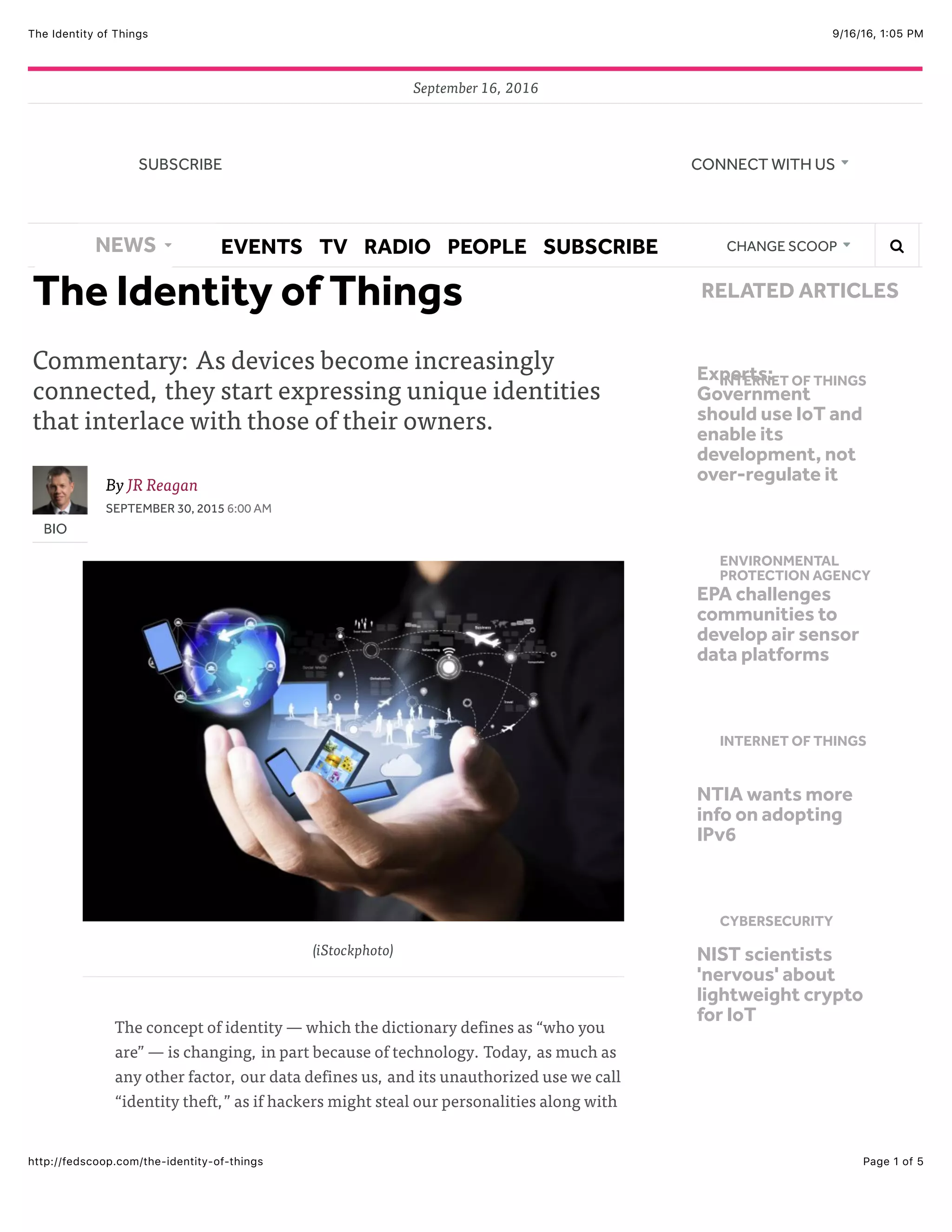
​The Identity of Things
Commentary: As devices become increasingly
connected, they start expressing unique identities
that interlace with those of their owners.
BIO
By JR Reagan
SEPTEMBER 30, 2015 6:00 AM
(iStockphoto)
The concept of identity — which the dictionary defines as “who you
are” — is changing, in part because of technology. Today, as much as
any other factor, our data defines us, and its unauthorized use we call
“identity theft,” as if hackers might steal our personalities along with
INTERNET OF THINGSExperts:
Government
should use IoT and
enable its
development, not
over-regulate it
ENVIRONMENTAL
PROTECTION AGENCY
EPA challenges
communities to
develop air sensor
data platforms
INTERNET OF THINGS
NTIA wants more
info on adopting
IPv6
CYBERSECURITY
NIST scientists
'nervous' about
lightweight crypto
for IoT
RELATED ARTICLES
NEWS EVENTS TV RADIO PEOPLE SUBSCRIBE CHANGE SCOOP !"
SUBSCRIBE CONNECT WITH US
9/16/16, 1:05 PMThe Identity of Things
Page 2 of 5http://fedscoop.com/the-identity-of-things
JR Reagan
our credit card and Social Security numbers.
Now the Internet of Things promises to expand the notion of identity
even further, connecting us not only with our friends and finances
but also with our objects.
You are what you own. This is true in a metaphoric sense: The clothes
we wear and the cars we drive help to define us. And as more of our
possessions go online — some 5 billion connected devices this year,
according to Gartner — a new kind of identity emerges, at once
intimately personal and vastly public. The details of our personal
lives are now on record, collected by our phones, sensors in our
clothing, GPS in our cars, by our thermostats and toothbrushes and
bed pillows, and not necessarily for our eyes only. Our schedules,
routines, habits and preferences may also be shared with
manufacturers, health care providers, advertisers, public agencies,
and more. In the Internet of Things, you own what you are, as well.
But who owns what, and vice versa? As
our things become more autonomous,
sending prompts not only to us but
also elsewhere on our behalf — as
emails, texts, phone calls and other
notifications — we can expect to see a
blurring of the lines between owner
and owned, between subject and
object, between identifier and
identified.
The new identity
What makes us who we are? In his book “The Storytelling Animal,”
scholar Jonathan Gottschall argues that stories — the stories of our
lives — make us human. Since no two people share the same story,
our personal narratives provide each of us with a unique identity.
Objects have stories, too, though. The film “The Red Violin” follows a
concert violin from its creation in 17th-century Italy through three
centuries, where it is played in concert halls, a monastery and in the
Chinese Cultural Revolution. Oh, the stories our things could tell, if
only they could talk!
Cybersecurity Insights &
Perspectives
Invincea's Anup
Ghosh on using
machine learning
to improve
cybersecurity
detection
capabilities
Cybersecurity Insights &
Perspectives
Veracode's Chris
Wysopal talks
about the impact
of '90s hacker
think tank
Content from Sponsors
DHS' Vincent
Sritapan on federal
IT modernization
September 20, 2016
Leveraging Your
Workforce in the
New
Communications
Era
September 28, 2016
Privileged User &
Insider Threat
Federal 2016
Ponemon Survey
Findings
October 05, 2016
VIEW ALL
TV/RADIO
EVENTS
9/16/16, 1:05 PMThe Identity of Things
Page 3 of 5http://fedscoop.com/the-identity-of-things
Soon, it seems, they’ll be able to. Sensors, chips and other forms of
digitalization already are turning commonplace objects into data
collectors. Many a newer model car could, if tapped, provide
information about when and where it was manufactured, how often
the oil has been changed, and where it has traveled. In short, it has a
story to tell — a “who I am.” An identity.
Linking our objects to the digital universe, the Internet of Things
promises to take object-identity to a new level. Suddenly, a coffee
maker isn’t just a coffee maker — it’s your coffee maker, and it
already knows how many cups you want it to brew and when, how
strong you like your coffee, and which beans you prefer —
information it shares with the grocery store as it orders more.
Connecting ordinary things gives them the extraordinary ability to
tell their stories, expressing their unique identities, which, while we
own them, intertwine inextricably with ours. Our vehicles soon may
share traffic information in real time with other cars, and use the data
others share to avoid traffic jams or construction sites. In this
manner, our cars stand to create their own narratives that help to
shape our stories, making decisions for us such as which route to take
from one place to another, and where and when to re-fuel and to
park.
At our service
When our objects communicate with one another and with us, the
story that is our everyday lives may flow more smoothly. Imagine this
scenario:
Knowing the traffic conditions — and precisely how long it will take
to get to work today — the car starts itself, opens the garage, and
alerts us when it’s time to leave. As we walk to the car, it unlocks
itself and signals the house to turn off the lights, change the
thermostat, and lock the doors. We don’t have to worry whether
we’ve left the stove on: It will switch itself off. On the way to the
office, we can relax, read the news, check emails, and sip our coffee
until the car drops us off and leaves to park itself. During the day, our
robots are cleaning the house, mowing the lawn, perhaps even
cooking dinner. When it’s time to go home, we summon the car. It
tells the house that we’re on our way, and learns from the refrigerator
that we’re nearly out of milk. After notifying the grocery store, the
October 05, 2016
What Hackers
Reveal About IT
Vulnerabilities
VIEW ALL
9/16/16, 1:05 PMThe Identity of Things
Page 4 of 5http://fedscoop.com/the-identity-of-things
-Explore Stories in Tech- NEWS > TECH
-In this Story-
Tech, Emerging Technology, Internet of Things, Commentary, Guest Columns
Stay alert to all the latest government IT news.
SIGN UP TODAY
car pulls up at the drive-thru window to collect our milk, then carries
us home, where the lights are already on, music is playing, the
temperature is comfortable and dinner is on the stove.
And after we’ve gone to bed at night, who knows? Once our pillow
has detected that we’re in deep sleep, perhaps our things will begin
sharing the adventures of their day with one another, telling their
stories — which are our stories, as well. And maybe we’ll sleep a bit
more soundly, knowing that, should anything happen in the night,
our house will awaken us and call the authorities. Like an extended
family, our Identified Things are not only taking care of us, they’re
watching out for us, as well. That’s cybersecurity.
JR Reagan is the global chief information security officer of Deloitte. He
also serves as professional faculty at Johns Hopkins, Cornell and Columbia
universities. Follow him @IdeaXplorer. Read more from JR Reagan.
JOIN THE CONVERSATION
So, you've
assumed
compromise. Now
what?
NSA: no zero days
were used in any
high profile
breaches over last
24 months
Election systems
safe from
cyberattacks,
experts believe
9/16/16, 1:05 PMThe Identity of Things
Page 5 of 5http://fedscoop.com/the-identity-of-things
0 Comments FedScoop SherryJones!
Share⤤ Sort by Best
Start the discussion…
Be the first to comment.
Subscribe✉ Add Disqus to your site Add Disqus Addd Privacy%
Recommend♥
ABOUT / CONTACT LEADERSHIP TEAM EDITORIAL TEAM
CONTRIBUTE CAREERS
# $ % & ' + )
BACK TO TOPCOPYRIGHT 2008-2016 FEDSCOOP. ALL RIGHTS RESERVED. ∠

​The Identity of Things

  • 1.
    9/16/16, 1:05 PMTheIdentity of Things Page 1 of 5http://fedscoop.com/the-identity-of-things September 16, 2016 ​The Identity of Things Commentary: As devices become increasingly connected, they start expressing unique identities that interlace with those of their owners. BIO By JR Reagan SEPTEMBER 30, 2015 6:00 AM (iStockphoto) The concept of identity — which the dictionary defines as “who you are” — is changing, in part because of technology. Today, as much as any other factor, our data defines us, and its unauthorized use we call “identity theft,” as if hackers might steal our personalities along with INTERNET OF THINGSExperts: Government should use IoT and enable its development, not over-regulate it ENVIRONMENTAL PROTECTION AGENCY EPA challenges communities to develop air sensor data platforms INTERNET OF THINGS NTIA wants more info on adopting IPv6 CYBERSECURITY NIST scientists 'nervous' about lightweight crypto for IoT RELATED ARTICLES NEWS EVENTS TV RADIO PEOPLE SUBSCRIBE CHANGE SCOOP !" SUBSCRIBE CONNECT WITH US
  • 2.
    9/16/16, 1:05 PMTheIdentity of Things Page 2 of 5http://fedscoop.com/the-identity-of-things JR Reagan our credit card and Social Security numbers. Now the Internet of Things promises to expand the notion of identity even further, connecting us not only with our friends and finances but also with our objects. You are what you own. This is true in a metaphoric sense: The clothes we wear and the cars we drive help to define us. And as more of our possessions go online — some 5 billion connected devices this year, according to Gartner — a new kind of identity emerges, at once intimately personal and vastly public. The details of our personal lives are now on record, collected by our phones, sensors in our clothing, GPS in our cars, by our thermostats and toothbrushes and bed pillows, and not necessarily for our eyes only. Our schedules, routines, habits and preferences may also be shared with manufacturers, health care providers, advertisers, public agencies, and more. In the Internet of Things, you own what you are, as well. But who owns what, and vice versa? As our things become more autonomous, sending prompts not only to us but also elsewhere on our behalf — as emails, texts, phone calls and other notifications — we can expect to see a blurring of the lines between owner and owned, between subject and object, between identifier and identified. The new identity What makes us who we are? In his book “The Storytelling Animal,” scholar Jonathan Gottschall argues that stories — the stories of our lives — make us human. Since no two people share the same story, our personal narratives provide each of us with a unique identity. Objects have stories, too, though. The film “The Red Violin” follows a concert violin from its creation in 17th-century Italy through three centuries, where it is played in concert halls, a monastery and in the Chinese Cultural Revolution. Oh, the stories our things could tell, if only they could talk! Cybersecurity Insights & Perspectives Invincea's Anup Ghosh on using machine learning to improve cybersecurity detection capabilities Cybersecurity Insights & Perspectives Veracode's Chris Wysopal talks about the impact of '90s hacker think tank Content from Sponsors DHS' Vincent Sritapan on federal IT modernization September 20, 2016 Leveraging Your Workforce in the New Communications Era September 28, 2016 Privileged User & Insider Threat Federal 2016 Ponemon Survey Findings October 05, 2016 VIEW ALL TV/RADIO EVENTS
  • 3.
    9/16/16, 1:05 PMTheIdentity of Things Page 3 of 5http://fedscoop.com/the-identity-of-things Soon, it seems, they’ll be able to. Sensors, chips and other forms of digitalization already are turning commonplace objects into data collectors. Many a newer model car could, if tapped, provide information about when and where it was manufactured, how often the oil has been changed, and where it has traveled. In short, it has a story to tell — a “who I am.” An identity. Linking our objects to the digital universe, the Internet of Things promises to take object-identity to a new level. Suddenly, a coffee maker isn’t just a coffee maker — it’s your coffee maker, and it already knows how many cups you want it to brew and when, how strong you like your coffee, and which beans you prefer — information it shares with the grocery store as it orders more. Connecting ordinary things gives them the extraordinary ability to tell their stories, expressing their unique identities, which, while we own them, intertwine inextricably with ours. Our vehicles soon may share traffic information in real time with other cars, and use the data others share to avoid traffic jams or construction sites. In this manner, our cars stand to create their own narratives that help to shape our stories, making decisions for us such as which route to take from one place to another, and where and when to re-fuel and to park. At our service When our objects communicate with one another and with us, the story that is our everyday lives may flow more smoothly. Imagine this scenario: Knowing the traffic conditions — and precisely how long it will take to get to work today — the car starts itself, opens the garage, and alerts us when it’s time to leave. As we walk to the car, it unlocks itself and signals the house to turn off the lights, change the thermostat, and lock the doors. We don’t have to worry whether we’ve left the stove on: It will switch itself off. On the way to the office, we can relax, read the news, check emails, and sip our coffee until the car drops us off and leaves to park itself. During the day, our robots are cleaning the house, mowing the lawn, perhaps even cooking dinner. When it’s time to go home, we summon the car. It tells the house that we’re on our way, and learns from the refrigerator that we’re nearly out of milk. After notifying the grocery store, the October 05, 2016 What Hackers Reveal About IT Vulnerabilities VIEW ALL
  • 4.
    9/16/16, 1:05 PMTheIdentity of Things Page 4 of 5http://fedscoop.com/the-identity-of-things -Explore Stories in Tech- NEWS > TECH -In this Story- Tech, Emerging Technology, Internet of Things, Commentary, Guest Columns Stay alert to all the latest government IT news. SIGN UP TODAY car pulls up at the drive-thru window to collect our milk, then carries us home, where the lights are already on, music is playing, the temperature is comfortable and dinner is on the stove. And after we’ve gone to bed at night, who knows? Once our pillow has detected that we’re in deep sleep, perhaps our things will begin sharing the adventures of their day with one another, telling their stories — which are our stories, as well. And maybe we’ll sleep a bit more soundly, knowing that, should anything happen in the night, our house will awaken us and call the authorities. Like an extended family, our Identified Things are not only taking care of us, they’re watching out for us, as well. That’s cybersecurity. JR Reagan is the global chief information security officer of Deloitte. He also serves as professional faculty at Johns Hopkins, Cornell and Columbia universities. Follow him @IdeaXplorer. Read more from JR Reagan. JOIN THE CONVERSATION So, you've assumed compromise. Now what? NSA: no zero days were used in any high profile breaches over last 24 months Election systems safe from cyberattacks, experts believe
  • 5.
    9/16/16, 1:05 PMTheIdentity of Things Page 5 of 5http://fedscoop.com/the-identity-of-things 0 Comments FedScoop SherryJones! Share⤤ Sort by Best Start the discussion… Be the first to comment. Subscribe✉ Add Disqus to your site Add Disqus Addd Privacy% Recommend♥ ABOUT / CONTACT LEADERSHIP TEAM EDITORIAL TEAM CONTRIBUTE CAREERS # $ % & ' + ) BACK TO TOPCOPYRIGHT 2008-2016 FEDSCOOP. ALL RIGHTS RESERVED. ∠