











You Can’t Spell Enterprise Security
Without MFA
Paul Madsen, Principal Technical
Architect
Office of the CTO
Ping Identity
Copyright 2013 Ping Identity Corp. All rights reserved.©
1
Agenda
Copyright 2013 Ping Identity Corp. All rights reserved.©
2
•Why
•What
•Which
•When & Where
WHY MFA?
Copyright 2013 Ping Identity Corp. All rights reserved.©
3
• Deficiencies & vulnerabilities of one factor
mitigated by another (unless they are dependent)
• Raises the bar for attackers
• Compromise of one factor insufficient to enable
attacker access to sensitive resources
• Voted ‘Easiest to pronounce acronym’ 4 years in a
row!
Copyright 2013 Ping Identity Corp. All rights reserved.©
4
5
I come not to bury
passwords but to appraise
them
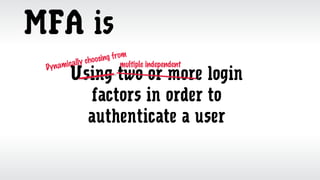
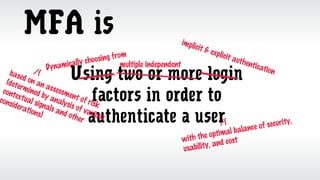
MFA is
Using two or more login
factors in order to
authenticate a user
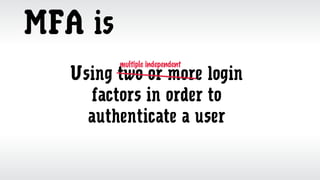
MFA is
Using two or more login
factors in order to
authenticate a user
multiple independent
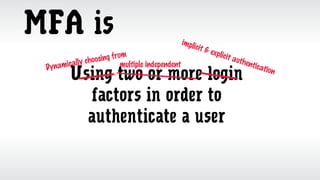
MFA is
Using two or more login
factors in order to
authenticate a user
Dynamically choosing from
multiple independent
MFA is
Using two or more login
factors in order to
authenticate a user
Dynamically choosing from
implicit & explicit authentication
multiple independent
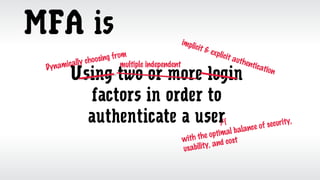
MFA is
Using two or more login
factors in order to
authenticate a user/
with the optimal balance of security,
usability, and cost
Dynamically choosing from
implicit & explicit authentication
multiple independent
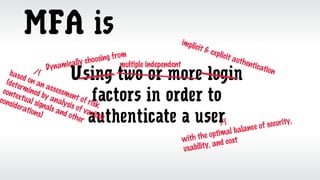
MFA is
Using two or more login
factors in order to
authenticate a user/
with the optimal balance of security,
usability, and cost
Dynamically choosing from
implicit & explicit authentication/based on an assessment of risk
(determined by analysis of various
contextual signals and other
considerations)
multiple independent
MFA is
Using two or more login
factors in order to
authenticate a user/
with the optimal balance of security,
usability, and cost
Dynamically choosing from
implicit & explicit authentication/based on an assessment of risk
(determined by analysis of various
contextual signals and other
considerations)
multiple independent
13
Authentication
Firstly, some secret thou knoweth,
secondly some object thoust have in thy
living, and thirdly some quality of thy
p'rson
In practice
•Something you forgot
•Something you left at home
•Something you are nervous
about sharing
15
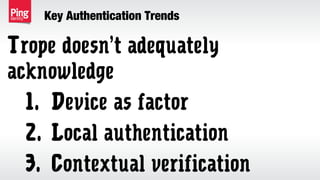
Key Authentication Trends
Trope doesn’t adequately
acknowledge
1. Device as factor
2. Local authentication
3. Contextual verification
17
Device as factor
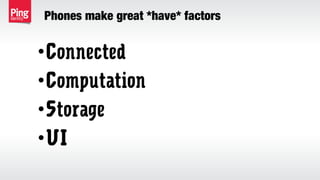
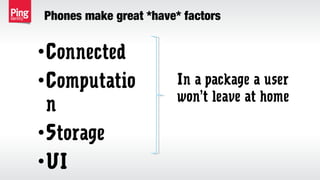
Phones make great *have* factors
•Connected
•Computation
•Storage
•UI
Phones make great *have* factors
•Connected
•Computatio
n
•Storage
•UI
In a package a user
won’t leave at home
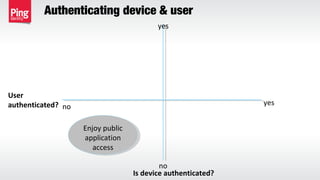
yes
no
Is device authenticated?
no
yes
User
authenticated?
Enjoy public
application
access
Enjoy public
application
access
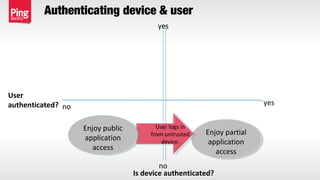
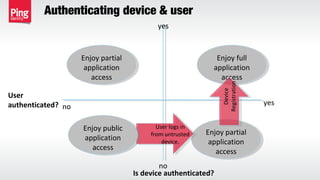
Authenticating device & user
yes
no
Is device authenticated?
no
yes
User
authenticated?
Enjoy partial
application
access
Enjoy partial
application
access
User logs in
from untrusted
device.
User logs in
from untrusted
device.
Enjoy public
application
access
Enjoy public
application
access
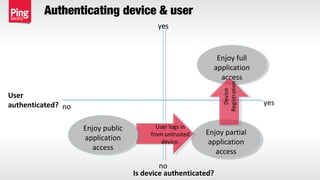
Authenticating device & user
yes
no
Is device authenticated?
no
yes
User
authenticated?
Enjoy partial
application
access
Enjoy partial
application
access
Enjoy full
application
access
Enjoy full
application
access
Device
Registration
Device
Registration
User logs in
from untrusted
device.
User logs in
from untrusted
device.
Enjoy public
application
access
Enjoy public
application
access
Authenticating device & user
yes
no
Is device authenticated?
no
yes
User
authenticated?
Enjoy partial
application
access
Enjoy partial
application
access
Enjoy full
application
access
Enjoy full
application
access
Device
Registration
Device
Registration
User logs in
from untrusted
device.
User logs in
from untrusted
device.
Enjoy public
application
access
Enjoy public
application
access
Authenticating device & user
Enjoy partial
application
access
Enjoy partial
application
access
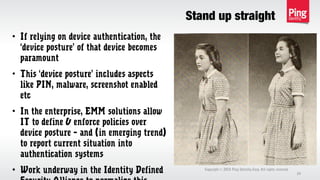
Stand up straight
Copyright 2013 Ping Identity Corp. All rights reserved.©
24
• If relying on device authentication, the
‘device posture’ of that device becomes
paramount
• This ‘device posture’ includes aspects
like PIN, malware, screenshot enabled
etc
• In the enterprise, EMM solutions allow
IT to define & enforce policies over
device posture – and (in emerging trend)
to report current situation into
authentication systems
• Work underway in the Identity Defined
25
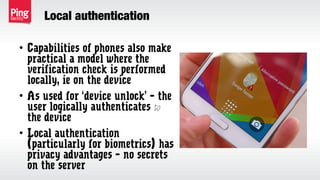
Local authentication
• Capabilities of phones also make
practical a model where the
verification check is performed
locally, ie on the device
• As used for ‘device unlock’ – the
user logically authenticates to
the device
• Local authentication
(particularly for biometrics) has
privacy advantages – no secrets
on the server
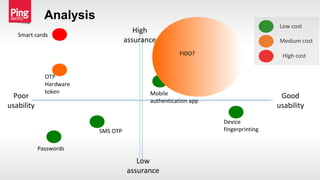
FIDO Alliance
Copyright 2013 Ping Identity Corp. All rights reserved.©
27
• The issue with leveraging local authentication is how
– A server can prompt the client to perform an authentication
– How client can ‘prove’ to server that it did so
• FIDO Alliance normalizes the above pattern
• Abstracts away from the server the specifics of the local
authentication on the client via an asymmetric
cryptographic challenge/response pattern
• Inherently multi-factor – must have the private key as well
as the local factor (either know or are)
28
Contextual
verification
Contextual verification
• Contextual verification is a model of passively collecting signals & parameters
from the user’s environment and analyzing/comparing them to identify
anomalies (from expected)
• In the context of authentication, supplements (or in some instance replaces)
traditional overt & explicit logins.
• Valuable because it can increase assurance without negative usability
implications
• Signals can be collected via multiple channels & touchpoints, e.g. device,
browser, agents
• Assumption is that attacker unlikely to be able to simulate all signals in order
to impersonate valid user
• Manifests as
• Geofencing Copyright 2014 Ping Identity Corp. All rights reserved.©
29
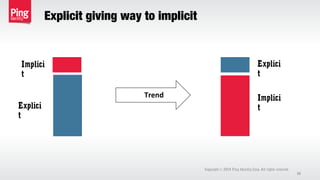
Explicit giving way to implicit
Copyright 2014 Ping Identity Corp. All rights reserved.©
30
Explici
t
Implici
t
Trend
Explici
t
Implici
t
31
Choosing Factors
Considerations when picking factors
Copyright 2013 Ping Identity Corp. All rights reserved.©
32
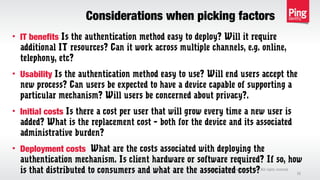
• IT benefits Is the authentication method easy to deploy? Will it require
additional IT resources? Can it work across multiple channels, e.g. online,
telephony, etc?
• Usability Is the authentication method easy to use? Will end users accept the
new process? Can users be expected to have a device capable of supporting a
particular mechanism? Will users be concerned about privacy?.
• Initial costs Is there a cost per user that will grow every time a new user is
added? What is the replacement cost – both for the device and its associated
administrative burden?
• Deployment costs What are the costs associated with deploying the
authentication mechanism. Is client hardware or software required? If so, how
is that distributed to consumers and what are the associated costs?
Copyright 2013 Ping Identity Corp. All rights reserved.©
33
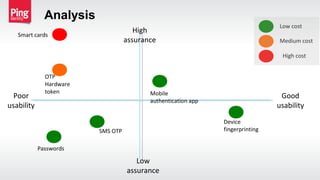
Analysis
Low
assurance
High
assurance
Poor
usability
Good
usability
Smart cards
OTP
Hardware
token
Passwords
Mobile
authentication app
Device
fingerprinting
Low cost
Medium cost
High cost
SMS OTP
Analysis
Low
assurance
High
assurance
Poor
usability
Good
usability
Smart cards
OTP
Hardware
token
Passwords
Mobile
authentication app
Device
fingerprinting
Low cost
Medium cost
High cost
SMS OTP
FIDO?
36
Recommendations
Risky business
Copyright 2013 Ping Identity Corp. All rights reserved.©
37
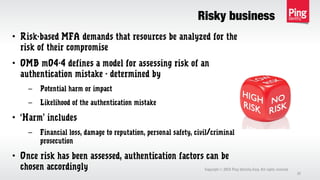
• Risk-based MFA demands that resources be analyzed for the
risk of their compromise
• OMB m04-4 defines a model for assessing risk of an
authentication mistake - determined by
– Potential harm or impact
– Likelihood of the authentication mistake
• ‘Harm’ includes
– Financial loss, damage to reputation, personal safety, civil/criminal
prosecution
• Once risk has been assessed, authentication factors can be
chosen accordingly
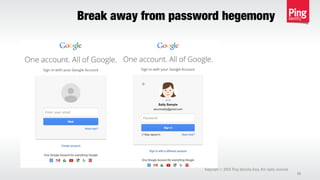
Break away from password hegemony
Copyright 2013 Ping Identity Corp. All rights reserved.©
38
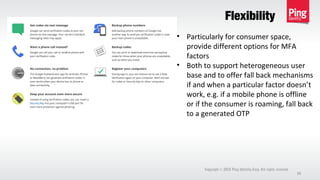
Flexibility
Copyright 2013 Ping Identity Corp. All rights reserved.©
39
• Particularly for consumer space,
provide different options for MFA
factors
• Both to support heterogeneous user
base and to offer fall back mechanisms
if and when a particular factor doesn’t
work, e.g. if a mobile phone is offline
or if the consumer is roaming, fall back
to a generated OTP
40
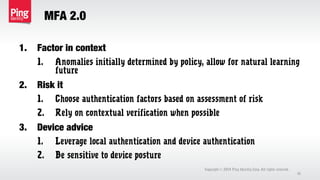
MFA 2.0
MFA 2.0
1. Factor in context
1. Anomalies initially determined by policy, allow for natural learning
future
2. Risk it
1. Choose authentication factors based on assessment of risk
2. Rely on contextual verification when possible
3. Device advice
1. Leverage local authentication and device authentication
2. Be sensitive to device posture
Copyright 2014 Ping Identity Corp. All rights reserved.©
41
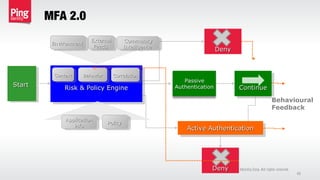
MFA 2.0
Copyright 2014 Ping Identity Corp. All rights reserved.©
42
Risk & Policy EngineRisk & Policy EngineRisk & Policy EngineRisk & Policy Engine ContinueContinueContinueContinueStartStartStartStart
Active AuthenticationActive AuthenticationActive AuthenticationActive Authentication
DenyDeny
BehaviorBehaviorBehaviorBehaviorContextContextContextContext
ExternalExternal
FeedsFeeds
ExternalExternal
FeedsFeeds
CommunityCommunity
IntelligenceIntelligence
CommunityCommunity
IntelligenceIntelligence
DenyDeny
Behavioural
Feedback
CorrelationCorrelationCorrelationCorrelation
EnvironmentEnvironmentEnvironmentEnvironment
ApplicationApplication
infoinfo
ApplicationApplication
infoinfo PolicyPolicyPolicyPolicy
Policy
Data Copyright 2014 Ping Identity Corp. All rights reserved.©
43
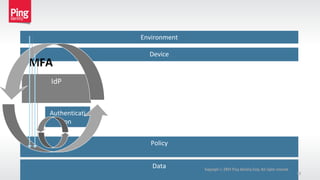
IdP
Device
Environment
Authenticati
on
MFA
Policy
Data Copyright 2014 Ping Identity Corp. All rights reserved.©
44
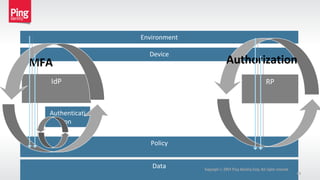
IdP RP
Device
Environment
Authenticati
on
MFA Authorization
45
The
M
is table stakes
46
Thanks

You Can't Spell Enterprise Security without MFA

  • 1.
    You Can’t SpellEnterprise Security Without MFA Paul Madsen, Principal Technical Architect Office of the CTO Ping Identity Copyright 2013 Ping Identity Corp. All rights reserved.© 1
  • 2.
    Agenda Copyright 2013 PingIdentity Corp. All rights reserved.© 2 •Why •What •Which •When & Where
  • 3.
    WHY MFA? Copyright 2013Ping Identity Corp. All rights reserved.© 3 • Deficiencies & vulnerabilities of one factor mitigated by another (unless they are dependent) • Raises the bar for attackers • Compromise of one factor insufficient to enable attacker access to sensitive resources • Voted ‘Easiest to pronounce acronym’ 4 years in a row!
  • 4.
    Copyright 2013 PingIdentity Corp. All rights reserved.© 4
  • 5.
    5 I come notto bury passwords but to appraise them
  • 6.
    MFA is Using twoor more login factors in order to authenticate a user
  • 7.
    MFA is Using twoor more login factors in order to authenticate a user multiple independent
  • 8.
    MFA is Using twoor more login factors in order to authenticate a user Dynamically choosing from multiple independent
  • 9.
    MFA is Using twoor more login factors in order to authenticate a user Dynamically choosing from implicit & explicit authentication multiple independent
  • 10.
    MFA is Using twoor more login factors in order to authenticate a user/ with the optimal balance of security, usability, and cost Dynamically choosing from implicit & explicit authentication multiple independent
  • 11.
    MFA is Using twoor more login factors in order to authenticate a user/ with the optimal balance of security, usability, and cost Dynamically choosing from implicit & explicit authentication/based on an assessment of risk (determined by analysis of various contextual signals and other considerations) multiple independent
  • 12.
    MFA is Using twoor more login factors in order to authenticate a user/ with the optimal balance of security, usability, and cost Dynamically choosing from implicit & explicit authentication/based on an assessment of risk (determined by analysis of various contextual signals and other considerations) multiple independent
  • 13.
  • 14.
    Firstly, some secretthou knoweth, secondly some object thoust have in thy living, and thirdly some quality of thy p'rson
  • 15.
    In practice •Something youforgot •Something you left at home •Something you are nervous about sharing 15
  • 16.
    Key Authentication Trends Tropedoesn’t adequately acknowledge 1. Device as factor 2. Local authentication 3. Contextual verification
  • 17.
  • 18.
    Phones make great*have* factors •Connected •Computation •Storage •UI
  • 19.
    Phones make great*have* factors •Connected •Computatio n •Storage •UI In a package a user won’t leave at home
  • 20.
    yes no Is device authenticated? no yes User authenticated? Enjoypublic application access Enjoy public application access Authenticating device & user
  • 21.
    yes no Is device authenticated? no yes User authenticated? Enjoypartial application access Enjoy partial application access User logs in from untrusted device. User logs in from untrusted device. Enjoy public application access Enjoy public application access Authenticating device & user
  • 22.
    yes no Is device authenticated? no yes User authenticated? Enjoypartial application access Enjoy partial application access Enjoy full application access Enjoy full application access Device Registration Device Registration User logs in from untrusted device. User logs in from untrusted device. Enjoy public application access Enjoy public application access Authenticating device & user
  • 23.
    yes no Is device authenticated? no yes User authenticated? Enjoypartial application access Enjoy partial application access Enjoy full application access Enjoy full application access Device Registration Device Registration User logs in from untrusted device. User logs in from untrusted device. Enjoy public application access Enjoy public application access Authenticating device & user Enjoy partial application access Enjoy partial application access
  • 24.
    Stand up straight Copyright2013 Ping Identity Corp. All rights reserved.© 24 • If relying on device authentication, the ‘device posture’ of that device becomes paramount • This ‘device posture’ includes aspects like PIN, malware, screenshot enabled etc • In the enterprise, EMM solutions allow IT to define & enforce policies over device posture – and (in emerging trend) to report current situation into authentication systems • Work underway in the Identity Defined
  • 25.
  • 26.
    Local authentication • Capabilitiesof phones also make practical a model where the verification check is performed locally, ie on the device • As used for ‘device unlock’ – the user logically authenticates to the device • Local authentication (particularly for biometrics) has privacy advantages – no secrets on the server
  • 27.
    FIDO Alliance Copyright 2013Ping Identity Corp. All rights reserved.© 27 • The issue with leveraging local authentication is how – A server can prompt the client to perform an authentication – How client can ‘prove’ to server that it did so • FIDO Alliance normalizes the above pattern • Abstracts away from the server the specifics of the local authentication on the client via an asymmetric cryptographic challenge/response pattern • Inherently multi-factor – must have the private key as well as the local factor (either know or are)
  • 28.
  • 29.
    Contextual verification • Contextualverification is a model of passively collecting signals & parameters from the user’s environment and analyzing/comparing them to identify anomalies (from expected) • In the context of authentication, supplements (or in some instance replaces) traditional overt & explicit logins. • Valuable because it can increase assurance without negative usability implications • Signals can be collected via multiple channels & touchpoints, e.g. device, browser, agents • Assumption is that attacker unlikely to be able to simulate all signals in order to impersonate valid user • Manifests as • Geofencing Copyright 2014 Ping Identity Corp. All rights reserved.© 29
  • 30.
    Explicit giving wayto implicit Copyright 2014 Ping Identity Corp. All rights reserved.© 30 Explici t Implici t Trend Explici t Implici t
  • 31.
  • 32.
    Considerations when pickingfactors Copyright 2013 Ping Identity Corp. All rights reserved.© 32 • IT benefits Is the authentication method easy to deploy? Will it require additional IT resources? Can it work across multiple channels, e.g. online, telephony, etc? • Usability Is the authentication method easy to use? Will end users accept the new process? Can users be expected to have a device capable of supporting a particular mechanism? Will users be concerned about privacy?. • Initial costs Is there a cost per user that will grow every time a new user is added? What is the replacement cost – both for the device and its associated administrative burden? • Deployment costs What are the costs associated with deploying the authentication mechanism. Is client hardware or software required? If so, how is that distributed to consumers and what are the associated costs?
  • 33.
    Copyright 2013 PingIdentity Corp. All rights reserved.© 33
  • 34.
  • 35.
  • 36.
  • 37.
    Risky business Copyright 2013Ping Identity Corp. All rights reserved.© 37 • Risk-based MFA demands that resources be analyzed for the risk of their compromise • OMB m04-4 defines a model for assessing risk of an authentication mistake - determined by – Potential harm or impact – Likelihood of the authentication mistake • ‘Harm’ includes – Financial loss, damage to reputation, personal safety, civil/criminal prosecution • Once risk has been assessed, authentication factors can be chosen accordingly
  • 38.
    Break away frompassword hegemony Copyright 2013 Ping Identity Corp. All rights reserved.© 38
  • 39.
    Flexibility Copyright 2013 PingIdentity Corp. All rights reserved.© 39 • Particularly for consumer space, provide different options for MFA factors • Both to support heterogeneous user base and to offer fall back mechanisms if and when a particular factor doesn’t work, e.g. if a mobile phone is offline or if the consumer is roaming, fall back to a generated OTP
  • 40.
  • 41.
    MFA 2.0 1. Factorin context 1. Anomalies initially determined by policy, allow for natural learning future 2. Risk it 1. Choose authentication factors based on assessment of risk 2. Rely on contextual verification when possible 3. Device advice 1. Leverage local authentication and device authentication 2. Be sensitive to device posture Copyright 2014 Ping Identity Corp. All rights reserved.© 41
  • 42.
    MFA 2.0 Copyright 2014Ping Identity Corp. All rights reserved.© 42 Risk & Policy EngineRisk & Policy EngineRisk & Policy EngineRisk & Policy Engine ContinueContinueContinueContinueStartStartStartStart Active AuthenticationActive AuthenticationActive AuthenticationActive Authentication DenyDeny BehaviorBehaviorBehaviorBehaviorContextContextContextContext ExternalExternal FeedsFeeds ExternalExternal FeedsFeeds CommunityCommunity IntelligenceIntelligence CommunityCommunity IntelligenceIntelligence DenyDeny Behavioural Feedback CorrelationCorrelationCorrelationCorrelation EnvironmentEnvironmentEnvironmentEnvironment ApplicationApplication infoinfo ApplicationApplication infoinfo PolicyPolicyPolicyPolicy
  • 43.
    Policy Data Copyright 2014Ping Identity Corp. All rights reserved.© 43 IdP Device Environment Authenticati on MFA
  • 44.
    Policy Data Copyright 2014Ping Identity Corp. All rights reserved.© 44 IdP RP Device Environment Authenticati on MFA Authorization
  • 45.
  • 46.

Editor's Notes

  • #15 This is outdated, doesn’t adequately account for recent trends
  • #17 Know/have/ar only partially accounts for these trends