Incorporation for Professionals Spring 2011
Introduction “ I have something my tax doctor calls ‘narcotaxis.’  Within 20 seconds of hearing someone launch into an explanation of tax laws, my eyes become glassy, my body loses all feeling and I go into a shallow coma.” Russell Baker, columnist and journalist
Why incorporate? Tax deferral Income-splitting Limited liability (generally applicable to business owners, but not to professionals)
Tax Deferral 13.5% corporate tax rate on active business income up to $500,000 26.5% corporate tax rate on active business over $500,000
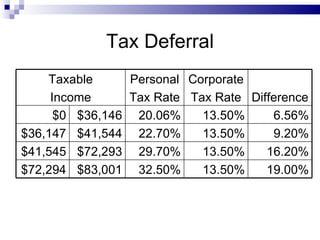
Tax Deferral Taxable Income Personal Tax Rate Corporate Tax Rate Difference $0 $36,146 20.06% 13.50% 6.56% $36,147 $41,544 22.70% 13.50% 9.20% $41,545 $72,293 29.70% 13.50% 16.20% $72,294 $83,001 32.50% 13.50% 19.00%
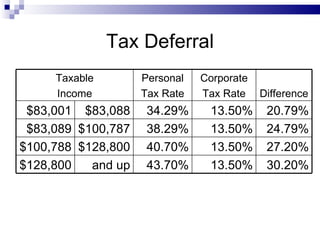
Tax Deferral Taxable Income Personal Tax Rate Corporate Tax Rate Difference $83,001 $83,088 34.29% 13.50% 20.79% $83,089 $100,787 38.29% 13.50% 24.79% $100,788 $128,800 40.70% 13.50% 27.20% $128,800 and up 43.70% 13.50% 30.20%
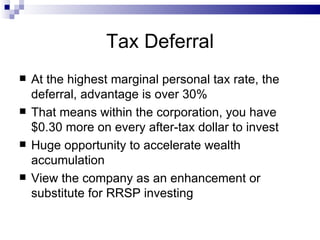
Tax Deferral At the highest marginal personal tax rate, the deferral, advantage is over 30% That means within the corporation, you have $0.30 more on every after-tax dollar to invest Huge opportunity to accelerate wealth accumulation View the company as an enhancement or substitute for RRSP investing
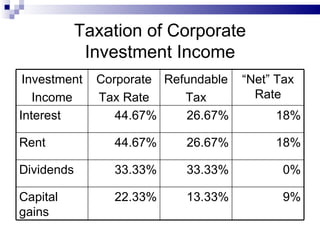
Taxation of Corporate Investment Income Investment Income Corporate Tax Rate Refundable Tax “ Net” Tax Rate Interest 44.67% 26.67% 18% Rent 44.67% 26.67% 18% Dividends 33.33% 33.33% 0% Capital gains 22.33% 13.33% 9%
Investment Asset Allocation Interest income in RRSP Dividends and capital gains in company - the tax preferred status of dividends and capital gains is lost in the RRSP
Income-Splitting Spouses, including common-law and same-sex couples Children - adult children (18 and over), OK - minor children, not OK (“kiddie-tax”) Consider Trust, rather than direct share ownership
Limited Liability Not applicable to liability arising from the provision of most professional services But does apply to other forms of liability Consider Holdco for investments to enhance creditor-protection, particularly with Trust as Holdco shareholder
Compensation Planning Salary vs. dividends CPP considerations RRSP consideration Income-splitting opportunities
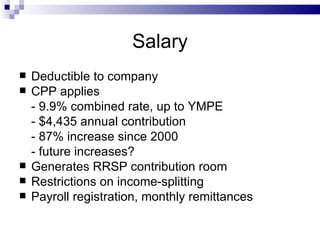
Salary Deductible to company CPP applies - 9.9% combined rate, up to YMPE - $4,435 annual contribution - 87% increase since 2000 - future increases? Generates RRSP contribution room Restrictions on income-splitting Payroll registration, monthly remittances
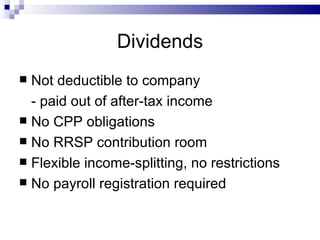
Dividends Not deductible to company - paid out of after-tax income No CPP obligations No RRSP contribution room Flexible income-splitting, no restrictions No payroll registration required
Tax Planning “ I’m proud to pay taxes…; the only thing is, I could be just as proud for half the money.” Arthur Godfrey Tax evasion is illegal, tax avoidance is your right!
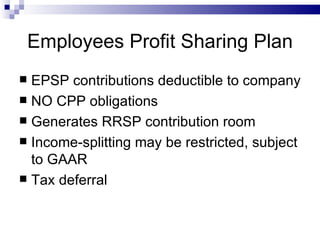
Employees Profit Sharing Plan EPSP contributions deductible to company NO CPP obligations Generates RRSP contribution room Income-splitting may be restricted, subject to GAAR Tax deferral
Private Health Services Plan Deductible to company, subject to reasonableness tests No taxable benefit to employee Direct reimbursement vs. “trusteed” third party plan
Tax Planning Life insurance Critical illness insurance Disability insurance Club fees and dues Death benefit
Tax Planning Transfer of non-registered investments - create tax-free shareholder’s loan balance - rollover vs. taxable transfer, capital gains tax rates vs. dividend tax rates - utilize capital loss carry-forwards
Tax Planning Understand that there’s generally always a tax cost to withdrawing funds from the company (i.e., lost tax deferral) Consider minimizing personal mortgage payments Consider leasing vs. buying automobile
CRAs Top 10 Audit List 1. Verification of capital gains and losses 2. Allowable business investment losses   (ABILs) 3. Carrying charges 4. Foreign tax credits 5. Province of residence
CRAs Top 10 Audit List 6.  Large charitable donations or donations   of property 7.  Employment expenses 8.  Child care expenses 9.  Mining and oil and gas investment   income reporting 10. Tuition/education expenses
David Letterman’s Top 10 (Dumb) Tax Tips (Canadian version) 10. Send tax return to NRA instead of CRA, since NRA   never pays taxes 9. Answer every question with, “Wouldn’t you like to   know?” 8. Hide all money in mattress; on return write “No   money hidden in mattress” 7. If you’ve just eaten, don’t do taxes for at least half an   hour 6. Hire yourself as an employee, fire yourself, sue   yourself for discrimination, deduct court costs
David Letterman’s Top 10 (Dumb) Tax Tips (Canadian version) 5. Report $1 billion income so CRA will think you’re   some sort of big shot 4. For charitable donations, list $9 you spent on last   Kevin Costner movie 3. Fill out Simplified Return because it has only two   lines. 2. Find out those two lines are: 1) “How much money   did you make?” and 2) “Send it to us.” 1. List your imaginary friend as a dependant
Final Comments “ Remember, today is the tomorrow that you worried about yesterday” Dale Carnegie Don’t procrastinate!
Questions?
Contact Information John Groenewold, CGA, CFP, TEP Groenewold + Associates 410 – 1508 West Broadway Vancouver, BC  V6J 1W8 (604) 683-3488 (phone) (888) 349-8834 (fax) [email_address]
Legal Disclaimer This presentation is not intended to provide legal, accounting, tax or specific investment advice.  If such advice is required, the services of a competent professional should be sought.  The information contained in this presentation was obtained or compiled from sources believed to be reliable.  However, Groenewold + Associates cannot represent that the information presented is accurate or complete.  Groenewold + Associates disclaims any responsibility or liability for any reliance placed on the content of this presentation.

Incorporation (2011)

  • 1.
  • 2.
    Introduction “ Ihave something my tax doctor calls ‘narcotaxis.’ Within 20 seconds of hearing someone launch into an explanation of tax laws, my eyes become glassy, my body loses all feeling and I go into a shallow coma.” Russell Baker, columnist and journalist
  • 3.
    Why incorporate? Taxdeferral Income-splitting Limited liability (generally applicable to business owners, but not to professionals)
  • 4.
    Tax Deferral 13.5%corporate tax rate on active business income up to $500,000 26.5% corporate tax rate on active business over $500,000
  • 5.
    Tax Deferral TaxableIncome Personal Tax Rate Corporate Tax Rate Difference $0 $36,146 20.06% 13.50% 6.56% $36,147 $41,544 22.70% 13.50% 9.20% $41,545 $72,293 29.70% 13.50% 16.20% $72,294 $83,001 32.50% 13.50% 19.00%
  • 6.
    Tax Deferral TaxableIncome Personal Tax Rate Corporate Tax Rate Difference $83,001 $83,088 34.29% 13.50% 20.79% $83,089 $100,787 38.29% 13.50% 24.79% $100,788 $128,800 40.70% 13.50% 27.20% $128,800 and up 43.70% 13.50% 30.20%
  • 7.
    Tax Deferral Atthe highest marginal personal tax rate, the deferral, advantage is over 30% That means within the corporation, you have $0.30 more on every after-tax dollar to invest Huge opportunity to accelerate wealth accumulation View the company as an enhancement or substitute for RRSP investing
  • 8.
    Taxation of CorporateInvestment Income Investment Income Corporate Tax Rate Refundable Tax “ Net” Tax Rate Interest 44.67% 26.67% 18% Rent 44.67% 26.67% 18% Dividends 33.33% 33.33% 0% Capital gains 22.33% 13.33% 9%
  • 9.
    Investment Asset AllocationInterest income in RRSP Dividends and capital gains in company - the tax preferred status of dividends and capital gains is lost in the RRSP
  • 10.
    Income-Splitting Spouses, includingcommon-law and same-sex couples Children - adult children (18 and over), OK - minor children, not OK (“kiddie-tax”) Consider Trust, rather than direct share ownership
  • 11.
    Limited Liability Notapplicable to liability arising from the provision of most professional services But does apply to other forms of liability Consider Holdco for investments to enhance creditor-protection, particularly with Trust as Holdco shareholder
  • 12.
    Compensation Planning Salaryvs. dividends CPP considerations RRSP consideration Income-splitting opportunities
  • 13.
    Salary Deductible tocompany CPP applies - 9.9% combined rate, up to YMPE - $4,435 annual contribution - 87% increase since 2000 - future increases? Generates RRSP contribution room Restrictions on income-splitting Payroll registration, monthly remittances
  • 14.
    Dividends Not deductibleto company - paid out of after-tax income No CPP obligations No RRSP contribution room Flexible income-splitting, no restrictions No payroll registration required
  • 15.
    Tax Planning “I’m proud to pay taxes…; the only thing is, I could be just as proud for half the money.” Arthur Godfrey Tax evasion is illegal, tax avoidance is your right!
  • 16.
    Employees Profit SharingPlan EPSP contributions deductible to company NO CPP obligations Generates RRSP contribution room Income-splitting may be restricted, subject to GAAR Tax deferral
  • 17.
    Private Health ServicesPlan Deductible to company, subject to reasonableness tests No taxable benefit to employee Direct reimbursement vs. “trusteed” third party plan
  • 18.
    Tax Planning Lifeinsurance Critical illness insurance Disability insurance Club fees and dues Death benefit
  • 19.
    Tax Planning Transferof non-registered investments - create tax-free shareholder’s loan balance - rollover vs. taxable transfer, capital gains tax rates vs. dividend tax rates - utilize capital loss carry-forwards
  • 20.
    Tax Planning Understandthat there’s generally always a tax cost to withdrawing funds from the company (i.e., lost tax deferral) Consider minimizing personal mortgage payments Consider leasing vs. buying automobile
  • 21.
    CRAs Top 10Audit List 1. Verification of capital gains and losses 2. Allowable business investment losses (ABILs) 3. Carrying charges 4. Foreign tax credits 5. Province of residence
  • 22.
    CRAs Top 10Audit List 6. Large charitable donations or donations of property 7. Employment expenses 8. Child care expenses 9. Mining and oil and gas investment income reporting 10. Tuition/education expenses
  • 23.
    David Letterman’s Top10 (Dumb) Tax Tips (Canadian version) 10. Send tax return to NRA instead of CRA, since NRA never pays taxes 9. Answer every question with, “Wouldn’t you like to know?” 8. Hide all money in mattress; on return write “No money hidden in mattress” 7. If you’ve just eaten, don’t do taxes for at least half an hour 6. Hire yourself as an employee, fire yourself, sue yourself for discrimination, deduct court costs
  • 24.
    David Letterman’s Top10 (Dumb) Tax Tips (Canadian version) 5. Report $1 billion income so CRA will think you’re some sort of big shot 4. For charitable donations, list $9 you spent on last Kevin Costner movie 3. Fill out Simplified Return because it has only two lines. 2. Find out those two lines are: 1) “How much money did you make?” and 2) “Send it to us.” 1. List your imaginary friend as a dependant
  • 25.
    Final Comments “Remember, today is the tomorrow that you worried about yesterday” Dale Carnegie Don’t procrastinate!
  • 26.
  • 27.
    Contact Information JohnGroenewold, CGA, CFP, TEP Groenewold + Associates 410 – 1508 West Broadway Vancouver, BC V6J 1W8 (604) 683-3488 (phone) (888) 349-8834 (fax) [email_address]
  • 28.
    Legal Disclaimer Thispresentation is not intended to provide legal, accounting, tax or specific investment advice. If such advice is required, the services of a competent professional should be sought. The information contained in this presentation was obtained or compiled from sources believed to be reliable. However, Groenewold + Associates cannot represent that the information presented is accurate or complete. Groenewold + Associates disclaims any responsibility or liability for any reliance placed on the content of this presentation.