CurrentThinking November/December 2012
A h “Fi l Cliff” L Y E dT Pl i i E i l
Following nearly $6 billion in campaign spending, Americans
voted to maintain the status quo by re‐electing President Obama
and keeping a divided Congress. Given the recent history of
spiteful partisan brinksmanship, many analysts considered this
a worst‐case outcome with regards to resolving the “fiscal cliff.”
If lawmakers can’t craft an agreement by the end of the year tax
As the “Fiscal Cliff” Looms,Year-EndTax Planning is Essential
If lawmakers can t craft an agreement by the end of the year, tax
increases totaling $560 billion for 2013 will be triggered on
January 1, along with approximately $136 billion in mandatory
spending cuts. This equates to a 3.6 percent decline in GDP, and
would cause the average household’s tax bill to rise by $3,500
next year, according to the Tax Policy Center.
While President Obama and Congressional leaders have displayed confidence that they can find common
http://www.columbiatribune.com/photos/2012/nov/3/
g p y y
ground, families and businesses must make end‐of‐year planning strategies under a great deal of uncertainty.
With a number of popular deductions and credits likely to expire, tax planning under a variety of possible
scenarios and outcomes between now and year‐end may be more important than ever.
Cliff Diving OverTax Rates?
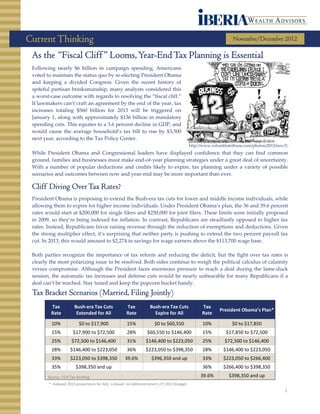
President Obama is proposing to extend the Bush‐era tax cuts for lower and middle income individuals, while
allowing them to expire for higher income individuals. Under President Obama’s plan, the 36 and 39.6 percentallowing them to expire for higher income individuals. Under President Obama s plan, the 36 and 39.6 percent
rates would start at $200,000 for single filers and $250,000 for joint filers. These limits were initially proposed
in 2009, so they’re being indexed for inflation. In contrast, Republicans are steadfastly opposed to higher tax
rates. Instead, Republicans favor raising revenue through the reduction of exemptions and deductions. Given
the strong multiplier effect, it’s surprising that neither party is pushing to extend the two percent payroll tax
cut. In 2013, this would amount to $2,274 in savings for wage earners above the $113,700 wage base.
Both parties recognize the importance of tax reform and reducing the deficit, but the fight over tax rates is
clearly the most polarizing issue to be resolved. Both sides continue to weigh the political calculus of calamity
versus compromise. Although the President faces enormous pressure to reach a deal during the lame‐duck
session, the automatic tax increases and defense cuts would be nearly unbearable for many Republicans if a
deal can’t be reached. Stay tuned and keep the popcorn bucket handy.
Tax Bracket Scenarios (Married, Filing Jointly)
Tax  Bush‐era Tax Cuts  Tax  Bush‐era Tax Cuts  Tax 
President Obama’s Plan*
Rate  Extended for All  Rate  Expire for All  Rate 
President Obama s Plan  
10% $0 to $17,900  15% $0 to $60,550  10% $0 to $17,850 
15% $17,900 to $72,500  28% $60,550 to $146,400  15% $17,850 to $72,500 
25% $72,500 to $146,400  31% $146,400 to $223,050  25% $72,500 to $146,400 
28% $146,400 to $223,050  36% $223,050 to $398,350  28% $146,400 to $223,050 
33% $223,050 to $398,350  39.6% $396,350 and up  33% $223,050 to $266,400 
1
*  Indexed 2013 projections for AGI, is based  on Administration’s FY 2013 Budget
35% $398,350 and up  36% $266,400 to $398,350 
Source: CCH Tax Briefing 39.6% $398,350 and up 
Year-EndTax Strategies for 2012
Due to the uncertainty about which provisions will expire, be extended or amended, it is critical to developy p p p
several tax plans heading into next year. If you haven’t already, speak with your tax practitioner and other
trusted advisors soon, and follow‐up regularly through the end of the year.
Estate Planning Issues are a Top Priority
It’s important to recognize that meaningful flexibility can be achieved through trusts and other structures that
allow for continued control over the assets as the tax law changes. To avoid losing the benefit of 2012
exemption limits, consider accelerating gifts in order to move assets out of the estate.
Without Congressional action, the maximum estate tax rate is scheduled to jump to 55 percent in 2013, with a
$1 million combined estate and gift tax exclusion amount. In contrast, the 2012 unified estate and gift tax
exclusion is $5.12 million, ($10.24 million for a married couple) with a 35 percent tax on the excess. Estate and
gift tax exemptions could be around $3.5 million, (a possible compromise figure) with a corresponding tax rate
of 45 percent. Currently, gifts to grandchildren either outright or in trust for their benefit utilizing the $5.12
million generation‐skipping transfer tax exemption are scheduled to be reduced to $1.4 million in 2013.
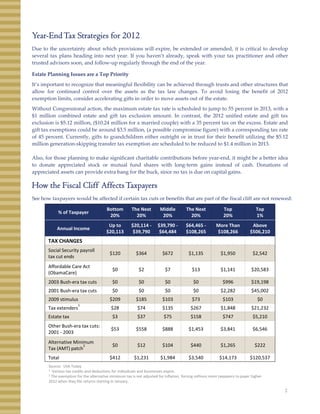
How the Fiscal Cliff AffectsTaxpayers
See how taxpayers would be affected if certain tax cuts or benefits that are part of the fiscal cliff are not renewed:
Also, for those planning to make significant charitable contributions before year‐end, it might be a better idea
to donate appreciated stock or mutual fund shares with long‐term gains instead of cash. Donations of
appreciated assets can provide extra bang for the buck, since no tax is due on capital gains.
% of Taxpayer 
Bottom 
20% 
The Next 
20% 
Middle 
20% 
The Next 
20% 
Top
20%
Top 
1% 
Annual Income 
Up to 
$20,113 
$20,114 ‐
$39,790 
$39,790 ‐
$64,484 
$64,465 ‐
$108,265 
More Than 
$108,266 
Above 
$506,210 
TAX CHANGES     
Social Security payroll 
tax cut ends 
$120  $364  $672  $1,135  $1,950  $2,542 
Affordable Care Act 
(ObamaCare) 
$0  $2  $7  $13  $1,141  $20,583 
2003 Bush‐era tax cuts  $0  $0  $0  $0  $996  $19,198 
2001 Bush‐era tax cuts  $0  $0  $0  $0  $2,282  $45,002 
2009 stimulus  $209  $185  $103  $73  $103  $0 
Tax extenders
1 
$28  $74  $135  $267  $1,848  $21,232 
Estate tax  $3  $37  $75  $158  $747  $5,210 
Other Bush‐era tax cuts:  
2001 ‐ 2003 
$53  $558  $888  $1,453  $3,841  $6,546 
Alternative Minimum 
Tax (AMT) patch
2  $0  $12  $104  $440  $1,265  $222 
Total  $412  $1,231  $1,984  $3,540  $14,173  $120,537 
2
Source:  USA Today
1 Various tax credits and deductions for individuals and businesses expire.
2 The exemption for the alternative minimum tax is not adjusted for inflation, forcing millions more taxpayers to payer higher 
2012 when they file returns starting in January.
Proposed Tax Laws on Capital Gains/Dividends
The maximum rate on long‐term capital gains is
expected to rise from 15 percent to 20 percent for
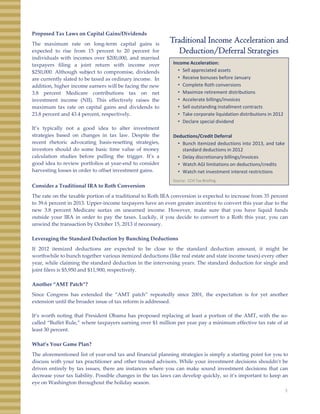
Traditional Income Acceleration and
Deduction/Deferral Strategiesexpected to rise from 15 percent to 20 percent for
individuals with incomes over $200,000, and married
taxpayers filing a joint return with income over
$250,000. Although subject to compromise, dividends
are currently slated to be taxed as ordinary income. In
addition, higher income earners will be facing the new
3.8 percent Medicare contributions tax on net
investment income (NII). This effectively raises the
Deduction/Deferral Strategies
Income Acceleration:
• Sell appreciated assets
• Receive bonuses before January
• Complete Roth conversions
• Maximize retirement distributions
• Accelerate billings/invoices
maximum tax rate on capital gains and dividends to
23.8 percent and 43.4 percent, respectively.
It’s typically not a good idea to alter investment
strategies based on changes in tax law. Despite the
recent rhetoric advocating basis‐resetting strategies,
investors should do some basic time value of money
l l ti t di b f lli th t i It’
• Sell outstanding installment contracts
• Take corporate liquidation distributions in 2012
• Declare special dividend
Deductions/Credit Deferral
• Bunch itemized deductions into 2013, and take
standard deductions in 2012
l di i billi /i icalculation studies before pulling the trigger. It’s a
good idea to review portfolios at year‐end to consider
harvesting losses in order to offset investment gains.
Consider a Traditional IRA to Roth Conversion
The rate on the taxable portion of a traditional to Roth IRA conversion is expected to increase from 35 percent
to 39.6 percent in 2013. Upper‐income taxpayers have an even greater incentive to convert this year due to the
• Delay discretionary billings/invoices
• Watch AGI limitations on deductions/credits
• Watch net investment interest restrictions
Source:  CCH Tax Briefing 
new 3.8 percent Medicare surtax on unearned income. However, make sure that you have liquid funds
outside your IRA in order to pay the taxes. Luckily, if you decide to convert to a Roth this year, you can
unwind the transaction by October 15, 2013 if necessary.
Leveraging the Standard Deduction by Bunching Deductions
If 2012 itemized deductions are expected to be close to the standard deduction amount, it might be
worthwhile to bunch together various itemized deductions (like real estate and state income taxes) every otherg y
year, while claiming the standard deduction in the intervening years. The standard deduction for single and
joint filers is $5,950 and $11,900, respectively.
Another “AMT Patch”?
Since Congress has extended the “AMT patch” repeatedly since 2001, the expectation is for yet another
extension until the broader issue of tax reform is addressed.
It’s worth noting that President Obama has proposed replacing at least a portion of the AMT, with the so‐
called “Buffet Rule,” where taxpayers earning over $1 million per year pay a minimum effective tax rate of at
least 30 percent.
What’s Your Game Plan?
The aforementioned list of year‐end tax and financial planning strategies is simply a starting point for you to
discuss with your tax practitioner and other trusted advisors While your investment decisions shouldn’t be
3
discuss with your tax practitioner and other trusted advisors. While your investment decisions shouldn t be
driven entirely by tax issues, there are instances where you can make sound investment decisions that can
decrease your tax liability. Possible changes in the tax laws can develop quickly, so it’s important to keep an
eye on Washington throughout the holiday season.
Investment Strategies in aWorld of High Liquidity and Slow Growth
In a coordinated manner, global central banks remain on the offensive against an anemic global economy. The
lti i ld id li idit h b t d t i d d d th b bilit f l b lresulting surge in worldwide liquidity has boosted asset prices, and reduced the probability of a global
recession. However, as we approach the limits of accommodative monetary policies, responsible pro‐growth
fiscal policies must be an integral part of the solution for generating a more broad‐based and sustainable
pattern of economic growth.
Given the fragile state of today’s economy, we can only hope that policymakers will ultimately favor
statesmanship ahead of brinksmanhip in resolving the fiscal cliff issue. Although we remain cautiously
optimistic, the upcoming fiscal drag, unsustainably high gross debt to GDP levels and unfavorableoptimistic, the upcoming fiscal drag, unsustainably high gross debt to GDP levels and unfavorable
demographic trends will continue to limit the growth trajectory for most of the developed countries.
The current environment of below‐trend growth, accommodative monetary policies and healthy corporate
balance sheets continue to favor our preference for mid‐tier risk assets such as corporate bonds and defensive
equities. We remain modestly underweight in equities, but with a tactical tilt toward attractively valued U.S.
large cap and dividend‐oriented strategies. Even though taxes on dividend income are likely to increase, the
current yield of 2.64 percent for the 404 dividend‐paying companies in the S&P 500 remains substantially
higher than the 10‐year Treasury yield of 1.6 percent. In addition, U.S. payout ratios are at record lows, and
many investors will continue to actively seek investments that boost investment income. Our neutral
weighting remains in place for fixed income, but with a distinct preference for investment grade corporate
bonds and mortgage bonds over Treasuries. We continue to favor an overweight position in alternative asset
strategies, mostly due to a more favorable risk/return profile relative to fixed income. In particular, we’re
focused on more independent sources of alpha that are less reliant on the overall market direction.
Ke i A Le o CFA
Disclosures
Views are as of the date above and are subject to change based on market conditions and other factors. The views
expressed are those of the author(s) and are subject to change at any time. These views are for informational
purposes only and should not be relied upon as a recommendation to purchase any security or as a solicitation or
investment advice from the Advisor.
Kevin A. Lenox, CFA
Portfolio Manager
The information contained in this presentation has been compiled from third party sources and is believed to be
reliable, but its accuracy is not guaranteed and should not be relied upon in any way, whatsoever. This information
does not constitute, and should not be construed as, investment advice or recommendations with respect to the
securities or sectors listed. Diversification and asset allocation do not assure a profit nor protect against loss.
The actual return and value of an account fluctuate and, at any time, the account may be worth more or less than the
amount invested. Past performance results are not indicative of future results.
Presentation is prepared by: IBERIA Wealth Advisors
Copyright © 2012, by IBERIA Wealth Advisors; All rights reserved.
Investment Products:   • Not FDIC Insured  • Not a Bank Deposit
• Not Insured By Any Federal Government Agency  • No Bank Guarantee  • May Lose Value
4
(800) 667‐6176
www.iberiawealth.com

Current Thinking, November/December 2012

  • 1.
    CurrentThinking November/December 2012 Ah “Fi l Cliff” L Y E dT Pl i i E i l Following nearly $6 billion in campaign spending, Americans voted to maintain the status quo by re‐electing President Obama and keeping a divided Congress. Given the recent history of spiteful partisan brinksmanship, many analysts considered this a worst‐case outcome with regards to resolving the “fiscal cliff.” If lawmakers can’t craft an agreement by the end of the year tax As the “Fiscal Cliff” Looms,Year-EndTax Planning is Essential If lawmakers can t craft an agreement by the end of the year, tax increases totaling $560 billion for 2013 will be triggered on January 1, along with approximately $136 billion in mandatory spending cuts. This equates to a 3.6 percent decline in GDP, and would cause the average household’s tax bill to rise by $3,500 next year, according to the Tax Policy Center. While President Obama and Congressional leaders have displayed confidence that they can find common http://www.columbiatribune.com/photos/2012/nov/3/ g p y y ground, families and businesses must make end‐of‐year planning strategies under a great deal of uncertainty. With a number of popular deductions and credits likely to expire, tax planning under a variety of possible scenarios and outcomes between now and year‐end may be more important than ever. Cliff Diving OverTax Rates? President Obama is proposing to extend the Bush‐era tax cuts for lower and middle income individuals, while allowing them to expire for higher income individuals. Under President Obama’s plan, the 36 and 39.6 percentallowing them to expire for higher income individuals. Under President Obama s plan, the 36 and 39.6 percent rates would start at $200,000 for single filers and $250,000 for joint filers. These limits were initially proposed in 2009, so they’re being indexed for inflation. In contrast, Republicans are steadfastly opposed to higher tax rates. Instead, Republicans favor raising revenue through the reduction of exemptions and deductions. Given the strong multiplier effect, it’s surprising that neither party is pushing to extend the two percent payroll tax cut. In 2013, this would amount to $2,274 in savings for wage earners above the $113,700 wage base. Both parties recognize the importance of tax reform and reducing the deficit, but the fight over tax rates is clearly the most polarizing issue to be resolved. Both sides continue to weigh the political calculus of calamity versus compromise. Although the President faces enormous pressure to reach a deal during the lame‐duck session, the automatic tax increases and defense cuts would be nearly unbearable for many Republicans if a deal can’t be reached. Stay tuned and keep the popcorn bucket handy. Tax Bracket Scenarios (Married, Filing Jointly) Tax  Bush‐era Tax Cuts  Tax  Bush‐era Tax Cuts  Tax  President Obama’s Plan* Rate  Extended for All  Rate  Expire for All  Rate  President Obama s Plan   10% $0 to $17,900  15% $0 to $60,550  10% $0 to $17,850  15% $17,900 to $72,500  28% $60,550 to $146,400  15% $17,850 to $72,500  25% $72,500 to $146,400  31% $146,400 to $223,050  25% $72,500 to $146,400  28% $146,400 to $223,050  36% $223,050 to $398,350  28% $146,400 to $223,050  33% $223,050 to $398,350  39.6% $396,350 and up  33% $223,050 to $266,400  1 *  Indexed 2013 projections for AGI, is based  on Administration’s FY 2013 Budget 35% $398,350 and up  36% $266,400 to $398,350  Source: CCH Tax Briefing 39.6% $398,350 and up 
  • 2.
    Year-EndTax Strategies for2012 Due to the uncertainty about which provisions will expire, be extended or amended, it is critical to developy p p p several tax plans heading into next year. If you haven’t already, speak with your tax practitioner and other trusted advisors soon, and follow‐up regularly through the end of the year. Estate Planning Issues are a Top Priority It’s important to recognize that meaningful flexibility can be achieved through trusts and other structures that allow for continued control over the assets as the tax law changes. To avoid losing the benefit of 2012 exemption limits, consider accelerating gifts in order to move assets out of the estate. Without Congressional action, the maximum estate tax rate is scheduled to jump to 55 percent in 2013, with a $1 million combined estate and gift tax exclusion amount. In contrast, the 2012 unified estate and gift tax exclusion is $5.12 million, ($10.24 million for a married couple) with a 35 percent tax on the excess. Estate and gift tax exemptions could be around $3.5 million, (a possible compromise figure) with a corresponding tax rate of 45 percent. Currently, gifts to grandchildren either outright or in trust for their benefit utilizing the $5.12 million generation‐skipping transfer tax exemption are scheduled to be reduced to $1.4 million in 2013. How the Fiscal Cliff AffectsTaxpayers See how taxpayers would be affected if certain tax cuts or benefits that are part of the fiscal cliff are not renewed: Also, for those planning to make significant charitable contributions before year‐end, it might be a better idea to donate appreciated stock or mutual fund shares with long‐term gains instead of cash. Donations of appreciated assets can provide extra bang for the buck, since no tax is due on capital gains. % of Taxpayer  Bottom  20%  The Next  20%  Middle  20%  The Next  20%  Top 20% Top  1%  Annual Income  Up to  $20,113  $20,114 ‐ $39,790  $39,790 ‐ $64,484  $64,465 ‐ $108,265  More Than  $108,266  Above  $506,210  TAX CHANGES      Social Security payroll  tax cut ends  $120  $364  $672  $1,135  $1,950  $2,542  Affordable Care Act  (ObamaCare)  $0  $2  $7  $13  $1,141  $20,583  2003 Bush‐era tax cuts  $0  $0  $0  $0  $996  $19,198  2001 Bush‐era tax cuts  $0  $0  $0  $0  $2,282  $45,002  2009 stimulus  $209  $185  $103  $73  $103  $0  Tax extenders 1  $28  $74  $135  $267  $1,848  $21,232  Estate tax  $3  $37  $75  $158  $747  $5,210  Other Bush‐era tax cuts:   2001 ‐ 2003  $53  $558  $888  $1,453  $3,841  $6,546  Alternative Minimum  Tax (AMT) patch 2  $0  $12  $104  $440  $1,265  $222  Total  $412  $1,231  $1,984  $3,540  $14,173  $120,537  2 Source:  USA Today 1 Various tax credits and deductions for individuals and businesses expire. 2 The exemption for the alternative minimum tax is not adjusted for inflation, forcing millions more taxpayers to payer higher  2012 when they file returns starting in January.
  • 3.
    Proposed Tax Lawson Capital Gains/Dividends The maximum rate on long‐term capital gains is expected to rise from 15 percent to 20 percent for Traditional Income Acceleration and Deduction/Deferral Strategiesexpected to rise from 15 percent to 20 percent for individuals with incomes over $200,000, and married taxpayers filing a joint return with income over $250,000. Although subject to compromise, dividends are currently slated to be taxed as ordinary income. In addition, higher income earners will be facing the new 3.8 percent Medicare contributions tax on net investment income (NII). This effectively raises the Deduction/Deferral Strategies Income Acceleration: • Sell appreciated assets • Receive bonuses before January • Complete Roth conversions • Maximize retirement distributions • Accelerate billings/invoices maximum tax rate on capital gains and dividends to 23.8 percent and 43.4 percent, respectively. It’s typically not a good idea to alter investment strategies based on changes in tax law. Despite the recent rhetoric advocating basis‐resetting strategies, investors should do some basic time value of money l l ti t di b f lli th t i It’ • Sell outstanding installment contracts • Take corporate liquidation distributions in 2012 • Declare special dividend Deductions/Credit Deferral • Bunch itemized deductions into 2013, and take standard deductions in 2012 l di i billi /i icalculation studies before pulling the trigger. It’s a good idea to review portfolios at year‐end to consider harvesting losses in order to offset investment gains. Consider a Traditional IRA to Roth Conversion The rate on the taxable portion of a traditional to Roth IRA conversion is expected to increase from 35 percent to 39.6 percent in 2013. Upper‐income taxpayers have an even greater incentive to convert this year due to the • Delay discretionary billings/invoices • Watch AGI limitations on deductions/credits • Watch net investment interest restrictions Source:  CCH Tax Briefing  new 3.8 percent Medicare surtax on unearned income. However, make sure that you have liquid funds outside your IRA in order to pay the taxes. Luckily, if you decide to convert to a Roth this year, you can unwind the transaction by October 15, 2013 if necessary. Leveraging the Standard Deduction by Bunching Deductions If 2012 itemized deductions are expected to be close to the standard deduction amount, it might be worthwhile to bunch together various itemized deductions (like real estate and state income taxes) every otherg y year, while claiming the standard deduction in the intervening years. The standard deduction for single and joint filers is $5,950 and $11,900, respectively. Another “AMT Patch”? Since Congress has extended the “AMT patch” repeatedly since 2001, the expectation is for yet another extension until the broader issue of tax reform is addressed. It’s worth noting that President Obama has proposed replacing at least a portion of the AMT, with the so‐ called “Buffet Rule,” where taxpayers earning over $1 million per year pay a minimum effective tax rate of at least 30 percent. What’s Your Game Plan? The aforementioned list of year‐end tax and financial planning strategies is simply a starting point for you to discuss with your tax practitioner and other trusted advisors While your investment decisions shouldn’t be 3 discuss with your tax practitioner and other trusted advisors. While your investment decisions shouldn t be driven entirely by tax issues, there are instances where you can make sound investment decisions that can decrease your tax liability. Possible changes in the tax laws can develop quickly, so it’s important to keep an eye on Washington throughout the holiday season.
  • 4.
    Investment Strategies inaWorld of High Liquidity and Slow Growth In a coordinated manner, global central banks remain on the offensive against an anemic global economy. The lti i ld id li idit h b t d t i d d d th b bilit f l b lresulting surge in worldwide liquidity has boosted asset prices, and reduced the probability of a global recession. However, as we approach the limits of accommodative monetary policies, responsible pro‐growth fiscal policies must be an integral part of the solution for generating a more broad‐based and sustainable pattern of economic growth. Given the fragile state of today’s economy, we can only hope that policymakers will ultimately favor statesmanship ahead of brinksmanhip in resolving the fiscal cliff issue. Although we remain cautiously optimistic, the upcoming fiscal drag, unsustainably high gross debt to GDP levels and unfavorableoptimistic, the upcoming fiscal drag, unsustainably high gross debt to GDP levels and unfavorable demographic trends will continue to limit the growth trajectory for most of the developed countries. The current environment of below‐trend growth, accommodative monetary policies and healthy corporate balance sheets continue to favor our preference for mid‐tier risk assets such as corporate bonds and defensive equities. We remain modestly underweight in equities, but with a tactical tilt toward attractively valued U.S. large cap and dividend‐oriented strategies. Even though taxes on dividend income are likely to increase, the current yield of 2.64 percent for the 404 dividend‐paying companies in the S&P 500 remains substantially higher than the 10‐year Treasury yield of 1.6 percent. In addition, U.S. payout ratios are at record lows, and many investors will continue to actively seek investments that boost investment income. Our neutral weighting remains in place for fixed income, but with a distinct preference for investment grade corporate bonds and mortgage bonds over Treasuries. We continue to favor an overweight position in alternative asset strategies, mostly due to a more favorable risk/return profile relative to fixed income. In particular, we’re focused on more independent sources of alpha that are less reliant on the overall market direction. Ke i A Le o CFA Disclosures Views are as of the date above and are subject to change based on market conditions and other factors. The views expressed are those of the author(s) and are subject to change at any time. These views are for informational purposes only and should not be relied upon as a recommendation to purchase any security or as a solicitation or investment advice from the Advisor. Kevin A. Lenox, CFA Portfolio Manager The information contained in this presentation has been compiled from third party sources and is believed to be reliable, but its accuracy is not guaranteed and should not be relied upon in any way, whatsoever. This information does not constitute, and should not be construed as, investment advice or recommendations with respect to the securities or sectors listed. Diversification and asset allocation do not assure a profit nor protect against loss. The actual return and value of an account fluctuate and, at any time, the account may be worth more or less than the amount invested. Past performance results are not indicative of future results. Presentation is prepared by: IBERIA Wealth Advisors Copyright © 2012, by IBERIA Wealth Advisors; All rights reserved. Investment Products:   • Not FDIC Insured  • Not a Bank Deposit • Not Insured By Any Federal Government Agency  • No Bank Guarantee  • May Lose Value 4 (800) 667‐6176 www.iberiawealth.com