The information contained herein is of a general nature and is not intended
  to address the circumstances of any particular individual or entity.
  Although we endeavor to provide accurate and timely information, there
  can be no guarantee that such information is accurate as of the date it is
  received or that it will continue to be accurate in the future. No one
  should act on such information without appropriate professional advice
  after a thorough examination of the particular situation.


                                                                          2
Estate Planning Update
 What happens on death
 Treatment of RRSP’s and RRIF’s
 Principal residence and vacation properties
 US property
 Charitable gifts and effect on income taxes
 Issues affecting business owners
 Probate Fees and other issues           (Additional
 considerations will apply to US Citizens)
Taxation on death – general rules

 Deemed disposition of all assets – capital
 gains and losses realized
 Capital gains on private corporation shares
 realized
 Balance of RRSP’s and RRIF’s are brought into
 income
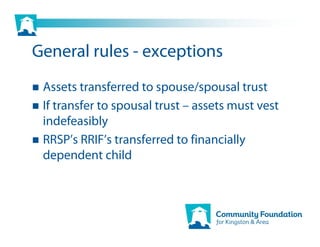
General rules - exceptions
 Assets transferred to spouse/spousal trust
 If transfer to spousal trust – assets must vest
 indefeasibly
 RRSP’s RRIF’s transferred to financially
 dependent child
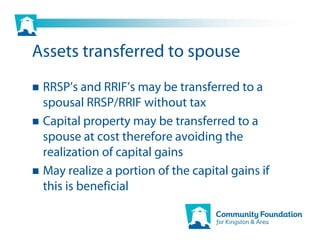
Assets transferred to spouse
 RRSP’s and RRIF’s may be transferred to a
 spousal RRSP/RRIF without tax
 Capital property may be transferred to a
 spouse at cost therefore avoiding the
 realization of capital gains
 May realize a portion of the capital gains if
 this is beneficial
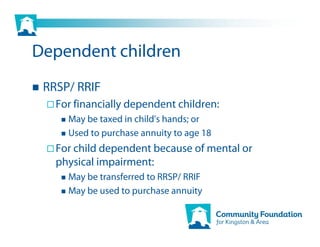
Dependent children
 RRSP/ RRIF
   For financially dependent children:
     May be taxed in child's hands; or
     Used to purchase annuity to age 18
   For child dependent because of mental or
   physical impairment:
     May be transferred to RRSP/ RRIF
     May be used to purchase annuity
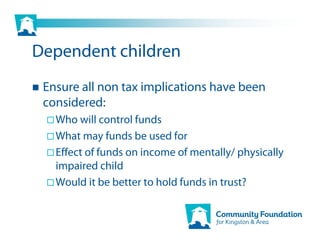
Dependent children
 Ensure all non tax implications have been
 considered:
   Who will control funds
   What may funds be used for
   Effect of funds on income of mentally/ physically
   impaired child
   Would it be better to hold funds in trust?
Principal Residence
 Includes, among other things, a house,
 condominium, share in a co-operative
 housing corporation
 Also includes land around house (but
 normally only up to ½ hectare-approx. 1.2
 acres)
   Land in excess of above included in limited cases
Principal Residence
 You, your spouse or child must have
 “ordinarily inhabited” the residence
   For this reason it will include a cottage or
   vacation property
 Since 1982 a family unit may only claim one
 principal residence per year
   Special rules if owned multiple properties pre
   1982
Principal Residence
 Generally, gain on principal residence not
 subject to tax
 If multiple properties, don’t need to decide
 until year of sale/death
 Can’t use exemption on property you rent
Vacation Property
 Vacation property may qualify as principal
 residence
 Must decide which property to claim as
 principal residence
 Only 1 property per family unit may be
 claimed
 Exemption claimed on yearly basis
Vacation Property
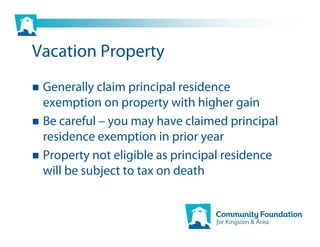
 Generally claim principal residence
 exemption on property with higher gain
 Be careful – you may have claimed principal
 residence exemption in prior year
 Property not eligible as principal residence
 will be subject to tax on death
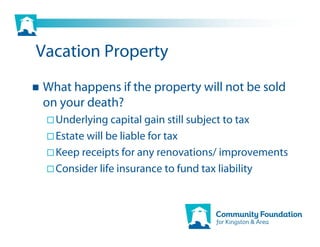
Vacation Property
What happens if the property will not be sold
on your death?
  Underlying capital gain still subject to tax
  Estate will be liable for tax
  Keep receipts for any renovations/ improvements
  Consider life insurance to fund tax liability
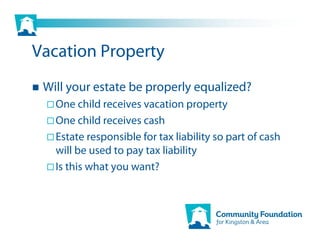
Vacation Property
 Will your estate be properly equalized?
   One child receives vacation property
   One child receives cash
   Estate responsible for tax liability so part of cash
   will be used to pay tax liability
   Is this what you want?
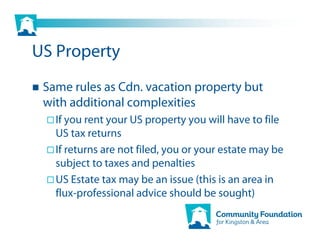
US Property
 Same rules as Cdn. vacation property but
 with additional complexities
   If you rent your US property you will have to file
   US tax returns
   If returns are not filed, you or your estate may be
   subject to taxes and penalties
   US Estate tax may be an issue (this is an area in
   flux-professional advice should be sought)
US Property
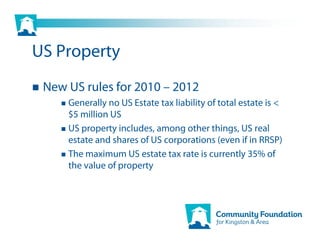
 New US rules for 2010 – 2012
     Generally no US Estate tax liability of total estate is <
     $5 million US
     US property includes, among other things, US real
     estate and shares of US corporations (even if in RRSP)
     The maximum US estate tax rate is currently 35% of
     the value of property
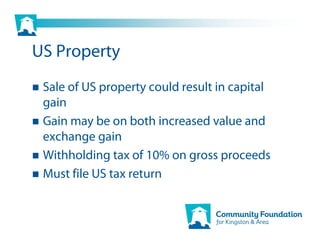
US Property
 Sale of US property could result in capital
 gain
 Gain may be on both increased value and
 exchange gain
 Withholding tax of 10% on gross proceeds
 Must file US tax return
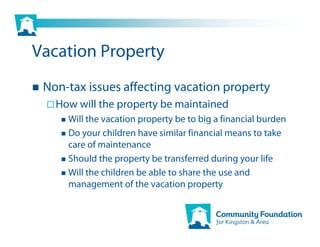
Vacation Property
 Non-tax issues affecting vacation property
   How will the property be maintained
     Will the vacation property be to big a financial burden
     Do your children have similar financial means to take
     care of maintenance
     Should the property be transferred during your life
     Will the children be able to share the use and
     management of the vacation property
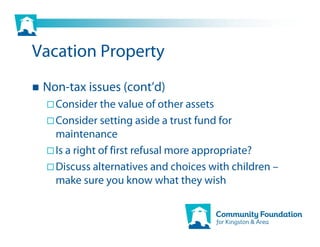
Vacation Property
 Non-tax issues (cont’d)
   Consider the value of other assets
   Consider setting aside a trust fund for
   maintenance
   Is a right of first refusal more appropriate?
   Discuss alternatives and choices with children –
   make sure you know what they wish
Charitable Gifts
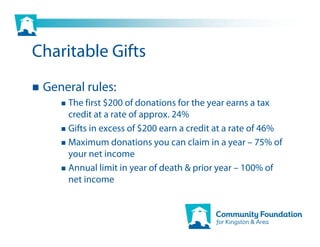
 General rules:
     The first $200 of donations for the year earns a tax
     credit at a rate of approx. 24%
     Gifts in excess of $200 earn a credit at a rate of 46%
     Maximum donations you can claim in a year – 75% of
     your net income
     Annual limit in year of death & prior year – 100% of
     net income
Charitable Gifts
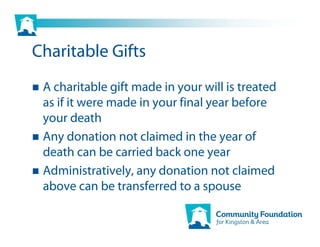
 A charitable gift made in your will is treated
 as if it were made in your final year before
 your death
 Any donation not claimed in the year of
 death can be carried back one year
 Administratively, any donation not claimed
 above can be transferred to a spouse
Charitable Gifts
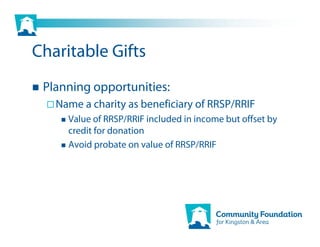
 Planning opportunities:
   Name a charity as beneficiary of RRSP/RRIF
     Value of RRSP/RRIF included in income but offset by
     credit for donation
     Avoid probate on value of RRSP/RRIF
Charitable Gifts
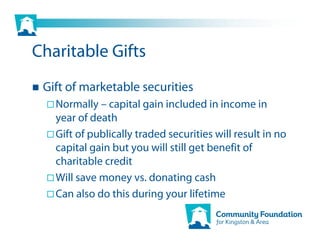
 Gift of marketable securities
   Normally – capital gain included in income in
   year of death
   Gift of publically traded securities will result in no
   capital gain but you will still get benefit of
   charitable credit
   Will save money vs. donating cash
   Can also do this during your lifetime
Charitable Gifts
 Special rules also available if you gift cultural
 property or ecologically sensitive land
Charitable Gifts
 Have you thought about making gifts during
 your lifetime?
 Enjoy the tax benefits now.
 Be in a position to see the benefit received
 from your gifts
 Endowments can provide for an ongoing
 benefit that you can remain involved with
Issues affecting business owners
 Deemed disposition of shares of private
 corporations (resulting capital gain subject to
 income tax)
 Shares to spouse must vest indefeasibly
 If shares not transferred to spouse, estate
 could have significant tax liability but no cash
Issues affecting business owners
 Use of available capital gains exemption
 Use of available capital gains exemption by
 spouse
 What shares qualify for capital gains
 exemption?
Issues affecting business owners
 Capital gains exemption
   Shares of qualified small business corp.; family
   farm corp. or partnership; qualified farm property
   90% of assets used in active business
   50% of assets used in active business throughout
   prior two years
   Are you structured to claim exemption?
Issues affecting business owners
 If you have time to plan and know who will
 succeed you in the business:
   Consider an estate freeze
   The value of your business id frozen at today’s
   value
   Future growth is passed to the next generation/
   existing management group
Estate Freeze (cont’d)
 Gain on death cannot exceed today’s value
 Draw down equity during your lifetime to
 fund lifestyle/retirement and reduce ultimate
 capital gain
 Must always ensure there is sufficient capital
 to last your lifetime
Issues affecting business owners
 Life insurance alternative
   Premiums paid by company at relatively low tax rate
   (premiums are not deductible)
   Insurance proceeds flow into the company tax free
   Can be paid out of the company without tax to pay for
   tax liability on capital gain
   Life insurance can also fund buy/sell agreement
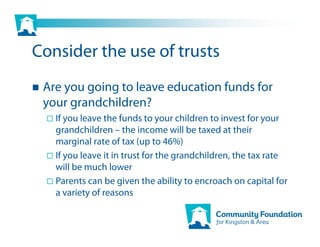
Consider the use of trusts
 Are you going to leave education funds for
 your grandchildren?
   If you leave the funds to your children to invest for your
   grandchildren – the income will be taxed at their
   marginal rate of tax (up to 46%)
   If you leave it in trust for the grandchildren, the tax rate
   will be much lower
   Parents can be given the ability to encroach on capital for
   a variety of reasons
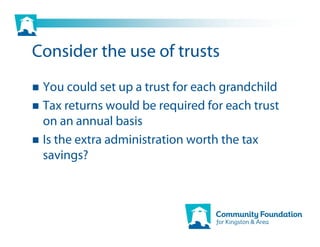
Consider the use of trusts
 You could set up a trust for each grandchild
 Tax returns would be required for each trust
 on an annual basis
 Is the extra administration worth the tax
 savings?
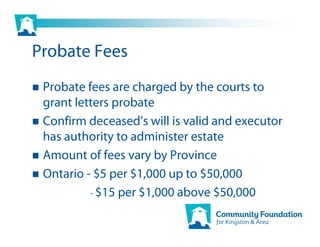
Probate Fees
 Probate fees are charged by the courts to
 grant letters probate
 Confirm deceased’s will is valid and executor
 has authority to administer estate
 Amount of fees vary by Province
 Ontario - $5 per $1,000 up to $50,000
          - $15 per $1,000 above $50,000
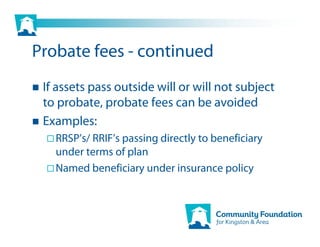
Probate fees - continued
 If assets pass outside will or will not subject
 to probate, probate fees can be avoided
 Examples:
   RRSP’s/ RRIF’s passing directly to beneficiary
   under terms of plan
   Named beneficiary under insurance policy
Probate fees - continued
 Examples – continued
   Assets held in joint ownership
   Will not subject to probate – e.g. second will
   dealing with private company shares
 Professional advice needed when planning
 to reduce probate fees – unintended
 problems may arise
Probate fees - problems
 Example 1
   Estate of $400,000 consists of principal residence
   worth $200,000 and RRSP worth $200,000
   1 child wants to retain house
   Will leaves house to 1 child and other child
   named direct beneficiary of RRSP
Probate fees
 Result of example 1
   RRSP goes directly to second child – value
   $200,000
   Estate is taxed on value of RRSP – estimated tax -
   $57,000
   Only asset of estate is house – house must be
   sold to pay tax and child ends up receiving
   $143,000 and no house.
Probate Fees
 Example 2
   Individual has two children. One child is more
   financially responsible than the other child
   In order to avoid probate, assets are put into joint
   ownership with the financially responsible child
   (child 2)
Probate Fees
 Example 2 – result
   On death of parent – assets automatically transfer to child 2 as
   a result of joint ownership
   Child two decides not to share assets with child 1
   Child 1 forced to go to court to try to enforce claim on assets
   Won’t happen with your children? – Unfortunately, there are
   many examples where this is not the case
   Probate fees do not represent a large amount – plan with
   caution- the cost may well exceed the savings
Consider impact of choices
 Everyone needs to have a will
 Who is responsible for tax liability on death
 How are assets being allocated
 Are beneficiaries receiving appropriate portion of
 assets after all debts and taxes are paid
 Does the Will minimize any contentious issues
 among family members
Questions?


             43

Tax Considerations in Estate Planning

  • 2.
    The information containedherein is of a general nature and is not intended to address the circumstances of any particular individual or entity. Although we endeavor to provide accurate and timely information, there can be no guarantee that such information is accurate as of the date it is received or that it will continue to be accurate in the future. No one should act on such information without appropriate professional advice after a thorough examination of the particular situation. 2
  • 3.
    Estate Planning Update What happens on death Treatment of RRSP’s and RRIF’s Principal residence and vacation properties US property Charitable gifts and effect on income taxes Issues affecting business owners Probate Fees and other issues (Additional considerations will apply to US Citizens)
  • 4.
    Taxation on death– general rules Deemed disposition of all assets – capital gains and losses realized Capital gains on private corporation shares realized Balance of RRSP’s and RRIF’s are brought into income
  • 5.
    General rules -exceptions Assets transferred to spouse/spousal trust If transfer to spousal trust – assets must vest indefeasibly RRSP’s RRIF’s transferred to financially dependent child
  • 6.
    Assets transferred tospouse RRSP’s and RRIF’s may be transferred to a spousal RRSP/RRIF without tax Capital property may be transferred to a spouse at cost therefore avoiding the realization of capital gains May realize a portion of the capital gains if this is beneficial
  • 7.
    Dependent children RRSP/RRIF For financially dependent children: May be taxed in child's hands; or Used to purchase annuity to age 18 For child dependent because of mental or physical impairment: May be transferred to RRSP/ RRIF May be used to purchase annuity
  • 8.
    Dependent children Ensureall non tax implications have been considered: Who will control funds What may funds be used for Effect of funds on income of mentally/ physically impaired child Would it be better to hold funds in trust?
  • 9.
    Principal Residence Includes,among other things, a house, condominium, share in a co-operative housing corporation Also includes land around house (but normally only up to ½ hectare-approx. 1.2 acres) Land in excess of above included in limited cases
  • 10.
    Principal Residence You,your spouse or child must have “ordinarily inhabited” the residence For this reason it will include a cottage or vacation property Since 1982 a family unit may only claim one principal residence per year Special rules if owned multiple properties pre 1982
  • 11.
    Principal Residence Generally,gain on principal residence not subject to tax If multiple properties, don’t need to decide until year of sale/death Can’t use exemption on property you rent
  • 12.
    Vacation Property Vacationproperty may qualify as principal residence Must decide which property to claim as principal residence Only 1 property per family unit may be claimed Exemption claimed on yearly basis
  • 13.
    Vacation Property Generallyclaim principal residence exemption on property with higher gain Be careful – you may have claimed principal residence exemption in prior year Property not eligible as principal residence will be subject to tax on death
  • 14.
    Vacation Property What happensif the property will not be sold on your death? Underlying capital gain still subject to tax Estate will be liable for tax Keep receipts for any renovations/ improvements Consider life insurance to fund tax liability
  • 15.
    Vacation Property Willyour estate be properly equalized? One child receives vacation property One child receives cash Estate responsible for tax liability so part of cash will be used to pay tax liability Is this what you want?
  • 16.
    US Property Samerules as Cdn. vacation property but with additional complexities If you rent your US property you will have to file US tax returns If returns are not filed, you or your estate may be subject to taxes and penalties US Estate tax may be an issue (this is an area in flux-professional advice should be sought)
  • 17.
    US Property NewUS rules for 2010 – 2012 Generally no US Estate tax liability of total estate is < $5 million US US property includes, among other things, US real estate and shares of US corporations (even if in RRSP) The maximum US estate tax rate is currently 35% of the value of property
  • 18.
    US Property Saleof US property could result in capital gain Gain may be on both increased value and exchange gain Withholding tax of 10% on gross proceeds Must file US tax return
  • 19.
    Vacation Property Non-taxissues affecting vacation property How will the property be maintained Will the vacation property be to big a financial burden Do your children have similar financial means to take care of maintenance Should the property be transferred during your life Will the children be able to share the use and management of the vacation property
  • 20.
    Vacation Property Non-taxissues (cont’d) Consider the value of other assets Consider setting aside a trust fund for maintenance Is a right of first refusal more appropriate? Discuss alternatives and choices with children – make sure you know what they wish
  • 21.
    Charitable Gifts Generalrules: The first $200 of donations for the year earns a tax credit at a rate of approx. 24% Gifts in excess of $200 earn a credit at a rate of 46% Maximum donations you can claim in a year – 75% of your net income Annual limit in year of death & prior year – 100% of net income
  • 22.
    Charitable Gifts Acharitable gift made in your will is treated as if it were made in your final year before your death Any donation not claimed in the year of death can be carried back one year Administratively, any donation not claimed above can be transferred to a spouse
  • 23.
    Charitable Gifts Planningopportunities: Name a charity as beneficiary of RRSP/RRIF Value of RRSP/RRIF included in income but offset by credit for donation Avoid probate on value of RRSP/RRIF
  • 24.
    Charitable Gifts Giftof marketable securities Normally – capital gain included in income in year of death Gift of publically traded securities will result in no capital gain but you will still get benefit of charitable credit Will save money vs. donating cash Can also do this during your lifetime
  • 25.
    Charitable Gifts Specialrules also available if you gift cultural property or ecologically sensitive land
  • 26.
    Charitable Gifts Haveyou thought about making gifts during your lifetime? Enjoy the tax benefits now. Be in a position to see the benefit received from your gifts Endowments can provide for an ongoing benefit that you can remain involved with
  • 27.
    Issues affecting businessowners Deemed disposition of shares of private corporations (resulting capital gain subject to income tax) Shares to spouse must vest indefeasibly If shares not transferred to spouse, estate could have significant tax liability but no cash
  • 28.
    Issues affecting businessowners Use of available capital gains exemption Use of available capital gains exemption by spouse What shares qualify for capital gains exemption?
  • 29.
    Issues affecting businessowners Capital gains exemption Shares of qualified small business corp.; family farm corp. or partnership; qualified farm property 90% of assets used in active business 50% of assets used in active business throughout prior two years Are you structured to claim exemption?
  • 30.
    Issues affecting businessowners If you have time to plan and know who will succeed you in the business: Consider an estate freeze The value of your business id frozen at today’s value Future growth is passed to the next generation/ existing management group
  • 31.
    Estate Freeze (cont’d) Gain on death cannot exceed today’s value Draw down equity during your lifetime to fund lifestyle/retirement and reduce ultimate capital gain Must always ensure there is sufficient capital to last your lifetime
  • 32.
    Issues affecting businessowners Life insurance alternative Premiums paid by company at relatively low tax rate (premiums are not deductible) Insurance proceeds flow into the company tax free Can be paid out of the company without tax to pay for tax liability on capital gain Life insurance can also fund buy/sell agreement
  • 33.
    Consider the useof trusts Are you going to leave education funds for your grandchildren? If you leave the funds to your children to invest for your grandchildren – the income will be taxed at their marginal rate of tax (up to 46%) If you leave it in trust for the grandchildren, the tax rate will be much lower Parents can be given the ability to encroach on capital for a variety of reasons
  • 34.
    Consider the useof trusts You could set up a trust for each grandchild Tax returns would be required for each trust on an annual basis Is the extra administration worth the tax savings?
  • 35.
    Probate Fees Probatefees are charged by the courts to grant letters probate Confirm deceased’s will is valid and executor has authority to administer estate Amount of fees vary by Province Ontario - $5 per $1,000 up to $50,000 - $15 per $1,000 above $50,000
  • 36.
    Probate fees -continued If assets pass outside will or will not subject to probate, probate fees can be avoided Examples: RRSP’s/ RRIF’s passing directly to beneficiary under terms of plan Named beneficiary under insurance policy
  • 37.
    Probate fees -continued Examples – continued Assets held in joint ownership Will not subject to probate – e.g. second will dealing with private company shares Professional advice needed when planning to reduce probate fees – unintended problems may arise
  • 38.
    Probate fees -problems Example 1 Estate of $400,000 consists of principal residence worth $200,000 and RRSP worth $200,000 1 child wants to retain house Will leaves house to 1 child and other child named direct beneficiary of RRSP
  • 39.
    Probate fees Resultof example 1 RRSP goes directly to second child – value $200,000 Estate is taxed on value of RRSP – estimated tax - $57,000 Only asset of estate is house – house must be sold to pay tax and child ends up receiving $143,000 and no house.
  • 40.
    Probate Fees Example2 Individual has two children. One child is more financially responsible than the other child In order to avoid probate, assets are put into joint ownership with the financially responsible child (child 2)
  • 41.
    Probate Fees Example2 – result On death of parent – assets automatically transfer to child 2 as a result of joint ownership Child two decides not to share assets with child 1 Child 1 forced to go to court to try to enforce claim on assets Won’t happen with your children? – Unfortunately, there are many examples where this is not the case Probate fees do not represent a large amount – plan with caution- the cost may well exceed the savings
  • 42.
    Consider impact ofchoices Everyone needs to have a will Who is responsible for tax liability on death How are assets being allocated Are beneficiaries receiving appropriate portion of assets after all debts and taxes are paid Does the Will minimize any contentious issues among family members
  • 43.