OBSERVATION
TD Economics
This morning the Government of Ontario announced a slew of measures, referred to as the Fair Housing
Plan, intended to address some of the challenges facing the rapidly overheating housing market. The com-
prehensive set of actions is meant to take a multifaceted approach by helping cool demand, address shortages
of supply, and promote affordability in the provincial housing market. Sixteen initiatives can be categorized
into three broad buckets:
Demand cooling:
•	 A 15% non-resident speculation tax (NRST) in the Greater Golden Horseshoe on residences between
one and six units. The NRST would be levied on non-citizens, non-permanent residents of Canada, and
foreign corporations, but would exclude refugees, and nominees under the Ontario Immigrant Nominee
Program. There were a number of exclusions, in which tax rebates would be available to those who
subsequently receive citizenship or resident status. In addition, exclusions were also made available for
international students and foreign nationals who can demonstrate residency for a period of time from
point-of-purchase of a home.
•	 Prevention of ‘paper flipping,’ or reselling properties pre-construction
Supply boosting:
•	 Allow municipalities to levy a property tax on vacant homes
•	 Provide flexibility for municipalities to impose higher taxes
on vacant land
•	 Lower property-taxes for new purpose-built apartment
buildings
•	 Leverage provincial assets to help build housing stock
•	 Introduce a $125 million program over five years to encourage
purpose-built apartments
Expanding rent control and enhancing standards:
•	 Expanding rent control to all renters and including purpose-
built properties built after 1991
•	 Strengthening rental standards and rules that govern the sales
of properties, as well as several other measures designed to
enhance efficiency and clarity in the housing market
ONTARIO INTRODUCES MEASURES TO REBALANCE
PROVINCIAL HOUSING MARKET
April 20, 2017
Beata Caranci, Chief Economist, 416-982-8067
Michael Dolega, Director & Senior Economist, 416-983-0500
Diana Petramala, Economist, 416-982-6420
@TD_Economics
-10.0
-5.0
0.0
5.0
10.0
15.0
20.0
25.0
2017F 2018F 2017F 2018F
CHART 1: AVERAGE HOME PRICE FORECAST
Forecast following policy changes
March forecast
Source: CREA. F. by TD Economics as of April 2017
Y/Y % Chg.
Ontario Toronto
TD Economics | www.td.com/economics
2April 20, 2017
Actions to cool the white-hot provincial housing mar-
kets have become increasingly necessary in recent months
as home prices in the Greater Golden Horseshoe continue
to surge and dent affordability. As far as the measures an-
nounced this morning, we believe the government’s initia-
tive to limit speculation in the housing market via the non-
resident speculation tax and the enhancement to Toronto’s
(and other municipalities) ability to impose vacancy taxes
are prudent. We also support the initiatives that would help
support the development of additional housing stock in the
province. However, we have some concerns surrounding the
rent control initiatives as they are currently designed in light
of potential unintended consequences. These may manifest
in a diminished supply of rental stock and could also have
adverse existing home market implications as investors
exit the market amidst heightened uncertainty and already
compressed capitalization rates.
Curbing speculation
To the extent that the recent home price acceleration has
been related to speculative behaviour, measures announced
today should help remove some of the froth. In particular,
the tax on non-residents and ‘paper flipping’should together
help stem speculative behavior, and cool demand for proper-
ties in the Greater Golden Horseshoe.
Ultimately, it is unknown what degree of home sales are
related to this speculative behavior. Anecdotal reports have
suggested that between 5% and 10% of sales are accounted
for by non-residents. If this is indeed the case, we anticipate
today’s new measures will cool price growth in Ontario and
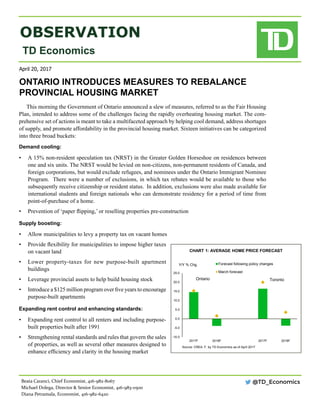
Toronto to roughly 15% this year, with prices likely to post
a mild decline of 4% next year as listings rebound and the
market rebalances. However, there is a fair bit of uncertainty
on this front due to the lack of data on investor flows and
the complexity of measures announced today.
Boosting supply
The provincial government has also introduced a set
of measures which should help unlock housing supply.
Rebating a portion of the development charges, lowering
new property taxes on purpose-built rentals,utilization of
provincial assets to spur development, and streamlining the
approval process were all part of the package introduced this
morning. Taken together the measures should help support
development of new housing stock in the province. These
should also help mitigate some of the potential negative
consequences that the expansion of rent control may have,
but will not eliminate them completely.
The Ontario government has also offered the City of
Toronto, and other interested municipalities, the power to
implement a vacant property and land tax, meant to spur
new housing supply. There are very few examples of such
taxes, with just two jurisdictions having implemented such
a tax – being Vancouver more recently and the borough of
Camden in the U.K. The Vancouver tax is too new to access
the impact it has had, but Camden’s experience with an ad-
ditional 50% property tax in 2013 has led to approximately
one-third of vacant properties being brought to the rental
market. However, the tracking of vacant properties can be
difficult and often subjective. For instance, Camden relied on
a hotline through which residents could call if they noticed
a property sitting empty, with the potential for increased
underreporting and loophole usage.
Rent control
The provincial government also introduced a slew of
measures expanding rent control. Tying rent increases to
consumer inflation overlooks the fact that it’s not the relevant
metric to incent rental unit supply or purpose-built rental
investment.  Consumer price inflation may be tempered by
prices related to clothing or furniture prices, which does
not pertain to the carrying cost of real estate, such as repair,
maintenance expenses, increases in condo-specific fees.  
Nor does it take into account the carrying cost related to
the high sticker-price of land and buildings in the city. As
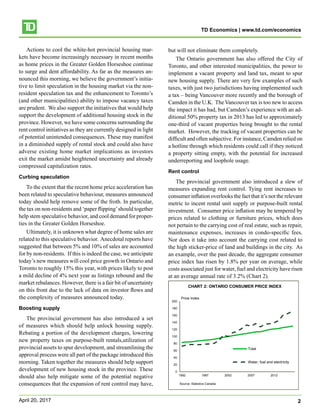
an example, over the past decade, the aggregate consumer
price index has risen by 1.8% per year on average, while
costs associated just for water, fuel and electricity have risen
at an average annual rate of 3.2% (Chart 2).
0
20
40
60
80
100
120
140
160
180
200
1992 1997 2002 2007 2012
CHART 2: ONTARIO CONSUMER PRICE INDEX
Total
Water, fuel and electricity
Source: Statistics Canada
Price Index
TD Economics | www.td.com/economics
3April 20, 2017
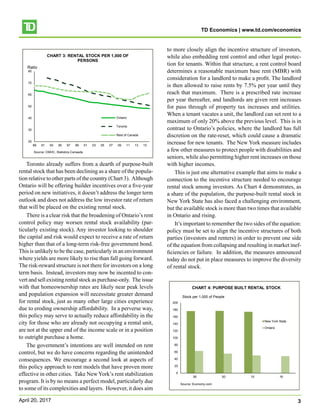
Toronto already suffers from a dearth of purpose-built
rental stock that has been declining as a share of the popula-
tion relative to other parts of the country (Chart 3). Although
Ontario will be offering builder incentives over a five-year
period on new initiatives, it doesn’t address the longer term
outlook and does not address the low investor rate of return
that will be placed on the existing rental stock.
There is a clear risk that the broadening of Ontario’s rent
control policy may worsen rental stock availability (par-
ticularly existing stock). Any investor looking to shoulder
the capital and risk would expect to receive a rate of return
higher than that of a long-term risk-free government bond.
This is unlikely to be the case, particularly in an environment
where yields are more likely to rise than fall going forward.
The risk-reward structure is not there for investors on a long
term basis. Instead, investors may now be incented to con-
vert and sell existing rental stock as purchase-only. The issue
with that homeownership rates are likely near peak levels
and population expansion will necessitate greater demand
for rental stock, just as many other large cities experience
due to eroding ownership affordability. In a perverse way,
this policy may serve to actually reduce affordability in the
city for those who are already not occupying a rental unit,
are not at the upper end of the income scale or in a position
to outright purchase a home.
The government’s intentions are well intended on rent
control, but we do have concerns regarding the unintended
consequences. We encourage a second look at aspects of
this policy approach to rent models that have proven more
effective in other cities.  Take New York’s rent stabilization
program. It is by no means a perfect model, particularly due
to some of its complexities and layers. However, it does aim
to more closely align the incentive structure of investors,
while also embedding rent control and other legal protec-
tion for tenants. Within that structure, a rent control board
determines a reasonable maximum base rent (MBR) with
consideration for a landlord to make a profit. The landlord
is then allowed to raise rents by 7.5% per year until they
reach that maximum. There is a prescribed rate increase
per year thereafter, and landlords are given rent increases
for pass through of property tax increases and utilities.
When a tenant vacates a unit, the landlord can set rent to a
maximum of only 20% above the previous level. This is in
contrast to Ontario’s policies, where the landlord has full
discretion on the rate-reset, which could cause a dramatic
increase for new tenants. The New York measure includes
a few other measures to protect people with disabilities and
seniors, while also permitting higher rent increases on those
with higher incomes.
This is just one alternative example that aims to make a
connection to the incentive structure needed to encourage
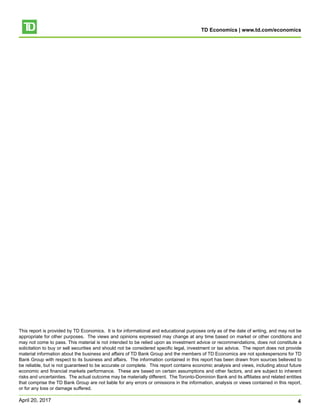
rental stock among investors. As Chart 4 demonstrates, as
a share of the population, the purpose-built rental stock in
New York State has also faced a challenging environment,
but the available stock is more than two times that available
in Ontario and rising.
It’s important to remember the two sides of the equation:
policy must be set to align the incentive structures of both
parties (investors and renters) in order to prevent one side
of the equation from collapsing and resulting in market inef-
ficiencies or failure.  In addition, the measures announced
today do not put in place measures to improve the diversity
of rental stock.
20
30
40
50
60
70
80
89 91 93 95 97 99 01 03 05 07 09 11 13 15
CHART 3: RENTAL STOCK PER 1,000 OF
PERSONS
Ontario
Toronto
Rest of Canada
Source: CMHC, Statistics Canaada
Ratio
0
20
40
60
80
100
120
140
160
180
200
90 00 10 16
CHART 4: PURPOSE BUILT RENTAL STOCK
New York State
Ontario
Source: Economy.com
Stock per 1,000 of People
TD Economics | www.td.com/economics
4April 20, 2017
This report is provided by TD Economics. It is for informational and educational purposes only as of the date of writing, and may not be
appropriate for other purposes. The views and opinions expressed may change at any time based on market or other conditions and
may not come to pass. This material is not intended to be relied upon as investment advice or recommendations, does not constitute a
solicitation to buy or sell securities and should not be considered specific legal, investment or tax advice. The report does not provide
material information about the business and affairs of TD Bank Group and the members of TD Economics are not spokespersons for TD
Bank Group with respect to its business and affairs. The information contained in this report has been drawn from sources believed to
be reliable, but is not guaranteed to be accurate or complete. This report contains economic analysis and views, including about future
economic and financial markets performance. These are based on certain assumptions and other factors, and are subject to inherent
risks and uncertainties. The actual outcome may be materially different. The Toronto-Dominion Bank and its affiliates and related entities
that comprise the TD Bank Group are not liable for any errors or omissions in the information, analysis or views contained in this report,
or for any loss or damage suffered.

Td Observation - Ontario Housing

  • 1.
    OBSERVATION TD Economics This morningthe Government of Ontario announced a slew of measures, referred to as the Fair Housing Plan, intended to address some of the challenges facing the rapidly overheating housing market. The com- prehensive set of actions is meant to take a multifaceted approach by helping cool demand, address shortages of supply, and promote affordability in the provincial housing market. Sixteen initiatives can be categorized into three broad buckets: Demand cooling: • A 15% non-resident speculation tax (NRST) in the Greater Golden Horseshoe on residences between one and six units. The NRST would be levied on non-citizens, non-permanent residents of Canada, and foreign corporations, but would exclude refugees, and nominees under the Ontario Immigrant Nominee Program. There were a number of exclusions, in which tax rebates would be available to those who subsequently receive citizenship or resident status. In addition, exclusions were also made available for international students and foreign nationals who can demonstrate residency for a period of time from point-of-purchase of a home. • Prevention of ‘paper flipping,’ or reselling properties pre-construction Supply boosting: • Allow municipalities to levy a property tax on vacant homes • Provide flexibility for municipalities to impose higher taxes on vacant land • Lower property-taxes for new purpose-built apartment buildings • Leverage provincial assets to help build housing stock • Introduce a $125 million program over five years to encourage purpose-built apartments Expanding rent control and enhancing standards: • Expanding rent control to all renters and including purpose- built properties built after 1991 • Strengthening rental standards and rules that govern the sales of properties, as well as several other measures designed to enhance efficiency and clarity in the housing market ONTARIO INTRODUCES MEASURES TO REBALANCE PROVINCIAL HOUSING MARKET April 20, 2017 Beata Caranci, Chief Economist, 416-982-8067 Michael Dolega, Director & Senior Economist, 416-983-0500 Diana Petramala, Economist, 416-982-6420 @TD_Economics -10.0 -5.0 0.0 5.0 10.0 15.0 20.0 25.0 2017F 2018F 2017F 2018F CHART 1: AVERAGE HOME PRICE FORECAST Forecast following policy changes March forecast Source: CREA. F. by TD Economics as of April 2017 Y/Y % Chg. Ontario Toronto
  • 2.
    TD Economics |www.td.com/economics 2April 20, 2017 Actions to cool the white-hot provincial housing mar- kets have become increasingly necessary in recent months as home prices in the Greater Golden Horseshoe continue to surge and dent affordability. As far as the measures an- nounced this morning, we believe the government’s initia- tive to limit speculation in the housing market via the non- resident speculation tax and the enhancement to Toronto’s (and other municipalities) ability to impose vacancy taxes are prudent. We also support the initiatives that would help support the development of additional housing stock in the province. However, we have some concerns surrounding the rent control initiatives as they are currently designed in light of potential unintended consequences. These may manifest in a diminished supply of rental stock and could also have adverse existing home market implications as investors exit the market amidst heightened uncertainty and already compressed capitalization rates. Curbing speculation To the extent that the recent home price acceleration has been related to speculative behaviour, measures announced today should help remove some of the froth. In particular, the tax on non-residents and ‘paper flipping’should together help stem speculative behavior, and cool demand for proper- ties in the Greater Golden Horseshoe. Ultimately, it is unknown what degree of home sales are related to this speculative behavior. Anecdotal reports have suggested that between 5% and 10% of sales are accounted for by non-residents. If this is indeed the case, we anticipate today’s new measures will cool price growth in Ontario and Toronto to roughly 15% this year, with prices likely to post a mild decline of 4% next year as listings rebound and the market rebalances. However, there is a fair bit of uncertainty on this front due to the lack of data on investor flows and the complexity of measures announced today. Boosting supply The provincial government has also introduced a set of measures which should help unlock housing supply. Rebating a portion of the development charges, lowering new property taxes on purpose-built rentals,utilization of provincial assets to spur development, and streamlining the approval process were all part of the package introduced this morning. Taken together the measures should help support development of new housing stock in the province. These should also help mitigate some of the potential negative consequences that the expansion of rent control may have, but will not eliminate them completely. The Ontario government has also offered the City of Toronto, and other interested municipalities, the power to implement a vacant property and land tax, meant to spur new housing supply. There are very few examples of such taxes, with just two jurisdictions having implemented such a tax – being Vancouver more recently and the borough of Camden in the U.K. The Vancouver tax is too new to access the impact it has had, but Camden’s experience with an ad- ditional 50% property tax in 2013 has led to approximately one-third of vacant properties being brought to the rental market. However, the tracking of vacant properties can be difficult and often subjective. For instance, Camden relied on a hotline through which residents could call if they noticed a property sitting empty, with the potential for increased underreporting and loophole usage. Rent control The provincial government also introduced a slew of measures expanding rent control. Tying rent increases to consumer inflation overlooks the fact that it’s not the relevant metric to incent rental unit supply or purpose-built rental investment. Consumer price inflation may be tempered by prices related to clothing or furniture prices, which does not pertain to the carrying cost of real estate, such as repair, maintenance expenses, increases in condo-specific fees. Nor does it take into account the carrying cost related to the high sticker-price of land and buildings in the city. As an example, over the past decade, the aggregate consumer price index has risen by 1.8% per year on average, while costs associated just for water, fuel and electricity have risen at an average annual rate of 3.2% (Chart 2). 0 20 40 60 80 100 120 140 160 180 200 1992 1997 2002 2007 2012 CHART 2: ONTARIO CONSUMER PRICE INDEX Total Water, fuel and electricity Source: Statistics Canada Price Index
  • 3.
    TD Economics |www.td.com/economics 3April 20, 2017 Toronto already suffers from a dearth of purpose-built rental stock that has been declining as a share of the popula- tion relative to other parts of the country (Chart 3). Although Ontario will be offering builder incentives over a five-year period on new initiatives, it doesn’t address the longer term outlook and does not address the low investor rate of return that will be placed on the existing rental stock. There is a clear risk that the broadening of Ontario’s rent control policy may worsen rental stock availability (par- ticularly existing stock). Any investor looking to shoulder the capital and risk would expect to receive a rate of return higher than that of a long-term risk-free government bond. This is unlikely to be the case, particularly in an environment where yields are more likely to rise than fall going forward. The risk-reward structure is not there for investors on a long term basis. Instead, investors may now be incented to con- vert and sell existing rental stock as purchase-only. The issue with that homeownership rates are likely near peak levels and population expansion will necessitate greater demand for rental stock, just as many other large cities experience due to eroding ownership affordability. In a perverse way, this policy may serve to actually reduce affordability in the city for those who are already not occupying a rental unit, are not at the upper end of the income scale or in a position to outright purchase a home. The government’s intentions are well intended on rent control, but we do have concerns regarding the unintended consequences. We encourage a second look at aspects of this policy approach to rent models that have proven more effective in other cities. Take New York’s rent stabilization program. It is by no means a perfect model, particularly due to some of its complexities and layers. However, it does aim to more closely align the incentive structure of investors, while also embedding rent control and other legal protec- tion for tenants. Within that structure, a rent control board determines a reasonable maximum base rent (MBR) with consideration for a landlord to make a profit. The landlord is then allowed to raise rents by 7.5% per year until they reach that maximum. There is a prescribed rate increase per year thereafter, and landlords are given rent increases for pass through of property tax increases and utilities. When a tenant vacates a unit, the landlord can set rent to a maximum of only 20% above the previous level. This is in contrast to Ontario’s policies, where the landlord has full discretion on the rate-reset, which could cause a dramatic increase for new tenants. The New York measure includes a few other measures to protect people with disabilities and seniors, while also permitting higher rent increases on those with higher incomes. This is just one alternative example that aims to make a connection to the incentive structure needed to encourage rental stock among investors. As Chart 4 demonstrates, as a share of the population, the purpose-built rental stock in New York State has also faced a challenging environment, but the available stock is more than two times that available in Ontario and rising. It’s important to remember the two sides of the equation: policy must be set to align the incentive structures of both parties (investors and renters) in order to prevent one side of the equation from collapsing and resulting in market inef- ficiencies or failure. In addition, the measures announced today do not put in place measures to improve the diversity of rental stock. 20 30 40 50 60 70 80 89 91 93 95 97 99 01 03 05 07 09 11 13 15 CHART 3: RENTAL STOCK PER 1,000 OF PERSONS Ontario Toronto Rest of Canada Source: CMHC, Statistics Canaada Ratio 0 20 40 60 80 100 120 140 160 180 200 90 00 10 16 CHART 4: PURPOSE BUILT RENTAL STOCK New York State Ontario Source: Economy.com Stock per 1,000 of People
  • 4.
    TD Economics |www.td.com/economics 4April 20, 2017 This report is provided by TD Economics. It is for informational and educational purposes only as of the date of writing, and may not be appropriate for other purposes. The views and opinions expressed may change at any time based on market or other conditions and may not come to pass. This material is not intended to be relied upon as investment advice or recommendations, does not constitute a solicitation to buy or sell securities and should not be considered specific legal, investment or tax advice. The report does not provide material information about the business and affairs of TD Bank Group and the members of TD Economics are not spokespersons for TD Bank Group with respect to its business and affairs. The information contained in this report has been drawn from sources believed to be reliable, but is not guaranteed to be accurate or complete. This report contains economic analysis and views, including about future economic and financial markets performance. These are based on certain assumptions and other factors, and are subject to inherent risks and uncertainties. The actual outcome may be materially different. The Toronto-Dominion Bank and its affiliates and related entities that comprise the TD Bank Group are not liable for any errors or omissions in the information, analysis or views contained in this report, or for any loss or damage suffered.