2016 | Individual Tax Planning Supplement
go
Set the coursefor where
youwant to
Strategies to Help Your
Plans Take Flight
Every journey starts with a plan. Tax considerations may not
be part of your initial idea, but they can assist you in reaching
your destination. Understanding the deductions, limits,
credits and other opportunities available helps reduce your
tax obligations. A lower tax liability means more flexibility
to do the activities you enjoy, be they traveling to new
destinations, spending more time with family or embarking
on a new venture.
The right tax strategy stays current with your environment.
The political landscape isn’t the only thing changing in
2016. Estate planning opportunities are also shifting. This
supplement incorporates estate planning updates and other
considerations into tips designed to decrease your 2016 tax
bill. Charts throughout the supplement, including tax rates,
qualified retirement plan limitations and FICA/Medicare
taxes further help with your tax planning.
This publication is distributed with the understanding that CBIZ MHM is not rendering legal, accounting or other
professional advice. As a result, you should obtain advice and guidance from your own tax professional, after discussing
your specific situation and facts, before taking any action based upon information contained in this guide. CBIZ MHM
assumes no liability whatsoever in connection with the use of this information and assumes no obligation to inform
the reader of any changes in tax laws or other factors that could affect the information contained herein. All of the
information contained herein is based on the tax laws in effect as of October 5, 2016.
Table of Contents
2016 Federal Individual Income Tax 3
Gift and Estate Taxes 4
FICA/Medicare Taxes on Earned Income 4
Qualified Retirement Plans  4
Alternative Minimum Tax (AMT)  5
Net Investment Income Tax 6
2016 Marginal Tax Rates 7
Notable Tax Provisions Extended by PATHA of 2015 8
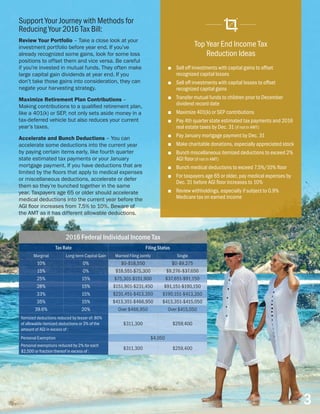
■■ Sell off investments with capital gains to offset
recognized capital losses
■■ Sell off investments with capital losses to offset
recognized capital gains
■■ Transfer mutual funds to children prior to December
dividend record date
■■ Maximize 401(k) or SEP contributions
■■ Pay 4th quarter state estimated tax payments and 2016
real estate taxes by Dec. 31 (if not in AMT)
■■ Pay January mortgage payment by Dec. 31
■■ Make charitable donations, especially appreciated stock
■■ Bunch miscellaneous itemized deductions to exceed 2%
AGI floor (if not in AMT)
■■ Bunch medical deductions to exceed 7.5%/10% floor
■■ For taxpayers age 65 or older, pay medical expenses by
Dec. 31 before AGI floor increases to 10%
■■ Review withholdings, especially if subject to 0.9%
Medicare tax on earned income
Top Year End Income Tax
Reduction Ideas
2016 Federal Individual Income Tax
Tax Rate Filing Status
Marginal Long-term Capital Gain Married Filing Jointly Single
10% 0% $0-$18,550 $0-$9,275
15% 0% $18,551-$75,300 $9,276-$37,650
25% 15% $75,301-$151,900 $37,651-$91,150
28% 15% $151,901-$231,450 $91,151-$190,150
33% 15% $231,451-$413,350 $190,151-$413,350
35% 15% $413,351-$466,950 $413,351-$415,050
39.6% 20% Over $466,950 Over $415,050
Itemized deductions reduced by lesser of: 80%
of allowable itemized deductions or 3% of the
amount of AGI in excess of :
$311,300 $259,400
Personal Exemption $4,050
Personal exemptions reduced by 2% for each
$2,500 or fraction thereof in excess of :
$311,300 $259,400
3
Support Your Journey with Methods for
Reducing Your 2016 Tax Bill:
Review Your Portfolio – Take a close look at your
investment portfolio before year end. If you’ve
already recognized some gains, look for some loss
positions to offset them and vice versa. Be careful
if you’re invested in mutual funds. They often make
large capital gain dividends at year end. If you
don’t take those gains into consideration, they can
negate your harvesting strategy.
Maximize Retirement Plan Contributions –
Making contributions to a qualified retirement plan,
like a 401(k) or SEP, not only sets aside money in a
tax-deferred vehicle but also reduces your current
year’s taxes.
Accelerate and Bunch Deductions – You can
accelerate some deductions into the current year
by paying certain items early, like fourth quarter
state estimated tax payments or your January
mortgage payment. If you have deductions that are
limited by the floors that apply to medical expenses
or miscellaneous deductions, accelerate or defer
them so they’re bunched together in the same
year. Taxpayers age 65 or older should accelerate
medical deductions into the current year before the
AGI floor increases from 7.5% to 10%. Beware of
the AMT as it has different allowable deductions.
4
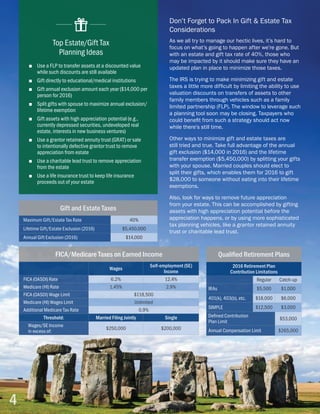
FICA/Medicare Taxes on Earned Income
Wages
Self-employment (SE)
Income
FICA (OASDI) Rate 6.2% 12.4%
Medicare (HI) Rate 1.45% 2.9%
FICA (OASDI) Wage Limit $118,500
Medicare (HI) Wages Limit Unlimited
Additional Medicare Tax Rate 0.9%
Threshold: Married Filing Jointly Single
Wages/SE Income
in excess of:
$250,000 $200,000
Qualified Retirement Plans
2016 Retirement Plan
Contribution Limitations
Regular Catch-up
IRAs $5,500 $1,000
401(k), 403(b), etc. $18,000 $6,000
SIMPLE $12,500 $3,000
Defined Contribution
Plan Limit
$53,000
Annual Compensation Limit $265,000
Top Estate/Gift Tax
Planning Ideas
■■ Use a FLP to transfer assets at a discounted value
while such discounts are still available
■■ Gift directly to educational/medical institutions
■■ Gift annual exclusion amount each year ($14,000 per
person for 2016)
■■ Split gifts with spouse to maximize annual exclusion/
lifetime exemption
■■ Gift assets with high appreciation potential (e.g.,
currently depressed securities, undeveloped real
estate, interests in new business ventures)
■■ Use a grantor retained annuity trust (GRAT) or sale
to intentionally defective grantor trust to remove
appreciation from estate
■■ Use a charitable lead trust to remove appreciation
from the estate
■■ Use a life insurance trust to keep life insurance
proceeds out of your estate
Gift and Estate Taxes
Maximum Gift/Estate Tax Rate 40%
Lifetime Gift/Estate Exclusion (2016) $5,450,000
Annual Gift Exclusion (2016) $14,000
Don’t Forget to Pack In Gift  Estate Tax
Considerations
As we all try to manage our hectic lives, it’s hard to
focus on what’s going to happen after we’re gone. But
with an estate and gift tax rate of 40%, those who
may be impacted by it should make sure they have an
updated plan in place to minimize those taxes.
The IRS is trying to make minimizing gift and estate
taxes a little more difficult by limiting the ability to use
valuation discounts on transfers of assets to other
family members through vehicles such as a family
limited partnership (FLP). The window to leverage such
a planning tool soon may be closing. Taxpayers who
could benefit from such a strategy should act now
while there’s still time.
Other ways to minimize gift and estate taxes are
still tried and true. Take full advantage of the annual
gift exclusion ($14,000 in 2016) and the lifetime
transfer exemption ($5,450,000) by splitting your gifts
with your spouse. Married couples should elect to
split their gifts, which enables them for 2016 to gift
$28,000 to someone without eating into their lifetime
exemptions.
Also, look for ways to remove future appreciation
from your estate. This can be accomplished by gifting
assets with high appreciation potential before the
appreciation happens, or by using more sophisticated
tax planning vehicles, like a grantor retained annuity
trust or charitable lead trust.
5
Alternative Minimum Tax (AMT)
AMT Tax Rate Married Filing Jointly Single
26% $0-$186,300 $0-$186,300
28% Over $186,300 Over $186,300
AMT Exemption
Exemption Amount $83,800 $53,900
Phaseout Range $159,700- $494,900 $119,700 - $335,300
■■ State and local income taxes
■■ Real estate taxes
■■ Personal property taxes
■■ Interest on home equity loan (not used to
improve residence)
■■ Investment expenses
■■ Unreimbursed employee business expenses
■■ Other 2% miscellaneous itemized deductions
Top Expenses NOT
Deductible for AMT
Map Out the AMT
Taxpayers in high tax brackets (e.g., 39.6%) may look at the
alternative minimum tax (AMT) with its 28% maximum rate
and think they have nothing to worry about. Unfortunately,
many itemized deductions allowable for regular tax
purposes are disallowed for the AMT, driving up your AMT
tax base, not to mention making strategies to bunch those
expenses together or pay them early useless.
Long-term capital gains are taxed at the same rate for the
AMT as they are for regular tax purposes, leading many
taxpayers to assume that large capital gains won’t cause
an AMT issue. This is not necessarily the case. Large
capital gains drive up your total income, which can cost you
your AMT exemption. Also, the state taxes that you pay on
those capital gains won’t be deductible for the AMT.
Taxpayers who exercise incentive stock options or
owners of pass-through entities in certain industries, like
construction, often face large AMT bills. In those instances,
at least, taxpayers often will receive a credit to help offset
taxes in future years.
6
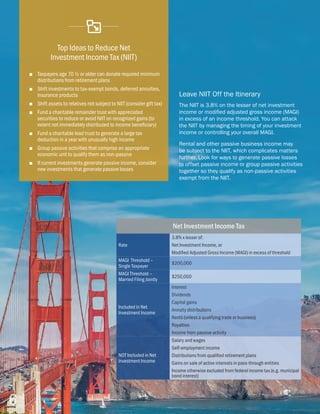
Net Investment Income Tax
Rate
3.8% x lesser of:
Net Investment Income, or
Modified Adjusted Gross Income (MAGI) in excess of threshold
MAGI Threshold –
Single Taxpayer
$200,000
MAGI Threshold –
Married Filing Jointly
$250,000
Included in Net
Investment Income
Interest
Dividends
Capital gains
Annuity distributions
Rents (unless a qualifying trade or business)
Royalties
Income from passive activity
NOT Included in Net
Investment Income
Salary and wages
Self-employment income
Distributions from qualified retirement plans
Gains on sale of active interests in pass-through entities
Income otherwise excluded from federal income tax (e.g. municipal
bond interest)
■■ Taxpayers age 70 ½ or older can donate required minimum
distributions from retirement plans
■■ Shift investments to tax-exempt bonds, deferred annuities,
insurance products
■■ Shift assets to relatives not subject to NIIT (consider gift tax)
■■ Fund a charitable remainder trust with appreciated
securities to reduce or avoid NIIT on recognized gains (to
extent not immediately distributed to income beneficiary)
■■ Fund a charitable lead trust to generate a large tax
deduction in a year with unusually high income
■■ Group passive activities that comprise an appropriate
economic unit to qualify them as non-passive
■■ If current investments generate passive income, consider
new investments that generate passive losses
Top Ideas to Reduce Net
Investment Income Tax (NIIT)
Leave NIIT Off the Itinerary
The NIIT is 3.8% on the lesser of net investment
income or modified adjusted gross income (MAGI)
in excess of an income threshold. You can attack
the NIIT by managing the timing of your investment
income or controlling your overall MAGI.
Rental and other passive business income may
be subject to the NIIT, which complicates matters
further. Look for ways to generate passive losses
to offset passive income or group passive activities
together so they qualify as non-passive activities
exempt from the NIIT.
7
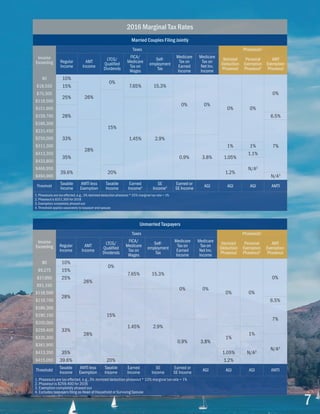
2016 Marginal Tax Rates
Married Couples Filing Jointly
Income
Exceeding
Taxes Phaseouts1
Regular
Income
AMT
Income
LTCG/
Qualified
Dividends
FICA/
Medicare
Tax on
Wages
Self-
employment
Tax
Medicare
Tax on
Earned
Income
Medicare
Tax on
Net Inv.
Income
Itemized
Deduction
Phaseout
Personal
Exemption
Phaseout2
AMT
Exemption
Phaseout
$0 10%
26%
0%
7.65% 15.3%
0% 0%
0% 0%
0%
$18,550 15%
$75,300
25%
15%
$118,500
1.45% 2.9%
$151,900
28%$159,700 6.5%
$186,300
28%
7%
$231,450
33%$250,000
0.9% 3.8%
$311,300 1% 1%
$413,350
35% 1.05%
1.1%
$433,800
N/A3$466,950
39.6% 20% 1.2%
$494,900 N/A3
Threshold
Taxable
Income
AMTI less
Exemption
Taxable
Income
Earned
Income4
SE
Income4
Earned or
SE Income
AGI AGI AGI AMTI
1. Phaseouts are tax effected, e.g., 3% itemized deduction phaseout * 33% marginal tax rate = 1%
2. Phaseout is $311,300 for 2016
3. Exemption completely phased out
4. Threshold applies separately to taxpayer and spouse
Unmarried Taxpayers
Income
Exceeding
Taxes Phaseouts1
Regular
Income
AMT
Income
LTCG/
Qualified
Dividends
FICA/
Medicare
Tax on
Wages
Self-
employment
Tax
Medicare
Tax on
Earned
Income
Medicare
Tax on
Net Inv.
Income
Itemized
Deduction
Phaseout
Personal
Exemption
Phaseout2
AMT
Exemption
Phaseout
$0 10%
26%
0%
7.65% 15.3%
0% 0%
0% 0%
0%
$9,275 15%
$37,650 25%
15%
$91,150
28%
$118,500
1.45% 2.9%
$119,700 6.5%
$186,300
28%
7%
$190,150
33%
$200,000
0.9% 3.8%
$259,400
1%
1%
$335,300
N/A3
$381,900
N/A3$413,350 35% 1.05%
$415,050  39.6% 20% 1.2%
Threshold
Taxable
Income
AMTI less
Exemption
Taxable
Income
Earned
Income
SE
Income
Earned or
SE Income
AGI AGI AGI AMTI
1. Phaseouts are tax effected, e.g., 3% itemized deduction phaseout * 33% marginal tax rate = 1%
2. Phaseout is $259,400 for 2016
3. Exemption completely phased out
4. Excludes taxpayers filing as Head of Household or Surviving Spouse
©Copyright2016.CBIZ,Inc.NYSEListed:CBZ.Allrightsreserved.•CBIZ-180,Rev.8
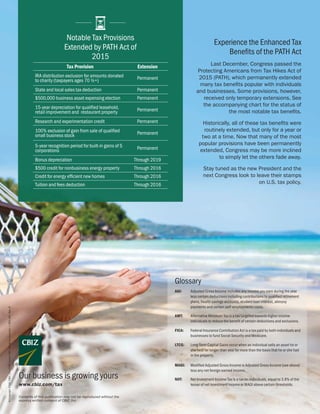
Experience the Enhanced Tax
Benefits of the PATH Act
Last December, Congress passed the
Protecting Americans from Tax Hikes Act of
2015 (PATH), which permanently extended
many tax benefits popular with individuals
and businesses. Some provisions, however,
received only temporary extensions. See
the accompanying chart for the status of
the most notable tax benefits.
Historically, all of these tax benefits were
routinely extended, but only for a year or
two at a time. Now that many of the most
popular provisions have been permanently
extended, Congress may be more inclined
to simply let the others fade away.
Stay tuned as the new President and the
next Congress look to leave their stamps
on U.S. tax policy.
www.cbiz.com/tax
Contents of this publication may not be reproduced without the
express written consent of CBIZ, Inc.
Our business is growing yours
Notable Tax Provisions
Extended by PATH Act of
2015
Tax Provision Extension
IRA distribution exclusion for amounts donated
to charity (taxpayers ages 70 ½+) Permanent
State and local sales tax deduction Permanent
$500,000 business asset expensing election Permanent
15-year depreciation for qualified leasehold,
retail improvement and restaurant property Permanent
Research and experimentation credit Permanent
100% exclusion of gain from sale of qualified
small business stock Permanent
5-year recognition period for built-in gains of S
corporations Permanent
Bonus depreciation Through 2019
$500 credit for nonbusiness energy property Through 2016
Credit for energy efficient new homes Through 2016
Tuition and fees deduction Through 2016
Glossary
AGI: Adjusted Gross Income includes any income you earn during the year
less certain deductions including contributions to qualified retirement
plans, health savings accounts, student loan interest, alimony
payments and certain self-employments costs.
AMT: Alternative Minimum Tax is a tax targeted towards higher income
individuals to reduce the benefit of certain deductions and exclusions.
FICA: Federal Insurance Contribution Act is a tax paid by both individuals and
businesses to fund Social Security and Medicare.
LTCG: Long-Term Capital Gains occur when an individual sells an asset he or
she held for longer than year for more than the basis that he or she had
in the property.
MAGI: Modified Adjusted Gross Income is Adjusted Gross Income (see above)
less any net foreign earned income.
NIIT: Net Investment Income Tax is a tax on individuals, equal to 3.8% of the
lesser of net investment income or MAGI above certain thresholds.

2016 Individual Tax Planning Supplement

  • 1.
    2016 | IndividualTax Planning Supplement go Set the coursefor where youwant to
  • 2.
    Strategies to HelpYour Plans Take Flight Every journey starts with a plan. Tax considerations may not be part of your initial idea, but they can assist you in reaching your destination. Understanding the deductions, limits, credits and other opportunities available helps reduce your tax obligations. A lower tax liability means more flexibility to do the activities you enjoy, be they traveling to new destinations, spending more time with family or embarking on a new venture. The right tax strategy stays current with your environment. The political landscape isn’t the only thing changing in 2016. Estate planning opportunities are also shifting. This supplement incorporates estate planning updates and other considerations into tips designed to decrease your 2016 tax bill. Charts throughout the supplement, including tax rates, qualified retirement plan limitations and FICA/Medicare taxes further help with your tax planning. This publication is distributed with the understanding that CBIZ MHM is not rendering legal, accounting or other professional advice. As a result, you should obtain advice and guidance from your own tax professional, after discussing your specific situation and facts, before taking any action based upon information contained in this guide. CBIZ MHM assumes no liability whatsoever in connection with the use of this information and assumes no obligation to inform the reader of any changes in tax laws or other factors that could affect the information contained herein. All of the information contained herein is based on the tax laws in effect as of October 5, 2016. Table of Contents 2016 Federal Individual Income Tax 3 Gift and Estate Taxes 4 FICA/Medicare Taxes on Earned Income 4 Qualified Retirement Plans 4 Alternative Minimum Tax (AMT) 5 Net Investment Income Tax 6 2016 Marginal Tax Rates 7 Notable Tax Provisions Extended by PATHA of 2015 8
  • 3.
    ■■ Sell offinvestments with capital gains to offset recognized capital losses ■■ Sell off investments with capital losses to offset recognized capital gains ■■ Transfer mutual funds to children prior to December dividend record date ■■ Maximize 401(k) or SEP contributions ■■ Pay 4th quarter state estimated tax payments and 2016 real estate taxes by Dec. 31 (if not in AMT) ■■ Pay January mortgage payment by Dec. 31 ■■ Make charitable donations, especially appreciated stock ■■ Bunch miscellaneous itemized deductions to exceed 2% AGI floor (if not in AMT) ■■ Bunch medical deductions to exceed 7.5%/10% floor ■■ For taxpayers age 65 or older, pay medical expenses by Dec. 31 before AGI floor increases to 10% ■■ Review withholdings, especially if subject to 0.9% Medicare tax on earned income Top Year End Income Tax Reduction Ideas 2016 Federal Individual Income Tax Tax Rate Filing Status Marginal Long-term Capital Gain Married Filing Jointly Single 10% 0% $0-$18,550 $0-$9,275 15% 0% $18,551-$75,300 $9,276-$37,650 25% 15% $75,301-$151,900 $37,651-$91,150 28% 15% $151,901-$231,450 $91,151-$190,150 33% 15% $231,451-$413,350 $190,151-$413,350 35% 15% $413,351-$466,950 $413,351-$415,050 39.6% 20% Over $466,950 Over $415,050 Itemized deductions reduced by lesser of: 80% of allowable itemized deductions or 3% of the amount of AGI in excess of : $311,300 $259,400 Personal Exemption $4,050 Personal exemptions reduced by 2% for each $2,500 or fraction thereof in excess of : $311,300 $259,400 3 Support Your Journey with Methods for Reducing Your 2016 Tax Bill: Review Your Portfolio – Take a close look at your investment portfolio before year end. If you’ve already recognized some gains, look for some loss positions to offset them and vice versa. Be careful if you’re invested in mutual funds. They often make large capital gain dividends at year end. If you don’t take those gains into consideration, they can negate your harvesting strategy. Maximize Retirement Plan Contributions – Making contributions to a qualified retirement plan, like a 401(k) or SEP, not only sets aside money in a tax-deferred vehicle but also reduces your current year’s taxes. Accelerate and Bunch Deductions – You can accelerate some deductions into the current year by paying certain items early, like fourth quarter state estimated tax payments or your January mortgage payment. If you have deductions that are limited by the floors that apply to medical expenses or miscellaneous deductions, accelerate or defer them so they’re bunched together in the same year. Taxpayers age 65 or older should accelerate medical deductions into the current year before the AGI floor increases from 7.5% to 10%. Beware of the AMT as it has different allowable deductions.
  • 4.
    4 FICA/Medicare Taxes onEarned Income Wages Self-employment (SE) Income FICA (OASDI) Rate 6.2% 12.4% Medicare (HI) Rate 1.45% 2.9% FICA (OASDI) Wage Limit $118,500 Medicare (HI) Wages Limit Unlimited Additional Medicare Tax Rate 0.9% Threshold: Married Filing Jointly Single Wages/SE Income in excess of: $250,000 $200,000 Qualified Retirement Plans 2016 Retirement Plan Contribution Limitations Regular Catch-up IRAs $5,500 $1,000 401(k), 403(b), etc. $18,000 $6,000 SIMPLE $12,500 $3,000 Defined Contribution Plan Limit $53,000 Annual Compensation Limit $265,000 Top Estate/Gift Tax Planning Ideas ■■ Use a FLP to transfer assets at a discounted value while such discounts are still available ■■ Gift directly to educational/medical institutions ■■ Gift annual exclusion amount each year ($14,000 per person for 2016) ■■ Split gifts with spouse to maximize annual exclusion/ lifetime exemption ■■ Gift assets with high appreciation potential (e.g., currently depressed securities, undeveloped real estate, interests in new business ventures) ■■ Use a grantor retained annuity trust (GRAT) or sale to intentionally defective grantor trust to remove appreciation from estate ■■ Use a charitable lead trust to remove appreciation from the estate ■■ Use a life insurance trust to keep life insurance proceeds out of your estate Gift and Estate Taxes Maximum Gift/Estate Tax Rate 40% Lifetime Gift/Estate Exclusion (2016) $5,450,000 Annual Gift Exclusion (2016) $14,000 Don’t Forget to Pack In Gift Estate Tax Considerations As we all try to manage our hectic lives, it’s hard to focus on what’s going to happen after we’re gone. But with an estate and gift tax rate of 40%, those who may be impacted by it should make sure they have an updated plan in place to minimize those taxes. The IRS is trying to make minimizing gift and estate taxes a little more difficult by limiting the ability to use valuation discounts on transfers of assets to other family members through vehicles such as a family limited partnership (FLP). The window to leverage such a planning tool soon may be closing. Taxpayers who could benefit from such a strategy should act now while there’s still time. Other ways to minimize gift and estate taxes are still tried and true. Take full advantage of the annual gift exclusion ($14,000 in 2016) and the lifetime transfer exemption ($5,450,000) by splitting your gifts with your spouse. Married couples should elect to split their gifts, which enables them for 2016 to gift $28,000 to someone without eating into their lifetime exemptions. Also, look for ways to remove future appreciation from your estate. This can be accomplished by gifting assets with high appreciation potential before the appreciation happens, or by using more sophisticated tax planning vehicles, like a grantor retained annuity trust or charitable lead trust.
  • 5.
    5 Alternative Minimum Tax(AMT) AMT Tax Rate Married Filing Jointly Single 26% $0-$186,300 $0-$186,300 28% Over $186,300 Over $186,300 AMT Exemption Exemption Amount $83,800 $53,900 Phaseout Range $159,700- $494,900 $119,700 - $335,300 ■■ State and local income taxes ■■ Real estate taxes ■■ Personal property taxes ■■ Interest on home equity loan (not used to improve residence) ■■ Investment expenses ■■ Unreimbursed employee business expenses ■■ Other 2% miscellaneous itemized deductions Top Expenses NOT Deductible for AMT Map Out the AMT Taxpayers in high tax brackets (e.g., 39.6%) may look at the alternative minimum tax (AMT) with its 28% maximum rate and think they have nothing to worry about. Unfortunately, many itemized deductions allowable for regular tax purposes are disallowed for the AMT, driving up your AMT tax base, not to mention making strategies to bunch those expenses together or pay them early useless. Long-term capital gains are taxed at the same rate for the AMT as they are for regular tax purposes, leading many taxpayers to assume that large capital gains won’t cause an AMT issue. This is not necessarily the case. Large capital gains drive up your total income, which can cost you your AMT exemption. Also, the state taxes that you pay on those capital gains won’t be deductible for the AMT. Taxpayers who exercise incentive stock options or owners of pass-through entities in certain industries, like construction, often face large AMT bills. In those instances, at least, taxpayers often will receive a credit to help offset taxes in future years.
  • 6.
    6 Net Investment IncomeTax Rate 3.8% x lesser of: Net Investment Income, or Modified Adjusted Gross Income (MAGI) in excess of threshold MAGI Threshold – Single Taxpayer $200,000 MAGI Threshold – Married Filing Jointly $250,000 Included in Net Investment Income Interest Dividends Capital gains Annuity distributions Rents (unless a qualifying trade or business) Royalties Income from passive activity NOT Included in Net Investment Income Salary and wages Self-employment income Distributions from qualified retirement plans Gains on sale of active interests in pass-through entities Income otherwise excluded from federal income tax (e.g. municipal bond interest) ■■ Taxpayers age 70 ½ or older can donate required minimum distributions from retirement plans ■■ Shift investments to tax-exempt bonds, deferred annuities, insurance products ■■ Shift assets to relatives not subject to NIIT (consider gift tax) ■■ Fund a charitable remainder trust with appreciated securities to reduce or avoid NIIT on recognized gains (to extent not immediately distributed to income beneficiary) ■■ Fund a charitable lead trust to generate a large tax deduction in a year with unusually high income ■■ Group passive activities that comprise an appropriate economic unit to qualify them as non-passive ■■ If current investments generate passive income, consider new investments that generate passive losses Top Ideas to Reduce Net Investment Income Tax (NIIT) Leave NIIT Off the Itinerary The NIIT is 3.8% on the lesser of net investment income or modified adjusted gross income (MAGI) in excess of an income threshold. You can attack the NIIT by managing the timing of your investment income or controlling your overall MAGI. Rental and other passive business income may be subject to the NIIT, which complicates matters further. Look for ways to generate passive losses to offset passive income or group passive activities together so they qualify as non-passive activities exempt from the NIIT.
  • 7.
    7 2016 Marginal TaxRates Married Couples Filing Jointly Income Exceeding Taxes Phaseouts1 Regular Income AMT Income LTCG/ Qualified Dividends FICA/ Medicare Tax on Wages Self- employment Tax Medicare Tax on Earned Income Medicare Tax on Net Inv. Income Itemized Deduction Phaseout Personal Exemption Phaseout2 AMT Exemption Phaseout $0 10% 26% 0% 7.65% 15.3% 0% 0% 0% 0% 0% $18,550 15% $75,300 25% 15% $118,500 1.45% 2.9% $151,900 28%$159,700 6.5% $186,300 28% 7% $231,450 33%$250,000 0.9% 3.8% $311,300 1% 1% $413,350 35% 1.05% 1.1% $433,800 N/A3$466,950 39.6% 20% 1.2% $494,900 N/A3 Threshold Taxable Income AMTI less Exemption Taxable Income Earned Income4 SE Income4 Earned or SE Income AGI AGI AGI AMTI 1. Phaseouts are tax effected, e.g., 3% itemized deduction phaseout * 33% marginal tax rate = 1% 2. Phaseout is $311,300 for 2016 3. Exemption completely phased out 4. Threshold applies separately to taxpayer and spouse Unmarried Taxpayers Income Exceeding Taxes Phaseouts1 Regular Income AMT Income LTCG/ Qualified Dividends FICA/ Medicare Tax on Wages Self- employment Tax Medicare Tax on Earned Income Medicare Tax on Net Inv. Income Itemized Deduction Phaseout Personal Exemption Phaseout2 AMT Exemption Phaseout $0 10% 26% 0% 7.65% 15.3% 0% 0% 0% 0% 0% $9,275 15% $37,650 25% 15% $91,150 28% $118,500 1.45% 2.9% $119,700 6.5% $186,300 28% 7% $190,150 33% $200,000 0.9% 3.8% $259,400 1% 1% $335,300 N/A3 $381,900 N/A3$413,350 35% 1.05% $415,050  39.6% 20% 1.2% Threshold Taxable Income AMTI less Exemption Taxable Income Earned Income SE Income Earned or SE Income AGI AGI AGI AMTI 1. Phaseouts are tax effected, e.g., 3% itemized deduction phaseout * 33% marginal tax rate = 1% 2. Phaseout is $259,400 for 2016 3. Exemption completely phased out 4. Excludes taxpayers filing as Head of Household or Surviving Spouse
  • 8.
    ©Copyright2016.CBIZ,Inc.NYSEListed:CBZ.Allrightsreserved.•CBIZ-180,Rev.8 Experience the EnhancedTax Benefits of the PATH Act Last December, Congress passed the Protecting Americans from Tax Hikes Act of 2015 (PATH), which permanently extended many tax benefits popular with individuals and businesses. Some provisions, however, received only temporary extensions. See the accompanying chart for the status of the most notable tax benefits. Historically, all of these tax benefits were routinely extended, but only for a year or two at a time. Now that many of the most popular provisions have been permanently extended, Congress may be more inclined to simply let the others fade away. Stay tuned as the new President and the next Congress look to leave their stamps on U.S. tax policy. www.cbiz.com/tax Contents of this publication may not be reproduced without the express written consent of CBIZ, Inc. Our business is growing yours Notable Tax Provisions Extended by PATH Act of 2015 Tax Provision Extension IRA distribution exclusion for amounts donated to charity (taxpayers ages 70 ½+) Permanent State and local sales tax deduction Permanent $500,000 business asset expensing election Permanent 15-year depreciation for qualified leasehold, retail improvement and restaurant property Permanent Research and experimentation credit Permanent 100% exclusion of gain from sale of qualified small business stock Permanent 5-year recognition period for built-in gains of S corporations Permanent Bonus depreciation Through 2019 $500 credit for nonbusiness energy property Through 2016 Credit for energy efficient new homes Through 2016 Tuition and fees deduction Through 2016 Glossary AGI: Adjusted Gross Income includes any income you earn during the year less certain deductions including contributions to qualified retirement plans, health savings accounts, student loan interest, alimony payments and certain self-employments costs. AMT: Alternative Minimum Tax is a tax targeted towards higher income individuals to reduce the benefit of certain deductions and exclusions. FICA: Federal Insurance Contribution Act is a tax paid by both individuals and businesses to fund Social Security and Medicare. LTCG: Long-Term Capital Gains occur when an individual sells an asset he or she held for longer than year for more than the basis that he or she had in the property. MAGI: Modified Adjusted Gross Income is Adjusted Gross Income (see above) less any net foreign earned income. NIIT: Net Investment Income Tax is a tax on individuals, equal to 3.8% of the lesser of net investment income or MAGI above certain thresholds.