R E T I N A - is a key bridge between the light that enters your eyes and the images you
see.
-is a layer of photoreceptors cells and glial cells within the eye that captures
incoming photons and transmits them along neuronal pathways as both
electrical and chemical signals for the brain to perceive a visual picture.
The retina converts light that enters into your eye into electrical signals your optic nerve sends
to your brain which creates the images you see. It’s a key part of your vision.
The retina is the layer at the very back of your eyeball; and retina responsible for visual
processing that turns light energy from photons into three dimensional images.
What does the retina do?
The retina captures the light that enters your eye and helps translate it into the images you see.
Light passes through the lens at the front of your eye and hits the retina.
Photoreceptors — cells inside your retina that react to light
— change light energy into an electrical signal. This signal travels through your
optic nerve and into your brain to become the picture of the world you see.
How does the retina help the eye function?
The retina is like a translator in your eye. When light hits it, your retina converts it to a signal
your brain processes and understands.
Without a retina — or with a damaged retina — your eye might still function (it would still take
in light) but your brain wouldn’t receive all the information it needs to create images.
Anything affecting your retina can cause your vision to get worse. That’s why you should see
your healthcare provider right away if your eyes or vision suddenly change.
Innervation of the Retina: retina has no sensory innervation
Primary Layers of the Retina (photoreceptor cell layer, bipolar cell layer, ganglion cell layer)
Where is the retina located?
The retina is at the back of your eye. It’s opposite the lens and pupil. The lens focuses light that
enters your eye to hit your retina and its photoreceptor cells.
What is the retina made of?
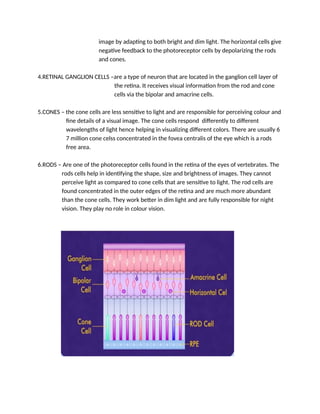
The retina is made of two parts, the macula and the peripheral retina. The macula is in the
center of your retina and processes most of what you’re directly looking at. The peripheral
retina fills in the parts of your vision at the edges of your visual field (your peripheral vision).
For example, if you’re sitting across the table from a friend, your macula helps you see their
face and your peripheral retina lets you see the rest of the room on either side of them.
The retina contains many types of cells. Photoreceptors process light into an electrical signal
that your brain can understand as images. Rods are photoreceptors that help you see at night
and in dim light. Cones process color and make up most of your usual vision. Both types of cells
work together to give a clear, accurate picture of what you’re seeing.
Blood supply of the Retina: the outer 4 layers are supplied by the choroidal layer
(choriocapillaris), while the inner layers supplied by the Central Retinal Artery.
PIGMENTS OF THE RETINA
1.Melanin –which is found at the retinal pigment epithelium; protects the cell from damage
caused by oxidative stress- (an imbalance of free radicals and antioxidants in your
body that leads to cell damage).
2.Lipofuscin – is a brown yellow electron dense
Auto-fluorescent material that accumulates progressively over time in
lysosomes of post mitotic cells such as neurons and cardiac myocytes.
3.Xantophyll –yellow carotenoid pigment found in macula lutea; from greek word “xanthos”
meaning yellow, and “phyllon” meaning leaf.
MAIN PORTION/PARTS OF THE RETINA
1.Pars Optica Retinae –make up the posterior 80% of the neural layer of the optic cup and
develop into the rods and cones, which are responsible for light
perception; photoreceptive part of the retina; retinal portion sensitive
to light, situated behind the ora serrata on the inner surface of the retina.
2.Pars Ciliaris Retinae –bi-laminar layer of black pigments cells which is continued forward
from the retina.
3.Pars Iridica Retinae –located on the posterior face of the iris (composed of a double layer
of pigmented cuboidal epithelium.
DISTINCT REGION OF THE RETINA
1.Peripheral Retina –fills in the parts of your vision at the edges of your visual field (your
peripheral vision).
2.Central Retina or Macula lutea–its primary function is photopic vision; processes most of
what you're directly looking at.
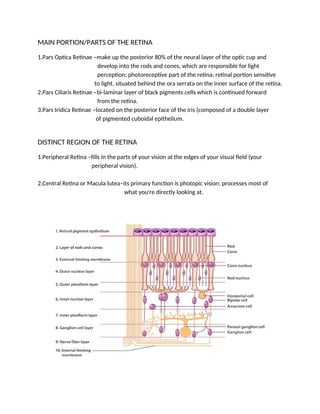
LAYERS OF THE RETINA
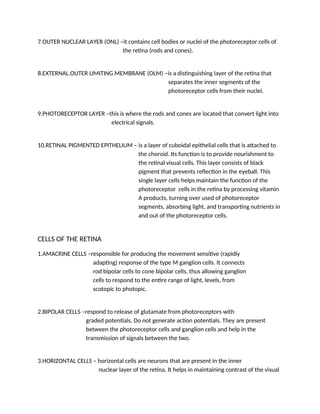
1.INNER LIMITING MEMBRANE (ILM) –is a boundary between the retina and vitreous body, it is
lined with astrocytes and Muller, they also maintain the
structural and functional stability of retinal cells. It also
acts as a boundary between vitreous humor and retina.
2.NERVE FIBER LAYER (NFL) –or the stratum opticum, is a layer is formed by the expansion of
optic nerves, the axons of the ganglion cell bodies also lie in this
layer.
3.GANGLION CELL LAYER (GCL) –it comprises all the cell bodies and nucleus of
ganglion cells. These cells extend to form an
optic nerve that conveys information to the brain
and take the electrical information from the
bipolar cells and process it to determine shapes,
contrast and color.
P-cells (Parvo) –(transmit information about colors
M-cells (Magno) –presentation of visual stimuli
4.INNER FLEXIFORM LAYER (IFL) –it is where the synapse between axons of
bipolar cells and dendrites of ganglion (and
amacrine) cells linger.
5.INNER NUCLEAR LAYER (INL) –also called the inner synaptic layer consists of axons of the
bipolar cells and dendritic processes of the ganglion and
amacrine cells a few spongioblast are also found
embedded in the layer, it contains nuclei of bipolar cell,
horizontal and amacrine cell bodies. It also consists of Muller’s
cells.
6.OUTER PLEXIFORM LAYER (OPL) –or the outer synaptic layer is a layer consisting of a dense
network of neural synapses between the dendrites of
horizontal cells and the photoreceptor cells (rods/cones)
that extend from the outer nuclear layer.
7.OUTER NUCLEAR LAYER (ONL) –it contains cell bodies or nuclei of the photoreceptor cells of
the retina (rods and cones).
8.EXTERNAL.OUTER LIMITING MEMBRANE (OLM) –is a distinguishing layer of the retina that
separates the inner segments of the
photoreceptor cells from their nuclei.
9.PHOTORECEPTOR LAYER –this is where the rods and cones are located that convert light into
electrical signals.
10.RETINAL PIGMENTED EPITHELIUM – is a layer of cuboidal epithelial cells that is attached to
the choroid. Its function is to provide nourishment to
the retinal visual cells. This layer consists of black
pigment that prevents reflection in the eyeball. This
single layer cells helps maintain the function of the
photoreceptor cells in the retina by processing vitamin
A products, turning over used of photoreceptor
segments, absorbing light, and transporting nutrients in
and out of the photoreceptor cells.
CELLS OF THE RETINA
1.AMACRINE CELLS –responsible for producing the movement sensitive (rapidly
adapting) response of the type M ganglion cells. It connects
rod bipolar cells to cone bipolar cells, thus allowing ganglion
cells to respond to the entire range of light, levels, from
scotopic to photopic.
2.BIPOLAR CELLS –respond to release of glutamate from photoreceptors with
graded potentials. Do not generate action potentials. They are present
between the photoreceptor cells and ganglion cells and help in the
transmission of signals between the two.
3.HORIZONTAL CELLS – horizontal cells are neurons that are present in the inner
nuclear layer of the retina. It helps in maintaining contrast of the visual
image by adapting to both bright and dim light. The horizontal cells give
negative feedback to the photoreceptor cells by depolarizing the rods
and cones.
4.RETINAL GANGLION CELLS –are a type of neuron that are located in the ganglion cell layer of
the retina. It receives visual information from the rod and cone
cells via the bipolar and amacrine cells.
5.CONES – the cone cells are less sensitive to light and are responsible for perceiving colour and
fine details of a visual image. The cone cells respond differently to different
wavelengths of light hence helping in visualizing different colors. There are usually 6
7 million cone celss concentrated in the fovea centralis of the eye which is a rods
free area.
6.RODS – Are one of the photoreceptor cells found in the retina of the eyes of vertebrates. The
rods cells help in identifying the shape, size and brightness of images. They cannot
perceive light as compared to cone cells that are sensitive to light. The rod cells are
found concentrated in the outer edges of the retina and are much more abundant
than the cone cells. They work better in dim light and are fully responsible for night
vision. They play no role in colour vision.
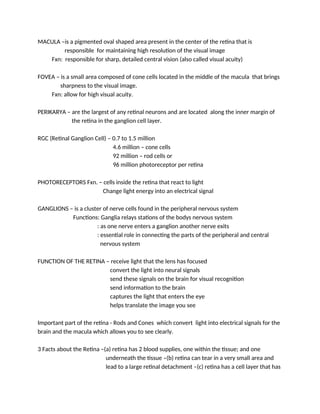
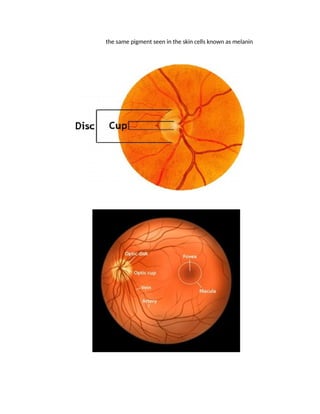
MACULA –is a pigmented oval shaped area present in the center of the retina that is
responsible for maintaining high resolution of the visual image
Fxn: responsible for sharp, detailed central vision (also called visual acuity)
FOVEA – is a small area composed of cone cells located in the middle of the macula that brings
sharpness to the visual image.
Fxn: allow for high visual acuity.
PERIKARYA – are the largest of any retinal neurons and are located along the inner margin of
the retina in the ganglion cell layer.
RGC (Retinal Ganglion Cell) – 0.7 to 1.5 million
4.6 million – cone cells
92 million – rod cells or
96 million photoreceptor per retina
PHOTORECEPTORS Fxn. – cells inside the retina that react to light
Change light energy into an electrical signal
GANGLIONS – is a cluster of nerve cells found in the peripheral nervous system
Functions: Ganglia relays stations of the bodys nervous system
: as one nerve enters a ganglion another nerve exits
: essential role in connecting the parts of the peripheral and central
nervous system
FUNCTION OF THE RETINA – receive light that the lens has focused
convert the light into neural signals
send these signals on the brain for visual recognition
send information to the brain
captures the light that enters the eye
helps translate the image you see
Important part of the retina - Rods and Cones which convert light into electrical signals for the
brain and the macula which allows you to see clearly.
3 Facts about the Retina –(a) retina has 2 blood supplies, one within the tissue; and one
underneath the tissue –(b) retina can tear in a very small area and
lead to a large retinal detachment –(c) retina has a cell layer that has
the same pigment seen in the skin cells known as melanin

R E T I N A - MIDTERM DOCUMENT REVIEWERS

  • 1.
    R E TI N A - is a key bridge between the light that enters your eyes and the images you see. -is a layer of photoreceptors cells and glial cells within the eye that captures incoming photons and transmits them along neuronal pathways as both electrical and chemical signals for the brain to perceive a visual picture. The retina converts light that enters into your eye into electrical signals your optic nerve sends to your brain which creates the images you see. It’s a key part of your vision. The retina is the layer at the very back of your eyeball; and retina responsible for visual processing that turns light energy from photons into three dimensional images. What does the retina do? The retina captures the light that enters your eye and helps translate it into the images you see. Light passes through the lens at the front of your eye and hits the retina. Photoreceptors — cells inside your retina that react to light — change light energy into an electrical signal. This signal travels through your optic nerve and into your brain to become the picture of the world you see. How does the retina help the eye function? The retina is like a translator in your eye. When light hits it, your retina converts it to a signal your brain processes and understands. Without a retina — or with a damaged retina — your eye might still function (it would still take in light) but your brain wouldn’t receive all the information it needs to create images. Anything affecting your retina can cause your vision to get worse. That’s why you should see your healthcare provider right away if your eyes or vision suddenly change. Innervation of the Retina: retina has no sensory innervation Primary Layers of the Retina (photoreceptor cell layer, bipolar cell layer, ganglion cell layer)
  • 2.
    Where is theretina located? The retina is at the back of your eye. It’s opposite the lens and pupil. The lens focuses light that enters your eye to hit your retina and its photoreceptor cells. What is the retina made of? The retina is made of two parts, the macula and the peripheral retina. The macula is in the center of your retina and processes most of what you’re directly looking at. The peripheral retina fills in the parts of your vision at the edges of your visual field (your peripheral vision). For example, if you’re sitting across the table from a friend, your macula helps you see their face and your peripheral retina lets you see the rest of the room on either side of them. The retina contains many types of cells. Photoreceptors process light into an electrical signal that your brain can understand as images. Rods are photoreceptors that help you see at night and in dim light. Cones process color and make up most of your usual vision. Both types of cells work together to give a clear, accurate picture of what you’re seeing. Blood supply of the Retina: the outer 4 layers are supplied by the choroidal layer (choriocapillaris), while the inner layers supplied by the Central Retinal Artery. PIGMENTS OF THE RETINA 1.Melanin –which is found at the retinal pigment epithelium; protects the cell from damage caused by oxidative stress- (an imbalance of free radicals and antioxidants in your body that leads to cell damage). 2.Lipofuscin – is a brown yellow electron dense Auto-fluorescent material that accumulates progressively over time in lysosomes of post mitotic cells such as neurons and cardiac myocytes. 3.Xantophyll –yellow carotenoid pigment found in macula lutea; from greek word “xanthos” meaning yellow, and “phyllon” meaning leaf.
  • 3.
    MAIN PORTION/PARTS OFTHE RETINA 1.Pars Optica Retinae –make up the posterior 80% of the neural layer of the optic cup and develop into the rods and cones, which are responsible for light perception; photoreceptive part of the retina; retinal portion sensitive to light, situated behind the ora serrata on the inner surface of the retina. 2.Pars Ciliaris Retinae –bi-laminar layer of black pigments cells which is continued forward from the retina. 3.Pars Iridica Retinae –located on the posterior face of the iris (composed of a double layer of pigmented cuboidal epithelium. DISTINCT REGION OF THE RETINA 1.Peripheral Retina –fills in the parts of your vision at the edges of your visual field (your peripheral vision). 2.Central Retina or Macula lutea–its primary function is photopic vision; processes most of what you're directly looking at.
  • 4.
    LAYERS OF THERETINA 1.INNER LIMITING MEMBRANE (ILM) –is a boundary between the retina and vitreous body, it is lined with astrocytes and Muller, they also maintain the structural and functional stability of retinal cells. It also acts as a boundary between vitreous humor and retina. 2.NERVE FIBER LAYER (NFL) –or the stratum opticum, is a layer is formed by the expansion of optic nerves, the axons of the ganglion cell bodies also lie in this layer. 3.GANGLION CELL LAYER (GCL) –it comprises all the cell bodies and nucleus of ganglion cells. These cells extend to form an optic nerve that conveys information to the brain and take the electrical information from the bipolar cells and process it to determine shapes, contrast and color. P-cells (Parvo) –(transmit information about colors M-cells (Magno) –presentation of visual stimuli 4.INNER FLEXIFORM LAYER (IFL) –it is where the synapse between axons of bipolar cells and dendrites of ganglion (and amacrine) cells linger. 5.INNER NUCLEAR LAYER (INL) –also called the inner synaptic layer consists of axons of the bipolar cells and dendritic processes of the ganglion and amacrine cells a few spongioblast are also found embedded in the layer, it contains nuclei of bipolar cell, horizontal and amacrine cell bodies. It also consists of Muller’s cells. 6.OUTER PLEXIFORM LAYER (OPL) –or the outer synaptic layer is a layer consisting of a dense network of neural synapses between the dendrites of horizontal cells and the photoreceptor cells (rods/cones) that extend from the outer nuclear layer.
  • 5.
    7.OUTER NUCLEAR LAYER(ONL) –it contains cell bodies or nuclei of the photoreceptor cells of the retina (rods and cones). 8.EXTERNAL.OUTER LIMITING MEMBRANE (OLM) –is a distinguishing layer of the retina that separates the inner segments of the photoreceptor cells from their nuclei. 9.PHOTORECEPTOR LAYER –this is where the rods and cones are located that convert light into electrical signals. 10.RETINAL PIGMENTED EPITHELIUM – is a layer of cuboidal epithelial cells that is attached to the choroid. Its function is to provide nourishment to the retinal visual cells. This layer consists of black pigment that prevents reflection in the eyeball. This single layer cells helps maintain the function of the photoreceptor cells in the retina by processing vitamin A products, turning over used of photoreceptor segments, absorbing light, and transporting nutrients in and out of the photoreceptor cells. CELLS OF THE RETINA 1.AMACRINE CELLS –responsible for producing the movement sensitive (rapidly adapting) response of the type M ganglion cells. It connects rod bipolar cells to cone bipolar cells, thus allowing ganglion cells to respond to the entire range of light, levels, from scotopic to photopic. 2.BIPOLAR CELLS –respond to release of glutamate from photoreceptors with graded potentials. Do not generate action potentials. They are present between the photoreceptor cells and ganglion cells and help in the transmission of signals between the two. 3.HORIZONTAL CELLS – horizontal cells are neurons that are present in the inner nuclear layer of the retina. It helps in maintaining contrast of the visual
  • 6.
    image by adaptingto both bright and dim light. The horizontal cells give negative feedback to the photoreceptor cells by depolarizing the rods and cones. 4.RETINAL GANGLION CELLS –are a type of neuron that are located in the ganglion cell layer of the retina. It receives visual information from the rod and cone cells via the bipolar and amacrine cells. 5.CONES – the cone cells are less sensitive to light and are responsible for perceiving colour and fine details of a visual image. The cone cells respond differently to different wavelengths of light hence helping in visualizing different colors. There are usually 6 7 million cone celss concentrated in the fovea centralis of the eye which is a rods free area. 6.RODS – Are one of the photoreceptor cells found in the retina of the eyes of vertebrates. The rods cells help in identifying the shape, size and brightness of images. They cannot perceive light as compared to cone cells that are sensitive to light. The rod cells are found concentrated in the outer edges of the retina and are much more abundant than the cone cells. They work better in dim light and are fully responsible for night vision. They play no role in colour vision.
  • 7.
    MACULA –is apigmented oval shaped area present in the center of the retina that is responsible for maintaining high resolution of the visual image Fxn: responsible for sharp, detailed central vision (also called visual acuity) FOVEA – is a small area composed of cone cells located in the middle of the macula that brings sharpness to the visual image. Fxn: allow for high visual acuity. PERIKARYA – are the largest of any retinal neurons and are located along the inner margin of the retina in the ganglion cell layer. RGC (Retinal Ganglion Cell) – 0.7 to 1.5 million 4.6 million – cone cells 92 million – rod cells or 96 million photoreceptor per retina PHOTORECEPTORS Fxn. – cells inside the retina that react to light Change light energy into an electrical signal GANGLIONS – is a cluster of nerve cells found in the peripheral nervous system Functions: Ganglia relays stations of the bodys nervous system : as one nerve enters a ganglion another nerve exits : essential role in connecting the parts of the peripheral and central nervous system FUNCTION OF THE RETINA – receive light that the lens has focused convert the light into neural signals send these signals on the brain for visual recognition send information to the brain captures the light that enters the eye helps translate the image you see Important part of the retina - Rods and Cones which convert light into electrical signals for the brain and the macula which allows you to see clearly. 3 Facts about the Retina –(a) retina has 2 blood supplies, one within the tissue; and one underneath the tissue –(b) retina can tear in a very small area and lead to a large retinal detachment –(c) retina has a cell layer that has
  • 8.
    the same pigmentseen in the skin cells known as melanin