Introduction to BusinessLetters
• Definition: Formal written communication
between organizations or individuals.
• Purpose: Convey information, requests, or
responses formally.
• Types: Inquiry, Order, Complaint, Adjustment,
Appointment, Resignation.
4.
Layout of aBusiness Letter
• Sender’s Address
• Date
• Receiver’s Address
• Salutation/Greeting
• Body (Introduction, Main Content, Conclusion)
• Complimentary Close
• Signature & Designation
• (Optional: Diagram of letter layout)
5.
Style of BusinessLetters
• Language: Formal, concise, polite, clear
• Tone: Professional and objective
• Formatting: Left-aligned, single spacing,
paragraph breaks
• Tips: Avoid contractions, slang, and personal
opinions
6.
Sample Business Letter
•Example: Order Letter or Complaint Letter
• Label sections: Address, Date, Salutation,
Body, Closing, Signature
7.
Agenda
• Definition: Listof items/topics for a meeting.
• Purpose: Organize flow, ensure all topics are
covered.
• Key Elements: Meeting title, Date & Time,
Venue, Topics, Chairperson & Attendees
8.
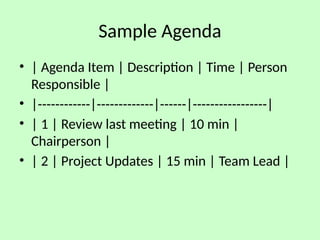
Sample Agenda
• |Agenda Item | Description | Time | Person
Responsible |
• |------------|-------------|------|-----------------|
• | 1 | Review last meeting | 10 min |
Chairperson |
• | 2 | Project Updates | 15 min | Team Lead |
9.
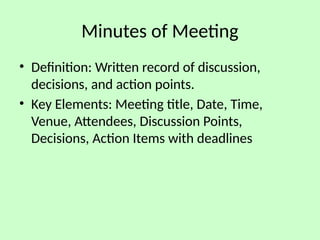
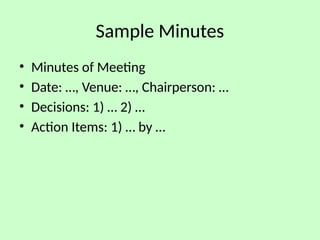
Minutes of Meeting
•Definition: Written record of discussion,
decisions, and action points.
• Key Elements: Meeting title, Date, Time,
Venue, Attendees, Discussion Points,
Decisions, Action Items with deadlines
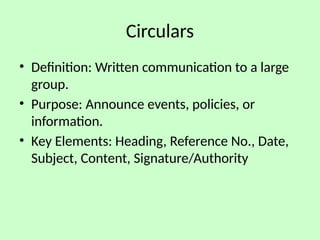
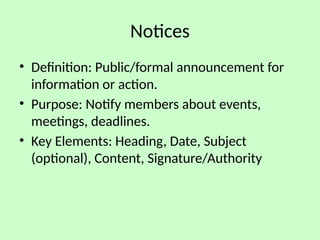
Notices
• Definition: Public/formalannouncement for
information or action.
• Purpose: Notify members about events,
meetings, deadlines.
• Key Elements: Heading, Date, Subject
(optional), Content, Signature/Authority