What is letter ?
• Letter writing is the exchange of written or printed messages.
• The business letter has obligatory parts and optional parts.
• Any formal letter is incomplete without obligatory parts.These are different
layouts based on the position occupied by obligatory parts in the letter.
What is Business Letter ?
• Writing a professional, polished business letter or business email is easy once you
know the basics. Most business letters are written in a simple format that is easily
adapted to any company’s needs, and business email follows a similarly simple
format. Read on to learn more about how to make your business correspondence

look its best.
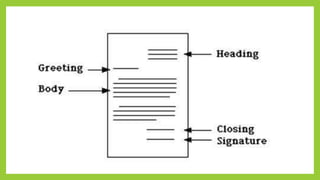
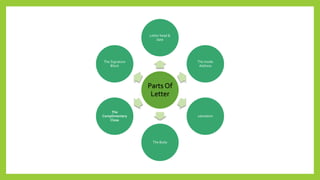
Parts Of
Letter
Letter head &
date
The Inside
Address
salutation
The Body
The
Complimentary
Close
The Signature
Block
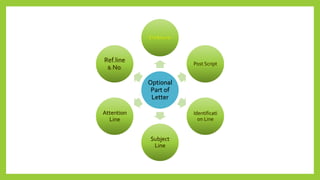
Optional
Part of
Letter
Enclosure
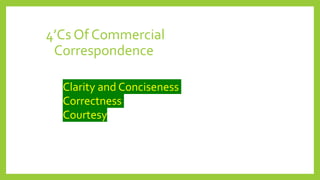
4’Cs Of Commercial
Correspondence
Correctness
Courtesy
Clarity and Conciseness
Clarity and Conciseness:-
• To achieve clarity and conciseness there are 4 simple rules
• 1. construct short sentences
• 2.use short words instead of long words
• 3.use familiar words instead of unfamiliar words
• 4.use concrete nouns instead of abstract nouns
Example-
• .“My mother had a really, really positive, amazing effect on my total life
experience.”
• If this sentence is revised for conciseness , it might read:
• “My mother had a positive effect on my life.”
• Statement 2 has better clarity & conciseness as compered to statement 1.
Correctness
• In a well written business letter their must be a correctness of language and
correctness of information.There can be no place for guess work or inaccurate
statement.When in doubt the best thing is to do enquire.
• From a grammatical point of view correctness will imply correct usage,correct
spelling & correct punctuation.
Courtesy:-
• Courtesy is a matter of frame of mind rather than the use of polite phases.
Courtesy can be show in variety of phase.-
• 1.By reply promptly.
• 2.By attending to complaints quickly.
• 3.By spelling proper names correctly
• 4.By attending to request promptly.
• 5.By making quick payment. It is a matter of tone. A word polite can be introduce
by using terms like ‘please or thank you’.
Minutes Of Meeting
• The written record of meetings, particularly of Boards of Directors and/or Share
holders of corporations, kept by thesecretary of the corporation or organizatio
n.
• The record of courtroom proceedings, such as the start and recess ofhearings and
trials, names of attorneys, witnesses, and rulings of the court, kept by the clerk of t
he court or the judge. Suchcourt minutes are not a transcript of everything that is s
aid, which is taken down by the court reporter if recorded at all.
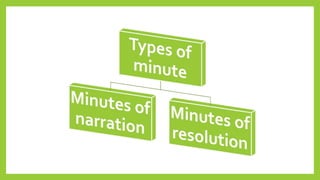
Minutes of narration:
• These minutes will be a concise summary of all discussions which took place,
reports received, actions to be taken and decisions made. It includes:
• Names of the participating members.
• Name of the proposer and supporter.
• Discussion summary. Resolutions.
Minutes of resolution:
• Minutes of resolution means the written statement of the decisions that have
been taken and approved by the participating members of the meeting. Only the
main conclusions which are reached at the meeting are recorded in minutes of
resolution.These are usually used for minutes of AGMs and other statutory
meeting.
• Example: Purchase of photocopier- the company secretary submitted a report
from the administrative manager containing full details of the trial of the AEZ
photocopier. It was resolved that the AEZ photocopier be purchased at a cost of
$250.
Factors considered in drafting minute
• Name and address of the organization
• Name of the meeting
• Date, time and venue of the meeting
• Name of the chair person
• Name and signature of the participating members
• Serial number
• Following of the rules and structure of minutes
• Name of the prosper and supplier of resolutions
• Number of regret letters
• Easy and understandable language
• Divisions
• Proper data
• Signature of the president
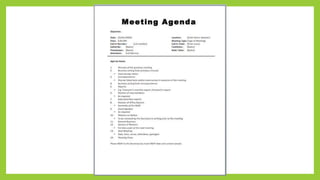
Agenda
• Agenda is a list of items to be discussed at the meeting
• It is usually sent with the notice of the meeting but it
may be sent later if it takes time to prepare it
What is a report?
A report is written for a clear purpose and to a particular audience. Specific information
and evidence are presented, analysed and applied to a particular problem or issue.The
information is presented in a clearly structured format making use of sections and
headings so that the information is easy to locate and follow.
When you are asked to write a report you will usually be given a report brief which provides
you with instructions and guidelines.The report brief may outline the purpose, audience
and problem or issue that your report must address, together with any specific
requirements for format or structure.This guide offers a general introduction to report
writing; be sure also to take account of specific instructions provided by your department.
Types of report
A. Informational report :-collect and resent data for the reader.
Example :- sales report, quarterly report, accident report.
B. Analytical report :- study & intrpret data but not offer suggestion or
recommendation.
Example :- annual report, audit report.
C. Recommendation report :- Recommendation suggest a solution.
Example :- reliability report, problem solving report.
Report
• 1.Authorization &Terms of Reference
• 2.Body of Procedure
• 3.Findings
• 4.Conclusion
• 5.Rcommendation
INTERNAL COMMUNICATION
• MEMO
• CIRCULATION
• NOTICE
• JOB INSTRUCTION
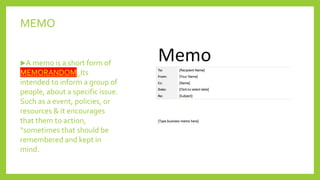
MEMO
A memo is a short form of
MEMORANDOM. Its
intended to inform a group of
people, about a specific issue.
Such as a event, policies, or
resources & it encourages
that them to action,
“sometimes that should be
remembered and kept in
mind.
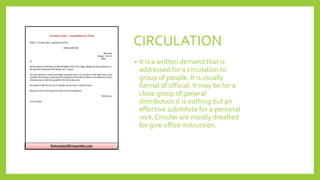
CIRCULATION
• It is a written demand that is
addressed for a circulation to
group of people. It is usually
formal of official. It may be for a
close group of general
distribution it is nothing but an
effective substitute for a personal
visit. Circular are mostly dreafted
for give office instruction.
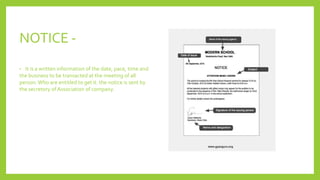
NOTICE -
• It is a written information of the date, pace, time and
the business to be transacted at the meeting of all
person.Who are entitled to get it. the notice is sent by
the secretory of Association of company.
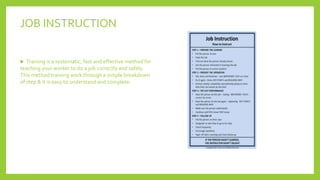
JOB INSTRUCTION
 Training is a systematic, fast and effective method for
teaching your worker to do a job correctly and safely.
This method training work through a simple breakdown
of step & it is easy to understand and complete.
MODERNS FORMS OF
COMMUNICATION
E-mail ,Teleconferencing and
Videoconferencing
Modern forms of Communication – Email,
Teleconferencing andVideoconferencing!
• The technological advances of the past few decades have made it possible to
transmit printed messages, pictures and even live performances to all comers of
the world with speed.
•
With a single touch, you can send communications to a number of destinations.
Not only large business houses but even medium and small ones use them in their
day-to-day working. Among such means are internet/email, teleconferencing and
videoconferencing.
Videoconferencing
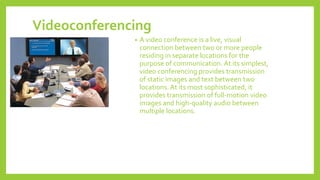
• A video conference is a live, visual
connection between two or more people
residing in separate locations for the
purpose of communication. At its simplest,
video conferencing provides transmission
of static images and text between two
locations. At its most sophisticated, it
provides transmission of full-motion video
images and high-quality audio between
multiple locations.
Advantage and Disadvantage ofVC
Advantage
• Reduced travel costs
• Increased time and improved
productivity
• Reduced carbon footprint
• Global partnering opportunities
Disadvantage
• Cost of equipment and training
• International time zones
• More impersonal
Teleconferceing
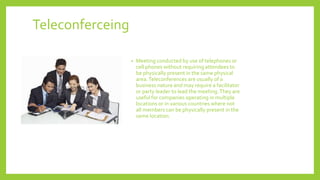
• Meeting conducted by use of telephones or
cell phones without requiring attendees to
be physically present in the same physical
area.Teleconferences are usually of a
business nature and may require a facilitator
or party leader to lead the meeting.They are
useful for companies operating in multiple
locations or in various countries where not
all members can be physically present in the
same location.
Advantages ofTeleconferencing
• Advantages ofTeleconferencing:
1. Saves money as you do not need to travel/commute to the other person's
location.
2. Saves your time and energy for the same reason (stated above), thereby
expediting work.
3. Latest applications like Skype allow you to meet up with several parties at once;
if the video does not work out, you also have the option to switch to audio-only
mode.
4. Allows you to observe the body language of the other person, giving non-verbal
clues that can help you manage the conversation better (e.g. putting at ease a
nervous employee).
Disadvantages ofTeleconferencing
1. Exchange of information is less dynamic than a face-to-face meeting.
2. Decision-making process can be slower as you may need to go offline to consult
other parties and then get back on call.
3.Technical issues like power failure, internet connectivity, the other party not
knowing how to use such technology, etc. can act as bottlenecks, sometimes
delaying work and causing you to miss deadlines.
Potentially, there can be more limitations of teleconferencing, depending on the
unique situations you face.
E-Mail :
• Email is widely used as a form of business
communication and overall it is a highly effective
communication tool. Email is inexpensive, only
requiring an Internet connection that is generally
already present in the business. Although a printout of
emails is possible, emails often stay as soft copies
because archiving and retrieving email
communications is easy to do. From the CEO to the
janitorial staff and even temporary employees of the
business can send and receive email communications.
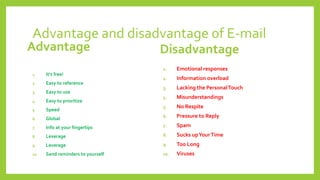
Advantage and disadvantage of E-mail
Advantage
1. It's free!
2. Easy to reference
3. Easy to use
4. Easy to prioritize
5. Speed
6. Global
7. Info at your fingertips
8. Leverage
9. Leverage
10. Send reminders to yourself
Disadvantage
1. Emotional responses
2. Information overload
3. Lacking the PersonalTouch
4. Misunderstandings
5. No Respite
6. Pressure to Reply
7. Spam
8. Sucks upYourTime
9. Too Long
10. Viruses
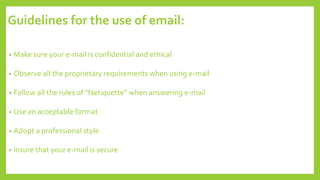
Guidelines for the use of email:
• Make sure your e-mail is confidential and ethical
• Observe all the proprietary requirements when using e-mail
• Follow all the rules of “Netiquette” when answering e-mail
• Use an acceptable format
• Adopt a professional style
• Insure that your e-mail is secure
MANAGERIAL COMMUNICATION

MANAGERIAL COMMUNICATION

  • 2.
    What is letter? • Letter writing is the exchange of written or printed messages. • The business letter has obligatory parts and optional parts. • Any formal letter is incomplete without obligatory parts.These are different layouts based on the position occupied by obligatory parts in the letter.
  • 3.
    What is BusinessLetter ? • Writing a professional, polished business letter or business email is easy once you know the basics. Most business letters are written in a simple format that is easily adapted to any company’s needs, and business email follows a similarly simple format. Read on to learn more about how to make your business correspondence look its best.
  • 5.
    Parts Of Letter Letter head& date The Inside Address salutation The Body The Complimentary Close The Signature Block
  • 6.
  • 7.
  • 8.
    Clarity and Conciseness:- •To achieve clarity and conciseness there are 4 simple rules • 1. construct short sentences • 2.use short words instead of long words • 3.use familiar words instead of unfamiliar words • 4.use concrete nouns instead of abstract nouns
  • 9.
    Example- • .“My motherhad a really, really positive, amazing effect on my total life experience.” • If this sentence is revised for conciseness , it might read: • “My mother had a positive effect on my life.” • Statement 2 has better clarity & conciseness as compered to statement 1.
  • 10.
    Correctness • In awell written business letter their must be a correctness of language and correctness of information.There can be no place for guess work or inaccurate statement.When in doubt the best thing is to do enquire. • From a grammatical point of view correctness will imply correct usage,correct spelling & correct punctuation.
  • 11.
    Courtesy:- • Courtesy isa matter of frame of mind rather than the use of polite phases. Courtesy can be show in variety of phase.- • 1.By reply promptly. • 2.By attending to complaints quickly. • 3.By spelling proper names correctly • 4.By attending to request promptly. • 5.By making quick payment. It is a matter of tone. A word polite can be introduce by using terms like ‘please or thank you’.
  • 12.
    Minutes Of Meeting •The written record of meetings, particularly of Boards of Directors and/or Share holders of corporations, kept by thesecretary of the corporation or organizatio n. • The record of courtroom proceedings, such as the start and recess ofhearings and trials, names of attorneys, witnesses, and rulings of the court, kept by the clerk of t he court or the judge. Suchcourt minutes are not a transcript of everything that is s aid, which is taken down by the court reporter if recorded at all.
  • 14.
    Minutes of narration: •These minutes will be a concise summary of all discussions which took place, reports received, actions to be taken and decisions made. It includes: • Names of the participating members. • Name of the proposer and supporter. • Discussion summary. Resolutions.
  • 15.
    Minutes of resolution: •Minutes of resolution means the written statement of the decisions that have been taken and approved by the participating members of the meeting. Only the main conclusions which are reached at the meeting are recorded in minutes of resolution.These are usually used for minutes of AGMs and other statutory meeting. • Example: Purchase of photocopier- the company secretary submitted a report from the administrative manager containing full details of the trial of the AEZ photocopier. It was resolved that the AEZ photocopier be purchased at a cost of $250.
  • 16.
    Factors considered indrafting minute • Name and address of the organization • Name of the meeting • Date, time and venue of the meeting • Name of the chair person • Name and signature of the participating members • Serial number • Following of the rules and structure of minutes • Name of the prosper and supplier of resolutions • Number of regret letters • Easy and understandable language • Divisions • Proper data • Signature of the president
  • 17.
    Agenda • Agenda isa list of items to be discussed at the meeting • It is usually sent with the notice of the meeting but it may be sent later if it takes time to prepare it
  • 19.
    What is areport? A report is written for a clear purpose and to a particular audience. Specific information and evidence are presented, analysed and applied to a particular problem or issue.The information is presented in a clearly structured format making use of sections and headings so that the information is easy to locate and follow. When you are asked to write a report you will usually be given a report brief which provides you with instructions and guidelines.The report brief may outline the purpose, audience and problem or issue that your report must address, together with any specific requirements for format or structure.This guide offers a general introduction to report writing; be sure also to take account of specific instructions provided by your department.
  • 20.
    Types of report A.Informational report :-collect and resent data for the reader. Example :- sales report, quarterly report, accident report. B. Analytical report :- study & intrpret data but not offer suggestion or recommendation. Example :- annual report, audit report. C. Recommendation report :- Recommendation suggest a solution. Example :- reliability report, problem solving report.
  • 21.
    Report • 1.Authorization &Termsof Reference • 2.Body of Procedure • 3.Findings • 4.Conclusion • 5.Rcommendation
  • 22.
    INTERNAL COMMUNICATION • MEMO •CIRCULATION • NOTICE • JOB INSTRUCTION
  • 23.
    MEMO A memo isa short form of MEMORANDOM. Its intended to inform a group of people, about a specific issue. Such as a event, policies, or resources & it encourages that them to action, “sometimes that should be remembered and kept in mind.
  • 24.
    CIRCULATION • It isa written demand that is addressed for a circulation to group of people. It is usually formal of official. It may be for a close group of general distribution it is nothing but an effective substitute for a personal visit. Circular are mostly dreafted for give office instruction.
  • 25.
    NOTICE - • Itis a written information of the date, pace, time and the business to be transacted at the meeting of all person.Who are entitled to get it. the notice is sent by the secretory of Association of company.
  • 26.
    JOB INSTRUCTION  Trainingis a systematic, fast and effective method for teaching your worker to do a job correctly and safely. This method training work through a simple breakdown of step & it is easy to understand and complete.
  • 27.
    MODERNS FORMS OF COMMUNICATION E-mail,Teleconferencing and Videoconferencing
  • 28.
    Modern forms ofCommunication – Email, Teleconferencing andVideoconferencing! • The technological advances of the past few decades have made it possible to transmit printed messages, pictures and even live performances to all comers of the world with speed. • With a single touch, you can send communications to a number of destinations. Not only large business houses but even medium and small ones use them in their day-to-day working. Among such means are internet/email, teleconferencing and videoconferencing.
  • 29.
    Videoconferencing • A videoconference is a live, visual connection between two or more people residing in separate locations for the purpose of communication. At its simplest, video conferencing provides transmission of static images and text between two locations. At its most sophisticated, it provides transmission of full-motion video images and high-quality audio between multiple locations.
  • 30.
    Advantage and DisadvantageofVC Advantage • Reduced travel costs • Increased time and improved productivity • Reduced carbon footprint • Global partnering opportunities Disadvantage • Cost of equipment and training • International time zones • More impersonal
  • 31.
    Teleconferceing • Meeting conductedby use of telephones or cell phones without requiring attendees to be physically present in the same physical area.Teleconferences are usually of a business nature and may require a facilitator or party leader to lead the meeting.They are useful for companies operating in multiple locations or in various countries where not all members can be physically present in the same location.
  • 32.
    Advantages ofTeleconferencing • AdvantagesofTeleconferencing: 1. Saves money as you do not need to travel/commute to the other person's location. 2. Saves your time and energy for the same reason (stated above), thereby expediting work. 3. Latest applications like Skype allow you to meet up with several parties at once; if the video does not work out, you also have the option to switch to audio-only mode. 4. Allows you to observe the body language of the other person, giving non-verbal clues that can help you manage the conversation better (e.g. putting at ease a nervous employee).
  • 33.
    Disadvantages ofTeleconferencing 1. Exchangeof information is less dynamic than a face-to-face meeting. 2. Decision-making process can be slower as you may need to go offline to consult other parties and then get back on call. 3.Technical issues like power failure, internet connectivity, the other party not knowing how to use such technology, etc. can act as bottlenecks, sometimes delaying work and causing you to miss deadlines. Potentially, there can be more limitations of teleconferencing, depending on the unique situations you face.
  • 34.
    E-Mail : • Emailis widely used as a form of business communication and overall it is a highly effective communication tool. Email is inexpensive, only requiring an Internet connection that is generally already present in the business. Although a printout of emails is possible, emails often stay as soft copies because archiving and retrieving email communications is easy to do. From the CEO to the janitorial staff and even temporary employees of the business can send and receive email communications.
  • 35.
    Advantage and disadvantageof E-mail Advantage 1. It's free! 2. Easy to reference 3. Easy to use 4. Easy to prioritize 5. Speed 6. Global 7. Info at your fingertips 8. Leverage 9. Leverage 10. Send reminders to yourself Disadvantage 1. Emotional responses 2. Information overload 3. Lacking the PersonalTouch 4. Misunderstandings 5. No Respite 6. Pressure to Reply 7. Spam 8. Sucks upYourTime 9. Too Long 10. Viruses
  • 36.
    Guidelines for theuse of email: • Make sure your e-mail is confidential and ethical • Observe all the proprietary requirements when using e-mail • Follow all the rules of “Netiquette” when answering e-mail • Use an acceptable format • Adopt a professional style • Insure that your e-mail is secure