BUSINESS CORRESPONDENCE
Dr DINESH S
Assistant Professor
Management Sciences
Sri Ramakrishna College of Arts & Science
(Autonomous)
Coimbatore - 641 006
Tamil Nadu, India
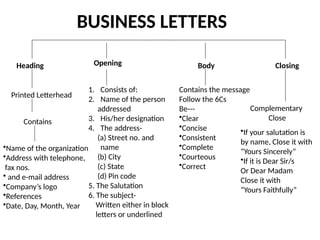
BUSINESS LETTERS
Heading Opening Body Closing
Printed Letterhead
Contains
•Name of the organization
•Address with telephone,
fax nos.
• and e-mail address
•Company’s logo
•References
•Date, Day, Month, Year
1. Consists of:
2. Name of the person
addressed
3. His/her designation
4. The address-
(a) Street no. and
name
(b) City
(c) State
(d) Pin code
5. The Salutation
6. The subject-
Written either in block
letters or underlined
Contains the message
Follow the 6Cs
Be---
•Clear
•Concise
•Consistent
•Complete
•Courteous
•Correct
Complementary
Close
•If your salutation is
by name, Close it with
“Yours Sincerely”
•If it is Dear Sir/s
Or Dear Madam
Close it with
“Yours Faithfully”
Written Communication
• Written communication is formal and precise.
• It requires a formal beginning and ending.
• Oral interpersonal communication is most often
informal.
• Whereas in oral communication one can depend
on tone of voice, facial expressions or gestures to
put across one’s message, in written
communication one has to depend only on the
formal, written words to get the message across.
Letters
• Letters are the most important means of written
communication as they become permanent records
and can be referred to in future.
• Maintaining customer relations, handling problems,
exchange of information, and maintaining goodwill
requires skillful letter writing.
• Reasons for writing a formal letter:
• To inform-To tell someone about something
• To instruct/order –To make somebody do something
• To reply- To reply to some communication
• To convince/persuade- To make somebody interested
in you or in your product
Features of Business Correspondence
• The overall tone of a business letter is restrained formality.
• Your letters should be brief but not curt.
• They should be polite and easily comprehensible.
• Plan your letter-
1. the reason and objective of writing
2. To whom you are writing-adjust your style according to the needs of the
person whom you are writing, his designation in the organization etc.
3. When are you going to write? Do you have a deadline to meet?
4. What will be the layout and construction of the letter?
• Formal letters should be short and to the point and devoid of complex
sentences and jargon laded language.
• Formal letters must incorporate You-Attitude- that is show respect for
readers’ needs, intelligence, integrity and the POV.
• A Dictionary and thesaurus are a good letter writer’s constant companions.
• Pick the right word
• Avoid repetition of words and verbosity
• Building one’s word power aids to using words with consummate skill
• Avoid cliches
• Spontaneity in a letter ensures smooth reading
• Make the letter balanced and positive in approach. Avoid using negative words like ‘failure’,
‘refuse’, ‘sorry’, ‘damage’ etc.
• Good business letters maintain ethical and moral standards, and show a sense of legitimacy.
• Learn to mitigate the hardship or adverse impact of the message through choice of words
and manner of presentation.
• Bring a unique perspective and experience to the letter by adding imagination and creativity
to it.
• The letter should reflect enthusiasm and innovative temper of the writer.
• A positive and progressive approach to writing letters generates regard and creates goodwill
for the writer.
• Prefer friendly and conversational style over stilted, dull and stiff writing.
• Clarity of goal should be reflected in both thought and expression.
• The most effective business letters are those that show the writer’s interest in the receiver.
Therefore, adopt “you” attitude.
• An effective letter emphasizes all important points by carefully positioning them in sentences
and paragraph.
• Effective business letters have tactful approach .Certain problems call for a ‘middle ground ‘
approach.
FORMS OF LAYOUT AND PARTS OFA BUSINESS LETTER
• Full Block Form
• Modified Block Form
• Semi Indented Form
• Hanging Indention Form
• Standard Elements
• Heading or Letterhead
• Reference Number
• Date
• Inside Address
• Mode of Address
• Salutation
• Subject Line
• Body of the Letter
• Formal Close
• Complimentary Close
• Signature block/slot
• Additional Elements
• Addressee Notation- labels such as ‘PERSONAL’, ‘CONFIDENTIAL’,
‘URGENT’, ‘PLEASE REDIRECT’ etc, typed in all capitals, two spaces above
the inside address.
• Attention Line-Draws the attention of a particular individual or
department for action- ‘Attention Accounts Officer’, ‘Attention Section
Officer’ etc.
• Subject Line-The purpose of the letter; helps in filing the letter for future
reference
• Reference initials-A set of two initials formed by using the initials of one
who dictates the letter and followed by the initials of the person who
types the letter. There are two ways to do it-SD/VM or SD:VM
• Enclosure Notation: Enclosure: Resume
• Postscript- a second afterthought has the notation ‘PS’or ‘P.S.’
• ‘CC’ or Carbon Copy Notation
• ‘PC’ or Photocopy Notation-pc: Mr. P.K. Arora
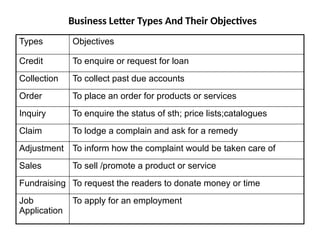
Business Letter Types And Their Objectives
Types Objectives
Credit To enquire or request for loan
Collection To collect past due accounts
Order To place an order for products or services
Inquiry To enquire the status of sth; price lists;catalogues
Claim To lodge a complain and ask for a remedy
Adjustment To inform how the complaint would be taken care of
Sales To sell /promote a product or service
Fundraising To request the readers to donate money or time
Job
Application
To apply for an employment
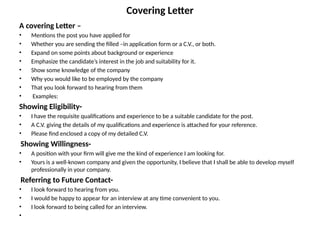
Covering Letter
A covering Letter –
• Mentions the post you have applied for
• Whether you are sending the filled –in application form or a C.V., or both.
• Expand on some points about background or experience
• Emphasize the candidate’s interest in the job and suitability for it.
• Show some knowledge of the company
• Why you would like to be employed by the company
• That you look forward to hearing from them
• Examples:
Showing Eligibility-
• I have the requisite qualifications and experience to be a suitable candidate for the post.
• A C.V. giving the details of my qualifications and experience is attached for your reference.
• Please find enclosed a copy of my detailed C.V.
Showing Willingness-
• A position with your firm will give me the kind of experience I am looking for.
• Yours is a well-known company and given the opportunity, I believe that I shall be able to develop myself
professionally in your company.
Referring to Future Contact-
• I look forward to hearing from you.
• I would be happy to appear for an interview at any time convenient to you.
• I look forward to being called for an interview.
•
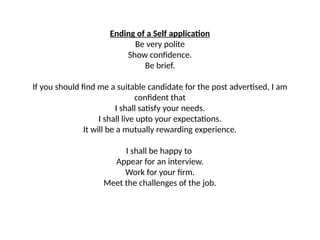
Ending of a Self application
Be very polite
Show confidence.
Be brief.
If you should find me a suitable candidate for the post advertised, I am
confident that
I shall satisfy your needs.
I shall live upto your expectations.
It will be a mutually rewarding experience.
I shall be happy to
Appear for an interview.
Work for your firm.
Meet the challenges of the job.
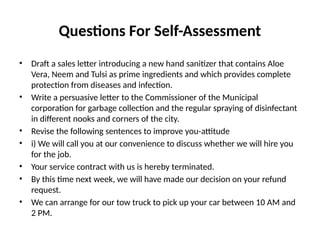
Questions For Self-Assessment
• Draft a sales letter introducing a new hand sanitizer that contains Aloe
Vera, Neem and Tulsi as prime ingredients and which provides complete
protection from diseases and infection.
• Write a persuasive letter to the Commissioner of the Municipal
corporation for garbage collection and the regular spraying of disinfectant
in different nooks and corners of the city.
• Revise the following sentences to improve you-attitude
• i) We will call you at our convenience to discuss whether we will hire you
for the job.
• Your service contract with us is hereby terminated.
• By this time next week, we will have made our decision on your refund
request.
• We can arrange for our tow truck to pick up your car between 10 AM and
2 PM.
References
• Locker, O Kitty, Stephen Kyo Kaczmarek. Business Communication. New
Delhi: Tata McGraw-Hill Publishing Company Limited, 2007.
• Malhotra Prerna, et al. Business Communication. New Delhi: Book Age
Publications, 2015.
• Soundarraj, Francis. Speaking and Writing For Effective Business
Communication. New Delhi: Macmillan,2008.
THANK YOU

BUSINESS CORRESPONDENCE - AN INDUSTRY PERSPECTIVE

  • 1.
    BUSINESS CORRESPONDENCE Dr DINESHS Assistant Professor Management Sciences Sri Ramakrishna College of Arts & Science (Autonomous) Coimbatore - 641 006 Tamil Nadu, India
  • 2.
    BUSINESS LETTERS Heading OpeningBody Closing Printed Letterhead Contains •Name of the organization •Address with telephone, fax nos. • and e-mail address •Company’s logo •References •Date, Day, Month, Year 1. Consists of: 2. Name of the person addressed 3. His/her designation 4. The address- (a) Street no. and name (b) City (c) State (d) Pin code 5. The Salutation 6. The subject- Written either in block letters or underlined Contains the message Follow the 6Cs Be--- •Clear •Concise •Consistent •Complete •Courteous •Correct Complementary Close •If your salutation is by name, Close it with “Yours Sincerely” •If it is Dear Sir/s Or Dear Madam Close it with “Yours Faithfully”
  • 3.
    Written Communication • Writtencommunication is formal and precise. • It requires a formal beginning and ending. • Oral interpersonal communication is most often informal. • Whereas in oral communication one can depend on tone of voice, facial expressions or gestures to put across one’s message, in written communication one has to depend only on the formal, written words to get the message across.
  • 4.
    Letters • Letters arethe most important means of written communication as they become permanent records and can be referred to in future. • Maintaining customer relations, handling problems, exchange of information, and maintaining goodwill requires skillful letter writing. • Reasons for writing a formal letter: • To inform-To tell someone about something • To instruct/order –To make somebody do something • To reply- To reply to some communication • To convince/persuade- To make somebody interested in you or in your product
  • 5.
    Features of BusinessCorrespondence • The overall tone of a business letter is restrained formality. • Your letters should be brief but not curt. • They should be polite and easily comprehensible. • Plan your letter- 1. the reason and objective of writing 2. To whom you are writing-adjust your style according to the needs of the person whom you are writing, his designation in the organization etc. 3. When are you going to write? Do you have a deadline to meet? 4. What will be the layout and construction of the letter? • Formal letters should be short and to the point and devoid of complex sentences and jargon laded language. • Formal letters must incorporate You-Attitude- that is show respect for readers’ needs, intelligence, integrity and the POV.
  • 6.
    • A Dictionaryand thesaurus are a good letter writer’s constant companions. • Pick the right word • Avoid repetition of words and verbosity • Building one’s word power aids to using words with consummate skill • Avoid cliches • Spontaneity in a letter ensures smooth reading • Make the letter balanced and positive in approach. Avoid using negative words like ‘failure’, ‘refuse’, ‘sorry’, ‘damage’ etc. • Good business letters maintain ethical and moral standards, and show a sense of legitimacy. • Learn to mitigate the hardship or adverse impact of the message through choice of words and manner of presentation. • Bring a unique perspective and experience to the letter by adding imagination and creativity to it. • The letter should reflect enthusiasm and innovative temper of the writer. • A positive and progressive approach to writing letters generates regard and creates goodwill for the writer. • Prefer friendly and conversational style over stilted, dull and stiff writing. • Clarity of goal should be reflected in both thought and expression. • The most effective business letters are those that show the writer’s interest in the receiver. Therefore, adopt “you” attitude. • An effective letter emphasizes all important points by carefully positioning them in sentences and paragraph. • Effective business letters have tactful approach .Certain problems call for a ‘middle ground ‘ approach.
  • 7.
    FORMS OF LAYOUTAND PARTS OFA BUSINESS LETTER • Full Block Form • Modified Block Form • Semi Indented Form • Hanging Indention Form • Standard Elements • Heading or Letterhead • Reference Number • Date • Inside Address • Mode of Address • Salutation • Subject Line • Body of the Letter • Formal Close • Complimentary Close • Signature block/slot
  • 8.
    • Additional Elements •Addressee Notation- labels such as ‘PERSONAL’, ‘CONFIDENTIAL’, ‘URGENT’, ‘PLEASE REDIRECT’ etc, typed in all capitals, two spaces above the inside address. • Attention Line-Draws the attention of a particular individual or department for action- ‘Attention Accounts Officer’, ‘Attention Section Officer’ etc. • Subject Line-The purpose of the letter; helps in filing the letter for future reference • Reference initials-A set of two initials formed by using the initials of one who dictates the letter and followed by the initials of the person who types the letter. There are two ways to do it-SD/VM or SD:VM • Enclosure Notation: Enclosure: Resume • Postscript- a second afterthought has the notation ‘PS’or ‘P.S.’ • ‘CC’ or Carbon Copy Notation • ‘PC’ or Photocopy Notation-pc: Mr. P.K. Arora
  • 9.
    Business Letter TypesAnd Their Objectives Types Objectives Credit To enquire or request for loan Collection To collect past due accounts Order To place an order for products or services Inquiry To enquire the status of sth; price lists;catalogues Claim To lodge a complain and ask for a remedy Adjustment To inform how the complaint would be taken care of Sales To sell /promote a product or service Fundraising To request the readers to donate money or time Job Application To apply for an employment
  • 10.
    Covering Letter A coveringLetter – • Mentions the post you have applied for • Whether you are sending the filled –in application form or a C.V., or both. • Expand on some points about background or experience • Emphasize the candidate’s interest in the job and suitability for it. • Show some knowledge of the company • Why you would like to be employed by the company • That you look forward to hearing from them • Examples: Showing Eligibility- • I have the requisite qualifications and experience to be a suitable candidate for the post. • A C.V. giving the details of my qualifications and experience is attached for your reference. • Please find enclosed a copy of my detailed C.V. Showing Willingness- • A position with your firm will give me the kind of experience I am looking for. • Yours is a well-known company and given the opportunity, I believe that I shall be able to develop myself professionally in your company. Referring to Future Contact- • I look forward to hearing from you. • I would be happy to appear for an interview at any time convenient to you. • I look forward to being called for an interview. •
  • 11.
    Ending of aSelf application Be very polite Show confidence. Be brief. If you should find me a suitable candidate for the post advertised, I am confident that I shall satisfy your needs. I shall live upto your expectations. It will be a mutually rewarding experience. I shall be happy to Appear for an interview. Work for your firm. Meet the challenges of the job.
  • 12.
    Questions For Self-Assessment •Draft a sales letter introducing a new hand sanitizer that contains Aloe Vera, Neem and Tulsi as prime ingredients and which provides complete protection from diseases and infection. • Write a persuasive letter to the Commissioner of the Municipal corporation for garbage collection and the regular spraying of disinfectant in different nooks and corners of the city. • Revise the following sentences to improve you-attitude • i) We will call you at our convenience to discuss whether we will hire you for the job. • Your service contract with us is hereby terminated. • By this time next week, we will have made our decision on your refund request. • We can arrange for our tow truck to pick up your car between 10 AM and 2 PM.
  • 13.
    References • Locker, OKitty, Stephen Kyo Kaczmarek. Business Communication. New Delhi: Tata McGraw-Hill Publishing Company Limited, 2007. • Malhotra Prerna, et al. Business Communication. New Delhi: Book Age Publications, 2015. • Soundarraj, Francis. Speaking and Writing For Effective Business Communication. New Delhi: Macmillan,2008.
  • 14.