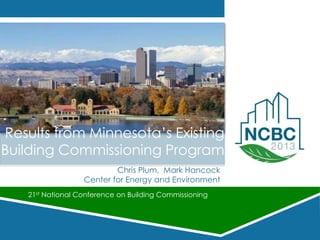
Chris Plum, Mark Hancock
Center for Energy and Environment
Results from Minnesota’s Existing
Building Commissioning Program
21st National Conference on Building Commissioning
AIA Quality Assurance
The Building Commissioning Association is a Registered Provider with The
American Institute of Architects Continuing Education Systems (AIA/CES).
Credit(s) earned on completion of this program will be reported to
AIA/CES for AIA members. Certificates of Completion for both AIA
members and non-AIA members are available upon request.
This program is registered with AIA/CES for continuing professional
education. As such, it does not include content that may be deemed or
construed to be an approval or endorsement by the AIA of any material
of construction or any method or manner of handling, using, distributing,
or dealing in any material or product.
Questions related to specific materials, methods, and services will be
addressed at the conclusion of this presentation.
21st NCBC Conference
Presentation Description
CEE administers the state program to perform existing building
commissioning (EBCx) on state government buildings in
Minnesota.
Investigations of 227 buildings containing nearly 19 million square
feet located on 50 sites throughout the state were performed.
The participation rate in the program is very high, which provides
a useful measure of the potential for broadly implemented EBCx
programs.
Several best practices for program managers were identified.
We included a rigorous quality assurance process which resulted
in a number of lessons learned, especially the need for a
meaningful provider certification if customers are to receive
consistent, high quality EBCx projects.
21st NCBC Conference
At the end of this session, participants will be able to:
1. Identify several best practices for Existing Building Commissioning
1. Requires specialized training
2. Would benefit from a rigorous certification process
2. Understand how to identify buildings where EBCx can be effective
1. Cost effectiveness of the investigation must be considered
3. See how quality assurance improves customer outcomes
Learning Objectives
21st NCBC Conference
PBEEEP
 Created in 2008 by MN State Legislature
 Meet two important needs:
 Access to technical services that will identify savings
 Access to funding to implement identified savings
 Designed in partnership with PECI
 Providers were selected before program development
21st NCBC Conference
PROGRAM BACKGROUND
“Public Buildings Enhanced Energy Efficiency Program” = PBEEEP
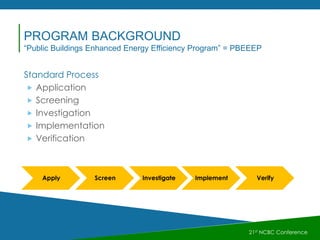
Standard Process
 Application
 Screening
 Investigation
 Implementation
 Verification
21st NCBC Conference
PROGRAM BACKGROUND
“Public Buildings Enhanced Energy Efficiency Program” = PBEEEP
Apply Screen Investigate Implement Verify
Unique features of a State Sponsored program
 Competitively Bid Phases
 Scope of work was well defined
 List of typical measure had to be checked
 Equipment was listed in detail
 All energy consuming equipment
 Anything that affected the energy consuming equipment
 State statute limited measures to 15 year payback or less
21st NCBC Conference
PROGRAM BACKGROUND
“Public Buildings Enhanced Energy Efficiency Program” = PBEEEP
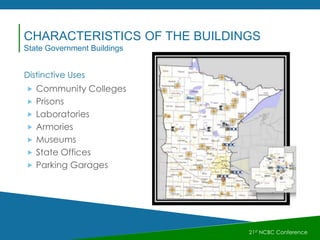
Distinctive Uses
 Community Colleges
 Prisons
 Laboratories
 Armories
 Museums
 State Offices
 Parking Garages
21st NCBC Conference
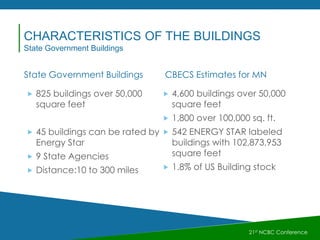
CHARACTERISTICS OF THE BUILDINGS
State Government Buildings
State Government Buildings CBECS Estimates for MN
 825 buildings over 50,000
square feet
 45 buildings can be rated by
Energy Star
 9 State Agencies
 Distance:10 to 300 miles
21st NCBC Conference
CHARACTERISTICS OF THE BUILDINGS
State Government Buildings
 4,600 buildings over 50,000
square feet
 1,800 over 100,000 sq. ft.
 542 ENERGY STAR labeled
buildings with 102,873,953
square feet
 1.8% of US Building stock
21st NCBC Conference
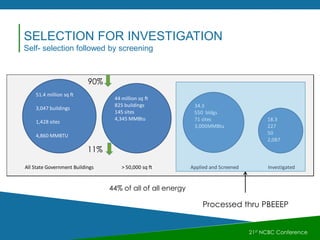
SELECTION FOR INVESTIGATION
Self- selection followed by screening
> 50,000 sq ft Applied and Screened InvestigatedAll State Government Buildings
51.4 million sq ft
3,047 buildings
1,428 sites
4,860 MMBTU
18.3
227
50
2,087
34.3
550 bldgs
71 sites
3,000MMBtu
44 million sq ft
825 buildings
145 sites
4,345 MMBtu
Processed thru PBEEEP
90%
11%
44% of all of all energy
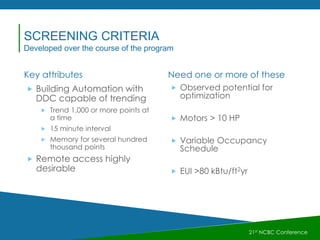
Key attributes Need one or more of these
 Building Automation with
DDC capable of trending
 Trend 1,000 or more points at
a time
 15 minute interval
 Memory for several hundred
thousand points
 Remote access highly
desirable
 Observed potential for
optimization
 Motors > 10 HP
 Variable Occupancy
Schedule
 EUI >80 kBtu/ft2yr
21st NCBC Conference
SCREENING CRITERIA
Developed over the course of the program
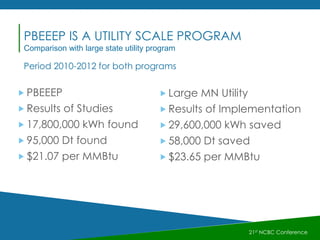
Period 2010-2012 for both programs
 PBEEEP
 Results of Studies
 17,800,000 kWh found
 95,000 Dt found
 $21.07 per MMBtu
 Large MN Utility
 Results of Implementation
 29,600,000 kWh saved
 58,000 Dt saved
 $23.65 per MMBtu
21st NCBC Conference
PBEEEP IS A UTILITY SCALE PROGRAM
Comparison with large state utility program
21st NCBC Conference
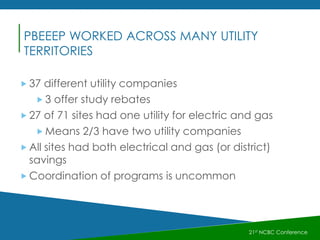
PBEEEP WORKED ACROSS MANY UTILITY
TERRITORIES
 37 different utility companies
 3 offer study rebates
 27 of 71 sites had one utility for electric and gas
 Means 2/3 have two utility companies
 All sites had both electrical and gas (or district)
savings
 Coordination of programs is uncommon
21st NCBC Conference
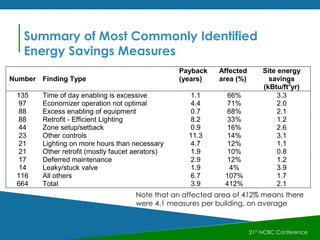
Summary of Most Commonly Identified
Energy Savings Measures
Number Finding Type
Payback
(years)
Affected
area (%)
Site energy
savings
(kBtu/ft2
yr)
135 Time of day enabling is excessive 1.1 66% 3.3
97 Economizer operation not optimal 4.4 71% 2.0
88 Excess enabling of equipment 0.7 68% 2.1
88 Retrofit - Efficient Lighting 8.2 33% 1.2
44 Zone setup/setback 0.9 16% 2.6
23 Other controls 11.3 14% 3.1
21 Lighting on more hours than necessary 4.7 12% 1.1
21 Other retrofit (mostly faucet aerators) 1.9 10% 0.8
17 Deferred maintenance 2.9 12% 1.2
14 Leaky/stuck valve 1.9 4% 3.9
116 All others 6.7 107% 1.7
664 Total 3.9 412% 2.1
Note that an affected area of 412% means there
were 4.1 measures per building, on average
21st NCBC Conference
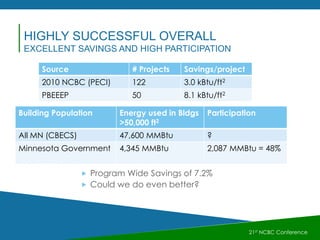
HIGHLY SUCCESSFUL OVERALL
EXCELLENT SAVINGS AND HIGH PARTICIPATION
 Program Wide Savings of 7.2%
 Could we do even better?
Source # Projects Savings/project
2010 NCBC (PECI) 122 3.0 kBtu/ft2
PBEEEP 50 8.1 kBtu/ft2
Building Population Energy used in Bldgs
>50,000 ft2
Participation
All MN (CBECS) 47,600 MMBtu ?
Minnesota Government 4,345 MMBtu 2,087 MMBtu = 48%
21st NCBC Conference
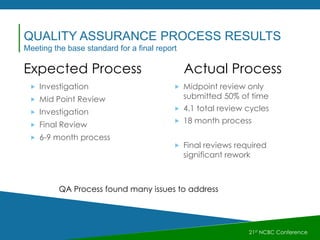
QUALITY ASSURANCE PROCESS RESULTS
Meeting the base standard for a final report
Expected Process Actual Process
 Investigation
 Mid Point Review
 Investigation
 Final Review
 6-9 month process
 Midpoint review only
submitted 50% of time
 4.1 total review cycles
 18 month process
 Final reviews required
significant rework
QA Process found many issues to address
21st NCBC Conference
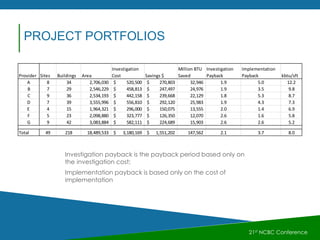
Investigation payback is the payback period based only on
the investigation cost;
Implementation payback is based only on the cost of
implementation
PROJECT PORTFOLIOS
Provider Sites Buildings Area
Investigation
Cost Savings $
Million BTU
Saved
Investigation
Payback
Implementation
Payback kbtu/sft
A 8 34 2,706,030 520,500$ 270,803$ 32,946 1.9 5.0 12.2
B 7 29 2,546,229 458,813$ 247,497$ 24,976 1.9 3.5 9.8
C 9 36 2,534,193 442,158$ 239,668$ 22,129 1.8 5.3 8.7
D 7 39 3,555,996 556,810$ 292,120$ 25,983 1.9 4.3 7.3
E 4 15 1,964,321 296,000$ 150,075$ 13,555 2.0 1.4 6.9
F 5 23 2,098,880 323,777$ 126,350$ 12,070 2.6 1.6 5.8
G 9 42 3,083,884 582,111$ 224,689$ 15,903 2.6 2.6 5.2
Total 49 218 18,489,533 3,180,169$ 1,551,202$ 147,562 2.1 3.7 8.0
21st NCBC Conference
Results of Calculation Reviews
SAVINGS CALCULATIONS REQUIRED
REVISION MOST OF THE TIME
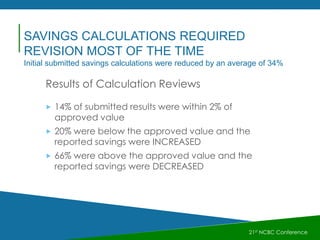
Initial submitted savings calculations were reduced by an average of 34%
 14% of submitted results were within 2% of
approved value
 20% were below the approved value and the
reported savings were INCREASED
 66% were above the approved value and the
reported savings were DECREASED
21st NCBC Conference
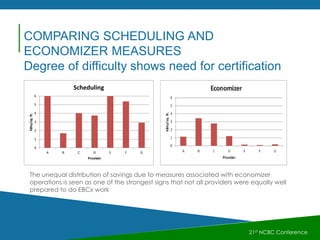
The unequal distribution of savings due to measures associated with economizer
operations is seen as one of the strongest signs that not all providers were equally well
prepared to do EBCx work
COMPARING SCHEDULING AND
ECONOMIZER MEASURES
Degree of difficulty shows need for certification
0
1
2
3
4
5
6
A B C D E F G
kBtu/sq.ft.
Provider
Scheduling
21st NCBC Conference
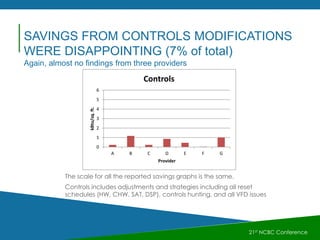
The scale for all the reported savings graphs is the same.
Controls includes adjustments and strategies including all reset
schedules (HW, CHW, SAT, DSP), controls hunting, and all VFD issues
SAVINGS FROM CONTROLS MODIFICATIONS
WERE DISAPPOINTING (7% of total)
Again, almost no findings from three providers
0
1
2
3
4
5
6
A B C D E F G
kBtu/sq.ft.
Provider
Controls
21st NCBC Conference
IF YOU COULD CHANGE ONE THING, WHAT
WOULD IT BE?
Have a method for selecting previously trained providers
A recognized certification process would deliver this
21st NCBC Conference
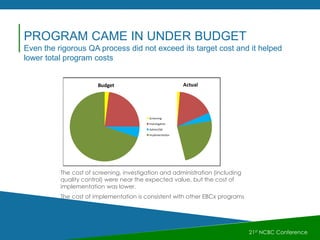
The cost of screening, investigation and administration (including
quality control) were near the expected value, but the cost of
implementation was lower.
The cost of implementation is consistent with other EBCx programs
PROGRAM CAME IN UNDER BUDGET
Even the rigorous QA process did not exceed its target cost and it helped
lower total program costs
ActualBudget
Screening
Investigation
Admin/QA
Implementation
21st NCBC Conference
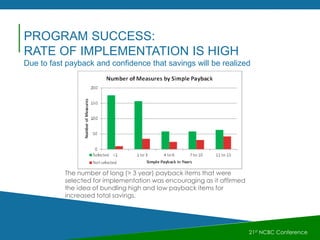
The number of long (> 3 year) payback items that were
selected for implementation was encouraging as it affirmed
the idea of bundling high and low payback items for
increased total savings.
PROGRAM SUCCESS:
RATE OF IMPLEMENTATION IS HIGH
Due to fast payback and confidence that savings will be realized
21st NCBC Conference
Qualified providers who understand the specialty of
existing building commissioning are essential to identify
all the potential savings
A good customer relationship will increase the rate of
implementation
Programs should address all energy sources at a site
Careful selection of buildings is necessary for a cost-
effective program; some buildings have minimal savings
opportunities.
BEST PRACTICES AND LESSONS LEARNED
Without a quality assurance process, we would not have known….
21st NCBC Conference
Center for Energy and Environment
Gustav Brandstrom, PE Tim Ellingson, PE
Neal Ray Angela Vreeland, PE
Russ Landry, PE Christie Traczyk
Pam Klocek
State of Minnesota
Department of Administration, Real Estate and Construction Services
Department of Commerce, Division of Energy Resources
US Department of Energy
American Recovery and Reinvestment Act Funds
THANK YOU
To the entire team
THANK YOU
Mark Hancock, PE mhancock@mncee.org
Christopher Plum cplum@mncee.org
Center for Energy and Environment
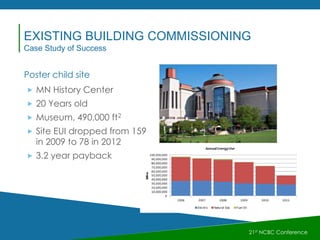
Poster child site
 MN History Center
 20 Years old
 Museum, 490,000 ft2
 Site EUI dropped from 159
in 2009 to 78 in 2012
 3.2 year payback
21st NCBC Conference
EXISTING BUILDING COMMISSIONING
Case Study of Success
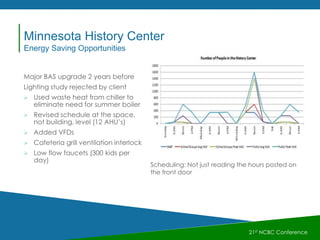
Major BAS upgrade 2 years before
Lighting study rejected by client
 Used waste heat from chiller to
eliminate need for summer boiler
 Revised schedule at the space,
not building, level (12 AHU’s)
 Added VFDs
 Cafeteria grill ventilation interlock
 Low flow faucets (300 kids per
day)
21st NCBC Conference
Scheduling: Not just reading the hours posted on
the front door
Minnesota History Center
Energy Saving Opportunities

Results from minnesota’s existing building commissioning program

  • 1.
    Chris Plum, MarkHancock Center for Energy and Environment Results from Minnesota’s Existing Building Commissioning Program 21st National Conference on Building Commissioning
  • 2.
    AIA Quality Assurance TheBuilding Commissioning Association is a Registered Provider with The American Institute of Architects Continuing Education Systems (AIA/CES). Credit(s) earned on completion of this program will be reported to AIA/CES for AIA members. Certificates of Completion for both AIA members and non-AIA members are available upon request. This program is registered with AIA/CES for continuing professional education. As such, it does not include content that may be deemed or construed to be an approval or endorsement by the AIA of any material of construction or any method or manner of handling, using, distributing, or dealing in any material or product. Questions related to specific materials, methods, and services will be addressed at the conclusion of this presentation. 21st NCBC Conference
  • 3.
    Presentation Description CEE administersthe state program to perform existing building commissioning (EBCx) on state government buildings in Minnesota. Investigations of 227 buildings containing nearly 19 million square feet located on 50 sites throughout the state were performed. The participation rate in the program is very high, which provides a useful measure of the potential for broadly implemented EBCx programs. Several best practices for program managers were identified. We included a rigorous quality assurance process which resulted in a number of lessons learned, especially the need for a meaningful provider certification if customers are to receive consistent, high quality EBCx projects. 21st NCBC Conference
  • 4.
    At the endof this session, participants will be able to: 1. Identify several best practices for Existing Building Commissioning 1. Requires specialized training 2. Would benefit from a rigorous certification process 2. Understand how to identify buildings where EBCx can be effective 1. Cost effectiveness of the investigation must be considered 3. See how quality assurance improves customer outcomes Learning Objectives 21st NCBC Conference
  • 5.
    PBEEEP  Created in2008 by MN State Legislature  Meet two important needs:  Access to technical services that will identify savings  Access to funding to implement identified savings  Designed in partnership with PECI  Providers were selected before program development 21st NCBC Conference PROGRAM BACKGROUND “Public Buildings Enhanced Energy Efficiency Program” = PBEEEP
  • 6.
    Standard Process  Application Screening  Investigation  Implementation  Verification 21st NCBC Conference PROGRAM BACKGROUND “Public Buildings Enhanced Energy Efficiency Program” = PBEEEP Apply Screen Investigate Implement Verify
  • 7.
    Unique features ofa State Sponsored program  Competitively Bid Phases  Scope of work was well defined  List of typical measure had to be checked  Equipment was listed in detail  All energy consuming equipment  Anything that affected the energy consuming equipment  State statute limited measures to 15 year payback or less 21st NCBC Conference PROGRAM BACKGROUND “Public Buildings Enhanced Energy Efficiency Program” = PBEEEP
  • 8.
    Distinctive Uses  CommunityColleges  Prisons  Laboratories  Armories  Museums  State Offices  Parking Garages 21st NCBC Conference CHARACTERISTICS OF THE BUILDINGS State Government Buildings
  • 9.
    State Government BuildingsCBECS Estimates for MN  825 buildings over 50,000 square feet  45 buildings can be rated by Energy Star  9 State Agencies  Distance:10 to 300 miles 21st NCBC Conference CHARACTERISTICS OF THE BUILDINGS State Government Buildings  4,600 buildings over 50,000 square feet  1,800 over 100,000 sq. ft.  542 ENERGY STAR labeled buildings with 102,873,953 square feet  1.8% of US Building stock
  • 10.
    21st NCBC Conference SELECTIONFOR INVESTIGATION Self- selection followed by screening > 50,000 sq ft Applied and Screened InvestigatedAll State Government Buildings 51.4 million sq ft 3,047 buildings 1,428 sites 4,860 MMBTU 18.3 227 50 2,087 34.3 550 bldgs 71 sites 3,000MMBtu 44 million sq ft 825 buildings 145 sites 4,345 MMBtu Processed thru PBEEEP 90% 11% 44% of all of all energy
  • 11.
    Key attributes Needone or more of these  Building Automation with DDC capable of trending  Trend 1,000 or more points at a time  15 minute interval  Memory for several hundred thousand points  Remote access highly desirable  Observed potential for optimization  Motors > 10 HP  Variable Occupancy Schedule  EUI >80 kBtu/ft2yr 21st NCBC Conference SCREENING CRITERIA Developed over the course of the program
  • 12.
    Period 2010-2012 forboth programs  PBEEEP  Results of Studies  17,800,000 kWh found  95,000 Dt found  $21.07 per MMBtu  Large MN Utility  Results of Implementation  29,600,000 kWh saved  58,000 Dt saved  $23.65 per MMBtu 21st NCBC Conference PBEEEP IS A UTILITY SCALE PROGRAM Comparison with large state utility program
  • 13.
    21st NCBC Conference PBEEEPWORKED ACROSS MANY UTILITY TERRITORIES  37 different utility companies  3 offer study rebates  27 of 71 sites had one utility for electric and gas  Means 2/3 have two utility companies  All sites had both electrical and gas (or district) savings  Coordination of programs is uncommon
  • 14.
    21st NCBC Conference Summaryof Most Commonly Identified Energy Savings Measures Number Finding Type Payback (years) Affected area (%) Site energy savings (kBtu/ft2 yr) 135 Time of day enabling is excessive 1.1 66% 3.3 97 Economizer operation not optimal 4.4 71% 2.0 88 Excess enabling of equipment 0.7 68% 2.1 88 Retrofit - Efficient Lighting 8.2 33% 1.2 44 Zone setup/setback 0.9 16% 2.6 23 Other controls 11.3 14% 3.1 21 Lighting on more hours than necessary 4.7 12% 1.1 21 Other retrofit (mostly faucet aerators) 1.9 10% 0.8 17 Deferred maintenance 2.9 12% 1.2 14 Leaky/stuck valve 1.9 4% 3.9 116 All others 6.7 107% 1.7 664 Total 3.9 412% 2.1 Note that an affected area of 412% means there were 4.1 measures per building, on average
  • 15.
    21st NCBC Conference HIGHLYSUCCESSFUL OVERALL EXCELLENT SAVINGS AND HIGH PARTICIPATION  Program Wide Savings of 7.2%  Could we do even better? Source # Projects Savings/project 2010 NCBC (PECI) 122 3.0 kBtu/ft2 PBEEEP 50 8.1 kBtu/ft2 Building Population Energy used in Bldgs >50,000 ft2 Participation All MN (CBECS) 47,600 MMBtu ? Minnesota Government 4,345 MMBtu 2,087 MMBtu = 48%
  • 16.
    21st NCBC Conference QUALITYASSURANCE PROCESS RESULTS Meeting the base standard for a final report Expected Process Actual Process  Investigation  Mid Point Review  Investigation  Final Review  6-9 month process  Midpoint review only submitted 50% of time  4.1 total review cycles  18 month process  Final reviews required significant rework QA Process found many issues to address
  • 17.
    21st NCBC Conference Investigationpayback is the payback period based only on the investigation cost; Implementation payback is based only on the cost of implementation PROJECT PORTFOLIOS Provider Sites Buildings Area Investigation Cost Savings $ Million BTU Saved Investigation Payback Implementation Payback kbtu/sft A 8 34 2,706,030 520,500$ 270,803$ 32,946 1.9 5.0 12.2 B 7 29 2,546,229 458,813$ 247,497$ 24,976 1.9 3.5 9.8 C 9 36 2,534,193 442,158$ 239,668$ 22,129 1.8 5.3 8.7 D 7 39 3,555,996 556,810$ 292,120$ 25,983 1.9 4.3 7.3 E 4 15 1,964,321 296,000$ 150,075$ 13,555 2.0 1.4 6.9 F 5 23 2,098,880 323,777$ 126,350$ 12,070 2.6 1.6 5.8 G 9 42 3,083,884 582,111$ 224,689$ 15,903 2.6 2.6 5.2 Total 49 218 18,489,533 3,180,169$ 1,551,202$ 147,562 2.1 3.7 8.0
  • 18.
    21st NCBC Conference Resultsof Calculation Reviews SAVINGS CALCULATIONS REQUIRED REVISION MOST OF THE TIME Initial submitted savings calculations were reduced by an average of 34%  14% of submitted results were within 2% of approved value  20% were below the approved value and the reported savings were INCREASED  66% were above the approved value and the reported savings were DECREASED
  • 19.
    21st NCBC Conference Theunequal distribution of savings due to measures associated with economizer operations is seen as one of the strongest signs that not all providers were equally well prepared to do EBCx work COMPARING SCHEDULING AND ECONOMIZER MEASURES Degree of difficulty shows need for certification 0 1 2 3 4 5 6 A B C D E F G kBtu/sq.ft. Provider Scheduling
  • 20.
    21st NCBC Conference Thescale for all the reported savings graphs is the same. Controls includes adjustments and strategies including all reset schedules (HW, CHW, SAT, DSP), controls hunting, and all VFD issues SAVINGS FROM CONTROLS MODIFICATIONS WERE DISAPPOINTING (7% of total) Again, almost no findings from three providers 0 1 2 3 4 5 6 A B C D E F G kBtu/sq.ft. Provider Controls
  • 21.
    21st NCBC Conference IFYOU COULD CHANGE ONE THING, WHAT WOULD IT BE? Have a method for selecting previously trained providers A recognized certification process would deliver this
  • 22.
    21st NCBC Conference Thecost of screening, investigation and administration (including quality control) were near the expected value, but the cost of implementation was lower. The cost of implementation is consistent with other EBCx programs PROGRAM CAME IN UNDER BUDGET Even the rigorous QA process did not exceed its target cost and it helped lower total program costs ActualBudget Screening Investigation Admin/QA Implementation
  • 23.
    21st NCBC Conference Thenumber of long (> 3 year) payback items that were selected for implementation was encouraging as it affirmed the idea of bundling high and low payback items for increased total savings. PROGRAM SUCCESS: RATE OF IMPLEMENTATION IS HIGH Due to fast payback and confidence that savings will be realized
  • 24.
    21st NCBC Conference Qualifiedproviders who understand the specialty of existing building commissioning are essential to identify all the potential savings A good customer relationship will increase the rate of implementation Programs should address all energy sources at a site Careful selection of buildings is necessary for a cost- effective program; some buildings have minimal savings opportunities. BEST PRACTICES AND LESSONS LEARNED Without a quality assurance process, we would not have known….
  • 25.
    21st NCBC Conference Centerfor Energy and Environment Gustav Brandstrom, PE Tim Ellingson, PE Neal Ray Angela Vreeland, PE Russ Landry, PE Christie Traczyk Pam Klocek State of Minnesota Department of Administration, Real Estate and Construction Services Department of Commerce, Division of Energy Resources US Department of Energy American Recovery and Reinvestment Act Funds THANK YOU To the entire team
  • 26.
    THANK YOU Mark Hancock,PE mhancock@mncee.org Christopher Plum cplum@mncee.org Center for Energy and Environment
  • 27.
    Poster child site MN History Center  20 Years old  Museum, 490,000 ft2  Site EUI dropped from 159 in 2009 to 78 in 2012  3.2 year payback 21st NCBC Conference EXISTING BUILDING COMMISSIONING Case Study of Success
  • 28.
    Major BAS upgrade2 years before Lighting study rejected by client  Used waste heat from chiller to eliminate need for summer boiler  Revised schedule at the space, not building, level (12 AHU’s)  Added VFDs  Cafeteria grill ventilation interlock  Low flow faucets (300 kids per day) 21st NCBC Conference Scheduling: Not just reading the hours posted on the front door Minnesota History Center Energy Saving Opportunities