Program Evaluation Overview
Date: June 9, 2015
New Jersey Comfort Partners Program Overview
• Statewide low-income energy conservation program.
• Sponsored by NJCEP and administered by the gas and electric
utilities.
• Treats all eligible low-income households.
• In its 14th year.
• No cost to participants.
Management
The Comfort Partners Program is a single entity administered statewide
by participating utility members of the Comfort Partners Working Group.
The Working Group was established to take advantage of economies of
scale and leverage the abilities of overlapping gas and electric service
territories to enable all eligible New Jersey low income utility customers
to be served by one program in a consistent manner. Each year the
Working Group submits a compliance filing to the BPU inclusive of
program details and funding specifications.
Program Statistics
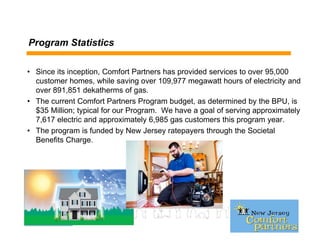
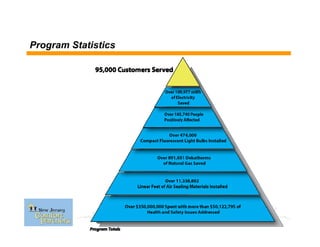
• Since its inception, Comfort Partners has provided services to over 95,000
customer homes, while saving over 109,977 megawatt hours of electricity and
over 891,851 dekatherms of gas.
• The current Comfort Partners Program budget, as determined by the BPU, is
$35 Million; typical for our Program. We have a goal of serving approximately
7,617 electric and approximately 6,985 gas customers this program year.
• The program is funded by New Jersey ratepayers through the Societal
Benefits Charge.
Program Statistics
Program Totals
Eligibility
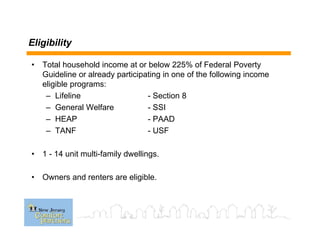
• Total household income at or below 225% of Federal Poverty
Guideline or already participating in one of the following income
eligible programs:
– Lifeline - Section 8
– General Welfare - SSI
– HEAP - PAAD
– TANF - USF
• 1 - 14 unit multi-family dwellings.
• Owners and renters are eligible.
Program Objectives
• Enhance the customer’s health, safety and comfort.
• Reduce the customer’s household energy
consumption.
• Make the customer’s energy bills more affordable.
– Low income customers pay a disproportionate
amount of their disposable income to utilities.
How we Achieve these Objectives
• Audit the customer's home for severe Health
and Safety issues.
• Install appropriate, energy saving products and
measures.
• Provide site-specific, customer energy education
partnering with the customer to take control of
their energy usage and energy bills.
Energy Savings Measures
• Measures chosen are determined by program
cost-effectiveness standards. Measures may
include:
– Air sealing
– Insulation
– Refrigerator replacement
– Hot water measures including hot water heaters
– Compact fluorescent lighting
– Evaluation / replacement of heating and air conditioning systems
– Duct repairs, etc.
Health & Safety Services
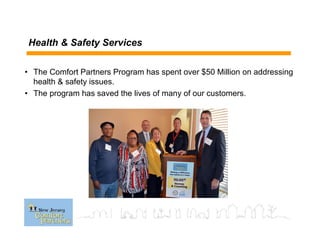
• The Comfort Partners Program has spent over $50 Million on addressing
health & safety issues.
• The program has saved the lives of many of our customers.
• We routinely save customers from serious and potentially life
threatening health/safety issues by performing the following measures:
– Gas leak testing / repair
– Combustion appliance testing
– Heating / cooling & water heating equipment repair / replacement
– Installation of CO detectors
– Flue / chimney repair
– Roof repair
– Sewer leak repair
– Venting gas & electric clothes dryers
– Remedying the cause of moisture problems
– Damming of heat producing fixtures
– Replacement of knob and tube wiring
Health & Safety Services
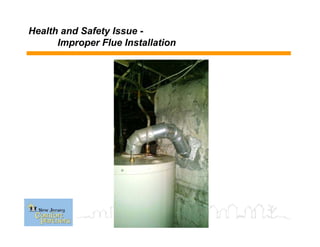
Health and Safety Issue -
Improper Flue Installation
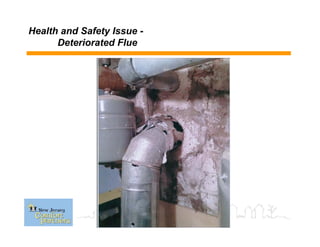
Health and Safety Issue -
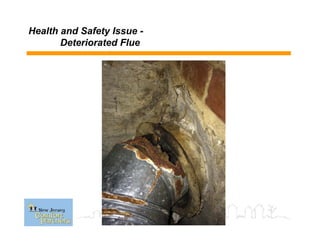
Deteriorated Flue
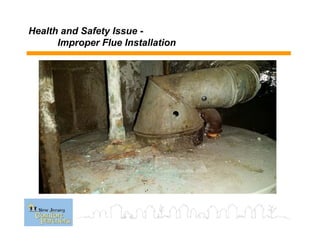
Health and Safety Issue -
Improper Flue Installation
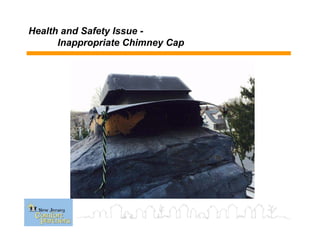
Health and Safety Issue -
Inappropriate Chimney Cap
Health and Safety Issue -
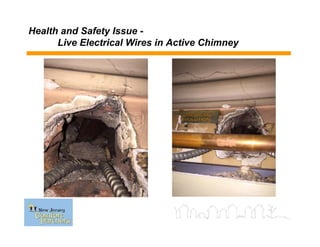
Live Electrical Wires in Active Chimney
Health and Safety Issue -
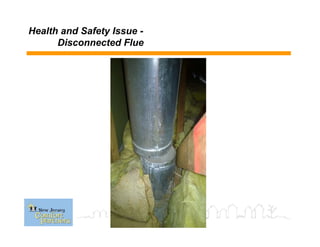
Disconnected Flue
Health and Safety Issue -
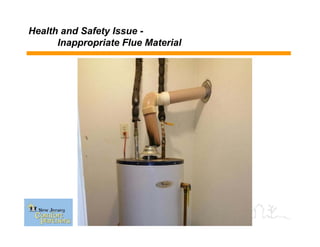
Inappropriate Flue Material
Health and Safety Issue -
Deteriorated Flue
Health and Safety Issue -
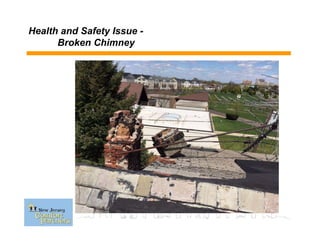
Broken Chimney
Health and Safety Issue -
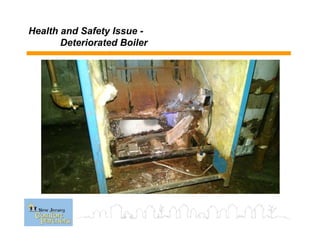
Deteriorated Boiler
How to Apply for New Jersey Comfort Partners
• Visit the www.njcleanenergy.com website
for an application.
• Or Call Comfort Partners Toll Free Number
1-888-773-8326.
• Contact Your Local Utility.
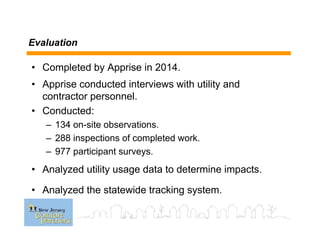
Evaluation
• Completed by Apprise in 2014.
• Apprise conducted interviews with utility and
contractor personnel.
• Conducted:
– 134 on-site observations.
– 288 inspections of completed work.
– 977 participant surveys.
• Analyzed utility usage data to determine impacts.
• Analyzed the statewide tracking system.
Key Findings
• Significant health and safety issues are remedied.
• Positive impacts on affordability and a positive impact for
ratepayers, as the USF credit declined.
• Utility joint delivery of Comfort Partners generates administrative
savings.
– Lower costs due to single site visit.
– Less burden on customer.
• Participant survey findings:
– 50% of participants found their home noticeably more comfortable in
winter after participation.
– 39% of participants found their home noticeably more comfortable in
summer after participation.
On a per household basis:
• Electric Baseload Savings of approx. 470 kWh annually, 6.6% of
treatment group usage.
• Electric Heating Savings of approx. 1,070 kWh annually, 8.2% of
treatment group usage.
• Gas Heating Savings of approx. 50 ccf annually, 4.9% of treatment
group usage.
Key Findings – per Household
Recommendations
• Key recommendations:
– Target high energy users.
– Explore deeper energy savings.
– Focus on improving implementation contractor quality.
• Listed 32 individual recommendations.
– Recommendations can be broken down into six categories:
1. Data Tracking System
2. Program Procedures
3. Contractor Training
4. Customer Targeting
5. Quality Control
6. Additional Program Improvements
1. Data Tracking System
• Evaluation highlighted that the data in the Comfort Partners System
is much more comprehensive than has been seen in many other
programs.
• Recommendations for improving the system are to provide more
efficient program management and operations.
• Evaluation advised that it is important to weigh the cost of such
changes against the potential benefits.
1. Data Tracking System (continued)
• Recommendations include:
– Adding additional reports that contractors, utilities and quality assurance
inspectors feel could be useful. – In Progress
– Adding new features such as tracking ambient CO, flue CO, and if a gas
leak was detected. – In Progress
– Data Accuracy: Utility managers will require that contractors develop
and submit a data quality control plan to prevent data entry errors.
– In Progress
2. Program Procedures
• Revised the Procedure Manual of the Comfort Partners program to
incorporate many of the recommendations from the Apprise
Evaluation. – Implemented
• Digitized both the Field Guide and the Procedure Manual to allow
ready access in the field on electronic devices such as tablets.
– Implemented
• Improved the instructions of several testing and installation
procedures to reduce confusion and ensure consistent
implementation in the field. – Implemented
2. Program Procedures (continued)
• Coordinated efforts with the 3rd party inspector to meet with
contractors and review procedure questions to ensure that everyone
had a thorough understanding of testing and installation methods.
– Implemented & Ongoing
• Streamlined the method that contractors use to determine seasonal
spending for default usage. – Implemented
• Creating a priority list of measures to be installed that will ensure
deeper savings and less missed opportunities. – In Progress
2. Program Procedures (continued)
• Improved the process by which contractors request additional
spending for weatherization or heath and safety.
– Implemented & Ongoing
• Added new procedures to improve ventilation and indoor air quality
in tight houses. – Implemented
• Initiated the evaluation’s recommendation that all houses that
receive attic insulation meet or exceed the minimum State
requirements. – Implemented
2. Program Procedures (continued)
• Created a guide for thermostat installations to ensure that
installations only happen where savings are most guaranteed.
– Implemented
• Modified procedures to restrict work that was being done in
situations where savings were not being realized. – Implemented
• Additional recommendations from the evaluation are being designed
and incorporated into program procedures on a regular basis.
– Ongoing
3. Contractor Training
• Evaluation highlighted need for enhanced training.
• Need for on-going vendor training.
• Knowledgeable and experienced workers are hard to find and retain.
– Workers need to be very knowledgeable in building science.
– Basics can be learned in class, however expertise is acquired through
field experience.
• Actions
– Working Group requires all contractors provide a quarterly training
update & QA/QC Vendor visits the training sessions listed to evaluate
training quality. – Implemented
– Revising Scope of Work of QA/QC Vendor to include Work in Progress
Inspections & Quarterly Technical Training Classes. – In Progress
– Will include regular vendor training and include training on proper field
techniques and training on the Comfort Partners Procedures Manual.
– In Progress & Ongoing
– Revise existing Priority List to provide guidance on the order of installing
measures and requesting additional funding. – Ongoing
3. Contractor Training (continued)
4. Customer Targeting
• Evaluation highlighted need for more and different forms of
outreach.
– Utilities are evaluating alternatives.
• Evaluation found many customers hear about the program through
word-of-mouth.
• USF – is primary target for participants, however many are difficult
to engage.
– Utilities are evaluating alternative marketing channels.
• In discussions with NJ SHARES.
– Utilities are evaluating alternative USF enrollment requirements.
• Many customers in inner cities have building envelope issues
preventing deeper energy efficiency measures from being installed.
– For example, major holes in roofs and walls, mold, asbestos and access
issues.
– Some cities have access to grant funding outside of Comfort Partners to
address building envelope issues.
• Create synergies between cities and Comfort Partners.
– In Progress & Ongoing
• Once building envelope issues are addressed Comfort Partners can perform
it’s work.
• Utilities are focusing these efforts in distressed cities.
4. Customer Targeting (continued)
Root Cause Analysis
• Some Procedures Manual language was ambiguous and
inconsistent.
• More Contractor training needed.
• Improved communication between QA/QC vendor and
installation contractors needed.
• Contractor QA/QC process improvements needed.
37
5. Quality Control
5. Quality Control (continued)
• Corrective Actions
• Contractors refined their QA/QC processes so essentially every job is
inspected internally prior to completion and submission.
– Implemented
• Ambiguous Procedures Manual language revised and clarified.
– Implemented & Ongoing
• Current QA/QC vendor evaluating contractor’s internal training.
– Implemented & Ongoing
• Contractors shadowing current QA/QC vendor on inspections.
– Implemented
5. Quality Control (continued)
• Work in Progress inspections performed by Current QA/QC vendor.
– In Progress
• Technical training classes performed by Current QA/QC vendor.
– In Progress
• Internal inspections of Current QA/QC vendor inspections.
– In Progress
• Corrective Actions
6. Additional Program Improvements
• Standardized work orders to be utilized in the program.
– In Progress
• Implement offset clause in implementation contractors contracts for
non-performing contractors. – In Progress
6. Additional Program Improvements (continued)
• The program has set up weekly QA/QC meetings with the program's
largest implementation contractors to ensure quality control is being
implemented successfully on all completed jobs.
– Implemented & Ongoing
• Utilities are meeting quarterly with all contractors reviewing any
challenges and exchanging best practices with the group to continue
to look for ways to increase customer satisfaction, the number of
measures being implemented, and the quality of the installation of
these measures. – Implemented & Ongoing
• Update Measurement and Verification Protocols
– Implemented & Ongoing
6. Additional Program Improvements (continued)
• Utilities have implemented a training review procedure to ensure
that all contractors are being trained quarterly on best practices in
the industry, on building science and home performance.
– Implemented
• Utilities will arrange for current QA/QC vendor to perform regular
mandatory training for implementation contractor staff.
– In Progress
• Yearly review meeting ensures that any contractors that fall below
the acceptable metrics for quality control are either removed from
the program, or must have an action plan approved by the program
and implemented within 90 days to continue as a contractor in the
Comfort Partners Program. – Pending Yearly Review Meeting
6. Additional Program Improvements (continued)
• Conduct analysis of the energy saving results on a regular basis -
The Utilities will review quarterly the average energy savings per
home by contractor. – In Progress
• Utilities will leverage its experience in other states in determining
what additional measures can be adopted by the program to
increase energy savings per job. – In Progress
• Review work at the contractor level - The program is committed to
driving contractors to a high level of performance.
Q&A
South Jersey Gas
Bruce Grossman
BGROSSMAN@sjindustries.com
PSE&G
Frank Vetri
frank.vetri@pseg.com
JCP&L
Nikky DiPietro
ndipietro@firstenergycorp.com
New Jersey Natural Gas
Gregory Seitz
glseitz@njng.com
Atlantic City Electric
William Ellis
wrellis@pepco.com
Elizabethtown Gas
Gina O'Donnell
godonnel@aglresources.com
All Questions can be sent to:

Final NJCP apprise overview 06 09 2015

  • 1.
  • 2.
    New Jersey ComfortPartners Program Overview • Statewide low-income energy conservation program. • Sponsored by NJCEP and administered by the gas and electric utilities. • Treats all eligible low-income households. • In its 14th year. • No cost to participants.
  • 3.
    Management The Comfort PartnersProgram is a single entity administered statewide by participating utility members of the Comfort Partners Working Group. The Working Group was established to take advantage of economies of scale and leverage the abilities of overlapping gas and electric service territories to enable all eligible New Jersey low income utility customers to be served by one program in a consistent manner. Each year the Working Group submits a compliance filing to the BPU inclusive of program details and funding specifications.
  • 4.
    Program Statistics • Sinceits inception, Comfort Partners has provided services to over 95,000 customer homes, while saving over 109,977 megawatt hours of electricity and over 891,851 dekatherms of gas. • The current Comfort Partners Program budget, as determined by the BPU, is $35 Million; typical for our Program. We have a goal of serving approximately 7,617 electric and approximately 6,985 gas customers this program year. • The program is funded by New Jersey ratepayers through the Societal Benefits Charge.
  • 5.
  • 6.
    Eligibility • Total householdincome at or below 225% of Federal Poverty Guideline or already participating in one of the following income eligible programs: – Lifeline - Section 8 – General Welfare - SSI – HEAP - PAAD – TANF - USF • 1 - 14 unit multi-family dwellings. • Owners and renters are eligible.
  • 7.
    Program Objectives • Enhancethe customer’s health, safety and comfort. • Reduce the customer’s household energy consumption. • Make the customer’s energy bills more affordable. – Low income customers pay a disproportionate amount of their disposable income to utilities.
  • 8.
    How we Achievethese Objectives • Audit the customer's home for severe Health and Safety issues. • Install appropriate, energy saving products and measures. • Provide site-specific, customer energy education partnering with the customer to take control of their energy usage and energy bills.
  • 9.
    Energy Savings Measures •Measures chosen are determined by program cost-effectiveness standards. Measures may include: – Air sealing – Insulation – Refrigerator replacement – Hot water measures including hot water heaters – Compact fluorescent lighting – Evaluation / replacement of heating and air conditioning systems – Duct repairs, etc.
  • 10.
    Health & SafetyServices • The Comfort Partners Program has spent over $50 Million on addressing health & safety issues. • The program has saved the lives of many of our customers.
  • 11.
    • We routinelysave customers from serious and potentially life threatening health/safety issues by performing the following measures: – Gas leak testing / repair – Combustion appliance testing – Heating / cooling & water heating equipment repair / replacement – Installation of CO detectors – Flue / chimney repair – Roof repair – Sewer leak repair – Venting gas & electric clothes dryers – Remedying the cause of moisture problems – Damming of heat producing fixtures – Replacement of knob and tube wiring Health & Safety Services
  • 12.
    Health and SafetyIssue - Improper Flue Installation
  • 13.
    Health and SafetyIssue - Deteriorated Flue
  • 14.
    Health and SafetyIssue - Improper Flue Installation
  • 15.
    Health and SafetyIssue - Inappropriate Chimney Cap
  • 16.
    Health and SafetyIssue - Live Electrical Wires in Active Chimney
  • 17.
    Health and SafetyIssue - Disconnected Flue
  • 18.
    Health and SafetyIssue - Inappropriate Flue Material
  • 19.
    Health and SafetyIssue - Deteriorated Flue
  • 20.
    Health and SafetyIssue - Broken Chimney
  • 21.
    Health and SafetyIssue - Deteriorated Boiler
  • 22.
    How to Applyfor New Jersey Comfort Partners • Visit the www.njcleanenergy.com website for an application. • Or Call Comfort Partners Toll Free Number 1-888-773-8326. • Contact Your Local Utility.
  • 23.
    Evaluation • Completed byApprise in 2014. • Apprise conducted interviews with utility and contractor personnel. • Conducted: – 134 on-site observations. – 288 inspections of completed work. – 977 participant surveys. • Analyzed utility usage data to determine impacts. • Analyzed the statewide tracking system.
  • 24.
    Key Findings • Significanthealth and safety issues are remedied. • Positive impacts on affordability and a positive impact for ratepayers, as the USF credit declined. • Utility joint delivery of Comfort Partners generates administrative savings. – Lower costs due to single site visit. – Less burden on customer. • Participant survey findings: – 50% of participants found their home noticeably more comfortable in winter after participation. – 39% of participants found their home noticeably more comfortable in summer after participation.
  • 25.
    On a perhousehold basis: • Electric Baseload Savings of approx. 470 kWh annually, 6.6% of treatment group usage. • Electric Heating Savings of approx. 1,070 kWh annually, 8.2% of treatment group usage. • Gas Heating Savings of approx. 50 ccf annually, 4.9% of treatment group usage. Key Findings – per Household
  • 26.
    Recommendations • Key recommendations: –Target high energy users. – Explore deeper energy savings. – Focus on improving implementation contractor quality. • Listed 32 individual recommendations. – Recommendations can be broken down into six categories: 1. Data Tracking System 2. Program Procedures 3. Contractor Training 4. Customer Targeting 5. Quality Control 6. Additional Program Improvements
  • 27.
    1. Data TrackingSystem • Evaluation highlighted that the data in the Comfort Partners System is much more comprehensive than has been seen in many other programs. • Recommendations for improving the system are to provide more efficient program management and operations. • Evaluation advised that it is important to weigh the cost of such changes against the potential benefits.
  • 28.
    1. Data TrackingSystem (continued) • Recommendations include: – Adding additional reports that contractors, utilities and quality assurance inspectors feel could be useful. – In Progress – Adding new features such as tracking ambient CO, flue CO, and if a gas leak was detected. – In Progress – Data Accuracy: Utility managers will require that contractors develop and submit a data quality control plan to prevent data entry errors. – In Progress
  • 29.
    2. Program Procedures •Revised the Procedure Manual of the Comfort Partners program to incorporate many of the recommendations from the Apprise Evaluation. – Implemented • Digitized both the Field Guide and the Procedure Manual to allow ready access in the field on electronic devices such as tablets. – Implemented • Improved the instructions of several testing and installation procedures to reduce confusion and ensure consistent implementation in the field. – Implemented
  • 30.
    2. Program Procedures(continued) • Coordinated efforts with the 3rd party inspector to meet with contractors and review procedure questions to ensure that everyone had a thorough understanding of testing and installation methods. – Implemented & Ongoing • Streamlined the method that contractors use to determine seasonal spending for default usage. – Implemented • Creating a priority list of measures to be installed that will ensure deeper savings and less missed opportunities. – In Progress
  • 31.
    2. Program Procedures(continued) • Improved the process by which contractors request additional spending for weatherization or heath and safety. – Implemented & Ongoing • Added new procedures to improve ventilation and indoor air quality in tight houses. – Implemented • Initiated the evaluation’s recommendation that all houses that receive attic insulation meet or exceed the minimum State requirements. – Implemented
  • 32.
    2. Program Procedures(continued) • Created a guide for thermostat installations to ensure that installations only happen where savings are most guaranteed. – Implemented • Modified procedures to restrict work that was being done in situations where savings were not being realized. – Implemented • Additional recommendations from the evaluation are being designed and incorporated into program procedures on a regular basis. – Ongoing
  • 33.
    3. Contractor Training •Evaluation highlighted need for enhanced training. • Need for on-going vendor training. • Knowledgeable and experienced workers are hard to find and retain. – Workers need to be very knowledgeable in building science. – Basics can be learned in class, however expertise is acquired through field experience.
  • 34.
    • Actions – WorkingGroup requires all contractors provide a quarterly training update & QA/QC Vendor visits the training sessions listed to evaluate training quality. – Implemented – Revising Scope of Work of QA/QC Vendor to include Work in Progress Inspections & Quarterly Technical Training Classes. – In Progress – Will include regular vendor training and include training on proper field techniques and training on the Comfort Partners Procedures Manual. – In Progress & Ongoing – Revise existing Priority List to provide guidance on the order of installing measures and requesting additional funding. – Ongoing 3. Contractor Training (continued)
  • 35.
    4. Customer Targeting •Evaluation highlighted need for more and different forms of outreach. – Utilities are evaluating alternatives. • Evaluation found many customers hear about the program through word-of-mouth. • USF – is primary target for participants, however many are difficult to engage. – Utilities are evaluating alternative marketing channels. • In discussions with NJ SHARES. – Utilities are evaluating alternative USF enrollment requirements.
  • 36.
    • Many customersin inner cities have building envelope issues preventing deeper energy efficiency measures from being installed. – For example, major holes in roofs and walls, mold, asbestos and access issues. – Some cities have access to grant funding outside of Comfort Partners to address building envelope issues. • Create synergies between cities and Comfort Partners. – In Progress & Ongoing • Once building envelope issues are addressed Comfort Partners can perform it’s work. • Utilities are focusing these efforts in distressed cities. 4. Customer Targeting (continued)
  • 37.
    Root Cause Analysis •Some Procedures Manual language was ambiguous and inconsistent. • More Contractor training needed. • Improved communication between QA/QC vendor and installation contractors needed. • Contractor QA/QC process improvements needed. 37 5. Quality Control
  • 38.
    5. Quality Control(continued) • Corrective Actions • Contractors refined their QA/QC processes so essentially every job is inspected internally prior to completion and submission. – Implemented • Ambiguous Procedures Manual language revised and clarified. – Implemented & Ongoing • Current QA/QC vendor evaluating contractor’s internal training. – Implemented & Ongoing • Contractors shadowing current QA/QC vendor on inspections. – Implemented
  • 39.
    5. Quality Control(continued) • Work in Progress inspections performed by Current QA/QC vendor. – In Progress • Technical training classes performed by Current QA/QC vendor. – In Progress • Internal inspections of Current QA/QC vendor inspections. – In Progress • Corrective Actions
  • 40.
    6. Additional ProgramImprovements • Standardized work orders to be utilized in the program. – In Progress • Implement offset clause in implementation contractors contracts for non-performing contractors. – In Progress
  • 41.
    6. Additional ProgramImprovements (continued) • The program has set up weekly QA/QC meetings with the program's largest implementation contractors to ensure quality control is being implemented successfully on all completed jobs. – Implemented & Ongoing • Utilities are meeting quarterly with all contractors reviewing any challenges and exchanging best practices with the group to continue to look for ways to increase customer satisfaction, the number of measures being implemented, and the quality of the installation of these measures. – Implemented & Ongoing • Update Measurement and Verification Protocols – Implemented & Ongoing
  • 42.
    6. Additional ProgramImprovements (continued) • Utilities have implemented a training review procedure to ensure that all contractors are being trained quarterly on best practices in the industry, on building science and home performance. – Implemented • Utilities will arrange for current QA/QC vendor to perform regular mandatory training for implementation contractor staff. – In Progress • Yearly review meeting ensures that any contractors that fall below the acceptable metrics for quality control are either removed from the program, or must have an action plan approved by the program and implemented within 90 days to continue as a contractor in the Comfort Partners Program. – Pending Yearly Review Meeting
  • 43.
    6. Additional ProgramImprovements (continued) • Conduct analysis of the energy saving results on a regular basis - The Utilities will review quarterly the average energy savings per home by contractor. – In Progress • Utilities will leverage its experience in other states in determining what additional measures can be adopted by the program to increase energy savings per job. – In Progress • Review work at the contractor level - The program is committed to driving contractors to a high level of performance.
  • 44.
    Q&A South Jersey Gas BruceGrossman BGROSSMAN@sjindustries.com PSE&G Frank Vetri frank.vetri@pseg.com JCP&L Nikky DiPietro ndipietro@firstenergycorp.com New Jersey Natural Gas Gregory Seitz glseitz@njng.com Atlantic City Electric William Ellis wrellis@pepco.com Elizabethtown Gas Gina O'Donnell godonnel@aglresources.com All Questions can be sent to: