ALL ABOUT HVAC
HEATING VENTILATION AND AIR CONDTIONING
WHAT IS HVAC?
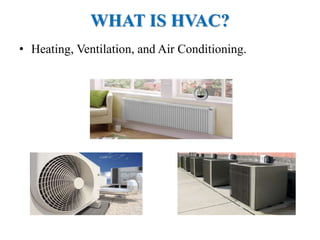
• Heating, Ventilation, and Air Conditioning.
WHAT DOES IT DO?
• HVAC is a basic requirement for your indoor air
quality, what you breathe, temperature, humidity in
your house.
• So when you hear the term "HVAC" it means the
entire air system of your place.
NEED OF HVAC SYSTEM
• Improvement of the air quality
• Moisture regulation
• Balancing environment
• Maintenance of the constant temperature throughout
the year
• Energy conservation
HVAC COMPONENTS
• Furnace
• Heat exchanger
• Evaporator Coil
• Ducts
• Vents
• Condensing Unit
• Refrigerant Lines
• Thermostat
HEATING
CONVECTION - Collective movement of groups
of molecules within fluids , through diffusion
CONDUCTION - Transfer of internal energy by
microscopic diffusion and collisions of particles within a
body due to a temperature gradient.
RADIATION - Electromagnetic waves (EMR) travel
through a vacuum or through matter-containing media.
DISTRIBUTION OF HEAT
WATER / STEAM -
• Piping is used to transport the heat to the rooms.
• Modern hot water boiler heating systems have a
circulator, which is a pump, to move hot water
through the distribution system .
AIR-
• Warm air systems distribute heated air through duct
work systems of supply and return air through metal
or fiberglass ducts.
• Many systems use the same ducts to distribute air
cooled by an evaporator coil for air conditioning.
VENTILATION
MECHANICAL OR FORCED -
Provided by an air handler and used to control indoor air
quality.
• Excess humidity, odours, and contaminants can often be
controlled via dilution or replacement with outside air.
• Kitchens and bathrooms
NATURAL -
ventilation of a building with outside air without using fans
or other mechanical systems.
-reduces spread of diseases- tuberculosis, common cold.
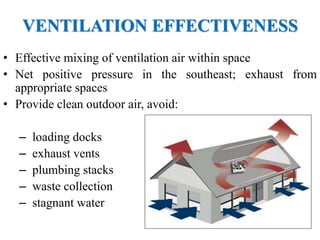
VENTILATION EFFECTIVENESS
• Effective mixing of ventilation air within space
• Net positive pressure in the southeast; exhaust from
appropriate spaces
• Provide clean outdoor air, avoid:
– loading docks
– exhaust vents
– plumbing stacks
– waste collection
– stagnant water
AIR CONDITIONING
An air conditioner is like a refrigerator without the
insulated box. It evaporates a refrigerant, like Freon, to
provide cooling.
Most Air Conditioners Have:
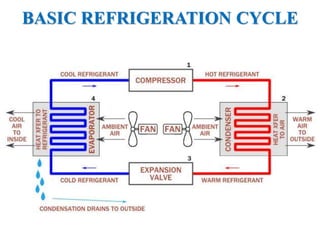
– A compressor
– An expansion valve
– A hot coil (on the outside)
– A chilled coil (on the inside)
– Two fans
– A control unit
BASIC REFRIGERATION CYCLE
BENEFITS OF HVAC
1. Increases Comfort
2. Conserves Energy
3. Regulates Moisture
4. Air Quality Improvement.
APPLICATIONS OF HVAC
• “Free cooling” during moderate temperatures (chiller
bypass).
• Thermal storage—isolation of storage tank
• Water source heat pump pre cooler with isolation
• Heating potable hot water (instantaneous heater)
• Waste heat recovery from condenser water
Created by-
Tel.: +91 9711820827 | Web.: http://www.mgcs.net.in

All About HVAC System - Created by MG Cooling Solutions

  • 1.
    ALL ABOUT HVAC HEATINGVENTILATION AND AIR CONDTIONING
  • 2.
    WHAT IS HVAC? •Heating, Ventilation, and Air Conditioning.
  • 3.
    WHAT DOES ITDO? • HVAC is a basic requirement for your indoor air quality, what you breathe, temperature, humidity in your house. • So when you hear the term "HVAC" it means the entire air system of your place.
  • 4.
    NEED OF HVACSYSTEM • Improvement of the air quality • Moisture regulation • Balancing environment • Maintenance of the constant temperature throughout the year • Energy conservation
  • 5.
    HVAC COMPONENTS • Furnace •Heat exchanger • Evaporator Coil • Ducts • Vents • Condensing Unit • Refrigerant Lines • Thermostat
  • 6.
    HEATING CONVECTION - Collectivemovement of groups of molecules within fluids , through diffusion CONDUCTION - Transfer of internal energy by microscopic diffusion and collisions of particles within a body due to a temperature gradient. RADIATION - Electromagnetic waves (EMR) travel through a vacuum or through matter-containing media.
  • 7.
    DISTRIBUTION OF HEAT WATER/ STEAM - • Piping is used to transport the heat to the rooms. • Modern hot water boiler heating systems have a circulator, which is a pump, to move hot water through the distribution system . AIR- • Warm air systems distribute heated air through duct work systems of supply and return air through metal or fiberglass ducts. • Many systems use the same ducts to distribute air cooled by an evaporator coil for air conditioning.
  • 8.
    VENTILATION MECHANICAL OR FORCED- Provided by an air handler and used to control indoor air quality. • Excess humidity, odours, and contaminants can often be controlled via dilution or replacement with outside air. • Kitchens and bathrooms NATURAL - ventilation of a building with outside air without using fans or other mechanical systems. -reduces spread of diseases- tuberculosis, common cold.
  • 9.
    VENTILATION EFFECTIVENESS • Effectivemixing of ventilation air within space • Net positive pressure in the southeast; exhaust from appropriate spaces • Provide clean outdoor air, avoid: – loading docks – exhaust vents – plumbing stacks – waste collection – stagnant water
  • 10.
    AIR CONDITIONING An airconditioner is like a refrigerator without the insulated box. It evaporates a refrigerant, like Freon, to provide cooling. Most Air Conditioners Have: – A compressor – An expansion valve – A hot coil (on the outside) – A chilled coil (on the inside) – Two fans – A control unit
  • 11.
  • 12.
    BENEFITS OF HVAC 1.Increases Comfort 2. Conserves Energy 3. Regulates Moisture 4. Air Quality Improvement.
  • 13.
    APPLICATIONS OF HVAC •“Free cooling” during moderate temperatures (chiller bypass). • Thermal storage—isolation of storage tank • Water source heat pump pre cooler with isolation • Heating potable hot water (instantaneous heater) • Waste heat recovery from condenser water
  • 14.
    Created by- Tel.: +919711820827 | Web.: http://www.mgcs.net.in