Restless legs syndrome

  CREATIVE ANALYSIS BY
MAN WITHOUT BRAIN TEAM
What is restless legs syndrome (RLS)?

• Restless legs syndrome is a disorder that makes you
  feel like you must move. This feeling usually affects the
  legs. But some people feel it in their arms, torso, or in a
  phantom limb (the part of a limb that has been
  amputated). People often describe these feelings as
  tingling, "pins and needles,"
  prickling, pulling, aching, or crawling. When you have
  restless legs syndrome, moving usually makes you feel
  better, at least for a short time. For most people, this
  problem happens at night when they are trying to
  sleep. The sensations can lead to sleep deprivation and
  stress.
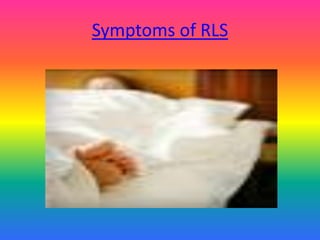
Symptoms of RLS
Severity of RLS symptoms
• The severity of RLS symptoms ranges from
  mild to intolerable. Symptoms can come and
  go and severity can also vary. The symptoms
  are generally worse in the evening and at
  night and less severe in the morning. For some
  people, symptoms may cause severe nightly
  sleep disruption that can significantly impair a
  person's quality of life.
Who Gets Restless Legs Syndrome?

• Restless legs syndrome affects both sexes but is
  more common in women and may begin at any
  age, even in young children. Most people who are
  affected severely are middle-aged or older.
• RLS is often unrecognized or misdiagnosed. In
  many people it is not diagnosed until 10 to 20
  years after symptoms begin. Once correctly
  diagnosed, RLS can often be treated successfully.
Causes of Restless Legs Syndrome
•   In most cases, doctors do not know the cause of restless leg
    syndrome; however, they suspect that genes play a role. About half
    of people with RLS also have a family member with the condition.
•   Other factors associated with the development or worsening of
    restless legs syndrome include:
•   Chronic diseases. Certain chronic diseases and medical
    conditions, including iron deficiency, Parkinson’s disease, kidney
    failure, diabetes, and peripheral neuropathy often include symptoms
    of RLS. Treating these conditions often gives some relief from restless
    legs symptoms.
•   Medications. Some types of medications, including antinausea
    drugs, antipsychotic drugs, some antidepressants, and cold and
    allergy medications containing antihistamines may worsen
    symptoms.
•   Pregnancy. Some women experience RLS during
    pregnancy, especially in the last trimester. Symptoms usually go away
    within a month after delivery.
•   Other factors, including alcohol use and sleep deprivation, may
    trigger symptoms or make them worse. Improving sleep or eliminating
    alcohol use in these cases may relieve symptoms.
Diagnosis of Restless Legs Syndrome

• There is no medical test to diagnose restless
  legs syndrome; however, doctors may use
  blood tests and other exams to rule out other
  conditions. The diagnosis of restless legs
  syndrome is based on a patient’s symptoms
  and answers to questions concerning family
  history of similar symptoms, medication
  use, the presence of other symptoms or
  medical conditions, or problems with daytime
  sleepiness.
TAKE ACTION FOR YOUR RLS
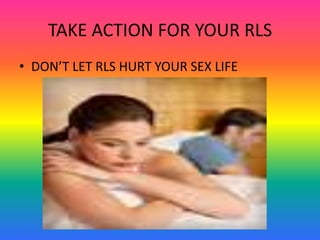
• DON’T LET RLS HURT YOUR SEX LIFE
TAKE ACTION FOR YOUR RLS
          DON’T LET RLS HURT YOUR SEX LIFE
•   Restless legs syndrome (RLS) can take a toll on your relationship. It
    can steal your sleep and make nights less comfortable for your
    partner.
•   Over time, that adds up. The relationship problems mainly relate to
    issues with sleeping. Most people with RLS also have a condition
    known as periodic limb movement disorder (PLMD) -- involuntary
    movement of the feet and legs.
•   That can cause problems for your partner.
•   When people don’t sleep well, they tend to feel fatigued, have
    trouble thinking clearly, and feel more stressed. A chronic state of
    sleep deprivation isn’t good for anyone, or their relationships.
•   If one partner’s RLS is bad enough that it interferes with their own and
    the other person’s sleep, then both people are chronically sleep
    deprived.
•   There are steps you can take to make sure your relationship stays
    strong despite your RLS.
•   It goes beyond treating your RLS or adjusting your lifestyle. It's also
    about how you communicate with your partner -- in general and
    about RLS.
TAKE ACTION FOR YOUR RLS
           DON’T LET RLS HURT YOUR SEX LIFE
Ways to Keep RLS From Hurting Your Sex Life
• 1. Talk with your partner about your RLS. Help your partner
  understand why you are pacing or moving around a lot.
  Conversation can prevent misunderstandings, such as thinking you
  just aren’t interested in him or her. Talking can also help you feel
  understood and supported, which could relieve some of your
  stress.
• 2. Take warm baths together. Bathing alone is fine, of course, but
  bathing with your partner offers a chance for
  communication, stress relief, and enjoyable intimate time together.
• 3. Enjoy a leg massage. A loving leg massage can relieve
  symptoms of RLS. Expand it to a full body massage, if you like.
• 4. Have sex. Some research links orgasm to the release of the brain
  chemical dopamine, which can ease RLS symptoms.
TAKE ACTION FOR YOUR RLS
                     CHANGE OF LIFE STYLE
If you've got restless legs syndrome (RLS), your daily habits can make a
difference to your condition.
Revamping your diet, exercise, and medications is just the beginning of
what you can do to improve your RLS. You might even find some help in
unexpected places.
TAKE ACTION FOR YOUR RLS
                                   CHANGE OF LIFE STYLE
                         Lifestyle Nips for Restless Legs Syndrome
•   Get hot and cold: Take a warm bath or shower before you go bed to relax.

•   Move and massage: Stretch your legs before bedtime. For instance, flex your ankles to
    stretch your calf muscles.Massage your legs. It's a kind of "counter-stimulation" to the
    sensations of RLS.

•   Review your medications:With your doctor, go over all the medications you
    take, including even those that don't need a prescription.

•   Be active, but don't overdo it: You need to be active, just like everyone else, for your
    best health. With RLS, you should avoid sudden changes in your activity level, such as
    suddenly starting to train for a marathon or quitting your usual routine.

•   Back off of caffeine Alcohol: Giving up coffee, chocolate, caffeinated sodas, and
    other caffeine-containing foods may help you wind down for better sleep. Alcohol
    might help you fall asleep, but alcohol will also wake you up in the middle of the night.
    When that happens, your restless legs may bother you even more.

•   Eat a healthy diet:Everyone needs to do this, and if you have RLS, it's even more
    important. Some cases of RLS are linked to not having enough iron. Supplementing
    with iron may help. Magnesium supplements might also be a good idea, though it's
    not clear how it helps, Vensel Rundo says. Talk to your doctor before starting
    magnesium supplements, and about what dose, since too much magnesium can
    cause diarrhea.
HOW TO GET MORE SLEEP
Upgrade your sleep habits.
• Finish eating 2-3 hours before bedtime, so you have time to digest.
• Go to bed at the same time each night.
• Keep your bedroom cool, dark, and primed for sleep.
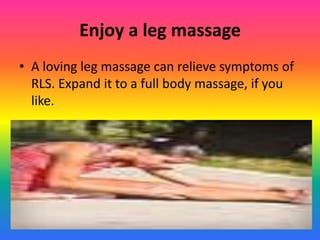
Enjoy a leg massage
• A loving leg massage can relieve symptoms of
  RLS. Expand it to a full body massage, if you
  like.
Talk with your doctor

• Where to go from here:
Now that you have read this information, you
are ready to find ways to get more sleep.
If you have questions about this
information, print it out and take it with you
when you visit your doctor. You may want to
mark areas or make notes where you have
questions. Your doctor may have more
suggestions on how you can sleep better.
Talk with your doctor
END
• THANK YOU

Restless legs syndrome

  • 1.
    Restless legs syndrome CREATIVE ANALYSIS BY MAN WITHOUT BRAIN TEAM
  • 2.
    What is restlesslegs syndrome (RLS)? • Restless legs syndrome is a disorder that makes you feel like you must move. This feeling usually affects the legs. But some people feel it in their arms, torso, or in a phantom limb (the part of a limb that has been amputated). People often describe these feelings as tingling, "pins and needles," prickling, pulling, aching, or crawling. When you have restless legs syndrome, moving usually makes you feel better, at least for a short time. For most people, this problem happens at night when they are trying to sleep. The sensations can lead to sleep deprivation and stress.
  • 3.
  • 4.
    Severity of RLSsymptoms • The severity of RLS symptoms ranges from mild to intolerable. Symptoms can come and go and severity can also vary. The symptoms are generally worse in the evening and at night and less severe in the morning. For some people, symptoms may cause severe nightly sleep disruption that can significantly impair a person's quality of life.
  • 5.
    Who Gets RestlessLegs Syndrome? • Restless legs syndrome affects both sexes but is more common in women and may begin at any age, even in young children. Most people who are affected severely are middle-aged or older. • RLS is often unrecognized or misdiagnosed. In many people it is not diagnosed until 10 to 20 years after symptoms begin. Once correctly diagnosed, RLS can often be treated successfully.
  • 6.
    Causes of RestlessLegs Syndrome • In most cases, doctors do not know the cause of restless leg syndrome; however, they suspect that genes play a role. About half of people with RLS also have a family member with the condition. • Other factors associated with the development or worsening of restless legs syndrome include: • Chronic diseases. Certain chronic diseases and medical conditions, including iron deficiency, Parkinson’s disease, kidney failure, diabetes, and peripheral neuropathy often include symptoms of RLS. Treating these conditions often gives some relief from restless legs symptoms. • Medications. Some types of medications, including antinausea drugs, antipsychotic drugs, some antidepressants, and cold and allergy medications containing antihistamines may worsen symptoms. • Pregnancy. Some women experience RLS during pregnancy, especially in the last trimester. Symptoms usually go away within a month after delivery. • Other factors, including alcohol use and sleep deprivation, may trigger symptoms or make them worse. Improving sleep or eliminating alcohol use in these cases may relieve symptoms.
  • 7.
    Diagnosis of RestlessLegs Syndrome • There is no medical test to diagnose restless legs syndrome; however, doctors may use blood tests and other exams to rule out other conditions. The diagnosis of restless legs syndrome is based on a patient’s symptoms and answers to questions concerning family history of similar symptoms, medication use, the presence of other symptoms or medical conditions, or problems with daytime sleepiness.
  • 8.
    TAKE ACTION FORYOUR RLS • DON’T LET RLS HURT YOUR SEX LIFE
  • 9.
    TAKE ACTION FORYOUR RLS DON’T LET RLS HURT YOUR SEX LIFE • Restless legs syndrome (RLS) can take a toll on your relationship. It can steal your sleep and make nights less comfortable for your partner. • Over time, that adds up. The relationship problems mainly relate to issues with sleeping. Most people with RLS also have a condition known as periodic limb movement disorder (PLMD) -- involuntary movement of the feet and legs. • That can cause problems for your partner. • When people don’t sleep well, they tend to feel fatigued, have trouble thinking clearly, and feel more stressed. A chronic state of sleep deprivation isn’t good for anyone, or their relationships. • If one partner’s RLS is bad enough that it interferes with their own and the other person’s sleep, then both people are chronically sleep deprived. • There are steps you can take to make sure your relationship stays strong despite your RLS. • It goes beyond treating your RLS or adjusting your lifestyle. It's also about how you communicate with your partner -- in general and about RLS.
  • 10.
    TAKE ACTION FORYOUR RLS DON’T LET RLS HURT YOUR SEX LIFE Ways to Keep RLS From Hurting Your Sex Life • 1. Talk with your partner about your RLS. Help your partner understand why you are pacing or moving around a lot. Conversation can prevent misunderstandings, such as thinking you just aren’t interested in him or her. Talking can also help you feel understood and supported, which could relieve some of your stress. • 2. Take warm baths together. Bathing alone is fine, of course, but bathing with your partner offers a chance for communication, stress relief, and enjoyable intimate time together. • 3. Enjoy a leg massage. A loving leg massage can relieve symptoms of RLS. Expand it to a full body massage, if you like. • 4. Have sex. Some research links orgasm to the release of the brain chemical dopamine, which can ease RLS symptoms.
  • 11.
    TAKE ACTION FORYOUR RLS CHANGE OF LIFE STYLE If you've got restless legs syndrome (RLS), your daily habits can make a difference to your condition. Revamping your diet, exercise, and medications is just the beginning of what you can do to improve your RLS. You might even find some help in unexpected places.
  • 12.
    TAKE ACTION FORYOUR RLS CHANGE OF LIFE STYLE Lifestyle Nips for Restless Legs Syndrome • Get hot and cold: Take a warm bath or shower before you go bed to relax. • Move and massage: Stretch your legs before bedtime. For instance, flex your ankles to stretch your calf muscles.Massage your legs. It's a kind of "counter-stimulation" to the sensations of RLS. • Review your medications:With your doctor, go over all the medications you take, including even those that don't need a prescription. • Be active, but don't overdo it: You need to be active, just like everyone else, for your best health. With RLS, you should avoid sudden changes in your activity level, such as suddenly starting to train for a marathon or quitting your usual routine. • Back off of caffeine Alcohol: Giving up coffee, chocolate, caffeinated sodas, and other caffeine-containing foods may help you wind down for better sleep. Alcohol might help you fall asleep, but alcohol will also wake you up in the middle of the night. When that happens, your restless legs may bother you even more. • Eat a healthy diet:Everyone needs to do this, and if you have RLS, it's even more important. Some cases of RLS are linked to not having enough iron. Supplementing with iron may help. Magnesium supplements might also be a good idea, though it's not clear how it helps, Vensel Rundo says. Talk to your doctor before starting magnesium supplements, and about what dose, since too much magnesium can cause diarrhea.
  • 13.
    HOW TO GETMORE SLEEP Upgrade your sleep habits. • Finish eating 2-3 hours before bedtime, so you have time to digest. • Go to bed at the same time each night. • Keep your bedroom cool, dark, and primed for sleep.
  • 14.
    Enjoy a legmassage • A loving leg massage can relieve symptoms of RLS. Expand it to a full body massage, if you like.
  • 15.
    Talk with yourdoctor • Where to go from here: Now that you have read this information, you are ready to find ways to get more sleep. If you have questions about this information, print it out and take it with you when you visit your doctor. You may want to mark areas or make notes where you have questions. Your doctor may have more suggestions on how you can sleep better.
  • 16.
  • 17.