Periodic Limb Movement Disorder
(PLMD)
Ade Wijaya, MD
August 2018
Introduction
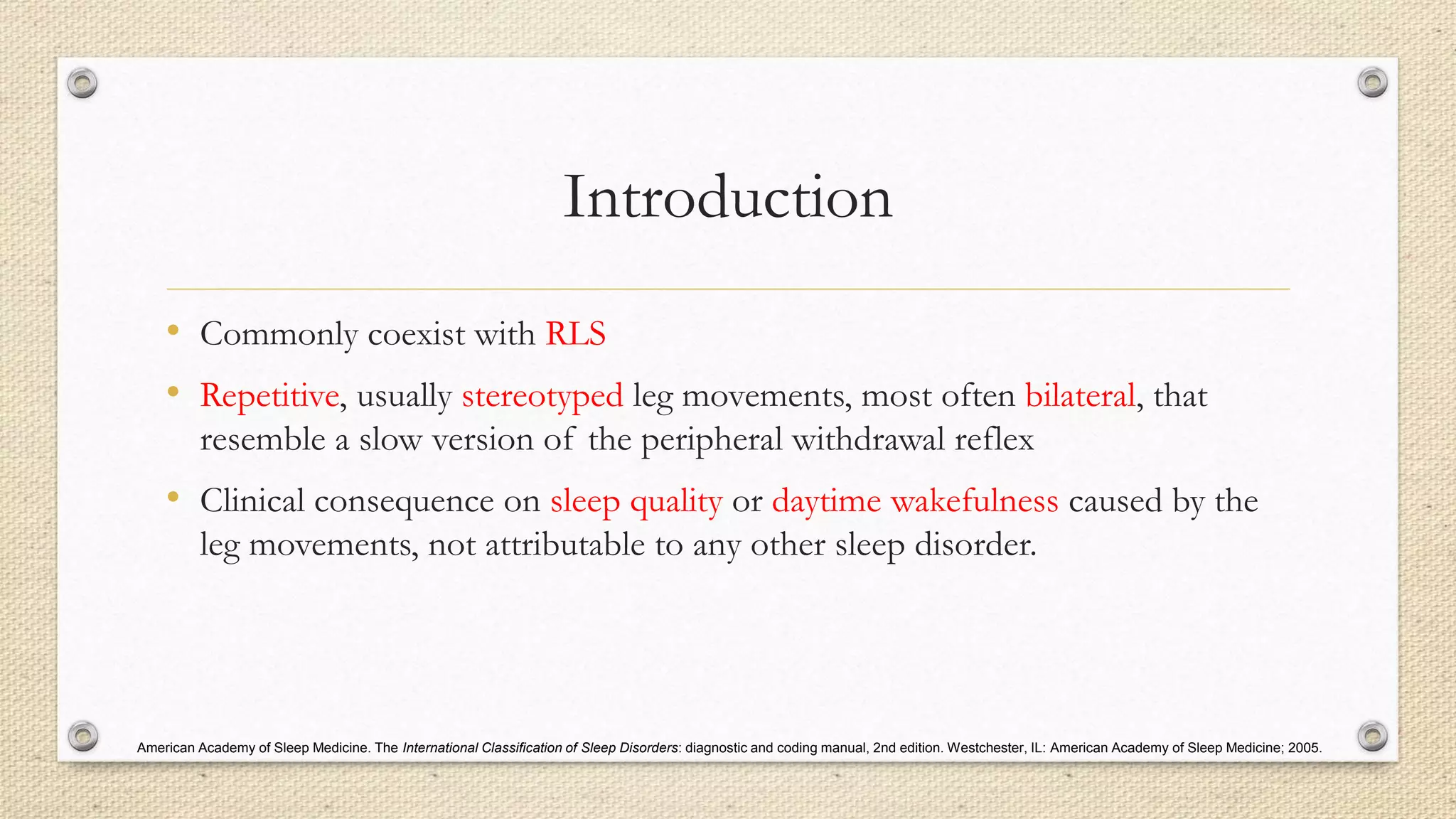
• Commonly coexist with RLS
• Repetitive, usually stereotyped leg movements, most often bilateral, that
resemble a slow version of the peripheral withdrawal reflex
• Clinical consequence on sleep quality or daytime wakefulness caused by the
leg movements, not attributable to any other sleep disorder.
American Academy of Sleep Medicine. The International Classification of Sleep Disorders: diagnostic and coding manual, 2nd edition. Westchester, IL: American Academy of Sleep Medicine; 2005.
Epidemiology
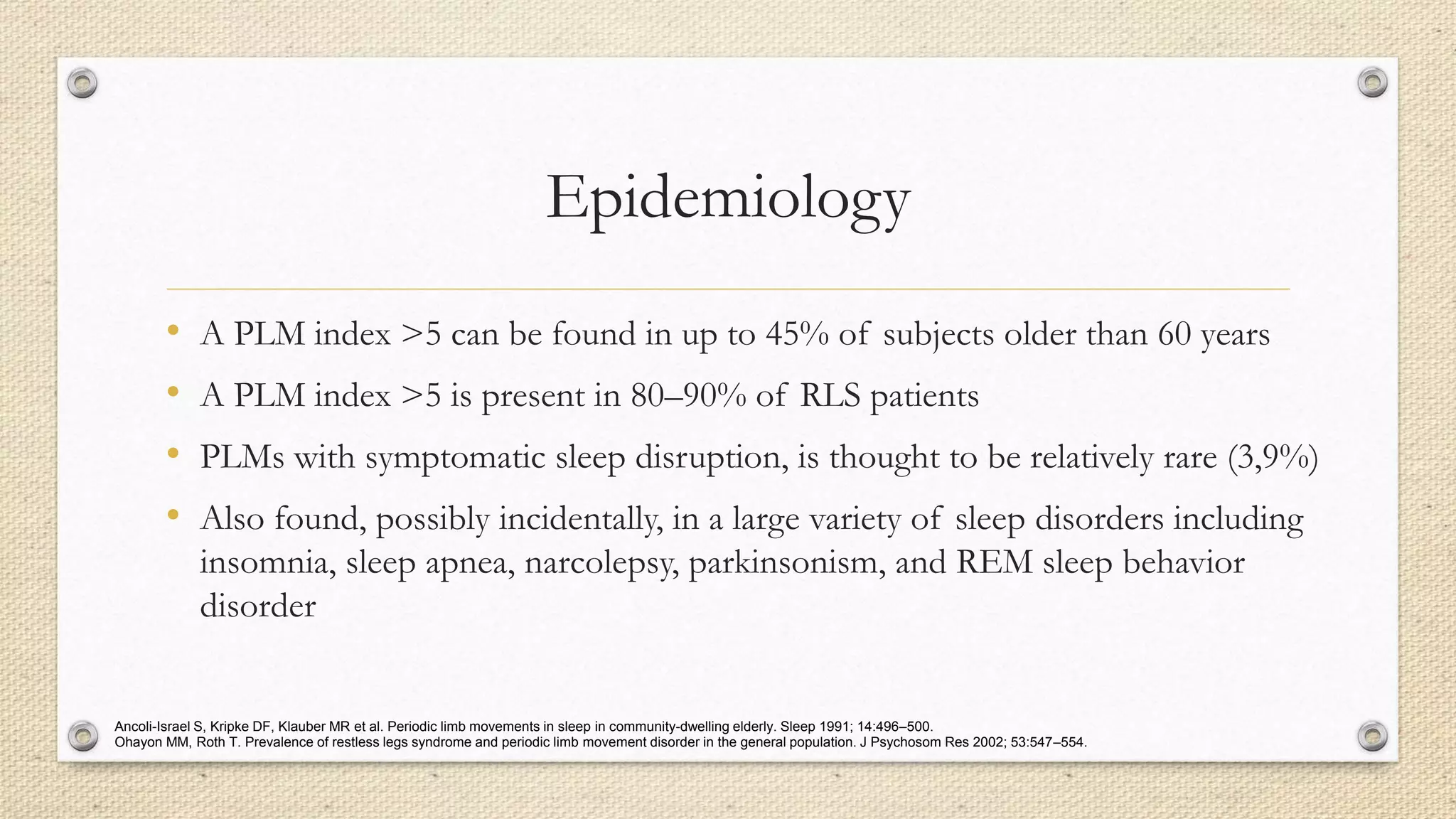
• A PLM index >5 can be found in up to 45% of subjects older than 60 years
• A PLM index >5 is present in 80–90% of RLS patients
• PLMs with symptomatic sleep disruption, is thought to be relatively rare (3,9%)
• Also found, possibly incidentally, in a large variety of sleep disorders including
insomnia, sleep apnea, narcolepsy, parkinsonism, and REM sleep behavior
disorder
Ancoli-Israel S, Kripke DF, Klauber MR et al. Periodic limb movements in sleep in community-dwelling elderly. Sleep 1991; 14:496–500.
Ohayon MM, Roth T. Prevalence of restless legs syndrome and periodic limb movement disorder in the general population. J Psychosom Res 2002; 53:547–554.
Diagnostic Criteria
American Academy of Sleep Medicine. The International Classification of Sleep Disorders: diagnostic and coding manual, 2nd edition. Westchester, IL: American Academy of Sleep Medicine; 2005.
Management
• Similar to RLS.
• Empirical trial of iron replacement if ferritin levels < 45 mg/l even in the
absence of anemia. (ferrous sulphate 365 mg + Vitamin C; 3 times daily)
• Folic acid replacement has also been shown to be of benefit in pregnancy or,
obviously, in folic acid deficiency.
• Magnesium supplementation
Hornyak M, Feige B, Riemann D et al. Periodic leg movements in sleep and periodic limb movement disorder: prevalence, clinical significance and treatment. Sleep Med Rev 2006; 10:169–177.
Management
Hornyak M, Feige B, Riemann D et al. Periodic leg movements in sleep and periodic limb movement disorder: prevalence, clinical significance and treatment. Sleep Med Rev 2006; 10:169–177.
Augmentation
García-Borreguero D, Allen RP, Kohnen R et al. Diagnostic standards for dopaminergic augmentation of restless legs syndrome: Report from a World Association of Sleep Medicine –
International Restless Legs Syndrome Study Group consensus conference at the Max Planck Institute. Sleep Med 2007; 8:520–530.
Dopamine Agonists
Fulda S, Wetter TC. Dopamine agonists for the treatment of restless legs syndrome. Expert Opin Pharmacother 2005; 6:2655–2666.
Opioids
Silber MH, Ehrenberg BL, Allen RP et al. An algorithm for the management of restless legs syndrome. Mayo Clin Proc 2004; 79:916–922
Summary
• Periodic limb movements are very often present in patients with RLS but their clinical
relevance is often unclear
• Check for ferritin
• dopamine agonists are regarded as first-line therapy.
• Augmentation is an important “side-effect” of dopaminergic agents, and sometimes difficult
to treat.
• Opioid drugs are useful as second-line therapy, often in combination with dopaminergic
supplementation.
• If sensory symptoms predominate, anecdotal evidence suggests that pregabalin or
gabapentin are helpful.
THANK YOU

Periodic Limb Movement Disorder

  • 1.
    Periodic Limb MovementDisorder (PLMD) Ade Wijaya, MD August 2018
  • 2.
    Introduction • Commonly coexistwith RLS • Repetitive, usually stereotyped leg movements, most often bilateral, that resemble a slow version of the peripheral withdrawal reflex • Clinical consequence on sleep quality or daytime wakefulness caused by the leg movements, not attributable to any other sleep disorder. American Academy of Sleep Medicine. The International Classification of Sleep Disorders: diagnostic and coding manual, 2nd edition. Westchester, IL: American Academy of Sleep Medicine; 2005.
  • 3.
    Epidemiology • A PLMindex >5 can be found in up to 45% of subjects older than 60 years • A PLM index >5 is present in 80–90% of RLS patients • PLMs with symptomatic sleep disruption, is thought to be relatively rare (3,9%) • Also found, possibly incidentally, in a large variety of sleep disorders including insomnia, sleep apnea, narcolepsy, parkinsonism, and REM sleep behavior disorder Ancoli-Israel S, Kripke DF, Klauber MR et al. Periodic limb movements in sleep in community-dwelling elderly. Sleep 1991; 14:496–500. Ohayon MM, Roth T. Prevalence of restless legs syndrome and periodic limb movement disorder in the general population. J Psychosom Res 2002; 53:547–554.
  • 4.
    Diagnostic Criteria American Academyof Sleep Medicine. The International Classification of Sleep Disorders: diagnostic and coding manual, 2nd edition. Westchester, IL: American Academy of Sleep Medicine; 2005.
  • 6.
    Management • Similar toRLS. • Empirical trial of iron replacement if ferritin levels < 45 mg/l even in the absence of anemia. (ferrous sulphate 365 mg + Vitamin C; 3 times daily) • Folic acid replacement has also been shown to be of benefit in pregnancy or, obviously, in folic acid deficiency. • Magnesium supplementation Hornyak M, Feige B, Riemann D et al. Periodic leg movements in sleep and periodic limb movement disorder: prevalence, clinical significance and treatment. Sleep Med Rev 2006; 10:169–177.
  • 7.
    Management Hornyak M, FeigeB, Riemann D et al. Periodic leg movements in sleep and periodic limb movement disorder: prevalence, clinical significance and treatment. Sleep Med Rev 2006; 10:169–177.
  • 8.
    Augmentation García-Borreguero D, AllenRP, Kohnen R et al. Diagnostic standards for dopaminergic augmentation of restless legs syndrome: Report from a World Association of Sleep Medicine – International Restless Legs Syndrome Study Group consensus conference at the Max Planck Institute. Sleep Med 2007; 8:520–530.
  • 9.
    Dopamine Agonists Fulda S,Wetter TC. Dopamine agonists for the treatment of restless legs syndrome. Expert Opin Pharmacother 2005; 6:2655–2666.
  • 10.
    Opioids Silber MH, EhrenbergBL, Allen RP et al. An algorithm for the management of restless legs syndrome. Mayo Clin Proc 2004; 79:916–922
  • 11.
    Summary • Periodic limbmovements are very often present in patients with RLS but their clinical relevance is often unclear • Check for ferritin • dopamine agonists are regarded as first-line therapy. • Augmentation is an important “side-effect” of dopaminergic agents, and sometimes difficult to treat. • Opioid drugs are useful as second-line therapy, often in combination with dopaminergic supplementation. • If sensory symptoms predominate, anecdotal evidence suggests that pregabalin or gabapentin are helpful.
  • 12.