Introduction
Rest seat:the prepared surface of an abutment to
receive the rest.
The topography of the rest should restore the
topography of the tooth.
5.
Functions of therest
Provide vertical support.
1- Maintains components in their planned position.
2- Maintains established occlusal relationships.
3-Prevents impingement of soft tissue.
4- Directs occlusal loads to abutment teeth.
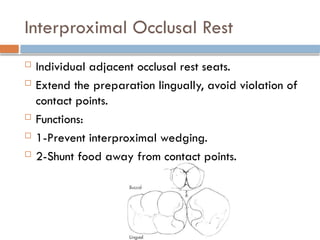
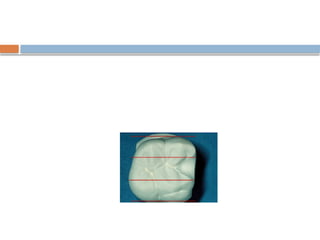
Occlusal Rest &Rest seat
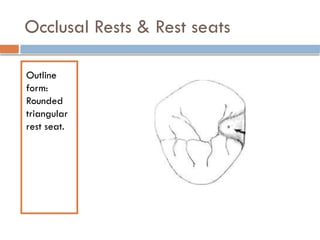
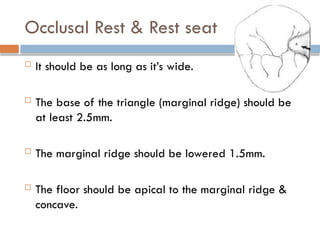
It should be as long as it’s wide.
The base of the triangle (marginal ridge) should be
at least 2.5mm.
The marginal ridge should be lowered 1.5mm.
The floor should be apical to the marginal ridge &
concave.
10.
Occlusal Rest &Rest seat
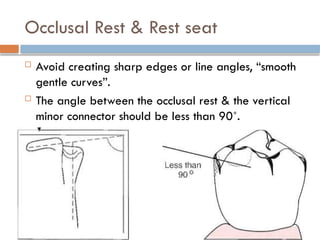
Avoid creating sharp edges or line angles, “smooth
gentle curves”.
The angle between the occlusal rest & the vertical
minor connector should be less than 90˚.
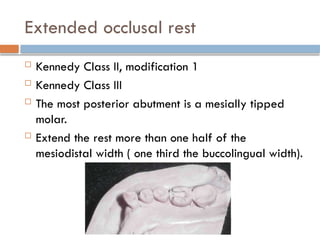
Extended occlusal rest
Kennedy Class II, modification 1
Kennedy Class III
The most posterior abutment is a mesially tipped
molar.
Extend the rest more than one half of the
mesiodistal width ( one third the buccolingual width).
Occlusal rest seatsas part of a new cast-metal
restoration
Restorations must be carefully planned &
fabricated.
Occlusal rest seats for cast restorations should be
placed during the wax pattern stage.
Special care is taken to ensure that the rest seat is
not altered during the casting process.
15.
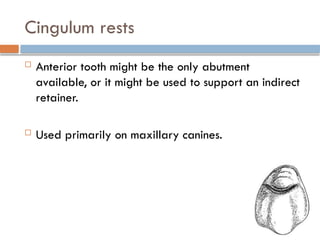
Cingulum rests
Anteriortooth might be the only abutment
available, or it might be used to support an indirect
retainer.
Used primarily on maxillary canines.
16.
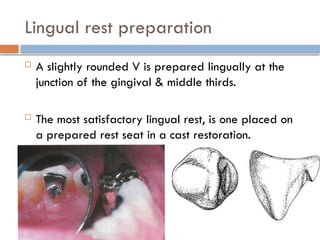
Lingual rest preparation
A slightly rounded V is prepared lingually at the
junction of the gingival & middle thirds.
The most satisfactory lingual rest, is one placed on
a prepared rest seat in a cast restoration.
17.
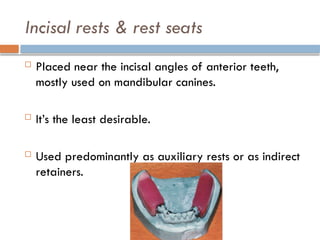
Incisal rests &rest seats
Placed near the incisal angles of anterior teeth,
mostly used on mandibular canines.
It’s the least desirable.
Used predominantly as auxiliary rests or as indirect
retainers.
18.
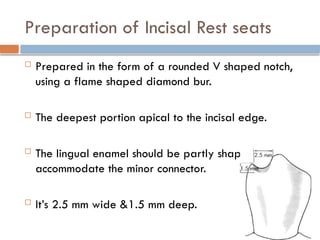
Preparation of IncisalRest seats
Prepared in the form of a rounded V shaped notch,
using a flame shaped diamond bur.
The deepest portion apical to the incisal edge.
The lingual enamel should be partly shaped to
accommodate the minor connector.
It’s 2.5 mm wide &1.5 mm deep.
19.
Conclusion
Care takenin selecting the type of rest seat to be
used, in preparing it, and in fabricating the
framework casting does much to ensure the success
of any type of rest.
20.
References
Counts AL,Hopkins AR, The use of ceramic orthodontic
brackets as rest seats for removable partial dentures.
Journal of prosthodntics 1995.
Albert Seiden, Occlusal rests & rest seats, the Journal of
Prosthetic Dentistry, May 1958.
Stewart’s Clinical Removable Partial Prosthodontics 3rd
edition.
Mc Crackens Removable Partial Prosthodontics 11th
edition.




![REST AND REST SEATS PPT [Autgvhgvosaved].ppt](https://cdn.slidesharecdn.com/ss_thumbnails/restandrestseatspptautosaved-240914045157-73622c2a-thumbnail.jpg?width=640&height=640&fit=bounds)


![OCCLUSION IN COMPLETE DENTURE - Copy [Autosaved].pptx](https://cdn.slidesharecdn.com/ss_thumbnails/occlusionincompletedenture-copyautosaved-250717091739-0dc0dc94-thumbnail.jpg?width=640&height=640&fit=bounds)


