RESTS AND REST SEATS
Dr. Waseem Bahjat Mushtaha
PhD in prosthodontics
Definitions:
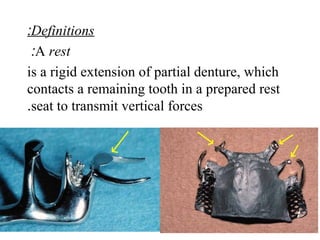
A rest:
is a rigid extension of partial denture, which
contacts a remaining tooth in a prepared rest
seat to transmit vertical forces.
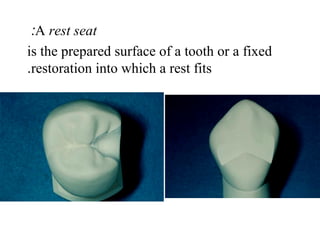
A rest seat:
is the prepared surface of a tooth or a fixed
restoration into which a rest fits.
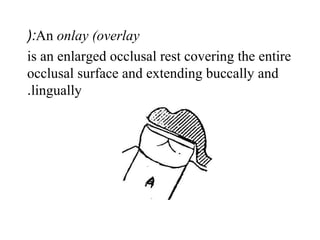
An onlay (overlay(:
is an enlarged occlusal rest covering the entire
occlusal surface and extending buccally and
lingually.
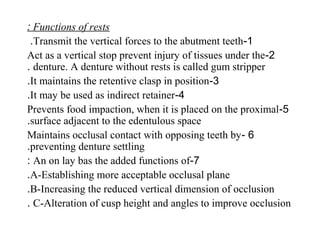
Functions of rests:
1-Transmit the vertical forces to the abutment teeth.
2-Act as a vertical stop prevent injury of tissues under the
denture. A denture without rests is called gum stripper.
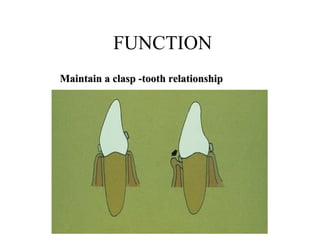
3-It maintains the retentive clasp in position.
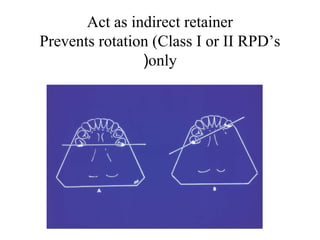
4-It may be used as indirect retainer.
5-Prevents food impaction, when it is placed on the proximal
surface adjacent to the edentulous space.
6-Maintains occlusal contact with opposing teeth by
preventing denture settling.
7-An on lay bas the added functions of:
A-Establishing more acceptable occlusal plane.
B-Increasing the reduced vertical dimension of occlusion.
C-Alteration of cusp height and angles to improve occlusion.
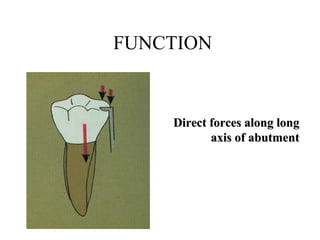
FUNCTION
Direct forces along longDirect forces along long
axis of abutmentaxis of abutment
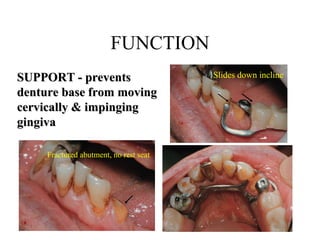
FUNCTION
Fractured abutment, no rest seat
Slides down inclineSUPPORT - preventsSUPPORT - prevents
denture base from movingdenture base from moving
cervically & impingingcervically & impinging
gingivagingiva
FUNCTION
Maintain a clasp -tooth relationshipMaintain a clasp -tooth relationship
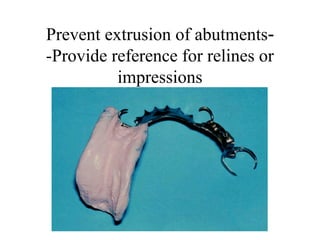
-Prevent extrusion of abutments
-Provide reference for relines or
impressions
Act as indirect retainer
Prevents rotation (Class I or II RPD’s
only(
Requirements of rests:
l-Should have sufficient thickness of metal to
prevent fracture, especially at the junction of the
rest and minor connector.
2-Should be placed only on surfaces that will direct
forces along the long axes of teeth. Should not be
placed on inclined tooth surface.
3-Should be extended as close to the center of the
tooth mesiodistally, as much as possible, to help
axial direction of force.
4-Should be laced in rest seats, which have smooth
rounded line angles to improve adaptation of
casting.
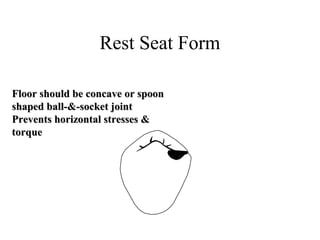
5-There should be slight movement within
the rest seat ( like a ball and socket joint) to
dissipated horizontal forces and protect the
abutment teeth.
6-If the edentulous space has decreases due
to drifting, a metal pontic can be placed in
this space using two occlusal rest.
7-A rest and a properly positioned minor
connector can be used for reciprocation.
Types of rests
I-Occlusal rests; seated on the occlusal
surfaces of a posterior tooth.
2-Cingulum or lingual rest; seated on the
lingual surface of a tooth.
3-Incisal rest; seated on the incisal edge of a
tooth.
Occlusal Rests
Types:
1-Conventional.
II- Extended.
III- Onlay (Overlay(.
IV- Intracoronal (Precision) Rest
I-conventional occlusal rest
Design:
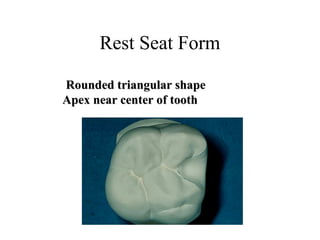
I-The rest demonstrates a rounded triangular outline
form when viewed from the occlusal. The base of
the triangle resting on the marginal ridge and the
rounded apex directed towards the center of the
tooth.
2-The tissue surface of the rest should be smooth and
rounded (spoon shape). All angles, walls and
ledges should be avoided, to prevent the
transmission of lateral forces to the abutment.
3-Its width varies from one third to one half the
mesiodistal diameter of the tooth and should be
one half the distance between the buccal and
lingual cusp tips.
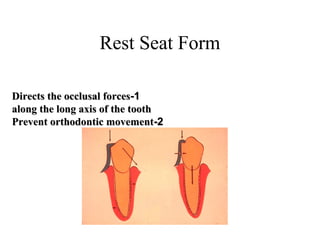
4-Floor of the rest seat should be inclined apically as
it approaches the center of the tooth. The angle
between the rest and the minor connector should
be less than 90 degrees, to transmit the vertical
forces along the long axis of the tooth .If this
angle is more than 90 degrees an inclined plane
effect will occurs, which results in slippage of the
rest and orthodontic movement of the abutment.
5-Teeth marginal ridges should be reduced l.5mm
for base metal alloy, and 2 mm for gold alloys, to
give enough thickness of metal to avoid its
fracture.
6-The occlusal rest is prepared in sound enamel or
in crowns and inlay. It is prepared in enamel if
there is law caries index and good oral hygiene.
7-An amalgam restoration is not suitable to support
an occlusal rest due to its tendency to flow. So if
amalgam is present it should be replaced by cast
restoration
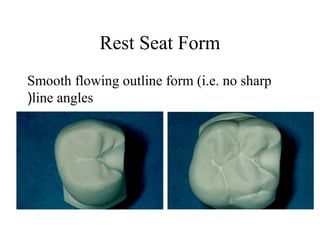
Rest Seat Form
Smooth flowing outline form (i.e. no sharp
line angles(
Rest Seat Form
Rounded triangular shapeRounded triangular shape
Apex near center of toothApex near center of tooth
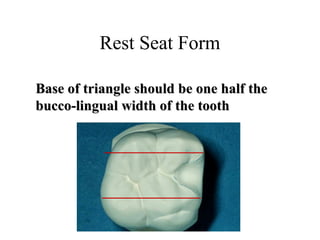
Rest Seat Form
Base of triangle should be one half theBase of triangle should be one half the
bucco-lingual width of the toothbucco-lingual width of the tooth
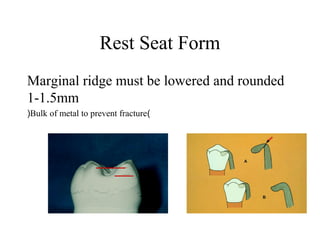
Rest Seat Form
Marginal ridge must be lowered and rounded
1-1.5mm
)Bulk of metal to prevent fracture(
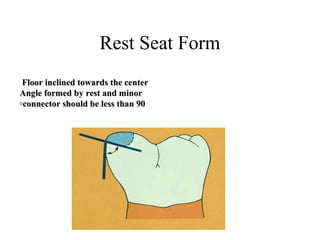
Rest Seat Form
Floor inclined towards the centerFloor inclined towards the center
Angle formed by rest and minorAngle formed by rest and minor
connector should be less than 90connector should be less than 90◦◦
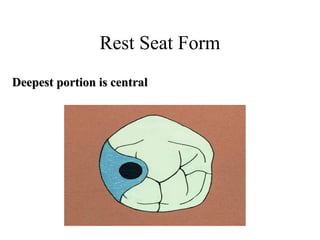
Rest Seat Form
Deepest portion is centralDeepest portion is central
Rest Seat Form
Floor should be concave or spoonFloor should be concave or spoon
shaped ball-&-socket jointshaped ball-&-socket joint
Prevents horizontal stresses &Prevents horizontal stresses &
torquetorque
Rest Seat Form
11--Directs the occlusal forcesDirects the occlusal forces
along the long axis of the toothalong the long axis of the tooth
22--Prevent orthodontic movementPrevent orthodontic movement
II- Extended occlusal rest
Indication:
For tooth borne segments of partial dentures in
which the most posterior abutment is mesially
tipped molar.
Advantage:
I-It promotes axial force direction.
2-Minimize further tipping of the abutment.
3- Minimize rotation of the abutment by its buccal
and lingual dovetail extension
Design:
An extended rest should be carried more than
one-half way the mesiodistal width of the
tooth, be approximately one-third the
buccolingual width of the tooth, and at least
of 1 mm thickness. The preparation should
be round with no undercuts or sharp angles
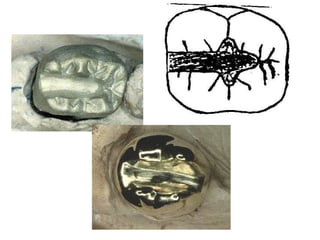
III- Onlay
Indication:
In severely tilted posterior abutment of a tooth borne
segment.
Advantages:
l-Direct the forces along the long axis of the tooth.
2-Promote RPD stability by its buccal and lingual
bevels and proximal guiding plane.
3-Minimize further tipping of the tooth.
4-Restore the occlusal plane.
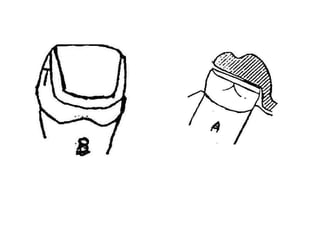
Design:
1-Cast restorations placed on tipped teeth may be
fabricated with a flat occlusal surface
perpendicular to the long axis. The tooth
preparation for onlay must include removing or
restoring pits, fissures, and grooves. A bevel of 1
to 2 mm on the facial and lingual surfaces and 2 to
3 mm guiding plane on the proximal.
2-The occlusion is restored with a base metal alloy
or gold occlusal onlay as part of the partial denture
framework
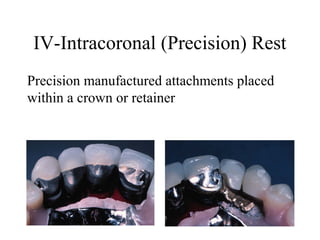
IV-Intracoronal (Precision) Rest
Precision manufactured attachments placed
within a crown or retainer
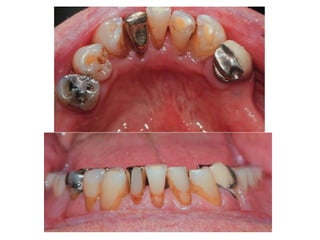
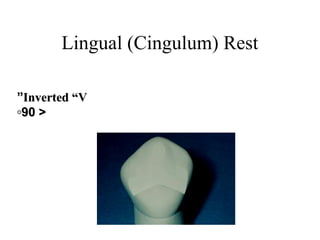
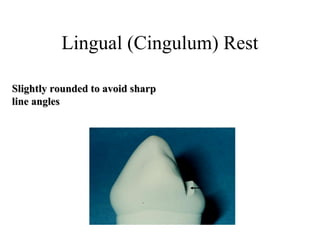
Lingual (Cingulum) Rest
Indications:
1-When there is no posterior tooth to place an occlusal rest. Occlusal rest
is preferred than lingual rest because of its mechanical advantage and
ease of seat preparation.
2-The lingual or Cingulum rest is used primarily on maxillary canine,
because the morphology of the tooth permits seat preparation.
3It is rarely used on incisors when the canine is missing. In this situation
multiple rests must be used to distribute the force over a number of
incisors.
4-To prepare a rest seat in enamel there should be:
a- prominent cingulum.
b- good oral hygiene.
c- law caries index.
Design:
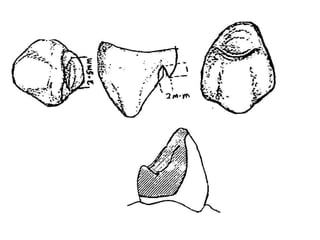
1-The rest seat is half moon shaped when viewed from the
lingual. The broadest portion is in the middle of the lingual
surface and becomes less broad as it approaches the
proximal surface .
2-Rest is V shaped when viewed from the proximal, with
rounded line angles. The V shaped preparation direct the
force into apical direction along the long axis of the tooth.
3-Mesiodistal length of preparation should be a minimum
of 2.5 mm, labiolingual width about 2mm, and incisal
apical depth a minimum of 1.5 mm.
4-Often difficult to obtain a positive apically inclined rest
seat due to tooth angulation or anatomy. The use of cast
restoration may be required to establish a definite rest seat
Lingual (Cingulum) Rest
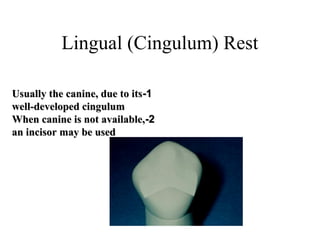
11--Usually the canine, due to itsUsually the canine, due to its
well-developed cingulumwell-developed cingulum
22--When canine is not available,When canine is not available,
an incisor may be usedan incisor may be used
Lingual (Cingulum) Rest
Inverted “VInverted “V””
>>9090◦◦
Lingual (Cingulum) Rest
Slightly rounded to avoid sharpSlightly rounded to avoid sharp
line anglesline angles
Incisal Rests
Indications:
1-Incisal rests are used mostly on mandibular
canines when the abutment is sound and when a
cast restoration is not indicated.
2-lt may be used as an auxiliary rest for indirect
retention.
Disadvantages:
1-The display of metal may be objectionable.
2-Greater mechanical leverage than lingual rests, due
to the longer minor connector required
Design:
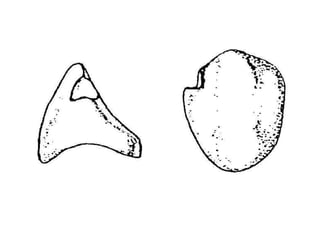
1-The incisal rest seat is prepared on the proximal line angle
of the tooth, usually the distal' for esthetic reason.
2-When seen from the facial surface, its floor is concave and
inclined towards the center of the tooth to direct the forces
along the long axis of the tooth.
3-The outline form of the rest seat is saddle shaped (Convex).
with buccal and lingual bevel, when viewed from the
proximal.
4-All borders of rest seats are rounded, especially at the
junction of the axial wall of the preparation and the floor
of the rest seat.
5-It should be approximately 2.5mm wide, and 1.5mm deep
4    rests and rest seats

4 rests and rest seats

  • 1.
    RESTS AND RESTSEATS Dr. Waseem Bahjat Mushtaha PhD in prosthodontics
  • 2.
    Definitions: A rest: is arigid extension of partial denture, which contacts a remaining tooth in a prepared rest seat to transmit vertical forces.
  • 3.
    A rest seat: isthe prepared surface of a tooth or a fixed restoration into which a rest fits.
  • 4.
    An onlay (overlay(: isan enlarged occlusal rest covering the entire occlusal surface and extending buccally and lingually.
  • 5.
    Functions of rests: 1-Transmitthe vertical forces to the abutment teeth. 2-Act as a vertical stop prevent injury of tissues under the denture. A denture without rests is called gum stripper. 3-It maintains the retentive clasp in position. 4-It may be used as indirect retainer. 5-Prevents food impaction, when it is placed on the proximal surface adjacent to the edentulous space. 6-Maintains occlusal contact with opposing teeth by preventing denture settling. 7-An on lay bas the added functions of: A-Establishing more acceptable occlusal plane. B-Increasing the reduced vertical dimension of occlusion. C-Alteration of cusp height and angles to improve occlusion.
  • 6.
    FUNCTION Direct forces alonglongDirect forces along long axis of abutmentaxis of abutment
  • 7.
    FUNCTION Fractured abutment, norest seat Slides down inclineSUPPORT - preventsSUPPORT - prevents denture base from movingdenture base from moving cervically & impingingcervically & impinging gingivagingiva
  • 9.
    FUNCTION Maintain a clasp-tooth relationshipMaintain a clasp -tooth relationship
  • 10.
    -Prevent extrusion ofabutments -Provide reference for relines or impressions
  • 11.
    Act as indirectretainer Prevents rotation (Class I or II RPD’s only(
  • 12.
    Requirements of rests: l-Shouldhave sufficient thickness of metal to prevent fracture, especially at the junction of the rest and minor connector. 2-Should be placed only on surfaces that will direct forces along the long axes of teeth. Should not be placed on inclined tooth surface. 3-Should be extended as close to the center of the tooth mesiodistally, as much as possible, to help axial direction of force. 4-Should be laced in rest seats, which have smooth rounded line angles to improve adaptation of casting.
  • 13.
    5-There should beslight movement within the rest seat ( like a ball and socket joint) to dissipated horizontal forces and protect the abutment teeth. 6-If the edentulous space has decreases due to drifting, a metal pontic can be placed in this space using two occlusal rest. 7-A rest and a properly positioned minor connector can be used for reciprocation.
  • 14.
    Types of rests I-Occlusalrests; seated on the occlusal surfaces of a posterior tooth. 2-Cingulum or lingual rest; seated on the lingual surface of a tooth. 3-Incisal rest; seated on the incisal edge of a tooth.
  • 15.
    Occlusal Rests Types: 1-Conventional. II- Extended. III-Onlay (Overlay(. IV- Intracoronal (Precision) Rest
  • 16.
    I-conventional occlusal rest Design: I-Therest demonstrates a rounded triangular outline form when viewed from the occlusal. The base of the triangle resting on the marginal ridge and the rounded apex directed towards the center of the tooth. 2-The tissue surface of the rest should be smooth and rounded (spoon shape). All angles, walls and ledges should be avoided, to prevent the transmission of lateral forces to the abutment.
  • 17.
    3-Its width variesfrom one third to one half the mesiodistal diameter of the tooth and should be one half the distance between the buccal and lingual cusp tips. 4-Floor of the rest seat should be inclined apically as it approaches the center of the tooth. The angle between the rest and the minor connector should be less than 90 degrees, to transmit the vertical forces along the long axis of the tooth .If this angle is more than 90 degrees an inclined plane effect will occurs, which results in slippage of the rest and orthodontic movement of the abutment.
  • 18.
    5-Teeth marginal ridgesshould be reduced l.5mm for base metal alloy, and 2 mm for gold alloys, to give enough thickness of metal to avoid its fracture. 6-The occlusal rest is prepared in sound enamel or in crowns and inlay. It is prepared in enamel if there is law caries index and good oral hygiene. 7-An amalgam restoration is not suitable to support an occlusal rest due to its tendency to flow. So if amalgam is present it should be replaced by cast restoration
  • 19.
    Rest Seat Form Smoothflowing outline form (i.e. no sharp line angles(
  • 20.
    Rest Seat Form Roundedtriangular shapeRounded triangular shape Apex near center of toothApex near center of tooth
  • 21.
    Rest Seat Form Baseof triangle should be one half theBase of triangle should be one half the bucco-lingual width of the toothbucco-lingual width of the tooth
  • 22.
    Rest Seat Form Marginalridge must be lowered and rounded 1-1.5mm )Bulk of metal to prevent fracture(
  • 23.
    Rest Seat Form Floorinclined towards the centerFloor inclined towards the center Angle formed by rest and minorAngle formed by rest and minor connector should be less than 90connector should be less than 90◦◦
  • 24.
    Rest Seat Form Deepestportion is centralDeepest portion is central
  • 25.
    Rest Seat Form Floorshould be concave or spoonFloor should be concave or spoon shaped ball-&-socket jointshaped ball-&-socket joint Prevents horizontal stresses &Prevents horizontal stresses & torquetorque
  • 26.
    Rest Seat Form 11--Directsthe occlusal forcesDirects the occlusal forces along the long axis of the toothalong the long axis of the tooth 22--Prevent orthodontic movementPrevent orthodontic movement
  • 27.
    II- Extended occlusalrest Indication: For tooth borne segments of partial dentures in which the most posterior abutment is mesially tipped molar. Advantage: I-It promotes axial force direction. 2-Minimize further tipping of the abutment. 3- Minimize rotation of the abutment by its buccal and lingual dovetail extension
  • 28.
    Design: An extended restshould be carried more than one-half way the mesiodistal width of the tooth, be approximately one-third the buccolingual width of the tooth, and at least of 1 mm thickness. The preparation should be round with no undercuts or sharp angles
  • 30.
    III- Onlay Indication: In severelytilted posterior abutment of a tooth borne segment. Advantages: l-Direct the forces along the long axis of the tooth. 2-Promote RPD stability by its buccal and lingual bevels and proximal guiding plane. 3-Minimize further tipping of the tooth. 4-Restore the occlusal plane.
  • 31.
    Design: 1-Cast restorations placedon tipped teeth may be fabricated with a flat occlusal surface perpendicular to the long axis. The tooth preparation for onlay must include removing or restoring pits, fissures, and grooves. A bevel of 1 to 2 mm on the facial and lingual surfaces and 2 to 3 mm guiding plane on the proximal. 2-The occlusion is restored with a base metal alloy or gold occlusal onlay as part of the partial denture framework
  • 33.
    IV-Intracoronal (Precision) Rest Precisionmanufactured attachments placed within a crown or retainer
  • 34.
    Lingual (Cingulum) Rest Indications: 1-Whenthere is no posterior tooth to place an occlusal rest. Occlusal rest is preferred than lingual rest because of its mechanical advantage and ease of seat preparation. 2-The lingual or Cingulum rest is used primarily on maxillary canine, because the morphology of the tooth permits seat preparation. 3It is rarely used on incisors when the canine is missing. In this situation multiple rests must be used to distribute the force over a number of incisors. 4-To prepare a rest seat in enamel there should be: a- prominent cingulum. b- good oral hygiene. c- law caries index.
  • 35.
    Design: 1-The rest seatis half moon shaped when viewed from the lingual. The broadest portion is in the middle of the lingual surface and becomes less broad as it approaches the proximal surface . 2-Rest is V shaped when viewed from the proximal, with rounded line angles. The V shaped preparation direct the force into apical direction along the long axis of the tooth. 3-Mesiodistal length of preparation should be a minimum of 2.5 mm, labiolingual width about 2mm, and incisal apical depth a minimum of 1.5 mm. 4-Often difficult to obtain a positive apically inclined rest seat due to tooth angulation or anatomy. The use of cast restoration may be required to establish a definite rest seat
  • 36.
    Lingual (Cingulum) Rest 11--Usuallythe canine, due to itsUsually the canine, due to its well-developed cingulumwell-developed cingulum 22--When canine is not available,When canine is not available, an incisor may be usedan incisor may be used
  • 37.
    Lingual (Cingulum) Rest Inverted“VInverted “V”” >>9090◦◦
  • 38.
    Lingual (Cingulum) Rest Slightlyrounded to avoid sharpSlightly rounded to avoid sharp line anglesline angles
  • 40.
    Incisal Rests Indications: 1-Incisal restsare used mostly on mandibular canines when the abutment is sound and when a cast restoration is not indicated. 2-lt may be used as an auxiliary rest for indirect retention. Disadvantages: 1-The display of metal may be objectionable. 2-Greater mechanical leverage than lingual rests, due to the longer minor connector required
  • 41.
    Design: 1-The incisal restseat is prepared on the proximal line angle of the tooth, usually the distal' for esthetic reason. 2-When seen from the facial surface, its floor is concave and inclined towards the center of the tooth to direct the forces along the long axis of the tooth. 3-The outline form of the rest seat is saddle shaped (Convex). with buccal and lingual bevel, when viewed from the proximal. 4-All borders of rest seats are rounded, especially at the junction of the axial wall of the preparation and the floor of the rest seat. 5-It should be approximately 2.5mm wide, and 1.5mm deep