Respiratory Syncytial Virus
What is RSV?
It is a virus
Discovered in 1956
Infects the lungs and
breathing passages
Can cause a wide
spectrum of illnesses
Seasonal
http://www.cdc.gov/Features/dsRSV/
Highly contagious airborne virus
Annually 75,000-125,000 infants <1 yr require
hospitalization
~1%-2% die (750—1,500 children)
Contagious period during first 3-8 days of their illness
http://www.kuleuven.be/rega/mvr/research.html
Who gets it?
Anyone, but experience different levels of severity
Most at risk:
premature infants and all infants less than 1 year of age
children < 2 years old with cardiac disease or chronic
lung disease (for example, asthma, cystic fibrosis, etc.)
those of any age with a compromised immune system
those 65 years of age or older
Diseases
Bronchiolitis
Pneumonia
Colds
Spread through respiratory
secretions
- coughing, sneezing
Symptoms
Vary from person to person
Symptoms most severe in children under the age of two
4-6 after exposure
Runny nose
Decreased appetite
1-3 days later
Wheezing
Coughing
Fever
Very young infants, irritability, decreased activity, and
breathing difficulties may be the only symptoms of
infection.
www.istockphoto.com/file_closeup/
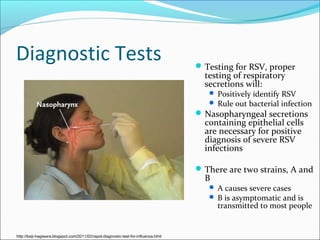
Diagnostic Tests Testing for RSV, proper
testing of respiratory
secretions will:
 Positively identify RSV
 Rule out bacterial infection
Nasopharyngeal secretions
containing epithelial cells
are necessary for positive
diagnosis of severe RSV
infections
There are two strains, A and
B
 A causes severe cases
 B is asymptomatic and is
transmitted to most people
http://keiji-hagiwara.blogspot.com/2011/02/rapid-diagnostic-test-for-influenza.html
Treatment
Currently no RSV vaccine available
No treatment given in mild
disease
just antipyretics
Oxygen therapy, pulmonary inhalation therapy, airway suction,
and mechanical ventilation (severe disease)
Ribavirin aerosol (severe disease)
Sometimes used---IGIV (immune globulin intravenous) with
RSV-IGIV (e.g. Synagis) and Ribavirin (Virazole). [severe
disease]
Recovery 1-2 wks (non hospitalized & hospitalized)
Prevention
Frequent hand washing
At-Risk children can be given an injection of RSV antibodies monthly
during peak season.
Keep school-age children away from younger siblings (anyone under 2
years of age) if cold symptoms are present
Minimize number of visitors with the infant
Avoid any crowded places
Don’t take child to daycare during RSV season (if possible)
Obtain influenza vaccinations
 According to CDC, almost all children will have infection by 2nd
birthday; however, only 25%-40% will have symptoms of bronchiolitis
or pneumonia. Of those, 0.5%-2% require hospitalization.
http://www.ctahr.hawaii.edu/new/GermCity/
Epidemiology
Transmission
 Transmitted via large, aerosolized respiratory particles or through
contact with nasal secretions. May even be transmitted indirectly
by contact with contaminated objects such as bathroom fixtures or
clothing. The most common sites of inoculation are the eyes and
nose
Prevalence
 Winter months
 Most frequently transmitted between family members and
hospitals
 The incubation period is three to five days for most patients
 Strain A more prevalent than Strain B
Global Distribution
 Warmer climates tend to have longer periods of outbreaks without
any peak times
 USA is generally November til May
References
 Centers for Disease Control and Prevention . (2010). Respiratory Syncytial Virus Infection. Accessed March 4, 2012 from
http://www.cdc.gov/rsv/index.html
 WebMD, LLC. (2012). Respiratory Syncytial Virus Infection. Accessed March 4, 2012 from http://www.webmd.com/lung/tc/respiratory-syncytial-
virus-rsv-infection-topic-overview

RSV presentation

  • 1.
  • 2.
    What is RSV? Itis a virus Discovered in 1956 Infects the lungs and breathing passages Can cause a wide spectrum of illnesses Seasonal http://www.cdc.gov/Features/dsRSV/
  • 3.
    Highly contagious airbornevirus Annually 75,000-125,000 infants <1 yr require hospitalization ~1%-2% die (750—1,500 children) Contagious period during first 3-8 days of their illness http://www.kuleuven.be/rega/mvr/research.html
  • 4.
    Who gets it? Anyone,but experience different levels of severity Most at risk: premature infants and all infants less than 1 year of age children < 2 years old with cardiac disease or chronic lung disease (for example, asthma, cystic fibrosis, etc.) those of any age with a compromised immune system those 65 years of age or older
  • 5.
  • 6.
    Symptoms Vary from personto person Symptoms most severe in children under the age of two 4-6 after exposure Runny nose Decreased appetite 1-3 days later Wheezing Coughing Fever Very young infants, irritability, decreased activity, and breathing difficulties may be the only symptoms of infection. www.istockphoto.com/file_closeup/
  • 7.
    Diagnostic Tests Testingfor RSV, proper testing of respiratory secretions will:  Positively identify RSV  Rule out bacterial infection Nasopharyngeal secretions containing epithelial cells are necessary for positive diagnosis of severe RSV infections There are two strains, A and B  A causes severe cases  B is asymptomatic and is transmitted to most people http://keiji-hagiwara.blogspot.com/2011/02/rapid-diagnostic-test-for-influenza.html
  • 8.
    Treatment Currently no RSVvaccine available No treatment given in mild disease just antipyretics Oxygen therapy, pulmonary inhalation therapy, airway suction, and mechanical ventilation (severe disease) Ribavirin aerosol (severe disease) Sometimes used---IGIV (immune globulin intravenous) with RSV-IGIV (e.g. Synagis) and Ribavirin (Virazole). [severe disease] Recovery 1-2 wks (non hospitalized & hospitalized)
  • 9.
    Prevention Frequent hand washing At-Riskchildren can be given an injection of RSV antibodies monthly during peak season. Keep school-age children away from younger siblings (anyone under 2 years of age) if cold symptoms are present Minimize number of visitors with the infant Avoid any crowded places Don’t take child to daycare during RSV season (if possible) Obtain influenza vaccinations  According to CDC, almost all children will have infection by 2nd birthday; however, only 25%-40% will have symptoms of bronchiolitis or pneumonia. Of those, 0.5%-2% require hospitalization. http://www.ctahr.hawaii.edu/new/GermCity/
  • 10.
    Epidemiology Transmission  Transmitted vialarge, aerosolized respiratory particles or through contact with nasal secretions. May even be transmitted indirectly by contact with contaminated objects such as bathroom fixtures or clothing. The most common sites of inoculation are the eyes and nose Prevalence  Winter months  Most frequently transmitted between family members and hospitals  The incubation period is three to five days for most patients  Strain A more prevalent than Strain B Global Distribution  Warmer climates tend to have longer periods of outbreaks without any peak times  USA is generally November til May
  • 11.
    References  Centers forDisease Control and Prevention . (2010). Respiratory Syncytial Virus Infection. Accessed March 4, 2012 from http://www.cdc.gov/rsv/index.html  WebMD, LLC. (2012). Respiratory Syncytial Virus Infection. Accessed March 4, 2012 from http://www.webmd.com/lung/tc/respiratory-syncytial- virus-rsv-infection-topic-overview

Editor's Notes

  • #6 RSV most common cause of bronchiolitis and pneumonia in children &amp;lt;1 yr in US.
  • #9 Virazole rarely given to pts with high risks of complications.