Theory
Introduction to crop physiology and its importance in Agriculture; Plant cell: an Overview; Diffusion and osmosis; Absorption of water,
transpiration and Stomatal Physiology; Mineral nutrition of Plants: Functions and deficiency symptoms of nutrients, nutrient uptake mechanisms;
Photosynthesis: Light and Dark reactions, C3, C4 and CAM plants; Respiration: Glycolysis, TCA cycle and electron transport chain; Fat
Metabolism: Fatty acid synthesis and Breakdown; Plant growth regulators: Physiological roles and agricultural uses, Physiological aspects of
growth and development of major crops: Growth analysis, Role of Physiological growth parameters in crop productivity.
Practical
Study of plant cells, structure and distribution of stomata, imbibitions, osmosis, plasmolysis, measurement of root pressure, rate of transpiration,
Separation of photosynthetic pigments through paper chromatography, Rate of transpiration, photosynthesis, respiration, tissue test for mineral
nutrients, estimation of relative water content, Measurement of photosynthetic CO2 assimilation by Infra Red Gas Analyser (IRGA).
References
1. Taiz, L. and zeiger,E. 2010. Plant Physiology 5th edition, Sinauer Associates, Sunderland, MA, USA. 2. Gardner, F.P., Pearce, R.B., and
Mitchell, R.L. 1985. Physiology of Crop Plants, Scientific Publishers, Jodhpur. 3. Noggle, G.R. and Fritz, G.J., 1983. Introductory Plant Physiology.
2nd Edition. Prentice Hall Publishers, New Jersey, USA
Fundamentals of Crop Physiology [ASPH1201]
Pradipta Banerjee, Ph.D.
Dept. of Biochemistry & Crop Physiology
CUTM, Paralakhemundi, Odisha
1. What are Respiratory substrates
2. Aerobic Respiration (mitochondria)
3. Anaerobic respiration (cytosol)
4. Oxidation of carbohydrates in 3 phases: Glycolysis, TCA cycle, ETS or Terminal respiration
5. Why TCA cycle is link between carbohydrate and protein metabolism?
6. TCA is an amphibolic pathway. Explain why?
7. Oxidative and substrate level phosphorylation
8. Significance of Pentose Phosphate Pathway
9. What is Pasteur Effect?
10. What is Crabtree Effect?
11. What is Extinction Point?
12. What is Bioluminescence
13. What is Respiratory Quotient?
14. Factors affecting Respiration in plants
FIND OUT…
The minimum amount of oxygen, at which aerobic respiration takes place & anaerobic respiration become extinct
is called as extinction point.
The ratio of the volume of CO2 released to the volume of O2 taken in respiration is called RQ. Value of RQ
depends upon the type of respiratory substrate used & measured by Ganong's respirometer.
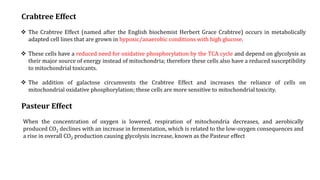
 The Crabtree Effect (named after the English biochemist Herbert Grace Crabtree) occurs in metabolically
adapted cell lines that are grown in hypoxic/anaerobic conditions with high glucose.
 These cells have a reduced need for oxidative phosphorylation by the TCA cycle and depend on glycolysis as
their major source of energy instead of mitochondria; therefore these cells also have a reduced susceptibility
to mitochondrial toxicants.
 The addition of galactose circumvents the Crabtree Effect and increases the reliance of cells on
mitochondrial oxidative phosphorylation; these cells are more sensitive to mitochondrial toxicity.
Crabtree Effect
When the concentration of oxygen is lowered, respiration of mitochondria decreases, and aerobically
produced CO2 declines with an increase in fermentation, which is related to the low-oxygen consequences and
a rise in overall CO2 production causing glycolysis increase, known as the Pasteur effect
Pasteur Effect
Outline of Respiratory Metabolism
1. Glycolysis or EMP (Embden-Meyerhof-Parnas) Pathway or Hexose Diphosphate
Pathway
2. Pentose Phosphate Pathway
3. TCA Cycle
4. ETS
General Outline of Carbohydrate metabolism
In animals, excess glucose is converted to its storage form, glycogen (plant – starch), by glycogenesis. When glucose
is needed as a source of energy or as a precursor molecule in biosynthetic processes, glycogen is degraded by
glycogenolysis. Glucose can be converted to ribose-5-phosphate (a component of nucleotides) and NADPH (a
powerful reducing agent) by means of the pentose phosphate pathway. Glucose is oxidized by glycolysis, an energy-
generating pathway that converts it to pyruvate. In the absence of oxygen, pyruvate is converted to lactate. When
oxygen is present, pyruvate is further degraded to form acetyl-CoA. Significant amounts of energy in the form of
ATP can be extracted from acetyl-CoA by the citric acid cycle and the electron transport system. Note that
carbohydrate metabolism is inextricably linked to the metabolism of other nutrients. For example, acetyl-CoA is
also generated from the breakdown of fatty acids and certain amino acids. When acetyl-CoA is present in excess, a
different pathway converts it into fatty acids.
General Outline of Carbohydrate metabolism
GLYCOLYSIS
GLYCOLYSIS
Each phosphoryl group, represented here as P, has two negative charges (--PO3
2-).
FATE OF PYRUVATE GENERATED IN GLYCOLYTIC PATHWAY
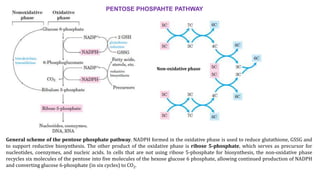
 The first phase of the
pentose phosphate pathway
consists of two oxidations
that convert glucose 6-
phosphate to ribulose 5-
phosphate and reduce
NADP+ to NADPH. The
second phase comprises
non-oxidative steps that
convert pentose phosphates
to glucose 6-phosphate,
which begins the cycle
again.
 Entry of glucose 6-
phosphate either into
glycolysis or into the
pentose phosphate pathway
is largely determined by the
relative concentrations of
NADP and NADPH.
PENTOSE PHOSPAHTE PATHWAY
General scheme of the pentose phosphate pathway. NADPH formed in the oxidative phase is used to reduce glutathione, GSSG and
to support reductive biosynthesis. The other product of the oxidative phase is ribose 5-phosphate, which serves as precursor for
nucleotides, coenzymes, and nucleic acids. In cells that are not using ribose 5-phosphate for biosynthesis, the non-oxidative phase
recycles six molecules of the pentose into five molecules of the hexose glucose 6 phosphate, allowing continued production of NADPH
and converting glucose 6-phosphate (in six cycles) to CO2.
Non-oxidative phase
PENTOSE PHOSPAHTE PATHWAY
Significance of Pentose Phosphate Pathway in plants
Differences between Glycolysis and Kreb’s Cycle
KREB’S CYCLE
1. Condensation
2. Dehydration
3. Hydration
4. Oxidative decarboxylation
5. Oxidative decarboxylation
6. Substrate level phosphorylation
7. Dehydrogenation
8. Hydration
9. Dehydrogenation
The citric acid cycle is amphibolic, serving in both
catabolism and anabolism; cycle intermediates
can be drawn off and used as the starting material
for a variety of biosynthetic products.
The citric acid cycle (Krebs cycle, TCA cycle) is a
nearly universal central catabolic pathway in
which compounds derived from the breakdown of
carbohydrates, fats, and proteins are oxidized to
CO2, with most of the energy of oxidation
temporarily held in the electron carriers FADH2
and NADH. During aerobic metabolism, these
electrons are transferred to O2 and the energy of
electron flow is trapped as ATP.
Significance of Kreb’s Cycle
Substrate Level Phosphorylation
 Substrate level phosphorylation involves the
enzyme catalyzed transfer of inorganic
phosphate from a molecule to ADP to form ATP.
 The synthesis of ATP via ETS with oxygen as
terminal electron acceptor, is known as
oxidative phosphorylation and it takes place
in mitochondria.
Organization of the
electron transport chain
and ATP synthesis in the
inner membrane of plant
mitochondria.
In addition to the five
standard protein complexes
found in nearly all other
mitochondria, the electron
transport chain of plant
mitochondria contains five
additional enzymes marked
in green. None of these
additional enzymes pumps
protons. Specific inhibitors,
rotenone for complex I,
antimycin for complex III,
cyanide for complex IV, and
salicylhydroxamic acid
(SHAM) for the alternative
oxidase, are important tools
to investigate the electron
transport chain of plant
mitochondria.
Electron Transport Chain
 ATP is the energy carrier used by cells to drive living processes, and chemical energy conserved during the
citric acid cycle in the form of NADH and FADH2 (redox equivalents with high-energy electrons) must be
converted to ATP to perform useful work in the cell. This O2-dependent process, called oxidative
phosphorylation, occurs in the inner mitochondrial membrane.
 The Electron Transport Chain catalyses a flow of electrons from NADH to O2,the final electron acceptor
of the respiratory process. For the oxidation of NADH, the overall two-electron transfer can be written as
follows: NADH + H+ + 1⁄2 O2 → NAD+ + H2O
 For each molecule of sucrose oxidized through glycolysis and the citric acid cycle pathways, 4 molecules of
NADH are generated in the cytosol and 16 molecules of NADH plus 4 molecules of FADH2 (associated with
succinate dehydrogenase) are generated in the mitochondrial matrix. These reduced compounds must be
re-oxidized or the entire respiratory process will come to a halt.
Electron Transport Chain – Key Points
 Each step of ETS is characterized by decrease in energy level
 The carriers presumably operate in order of an increasing tendency to undergo
reduction (reducing potential becomes increasingly positive from NADH through
cyctochrome a3
Electron Transport Chain – Key Points
Complex I (NADH dehydrogenase). Electrons from NADH generated in the mitochondrial matrix during the citric
acid cycle are oxidized by complex I (an NADH dehydrogenase). The electron carriers in complex I include a tightly
bound cofactor (flavin mononucleotide [FMN], which is chemically similar to FAD; and several iron–sulfur centers.
Complex I then transfers these electrons to ubiquinone. Four protons are pumped from the matrix to the
intermembrane space for every electron pair passing through the complex.
Ubiquinone, a small lipid-soluble electron and proton carrier, is located within the inner membrane. It is not
tightly associated with any protein, and it can diffuse within the hydrophobic core of the membrane bilayer.
Complex II (succinate dehydrogenase). Oxidation of succinate in the citric acid cycle is catalyzed by this complex,
and the reducing equivalents are transferred via the FADH2 and a group of iron–sulfur proteins into the ubiquinone
pool. This complex does not pump protons.
Complex III (cytochrome bc1 complex). This complex oxidizes reduced ubiquinone (ubiquinol) and transfers the
electrons via an iron–sulfur center, two b-type cytochromes (b565 and b560), and a membrane-bound cytochrome
c1 to cytochrome c. Four protons per electron pair are pumped by complex III.
Cytochrome c is a small protein loosely attached to the outer surface of the inner membrane and serves as a mobile
carrier to transfer electrons between complexes III and IV.
Components of Electron Transport Chain
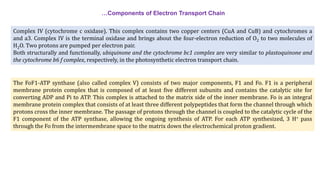
Complex IV (cytochrome c oxidase). This complex contains two copper centers (CuA and CuB) and cytochromes a
and a3. Complex IV is the terminal oxidase and brings about the four-electron reduction of O2 to two molecules of
H2O. Two protons are pumped per electron pair.
Both structurally and functionally, ubiquinone and the cytochrome bc1 complex are very similar to plastoquinone and
the cytochrome b6 f complex, respectively, in the photosynthetic electron transport chain.
The FoF1-ATP synthase (also called complex V) consists of two major components, F1 and Fo. F1 is a peripheral
membrane protein complex that is composed of at least five different subunits and contains the catalytic site for
converting ADP and Pi to ATP. This complex is attached to the matrix side of the inner membrane. Fo is an integral
membrane protein complex that consists of at least three different polypeptides that form the channel through which
protons cross the inner membrane. The passage of protons through the channel is coupled to the catalytic cycle of the
F1 component of the ATP synthase, allowing the ongoing synthesis of ATP. For each ATP synthesized, 3 H+ pass
through the Fo from the intermembrane space to the matrix down the electrochemical proton gradient.
…Components of Electron Transport Chain
1st -5th reactions = Glycolysis; 6th reaction = Oxidative decarboxylation of Pyruvate; 7th -11th reactions = TCA Cycle

Respiration

  • 1.
    Theory Introduction to cropphysiology and its importance in Agriculture; Plant cell: an Overview; Diffusion and osmosis; Absorption of water, transpiration and Stomatal Physiology; Mineral nutrition of Plants: Functions and deficiency symptoms of nutrients, nutrient uptake mechanisms; Photosynthesis: Light and Dark reactions, C3, C4 and CAM plants; Respiration: Glycolysis, TCA cycle and electron transport chain; Fat Metabolism: Fatty acid synthesis and Breakdown; Plant growth regulators: Physiological roles and agricultural uses, Physiological aspects of growth and development of major crops: Growth analysis, Role of Physiological growth parameters in crop productivity. Practical Study of plant cells, structure and distribution of stomata, imbibitions, osmosis, plasmolysis, measurement of root pressure, rate of transpiration, Separation of photosynthetic pigments through paper chromatography, Rate of transpiration, photosynthesis, respiration, tissue test for mineral nutrients, estimation of relative water content, Measurement of photosynthetic CO2 assimilation by Infra Red Gas Analyser (IRGA). References 1. Taiz, L. and zeiger,E. 2010. Plant Physiology 5th edition, Sinauer Associates, Sunderland, MA, USA. 2. Gardner, F.P., Pearce, R.B., and Mitchell, R.L. 1985. Physiology of Crop Plants, Scientific Publishers, Jodhpur. 3. Noggle, G.R. and Fritz, G.J., 1983. Introductory Plant Physiology. 2nd Edition. Prentice Hall Publishers, New Jersey, USA Fundamentals of Crop Physiology [ASPH1201] Pradipta Banerjee, Ph.D. Dept. of Biochemistry & Crop Physiology CUTM, Paralakhemundi, Odisha
  • 2.
    1. What areRespiratory substrates 2. Aerobic Respiration (mitochondria) 3. Anaerobic respiration (cytosol) 4. Oxidation of carbohydrates in 3 phases: Glycolysis, TCA cycle, ETS or Terminal respiration 5. Why TCA cycle is link between carbohydrate and protein metabolism? 6. TCA is an amphibolic pathway. Explain why? 7. Oxidative and substrate level phosphorylation 8. Significance of Pentose Phosphate Pathway 9. What is Pasteur Effect? 10. What is Crabtree Effect? 11. What is Extinction Point? 12. What is Bioluminescence 13. What is Respiratory Quotient? 14. Factors affecting Respiration in plants FIND OUT…
  • 3.
    The minimum amountof oxygen, at which aerobic respiration takes place & anaerobic respiration become extinct is called as extinction point. The ratio of the volume of CO2 released to the volume of O2 taken in respiration is called RQ. Value of RQ depends upon the type of respiratory substrate used & measured by Ganong's respirometer.
  • 4.
     The CrabtreeEffect (named after the English biochemist Herbert Grace Crabtree) occurs in metabolically adapted cell lines that are grown in hypoxic/anaerobic conditions with high glucose.  These cells have a reduced need for oxidative phosphorylation by the TCA cycle and depend on glycolysis as their major source of energy instead of mitochondria; therefore these cells also have a reduced susceptibility to mitochondrial toxicants.  The addition of galactose circumvents the Crabtree Effect and increases the reliance of cells on mitochondrial oxidative phosphorylation; these cells are more sensitive to mitochondrial toxicity. Crabtree Effect When the concentration of oxygen is lowered, respiration of mitochondria decreases, and aerobically produced CO2 declines with an increase in fermentation, which is related to the low-oxygen consequences and a rise in overall CO2 production causing glycolysis increase, known as the Pasteur effect Pasteur Effect
  • 5.
    Outline of RespiratoryMetabolism 1. Glycolysis or EMP (Embden-Meyerhof-Parnas) Pathway or Hexose Diphosphate Pathway 2. Pentose Phosphate Pathway 3. TCA Cycle 4. ETS
  • 6.
    General Outline ofCarbohydrate metabolism
  • 7.
    In animals, excessglucose is converted to its storage form, glycogen (plant – starch), by glycogenesis. When glucose is needed as a source of energy or as a precursor molecule in biosynthetic processes, glycogen is degraded by glycogenolysis. Glucose can be converted to ribose-5-phosphate (a component of nucleotides) and NADPH (a powerful reducing agent) by means of the pentose phosphate pathway. Glucose is oxidized by glycolysis, an energy- generating pathway that converts it to pyruvate. In the absence of oxygen, pyruvate is converted to lactate. When oxygen is present, pyruvate is further degraded to form acetyl-CoA. Significant amounts of energy in the form of ATP can be extracted from acetyl-CoA by the citric acid cycle and the electron transport system. Note that carbohydrate metabolism is inextricably linked to the metabolism of other nutrients. For example, acetyl-CoA is also generated from the breakdown of fatty acids and certain amino acids. When acetyl-CoA is present in excess, a different pathway converts it into fatty acids. General Outline of Carbohydrate metabolism
  • 8.
  • 9.
    GLYCOLYSIS Each phosphoryl group,represented here as P, has two negative charges (--PO3 2-).
  • 14.
    FATE OF PYRUVATEGENERATED IN GLYCOLYTIC PATHWAY
  • 16.
     The firstphase of the pentose phosphate pathway consists of two oxidations that convert glucose 6- phosphate to ribulose 5- phosphate and reduce NADP+ to NADPH. The second phase comprises non-oxidative steps that convert pentose phosphates to glucose 6-phosphate, which begins the cycle again.  Entry of glucose 6- phosphate either into glycolysis or into the pentose phosphate pathway is largely determined by the relative concentrations of NADP and NADPH. PENTOSE PHOSPAHTE PATHWAY
  • 17.
    General scheme ofthe pentose phosphate pathway. NADPH formed in the oxidative phase is used to reduce glutathione, GSSG and to support reductive biosynthesis. The other product of the oxidative phase is ribose 5-phosphate, which serves as precursor for nucleotides, coenzymes, and nucleic acids. In cells that are not using ribose 5-phosphate for biosynthesis, the non-oxidative phase recycles six molecules of the pentose into five molecules of the hexose glucose 6 phosphate, allowing continued production of NADPH and converting glucose 6-phosphate (in six cycles) to CO2. Non-oxidative phase PENTOSE PHOSPAHTE PATHWAY
  • 18.
    Significance of PentosePhosphate Pathway in plants
  • 19.
  • 22.
    KREB’S CYCLE 1. Condensation 2.Dehydration 3. Hydration 4. Oxidative decarboxylation 5. Oxidative decarboxylation 6. Substrate level phosphorylation 7. Dehydrogenation 8. Hydration 9. Dehydrogenation
  • 23.
    The citric acidcycle is amphibolic, serving in both catabolism and anabolism; cycle intermediates can be drawn off and used as the starting material for a variety of biosynthetic products. The citric acid cycle (Krebs cycle, TCA cycle) is a nearly universal central catabolic pathway in which compounds derived from the breakdown of carbohydrates, fats, and proteins are oxidized to CO2, with most of the energy of oxidation temporarily held in the electron carriers FADH2 and NADH. During aerobic metabolism, these electrons are transferred to O2 and the energy of electron flow is trapped as ATP.
  • 25.
  • 26.
    Substrate Level Phosphorylation Substrate level phosphorylation involves the enzyme catalyzed transfer of inorganic phosphate from a molecule to ADP to form ATP.  The synthesis of ATP via ETS with oxygen as terminal electron acceptor, is known as oxidative phosphorylation and it takes place in mitochondria.
  • 27.
    Organization of the electrontransport chain and ATP synthesis in the inner membrane of plant mitochondria. In addition to the five standard protein complexes found in nearly all other mitochondria, the electron transport chain of plant mitochondria contains five additional enzymes marked in green. None of these additional enzymes pumps protons. Specific inhibitors, rotenone for complex I, antimycin for complex III, cyanide for complex IV, and salicylhydroxamic acid (SHAM) for the alternative oxidase, are important tools to investigate the electron transport chain of plant mitochondria. Electron Transport Chain
  • 28.
     ATP isthe energy carrier used by cells to drive living processes, and chemical energy conserved during the citric acid cycle in the form of NADH and FADH2 (redox equivalents with high-energy electrons) must be converted to ATP to perform useful work in the cell. This O2-dependent process, called oxidative phosphorylation, occurs in the inner mitochondrial membrane.  The Electron Transport Chain catalyses a flow of electrons from NADH to O2,the final electron acceptor of the respiratory process. For the oxidation of NADH, the overall two-electron transfer can be written as follows: NADH + H+ + 1⁄2 O2 → NAD+ + H2O  For each molecule of sucrose oxidized through glycolysis and the citric acid cycle pathways, 4 molecules of NADH are generated in the cytosol and 16 molecules of NADH plus 4 molecules of FADH2 (associated with succinate dehydrogenase) are generated in the mitochondrial matrix. These reduced compounds must be re-oxidized or the entire respiratory process will come to a halt. Electron Transport Chain – Key Points
  • 29.
     Each stepof ETS is characterized by decrease in energy level  The carriers presumably operate in order of an increasing tendency to undergo reduction (reducing potential becomes increasingly positive from NADH through cyctochrome a3 Electron Transport Chain – Key Points
  • 30.
    Complex I (NADHdehydrogenase). Electrons from NADH generated in the mitochondrial matrix during the citric acid cycle are oxidized by complex I (an NADH dehydrogenase). The electron carriers in complex I include a tightly bound cofactor (flavin mononucleotide [FMN], which is chemically similar to FAD; and several iron–sulfur centers. Complex I then transfers these electrons to ubiquinone. Four protons are pumped from the matrix to the intermembrane space for every electron pair passing through the complex. Ubiquinone, a small lipid-soluble electron and proton carrier, is located within the inner membrane. It is not tightly associated with any protein, and it can diffuse within the hydrophobic core of the membrane bilayer. Complex II (succinate dehydrogenase). Oxidation of succinate in the citric acid cycle is catalyzed by this complex, and the reducing equivalents are transferred via the FADH2 and a group of iron–sulfur proteins into the ubiquinone pool. This complex does not pump protons. Complex III (cytochrome bc1 complex). This complex oxidizes reduced ubiquinone (ubiquinol) and transfers the electrons via an iron–sulfur center, two b-type cytochromes (b565 and b560), and a membrane-bound cytochrome c1 to cytochrome c. Four protons per electron pair are pumped by complex III. Cytochrome c is a small protein loosely attached to the outer surface of the inner membrane and serves as a mobile carrier to transfer electrons between complexes III and IV. Components of Electron Transport Chain
  • 31.
    Complex IV (cytochromec oxidase). This complex contains two copper centers (CuA and CuB) and cytochromes a and a3. Complex IV is the terminal oxidase and brings about the four-electron reduction of O2 to two molecules of H2O. Two protons are pumped per electron pair. Both structurally and functionally, ubiquinone and the cytochrome bc1 complex are very similar to plastoquinone and the cytochrome b6 f complex, respectively, in the photosynthetic electron transport chain. The FoF1-ATP synthase (also called complex V) consists of two major components, F1 and Fo. F1 is a peripheral membrane protein complex that is composed of at least five different subunits and contains the catalytic site for converting ADP and Pi to ATP. This complex is attached to the matrix side of the inner membrane. Fo is an integral membrane protein complex that consists of at least three different polypeptides that form the channel through which protons cross the inner membrane. The passage of protons through the channel is coupled to the catalytic cycle of the F1 component of the ATP synthase, allowing the ongoing synthesis of ATP. For each ATP synthesized, 3 H+ pass through the Fo from the intermembrane space to the matrix down the electrochemical proton gradient. …Components of Electron Transport Chain
  • 32.
    1st -5th reactions= Glycolysis; 6th reaction = Oxidative decarboxylation of Pyruvate; 7th -11th reactions = TCA Cycle