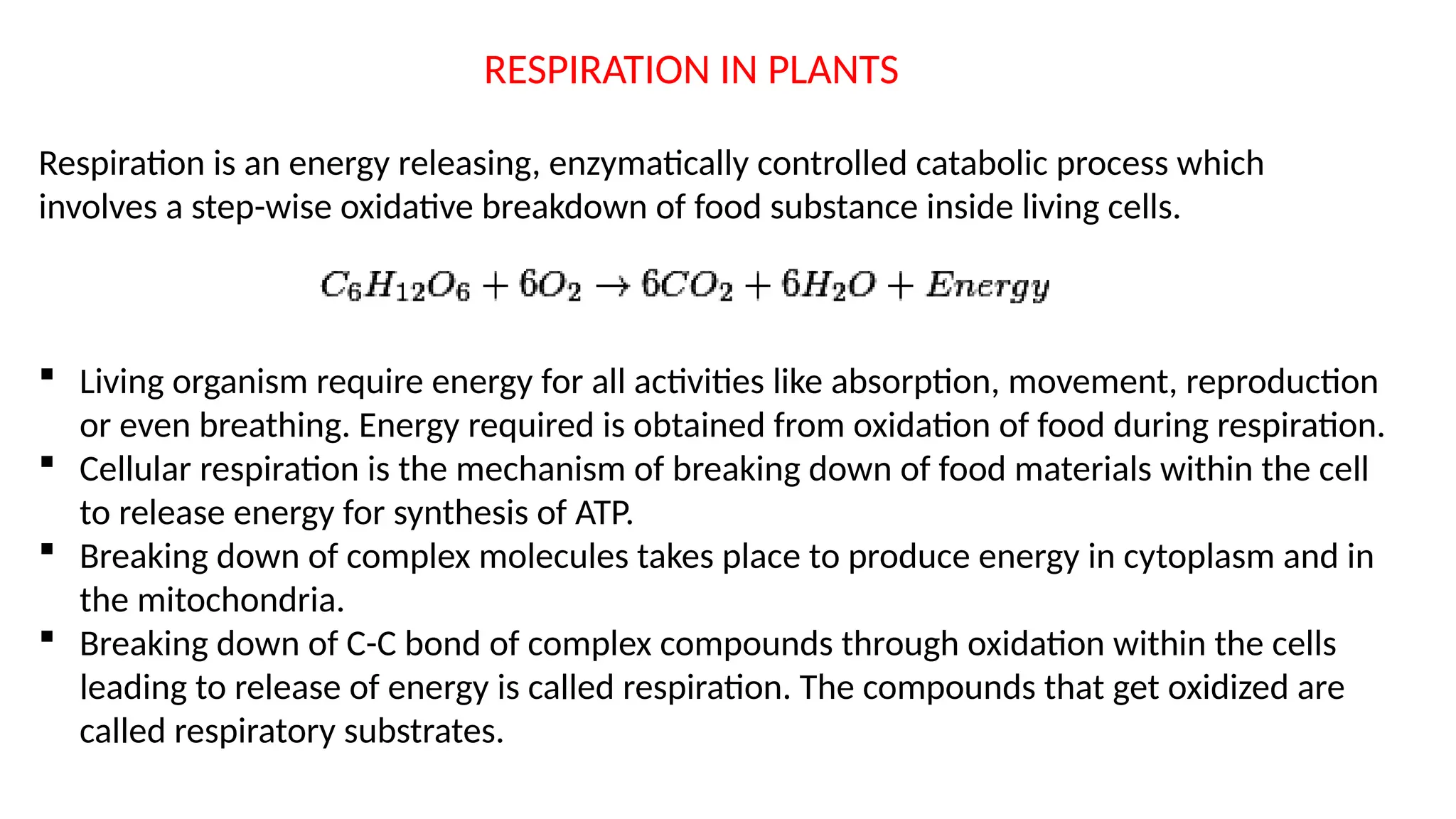
Respiration is an energy releasing, enzymatically controlled catabolic process which
involves a step-wise oxidative breakdown of food substance inside living cells.
 Living organism require energy for all activities like absorption, movement, reproduction
or even breathing. Energy required is obtained from oxidation of food during respiration.
 Cellular respiration is the mechanism of breaking down of food materials within the cell
to release energy for synthesis of ATP.
 Breaking down of complex molecules takes place to produce energy in cytoplasm and in
the mitochondria.
 Breaking down of C-C bond of complex compounds through oxidation within the cells
leading to release of energy is called respiration. The compounds that get oxidized are
called respiratory substrates.
RESPIRATION IN PLANTS
•Energy released during oxidation is not used directly but utilized in synthesis of
ATP, which is broken down when energy is required. Therefore, ATP is called
energy currency of cells.
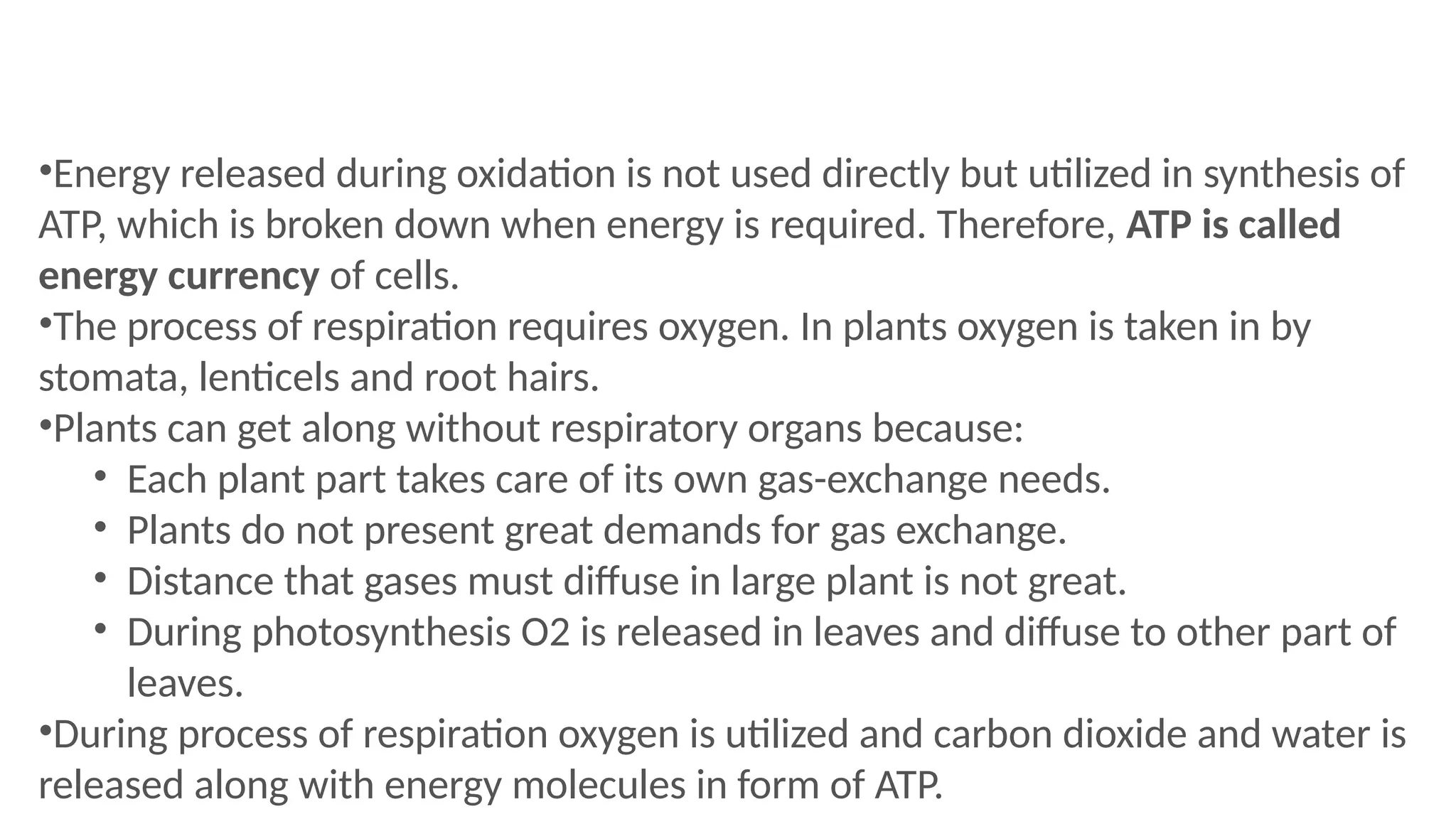
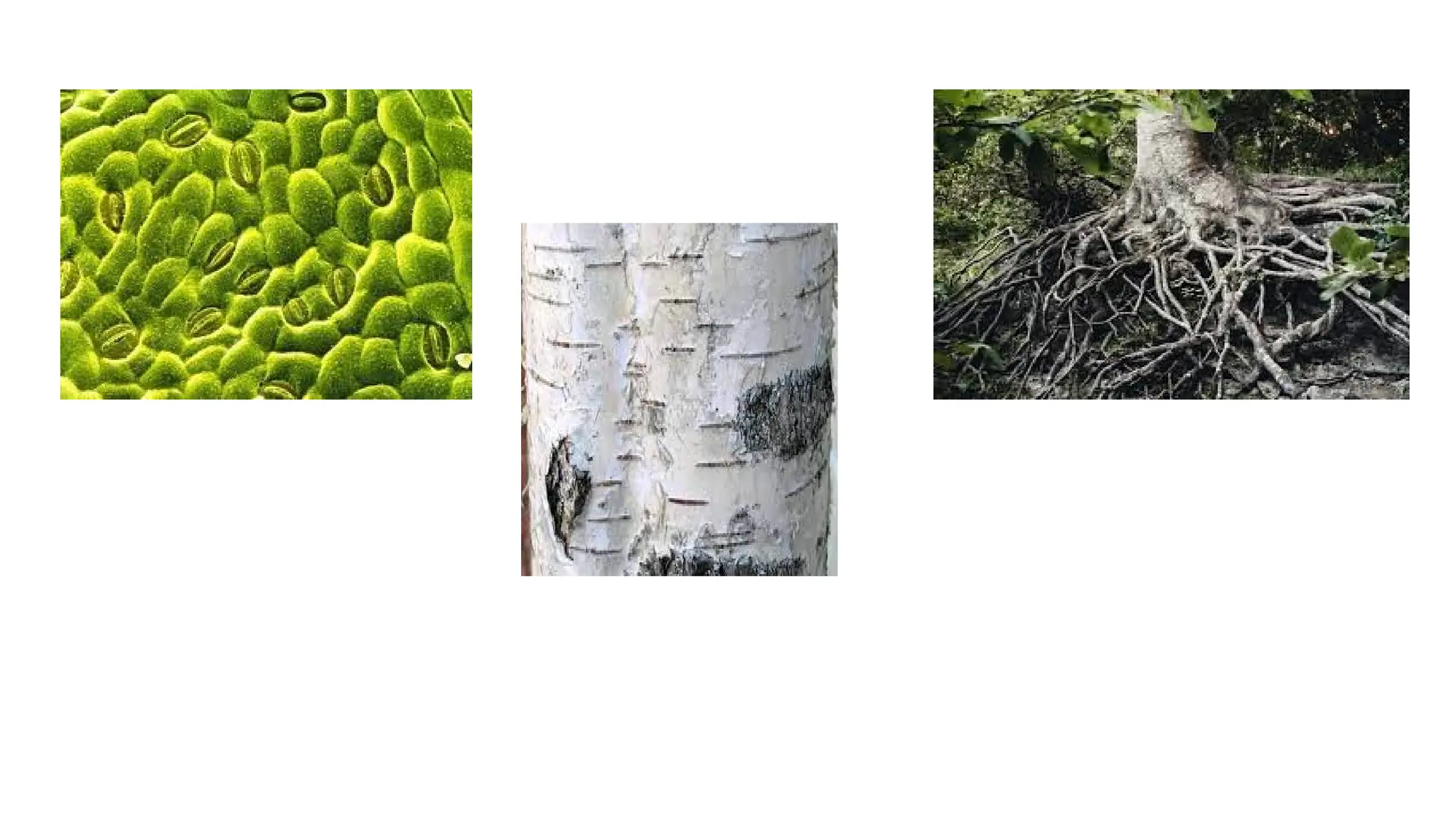
•The process of respiration requires oxygen. In plants oxygen is taken in by
stomata, lenticels and root hairs.
•Plants can get along without respiratory organs because:
• Each plant part takes care of its own gas-exchange needs.
• Plants do not present great demands for gas exchange.
• Distance that gases must diffuse in large plant is not great.
• During photosynthesis O2 is released in leaves and diffuse to other part of
leaves.
•During process of respiration oxygen is utilized and carbon dioxide and water is
released along with energy molecules in form of ATP.
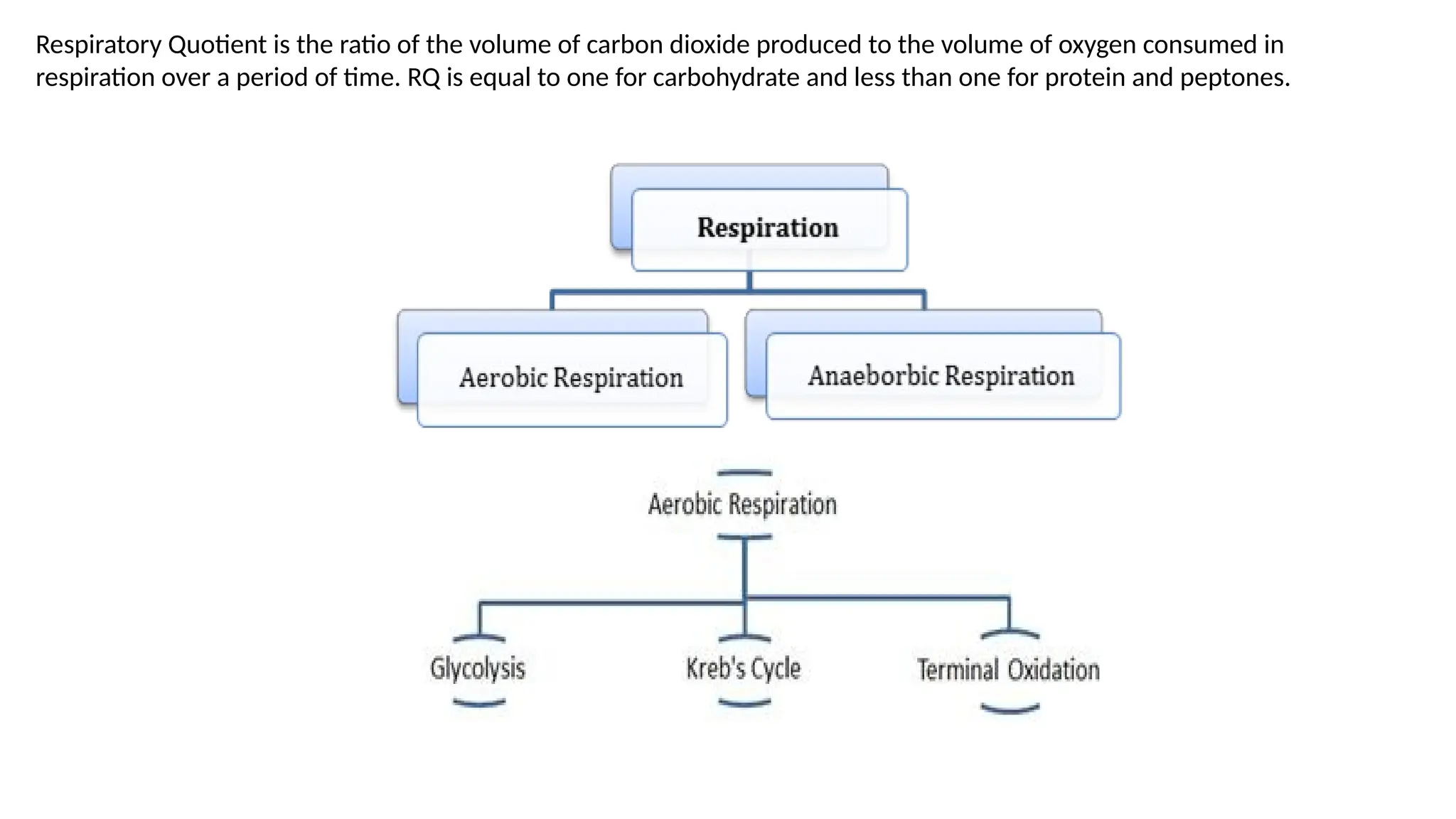
Respiratory Quotient is the ratio of the volume of carbon dioxide produced to the volume of oxygen consumed in
respiration over a period of time. RQ is equal to one for carbohydrate and less than one for protein and peptones.
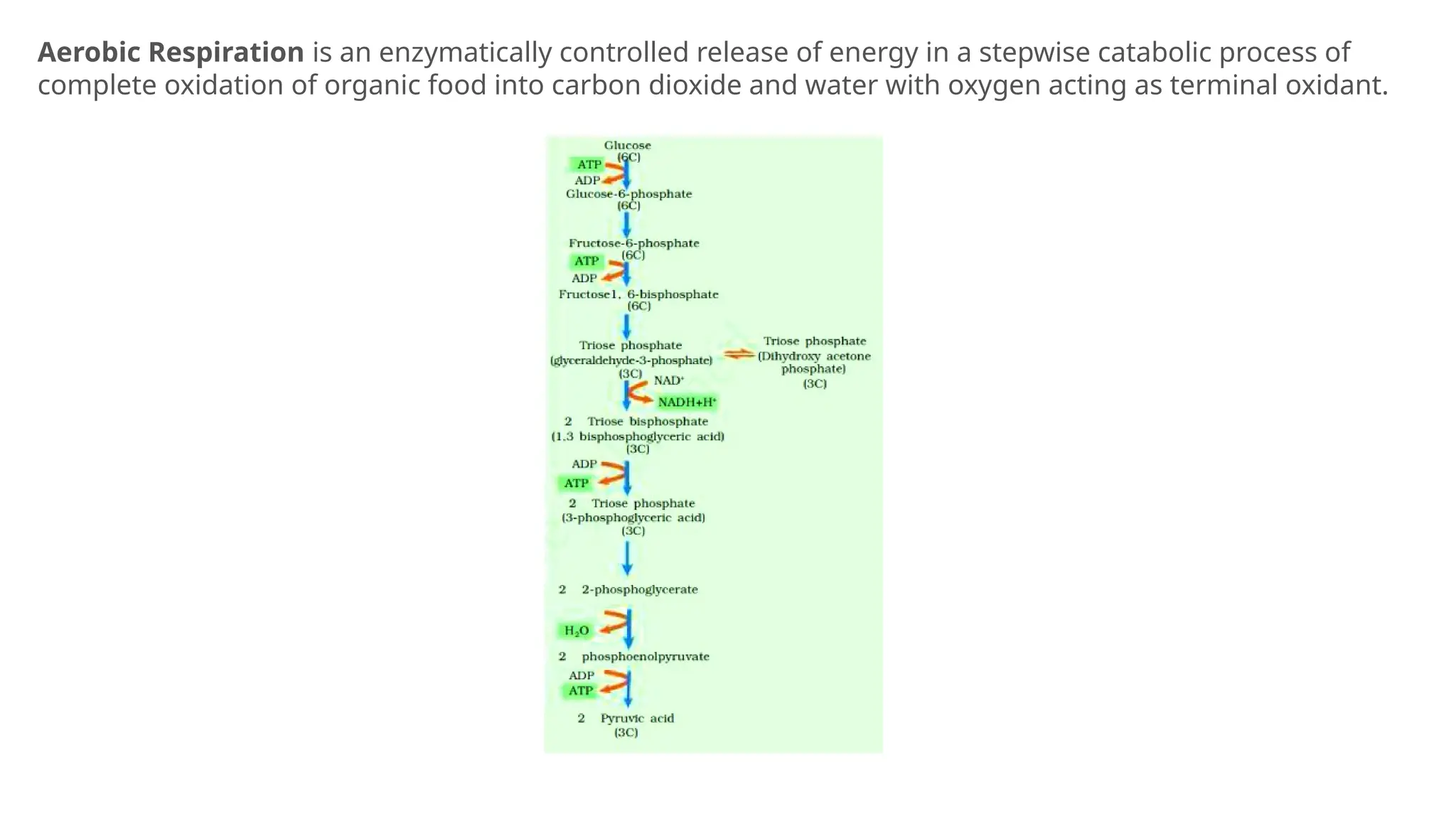
Aerobic Respiration is an enzymatically controlled release of energy in a stepwise catabolic process of
complete oxidation of organic food into carbon dioxide and water with oxygen acting as terminal oxidant.
Glycolysis
•The scheme of glycolysis is given by Gustav Embden, Otto Meyerhof, and J.
Parnas. It is also called as EMP pathway.
•Glycolysis is the partial oxidation of glucose or similar hexose sugar into two
molecules of pyruvic acid through a series of enzyme mediated reaction
releasing some ATP and NADH2. It occurs in cytoplasm.
•In plants glucose is derived from sucrose or from storage carbohydrates.
Sucrose is converted into glucose and fructose by enzyme invertase.
•Glycolysis starts with phosphorylation of glucose in presence of
enzyme hexokinase to form Glucose-6-phosphate. One molecules of ATP is
used in this process.
•In next steps Glucose-6-phosphate is converted into fructose-6-phosphate,
catalysed by enzyme phosphohexose isomerase.
•Fructose-6-phosphate uses another molecule of ATP to form Fructose-1-6
biphospahte in presence of enzyme phosphfructokinase.
•In glycolysis two molecules of ATP are consumed during double phosphorylation of glucose
to fructose 1,6 biphosphate. Two molecules of NADPH2 are formed at the time of oxidation
of glyceraldehyde 3-phosphate to 1,3 biphosphoglycerate. Each NADH is equivalent to 3ATP,
so that net gain in glycolysis is 8 ATP.
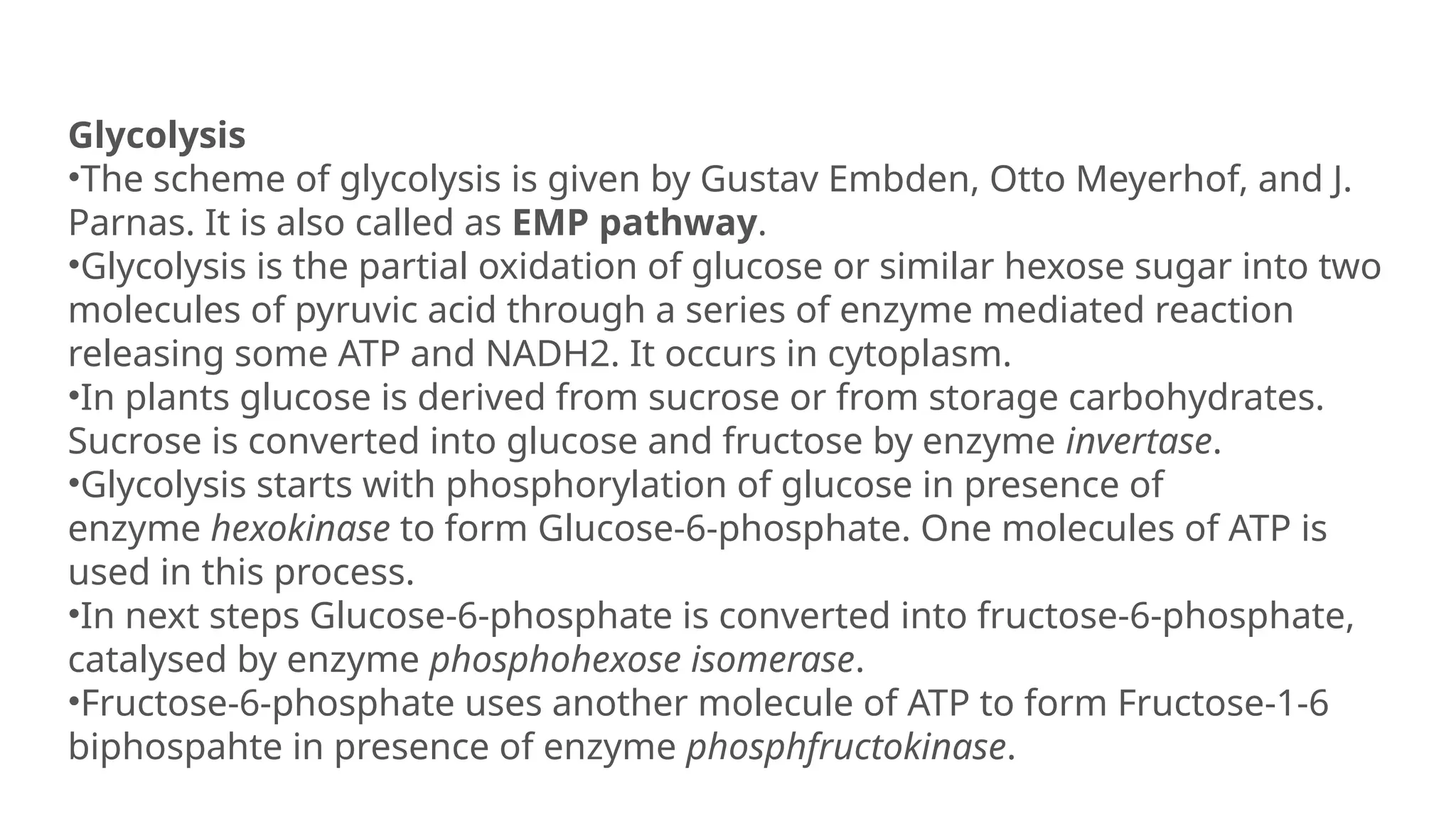
•Pyruvic acid is the key product of glycolysis, further breakdown of pyruvic acid depends
upon the need of the cell.
•In animal cells, like muscles during exercise, when oxygen is insufficient for aerobic
respiration, pyruvic acid is reduced to Lactic acid by enzyme lactate dehydrogenase due to
reduction by NADH2.
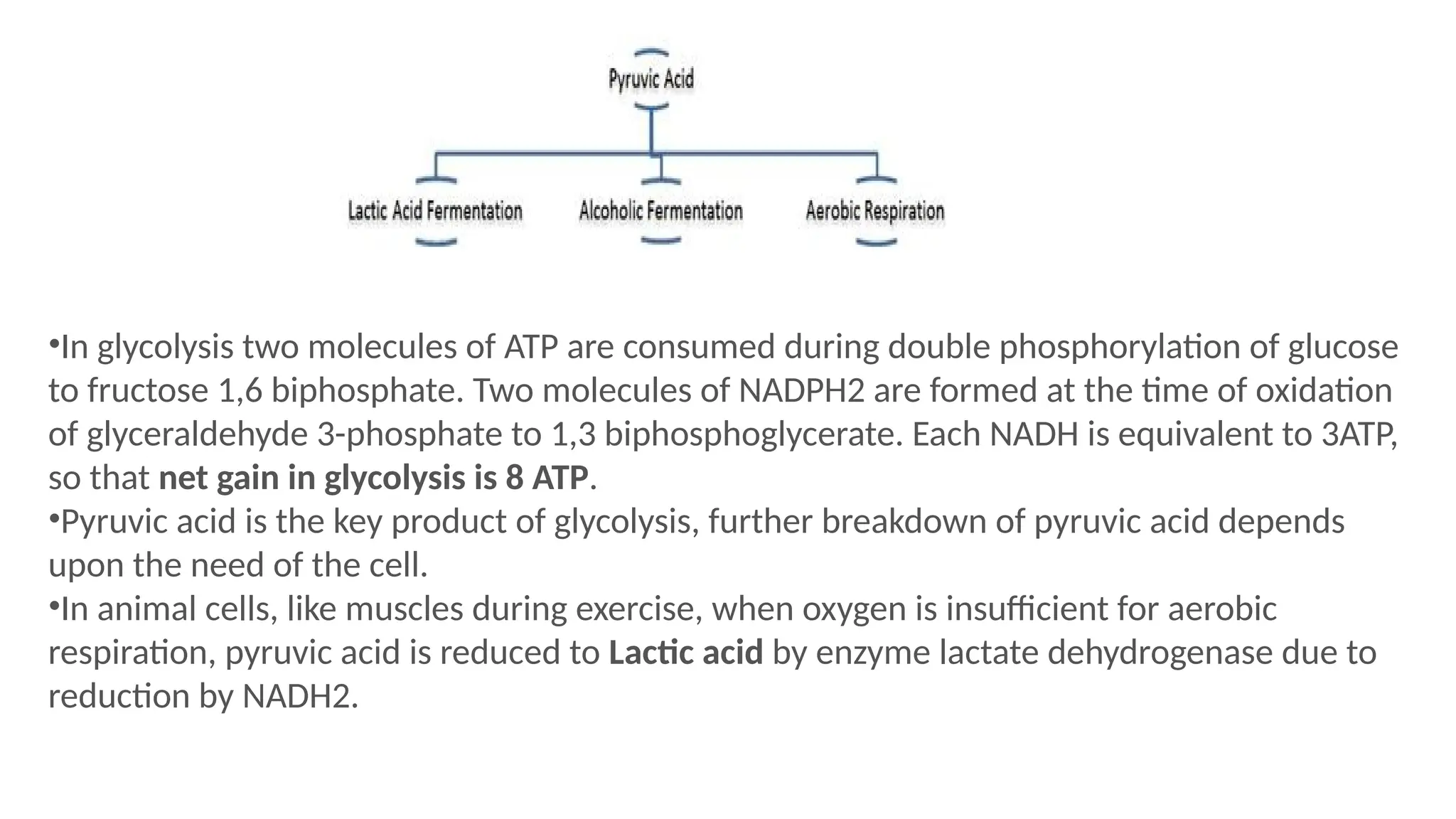
In fermentation by yeast, pyruvic acid is converted to ethanol and CO2. The enzyme involved is pyruvic acid decarboxylase
and alcohol dehydrogenase catalyse this reaction.
In both lactic acid fermentation and alcohol fermentation very less amount of energy is released.
Yeasts poison themselves to death if concentration of alcohol reaches above 13%.
Final product of glycolysis, pyruvate is transported from the cytoplasm into mitochondria for further breakdown.
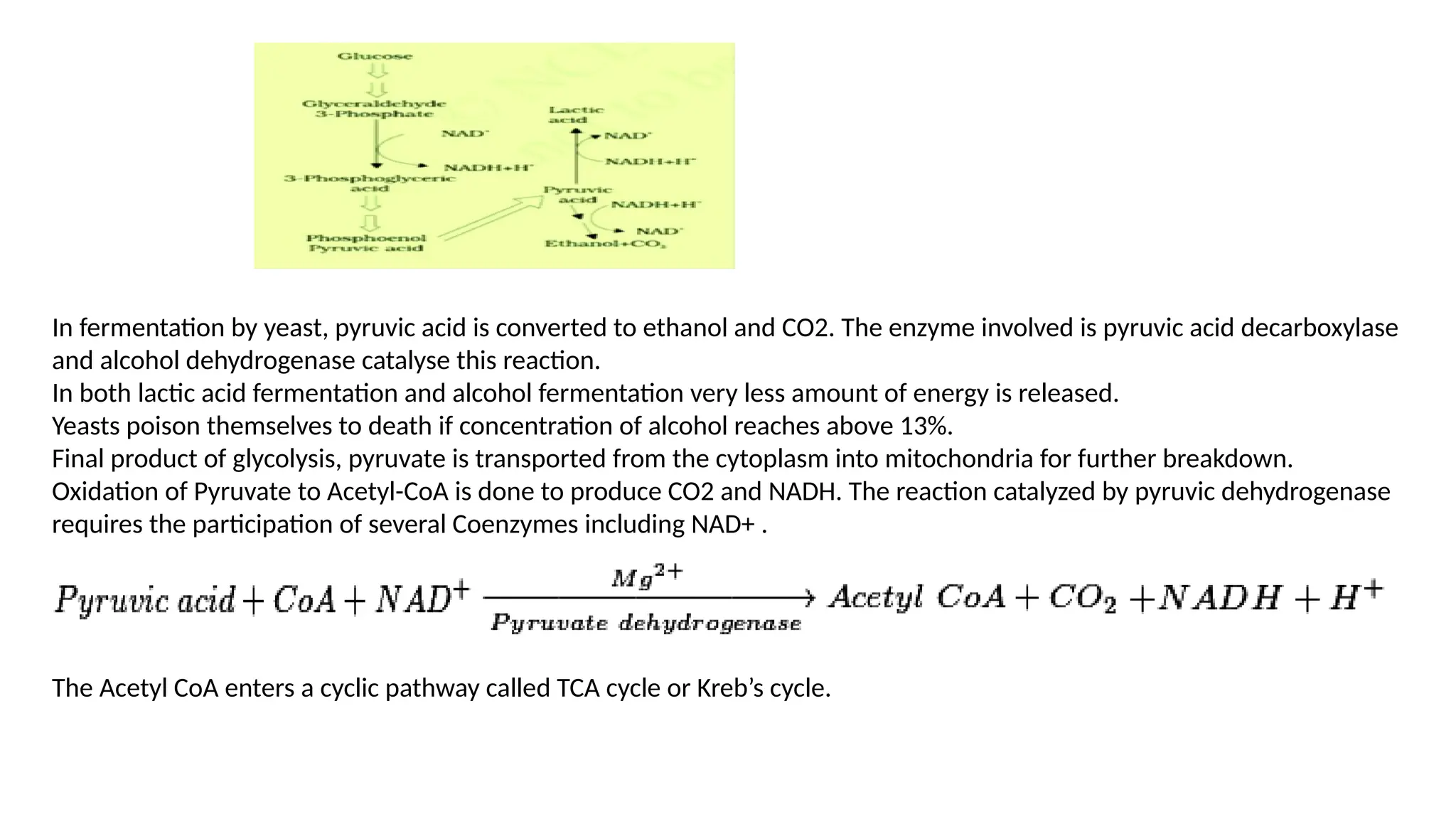
Oxidation of Pyruvate to Acetyl-CoA is done to produce CO2 and NADH. The reaction catalyzed by pyruvic dehydrogenase
requires the participation of several Coenzymes including NAD+ .
The Acetyl CoA enters a cyclic pathway called TCA cycle or Kreb’s cycle.
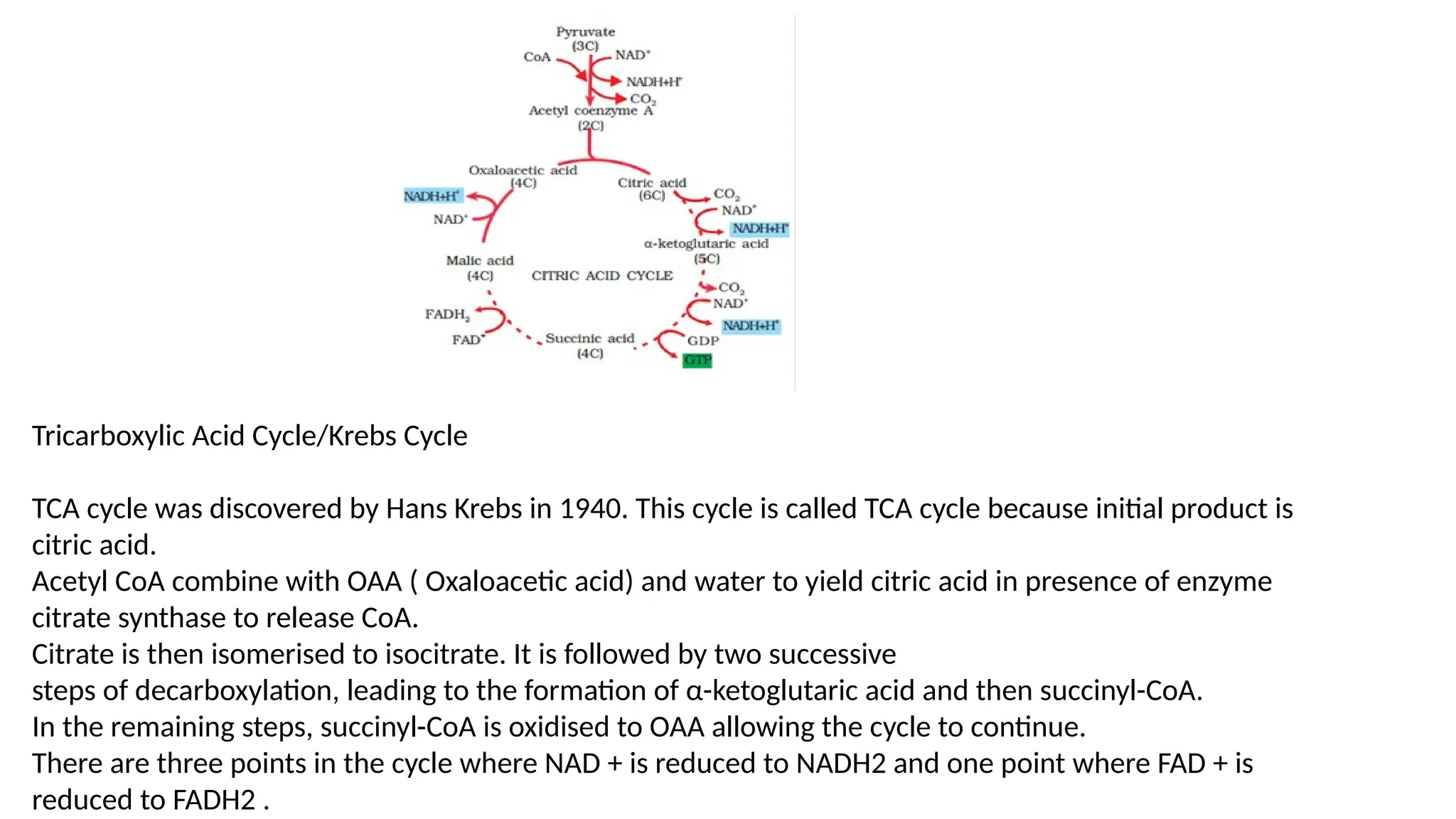
Tricarboxylic Acid Cycle/Krebs Cycle
TCA cycle was discovered by Hans Krebs in 1940. This cycle is called TCA cycle because initial product is
citric acid.
Acetyl CoA combine with OAA ( Oxaloacetic acid) and water to yield citric acid in presence of enzyme
citrate synthase to release CoA.
Citrate is then isomerised to isocitrate. It is followed by two successive
steps of decarboxylation, leading to the formation of α-ketoglutaric acid and then succinyl-CoA.
In the remaining steps, succinyl-CoA is oxidised to OAA allowing the cycle to continue.
There are three points in the cycle where NAD + is reduced to NADH2 and one point where FAD + is
reduced to FADH2 .
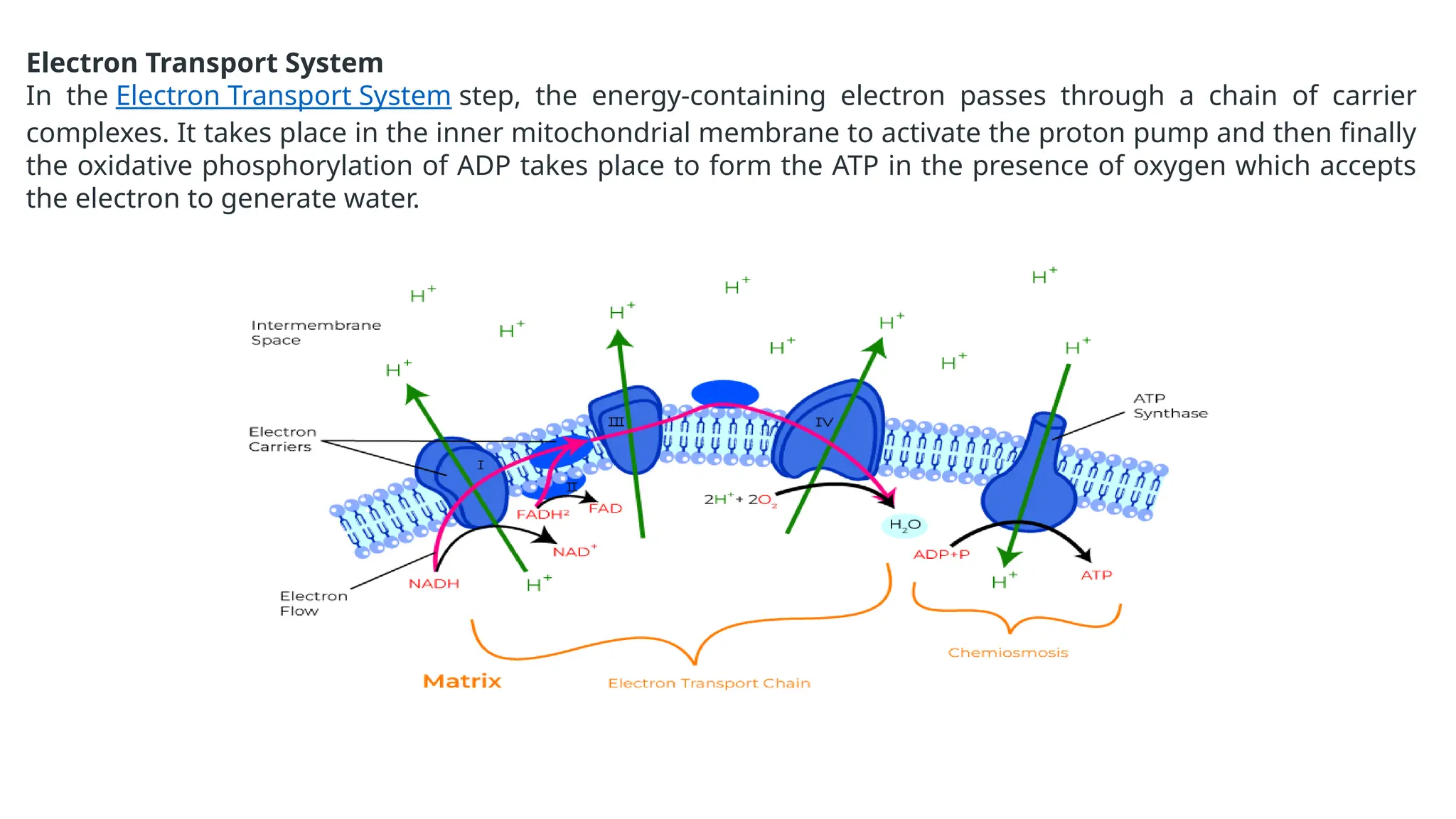
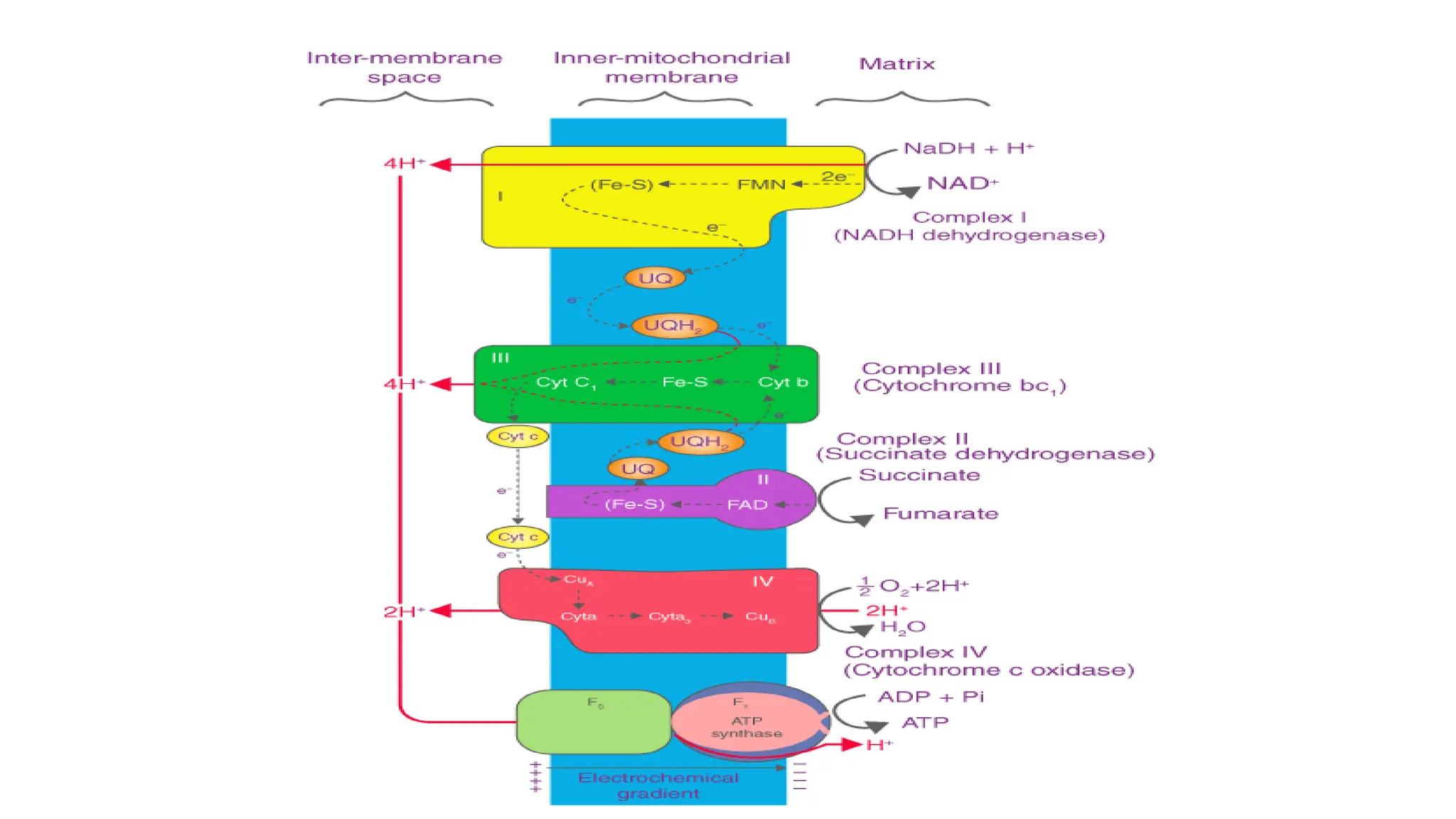
Electron Transport System
In the Electron Transport System step, the energy-containing electron passes through a chain of carrier
complexes. It takes place in the inner mitochondrial membrane to activate the proton pump and then finally
the oxidative phosphorylation of ADP takes place to form the ATP in the presence of oxygen which accepts
the electron to generate water.
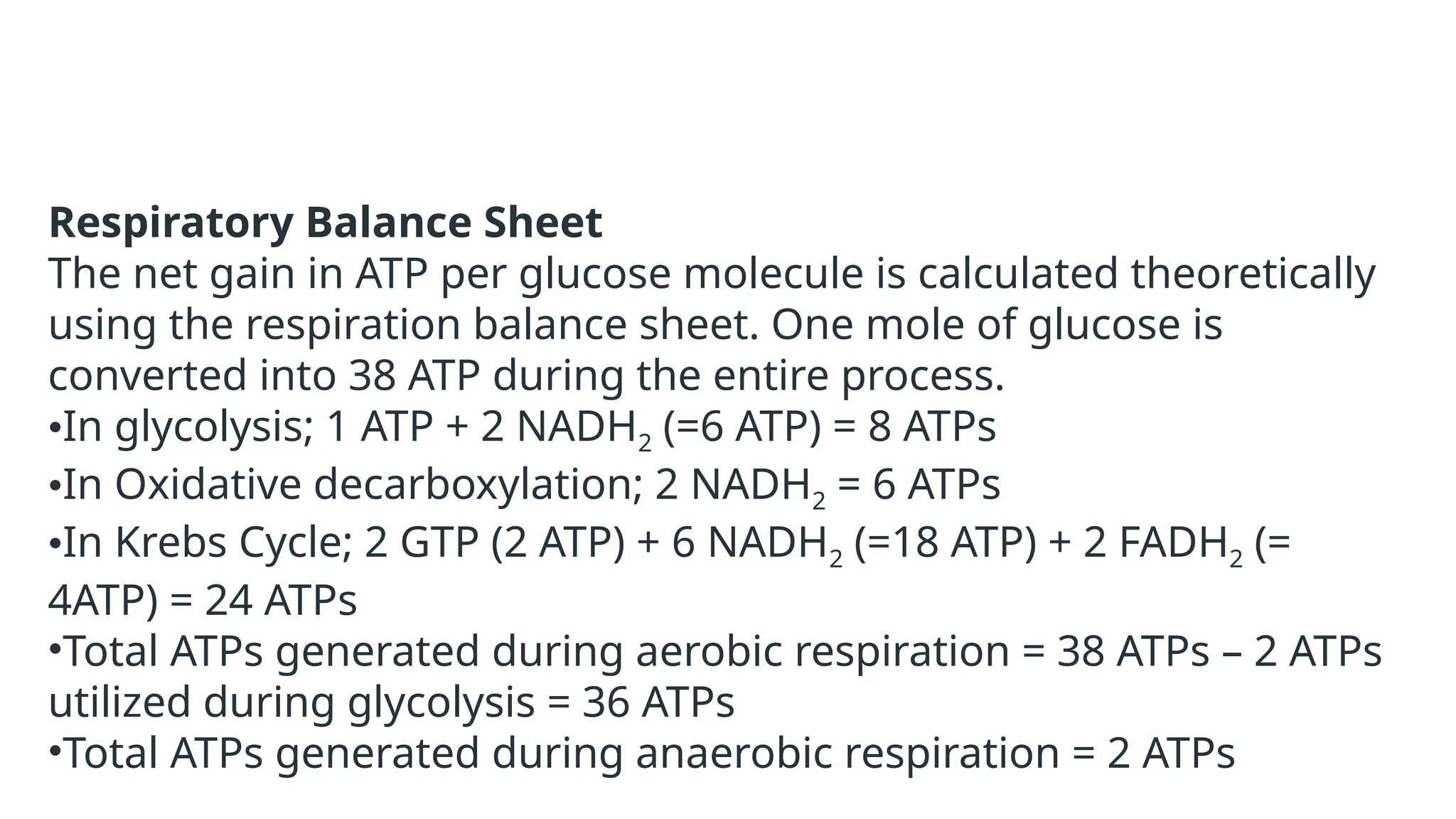
Respiratory Balance Sheet
The net gain in ATP per glucose molecule is calculated theoretically
using the respiration balance sheet. One mole of glucose is
converted into 38 ATP during the entire process.
•In glycolysis; 1 ATP + 2 NADH2 (=6 ATP) = 8 ATPs
•In Oxidative decarboxylation; 2 NADH2 = 6 ATPs
•In Krebs Cycle; 2 GTP (2 ATP) + 6 NADH2 (=18 ATP) + 2 FADH2 (=
4ATP) = 24 ATPs
•Total ATPs generated during aerobic respiration = 38 ATPs – 2 ATPs
utilized during glycolysis = 36 ATPs
•Total ATPs generated during anaerobic respiration = 2 ATPs
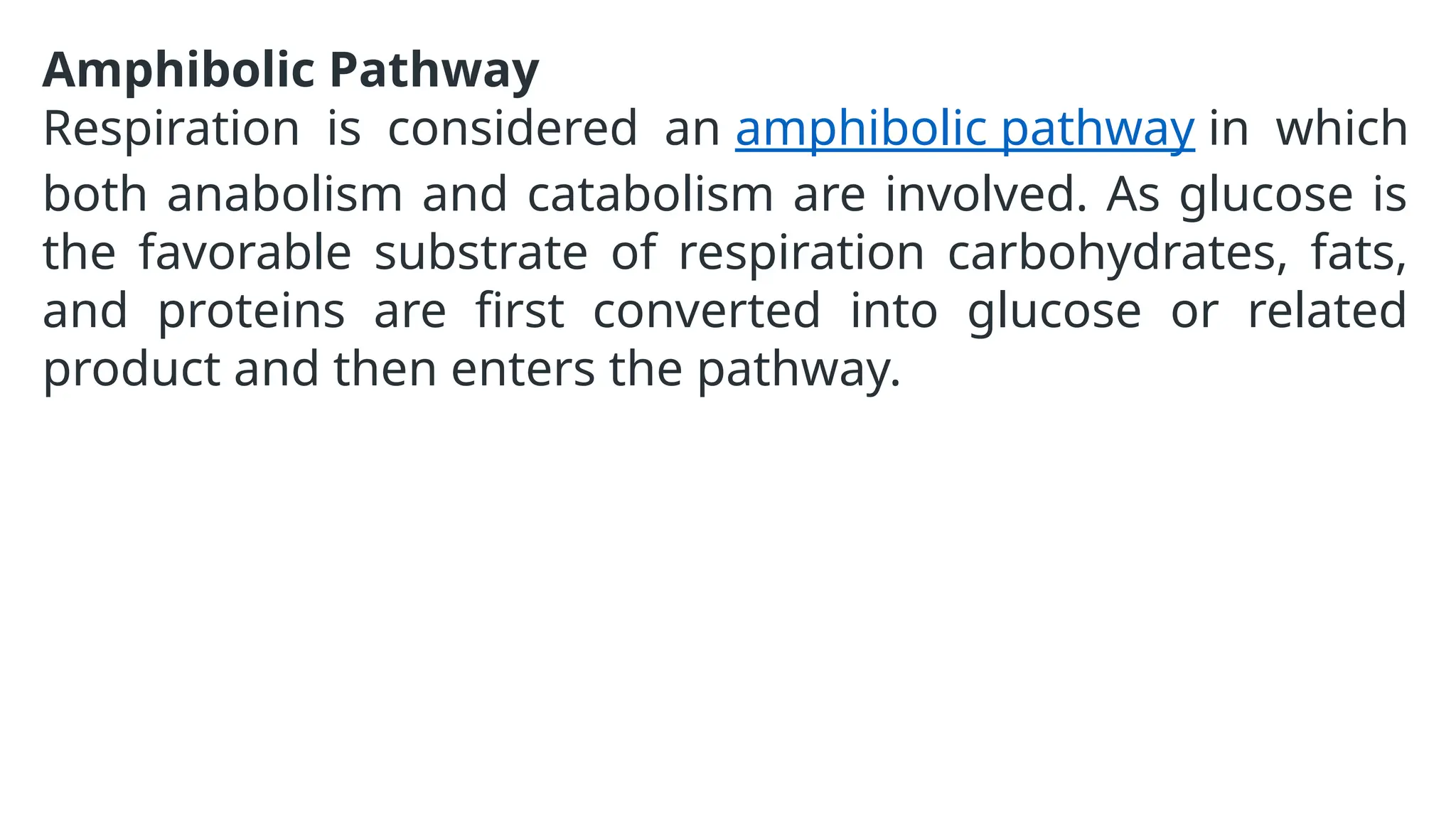
Amphibolic Pathway
Respiration is considered an amphibolic pathway in which
both anabolism and catabolism are involved. As glucose is
the favorable substrate of respiration carbohydrates, fats,
and proteins are first converted into glucose or related
product and then enters the pathway.
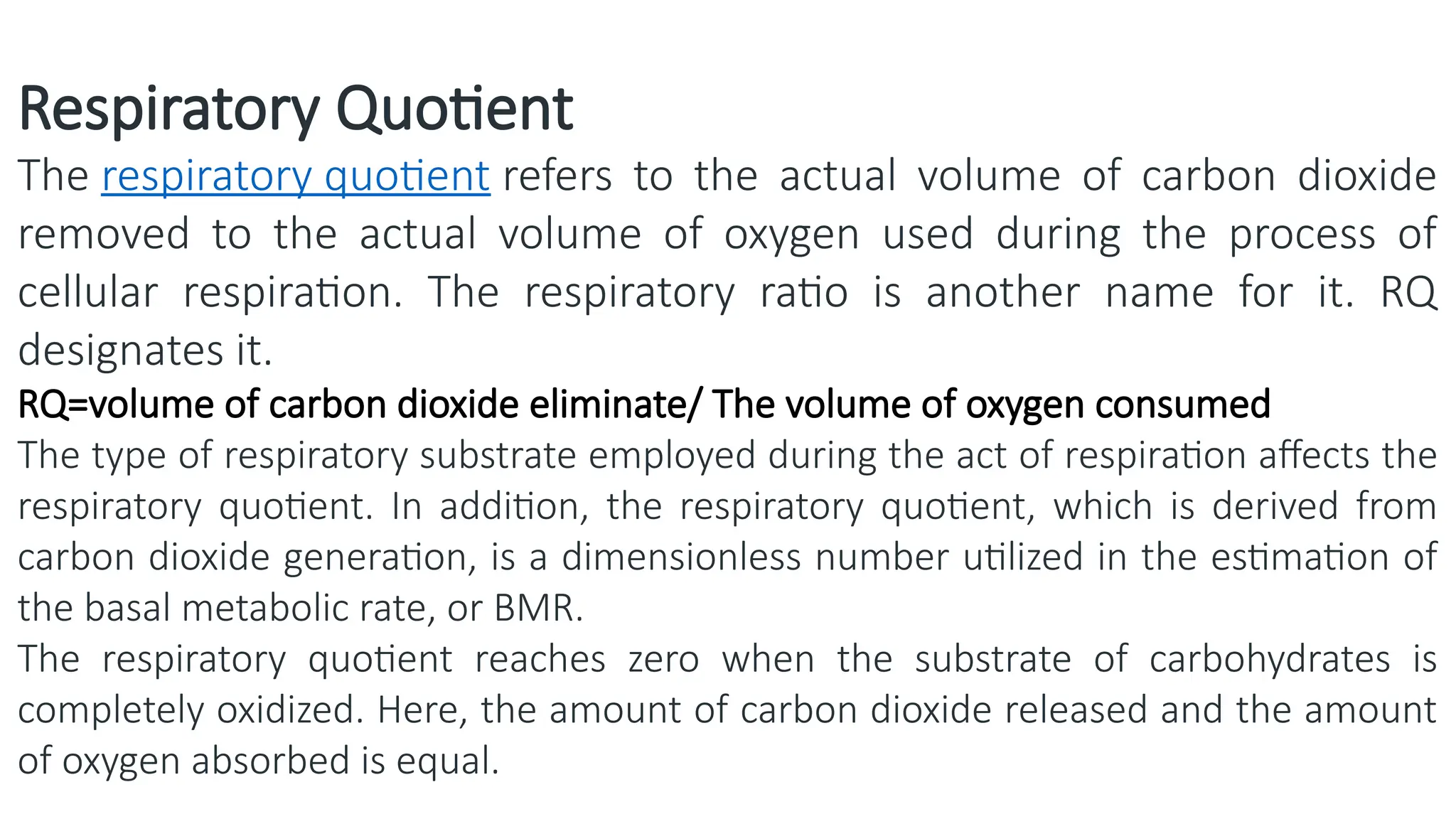
Respiratory Quotient
The respiratory quotient refers to the actual volume of carbon dioxide
removed to the actual volume of oxygen used during the process of
cellular respiration. The respiratory ratio is another name for it. RQ
designates it.
RQ=volume of carbon dioxide eliminate/ The volume of oxygen consumed
The type of respiratory substrate employed during the act of respiration affects the
respiratory quotient. In addition, the respiratory quotient, which is derived from
carbon dioxide generation, is a dimensionless number utilized in the estimation of
the basal metabolic rate, or BMR.
The respiratory quotient reaches zero when the substrate of carbohydrates is
completely oxidized. Here, the amount of carbon dioxide released and the amount
of oxygen absorbed is equal.
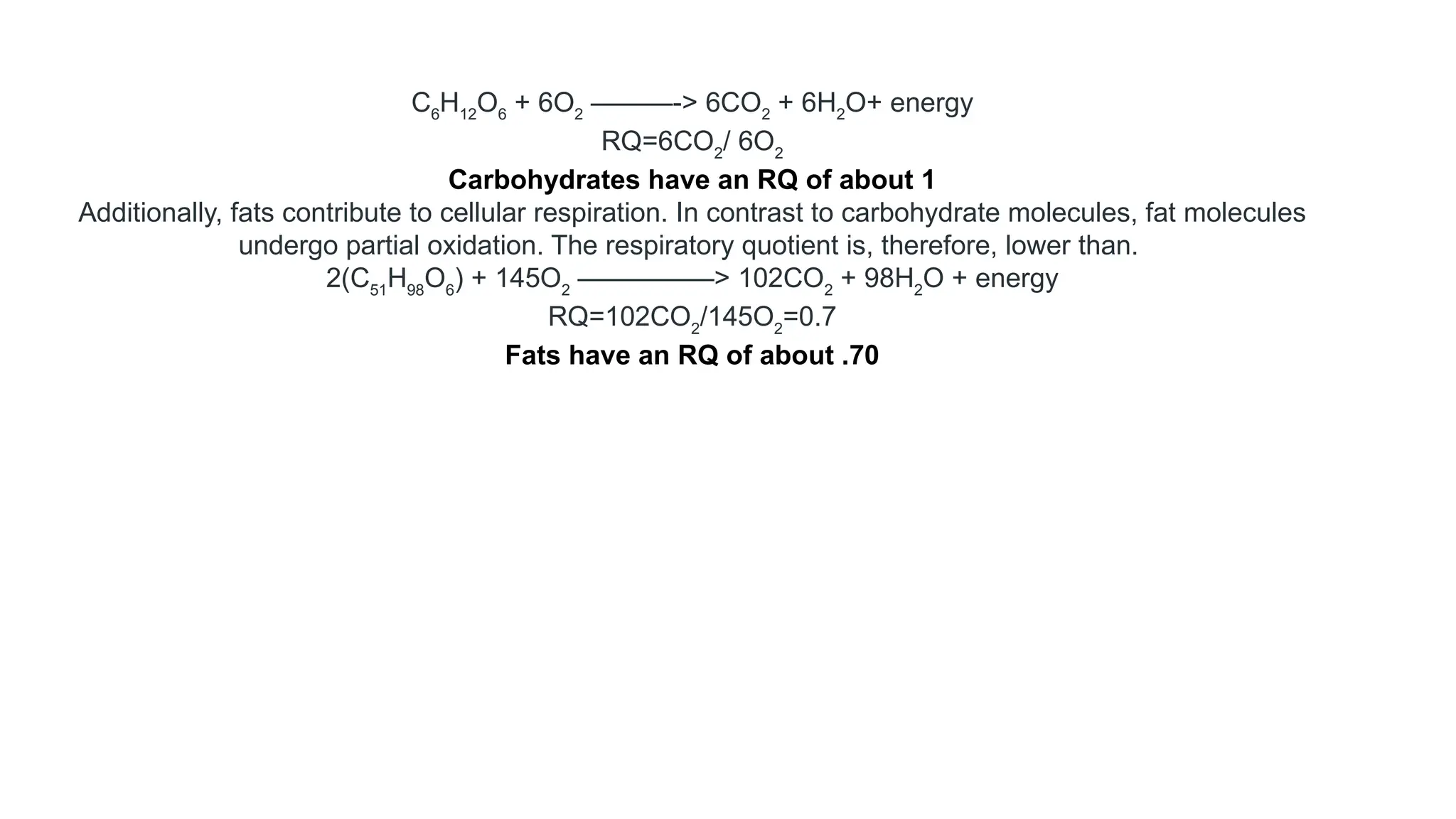
C6
H12
O6
+ 6O2
———-> 6CO2
+ 6H2
O+ energy
RQ=6CO2
/ 6O2
Carbohydrates have an RQ of about 1
Additionally, fats contribute to cellular respiration. In contrast to carbohydrate molecules, fat molecules
undergo partial oxidation. The respiratory quotient is, therefore, lower than.
2(C51
H98
O6
) + 145O2
—————> 102CO2
+ 98H2
O + energy
RQ=102CO2
/145O2
=0.7
Fats have an RQ of about .70

RESPIRATION IN PLANTS+ class 11It helps learn to understand the concept in detail

  • 1.
    Respiration is anenergy releasing, enzymatically controlled catabolic process which involves a step-wise oxidative breakdown of food substance inside living cells.  Living organism require energy for all activities like absorption, movement, reproduction or even breathing. Energy required is obtained from oxidation of food during respiration.  Cellular respiration is the mechanism of breaking down of food materials within the cell to release energy for synthesis of ATP.  Breaking down of complex molecules takes place to produce energy in cytoplasm and in the mitochondria.  Breaking down of C-C bond of complex compounds through oxidation within the cells leading to release of energy is called respiration. The compounds that get oxidized are called respiratory substrates. RESPIRATION IN PLANTS
  • 2.
    •Energy released duringoxidation is not used directly but utilized in synthesis of ATP, which is broken down when energy is required. Therefore, ATP is called energy currency of cells. •The process of respiration requires oxygen. In plants oxygen is taken in by stomata, lenticels and root hairs. •Plants can get along without respiratory organs because: • Each plant part takes care of its own gas-exchange needs. • Plants do not present great demands for gas exchange. • Distance that gases must diffuse in large plant is not great. • During photosynthesis O2 is released in leaves and diffuse to other part of leaves. •During process of respiration oxygen is utilized and carbon dioxide and water is released along with energy molecules in form of ATP.
  • 4.
    Respiratory Quotient isthe ratio of the volume of carbon dioxide produced to the volume of oxygen consumed in respiration over a period of time. RQ is equal to one for carbohydrate and less than one for protein and peptones.
  • 5.
    Aerobic Respiration isan enzymatically controlled release of energy in a stepwise catabolic process of complete oxidation of organic food into carbon dioxide and water with oxygen acting as terminal oxidant.
  • 6.
    Glycolysis •The scheme ofglycolysis is given by Gustav Embden, Otto Meyerhof, and J. Parnas. It is also called as EMP pathway. •Glycolysis is the partial oxidation of glucose or similar hexose sugar into two molecules of pyruvic acid through a series of enzyme mediated reaction releasing some ATP and NADH2. It occurs in cytoplasm. •In plants glucose is derived from sucrose or from storage carbohydrates. Sucrose is converted into glucose and fructose by enzyme invertase. •Glycolysis starts with phosphorylation of glucose in presence of enzyme hexokinase to form Glucose-6-phosphate. One molecules of ATP is used in this process. •In next steps Glucose-6-phosphate is converted into fructose-6-phosphate, catalysed by enzyme phosphohexose isomerase. •Fructose-6-phosphate uses another molecule of ATP to form Fructose-1-6 biphospahte in presence of enzyme phosphfructokinase.
  • 7.
    •In glycolysis twomolecules of ATP are consumed during double phosphorylation of glucose to fructose 1,6 biphosphate. Two molecules of NADPH2 are formed at the time of oxidation of glyceraldehyde 3-phosphate to 1,3 biphosphoglycerate. Each NADH is equivalent to 3ATP, so that net gain in glycolysis is 8 ATP. •Pyruvic acid is the key product of glycolysis, further breakdown of pyruvic acid depends upon the need of the cell. •In animal cells, like muscles during exercise, when oxygen is insufficient for aerobic respiration, pyruvic acid is reduced to Lactic acid by enzyme lactate dehydrogenase due to reduction by NADH2.
  • 8.
    In fermentation byyeast, pyruvic acid is converted to ethanol and CO2. The enzyme involved is pyruvic acid decarboxylase and alcohol dehydrogenase catalyse this reaction. In both lactic acid fermentation and alcohol fermentation very less amount of energy is released. Yeasts poison themselves to death if concentration of alcohol reaches above 13%. Final product of glycolysis, pyruvate is transported from the cytoplasm into mitochondria for further breakdown. Oxidation of Pyruvate to Acetyl-CoA is done to produce CO2 and NADH. The reaction catalyzed by pyruvic dehydrogenase requires the participation of several Coenzymes including NAD+ . The Acetyl CoA enters a cyclic pathway called TCA cycle or Kreb’s cycle.
  • 9.
    Tricarboxylic Acid Cycle/KrebsCycle TCA cycle was discovered by Hans Krebs in 1940. This cycle is called TCA cycle because initial product is citric acid. Acetyl CoA combine with OAA ( Oxaloacetic acid) and water to yield citric acid in presence of enzyme citrate synthase to release CoA. Citrate is then isomerised to isocitrate. It is followed by two successive steps of decarboxylation, leading to the formation of α-ketoglutaric acid and then succinyl-CoA. In the remaining steps, succinyl-CoA is oxidised to OAA allowing the cycle to continue. There are three points in the cycle where NAD + is reduced to NADH2 and one point where FAD + is reduced to FADH2 .
  • 10.
    Electron Transport System Inthe Electron Transport System step, the energy-containing electron passes through a chain of carrier complexes. It takes place in the inner mitochondrial membrane to activate the proton pump and then finally the oxidative phosphorylation of ADP takes place to form the ATP in the presence of oxygen which accepts the electron to generate water.
  • 12.
    Respiratory Balance Sheet Thenet gain in ATP per glucose molecule is calculated theoretically using the respiration balance sheet. One mole of glucose is converted into 38 ATP during the entire process. •In glycolysis; 1 ATP + 2 NADH2 (=6 ATP) = 8 ATPs •In Oxidative decarboxylation; 2 NADH2 = 6 ATPs •In Krebs Cycle; 2 GTP (2 ATP) + 6 NADH2 (=18 ATP) + 2 FADH2 (= 4ATP) = 24 ATPs •Total ATPs generated during aerobic respiration = 38 ATPs – 2 ATPs utilized during glycolysis = 36 ATPs •Total ATPs generated during anaerobic respiration = 2 ATPs
  • 13.
    Amphibolic Pathway Respiration isconsidered an amphibolic pathway in which both anabolism and catabolism are involved. As glucose is the favorable substrate of respiration carbohydrates, fats, and proteins are first converted into glucose or related product and then enters the pathway.
  • 14.
    Respiratory Quotient The respiratoryquotient refers to the actual volume of carbon dioxide removed to the actual volume of oxygen used during the process of cellular respiration. The respiratory ratio is another name for it. RQ designates it. RQ=volume of carbon dioxide eliminate/ The volume of oxygen consumed The type of respiratory substrate employed during the act of respiration affects the respiratory quotient. In addition, the respiratory quotient, which is derived from carbon dioxide generation, is a dimensionless number utilized in the estimation of the basal metabolic rate, or BMR. The respiratory quotient reaches zero when the substrate of carbohydrates is completely oxidized. Here, the amount of carbon dioxide released and the amount of oxygen absorbed is equal.
  • 15.
    C6 H12 O6 + 6O2 ———-> 6CO2 +6H2 O+ energy RQ=6CO2 / 6O2 Carbohydrates have an RQ of about 1 Additionally, fats contribute to cellular respiration. In contrast to carbohydrate molecules, fat molecules undergo partial oxidation. The respiratory quotient is, therefore, lower than. 2(C51 H98 O6 ) + 145O2 —————> 102CO2 + 98H2 O + energy RQ=102CO2 /145O2 =0.7 Fats have an RQ of about .70