Developing the Growth
Mindset for Enhanced
Productivity
- Olusegun Mosugu
WRITE DOWN
 One thing you have always been good at
 One thing you think you’ll never be good at
 One thing you weren’t good at, but became
good at over time
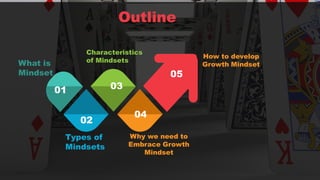
Outline
What is
Mindset
Types of
Mindsets
Characteristics
of Mindsets
How to develop
Growth Mindset
01
02
04
05
Why we need to
Embrace Growth
Mindset
03
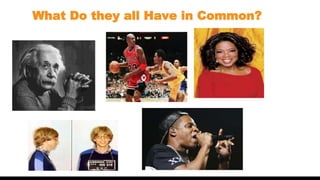
What Do they all Have in Common?
What’s the Difference Between these Two Images?
The Age-Old Question
 Can human qualities, including intellectual ability,
be cultivated or are they carved in stone?
 Nature vs. nurture
 Genes vs. environment
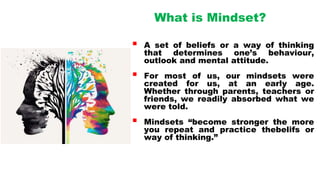
What is Mindset?
 A set of beliefs or a way of thinking
that determines one’s behaviour,
outlook and mental attitude.
 For most of us, our mindsets were
created for us, at an early age.
Whether through parents, teachers or
friends, we readily absorbed what we
were told.
 Mindsets “become stronger the more
you repeat and practice thebelifs or
way of thinking.”
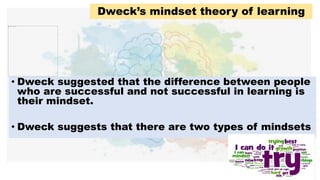
Dweck’s mindset theory of learning
• Dweck suggested that the difference between people
who are successful and not successful in learning is
their mindset.
• Dweck suggests that there are two types of mindsets
Mindset Features
Mindsets are along a continuum or spectrum. It’s rarely one or the
other. In some situations someone will put in lots of effort -
whereas in others the same person won’t.
Mindset determines how you deal with failure:
• Fixed – give up as success should come without too much effort
• Growth – sees failure as an opportunity to learn more and
overcome obstacle.
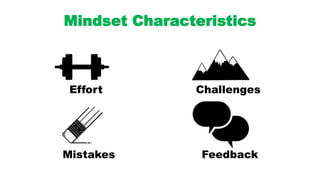
Mindset Characteristics
Effort Challenges
Mistakes Feedback
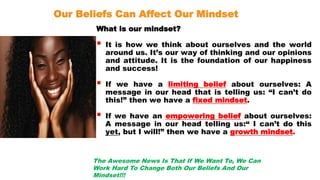
Our Beliefs Can Affect Our Mindset
What is our mindset?
 It is how we think about ourselves and the world
around us. It’s our way of thinking and our opinions
and attitude. It is the foundation of our happiness
and success!
 If we have a limiting belief about ourselves: A
message in our head that is telling us: “I can’t do
this!” then we have a fixed mindset.
 If we have an empowering belief about ourselves:
A message in our head telling us:“ I can’t do this
yet, but I will!” then we have a growth mindset.
The Awesome News Is That If We Want To, We Can
Work Hard To Change Both Our Beliefs And Our
Mindset!!!
LO: To outline and evaluate Dweck’s mindset theory of learning.
A man and his son were in a car crash. The father
died, but the son was critically injured and rushed to
hospital.
They decided he needed surgery immediately. When
he reached the operating table, the surgeon on duty
looked at him and said “I can’t operate because he’s
my son’.
How can this be?
A PUZZLE FOR YOU
5
Types of Mindsets
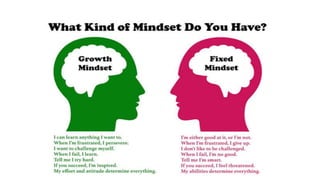
 Fixed mindset
 Growth mindset
5
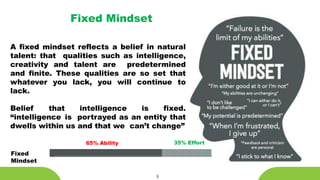
Fixed Mindset
A fixed mindset reflects a belief in natural
talent: that qualities such as intelligence,
creativity and talent are predetermined
and finite. These qualities are so set that
whatever you lack, you will continue to
lack.

Belief that intelligence is fixed.
“intelligence is portrayed as an entity that
dwells within us and that we can’t change”
Fixed
Mindset
65% Ability 35% Effort
6
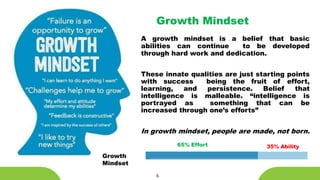
Growth Mindset
A growth mindset is a belief that basic
abilities can continue to be developed
through hard work and dedication.
These innate qualities are just starting points
with success being the fruit of effort,
learning, and persistence. Belief that
intelligence is malleable. “intelligence is
portrayed as something that can be
increased through one’s efforts”
In growth mindset, people are made, not born.
35% Ability
65% Effort
Growth
Mindset
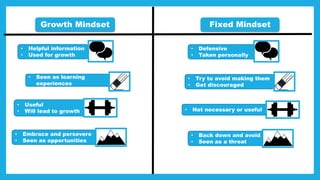
• Not necessary or useful
• Useful
• Will lead to growth
• Back down and avoid
• Seen as a threat
• Embrace and persevere
• Seen as opportunities
• Try to avoid making them
• Get discouraged
• Seen as learning
experiences
• Defensive
• Taken personally
• Helpful information
• Used for growth
Growth Mindset Fixed Mindset
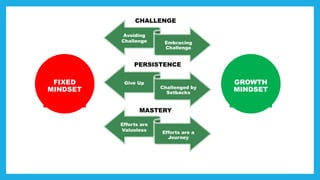
GROWTH
MINDSET
FIXED
MINDSET
Avoiding
Challenge Embracing
Challenge
CHALLENGE
PERSISTENCE
Give Up
Challenged by
Setbacks
MASTERY
Efforts are
Valueless Efforts are a
Journey
• GROWTH
MINDSET
FIXED
MINDSET
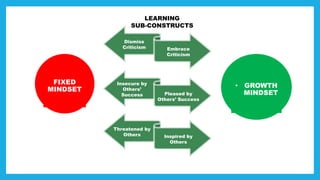
Dismiss
Criticism Embrace
Criticism
LEARNING
SUB-CONSTRUCTS
Insecure by
Others’
Success Pleased by
Others’ Success
Threatened by
Others Inspired by
Others
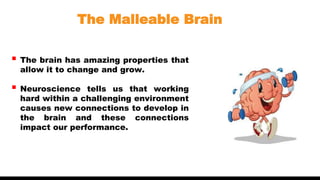
The Malleable Brain
 The brain has amazing properties that
allow it to change and grow.
 Neuroscience tells us that working
hard within a challenging environment
causes new connections to develop in
the brain and these connections
impact our performance.
The Malleable Brain
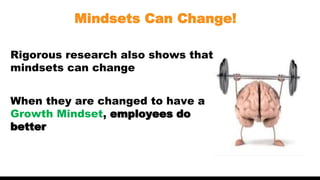
Mindsets Can Change!
Rigorous research also shows that
mindsets can change
When they are changed to have a
Growth Mindset, employees do
better
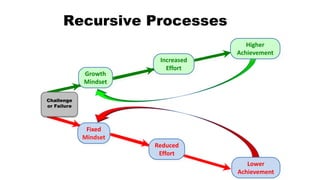
Recursive Processes
Reduced
Effort
Lower
Achievement
Higher
Achievement
Growth
Mindset
Increased
Effort
Challenge
or Failure
Fixed
Mindset
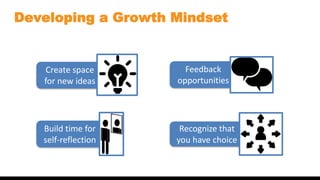
Developing a Growth Mindset
Recognize that
you have choice
Create space
for new ideas
Build time for
self-reflection
Feedback
opportunities
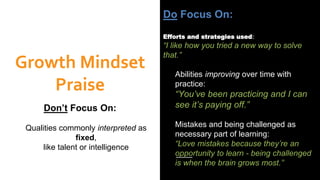
Growth Mindset
Praise
Don’t Focus On:
Qualities commonly interpreted as
fixed,
like talent or intelligence
Do Focus On:
Efforts and strategies used:
“I like how you tried a new way to solve
that.”
Abilities improving over time with
practice:
“You’ve been practicing and I can
see it’s paying off.”
Mistakes and being challenged as
necessary part of learning:
“Love mistakes because they’re an
opportunity to learn - being challenged
is when the brain grows most.”
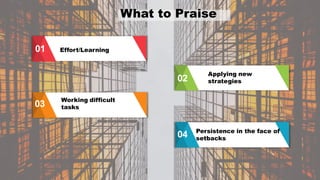
What to Praise
01 Effort/Learning
02
Applying new
strategies
03
Working difficult
tasks
04 Persistence in the face of
setbacks
10
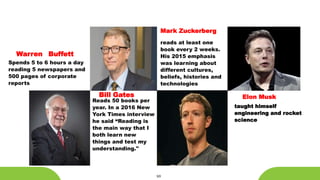
Warren Buffett
Spends 5 to 6 hours a day
reading 5 newspapers and
500 pages of corporate
reports
Reads 50 books per
year. In a 2016 New
York Times interview
he said “Reading is
the main way that I
both learn new
things and test my
understanding."
Bill Gates
reads at least one
book every 2 weeks.
His 2015 emphasis
was learning about
different cultures,
beliefs, histories and
technologies
Mark Zuckerberg
taught himself
engineering and rocket
science
Elon Musk
11
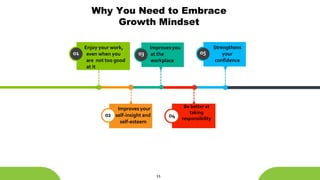
Why You Need to Embrace
Growth Mindset
Enjoy your work,
even when you
are not too good
at it
Improvesyou
at the
workplace
Be better at
taking
responsibility
Strengthens
your
confidence
01
Improves your
02 self-insight and
self-esteem
03
04
05
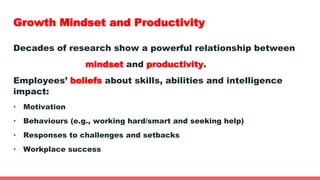
Growth Mindset and Productivity
Decades of research show a powerful relationship between
mindset and productivity.
Employees’ beliefs about skills, abilities and intelligence
impact:
• Motivation
• Behaviours (e.g., working hard/smart and seeking help)
• Responses to challenges and setbacks
• Workplace success
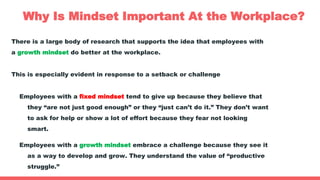
Why Is Mindset Important At the Workplace?
There is a large body of research that supports the idea that employees with
a growth mindset do better at the workplace.
This is especially evident in response to a setback or challenge
Employees with a fixed mindset tend to give up because they believe that
they “are not just good enough” or they “just can’t do it.” They don’t want
to ask for help or show a lot of effort because they fear not looking
smart.
Employees with a growth mindset embrace a challenge because they see it
as a way to develop and grow. They understand the value of “productive
struggle.”
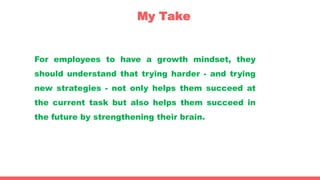
My Take
For employees to have a growth mindset, they
should understand that trying harder - and trying
new strategies - not only helps them succeed at
the current task but also helps them succeed in
the future by strengthening their brain.
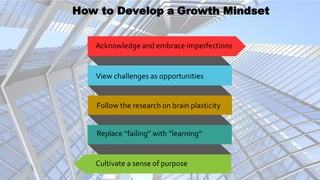
How to Develop a Growth Mindset
Acknowledge and embrace imperfections
View challenges as opportunities
Follow the research on brain plasticity
Replace “failing” with “learning”
Cultivate a sense of purpose
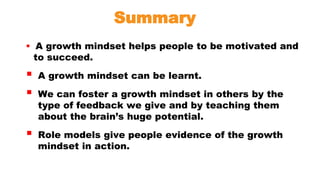
Summary
 A growth mindset helps people to be motivated and
to succeed.
 A growth mindset can be learnt.
 We can foster a growth mindset in others by the
type of feedback we give and by teaching them
about the brain’s huge potential.
 Role models give people evidence of the growth
mindset in action.
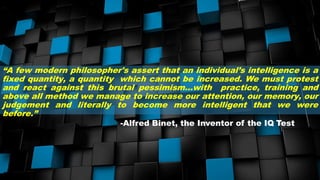
“A few modern philosopher's assert that an individual’s intelligence is a
fixed quantity, a quantity which cannot be increased. We must protest
and react against this brutal pessimism…with practice, training and
above all method we manage to increase our attention, our memory, our
judgement and literally to become more intelligent that we were
before.”
-Alfred Binet, the Inventor of the IQ Test
“I don’t divide the world into weak and strong or
successes and failures. I divide the world
into learners and non-learners.”
-Benjamin Barber
Developing the Growth Mindset for Enhanced Productivity.pptx

Developing the Growth Mindset for Enhanced Productivity.pptx

  • 1.
    Developing the Growth Mindsetfor Enhanced Productivity - Olusegun Mosugu
  • 2.
    WRITE DOWN  Onething you have always been good at  One thing you think you’ll never be good at  One thing you weren’t good at, but became good at over time
  • 3.
    Outline What is Mindset Types of Mindsets Characteristics ofMindsets How to develop Growth Mindset 01 02 04 05 Why we need to Embrace Growth Mindset 03
  • 4.
    What Do theyall Have in Common?
  • 5.
    What’s the DifferenceBetween these Two Images?
  • 6.
    The Age-Old Question Can human qualities, including intellectual ability, be cultivated or are they carved in stone?  Nature vs. nurture  Genes vs. environment
  • 7.
    What is Mindset? A set of beliefs or a way of thinking that determines one’s behaviour, outlook and mental attitude.  For most of us, our mindsets were created for us, at an early age. Whether through parents, teachers or friends, we readily absorbed what we were told.  Mindsets “become stronger the more you repeat and practice thebelifs or way of thinking.”
  • 8.
    Dweck’s mindset theoryof learning • Dweck suggested that the difference between people who are successful and not successful in learning is their mindset. • Dweck suggests that there are two types of mindsets
  • 9.
    Mindset Features Mindsets arealong a continuum or spectrum. It’s rarely one or the other. In some situations someone will put in lots of effort - whereas in others the same person won’t. Mindset determines how you deal with failure: • Fixed – give up as success should come without too much effort • Growth – sees failure as an opportunity to learn more and overcome obstacle.
  • 10.
  • 11.
    Our Beliefs CanAffect Our Mindset What is our mindset?  It is how we think about ourselves and the world around us. It’s our way of thinking and our opinions and attitude. It is the foundation of our happiness and success!  If we have a limiting belief about ourselves: A message in our head that is telling us: “I can’t do this!” then we have a fixed mindset.  If we have an empowering belief about ourselves: A message in our head telling us:“ I can’t do this yet, but I will!” then we have a growth mindset. The Awesome News Is That If We Want To, We Can Work Hard To Change Both Our Beliefs And Our Mindset!!!
  • 12.
    LO: To outlineand evaluate Dweck’s mindset theory of learning. A man and his son were in a car crash. The father died, but the son was critically injured and rushed to hospital. They decided he needed surgery immediately. When he reached the operating table, the surgeon on duty looked at him and said “I can’t operate because he’s my son’. How can this be? A PUZZLE FOR YOU
  • 13.
    5 Types of Mindsets Fixed mindset  Growth mindset
  • 14.
    5 Fixed Mindset A fixedmindset reflects a belief in natural talent: that qualities such as intelligence, creativity and talent are predetermined and finite. These qualities are so set that whatever you lack, you will continue to lack. Belief that intelligence is fixed. “intelligence is portrayed as an entity that dwells within us and that we can’t change” Fixed Mindset 65% Ability 35% Effort

  • 15.
    6 Growth Mindset A growthmindset is a belief that basic abilities can continue to be developed through hard work and dedication. These innate qualities are just starting points with success being the fruit of effort, learning, and persistence. Belief that intelligence is malleable. “intelligence is portrayed as something that can be increased through one’s efforts” In growth mindset, people are made, not born. 35% Ability 65% Effort Growth Mindset
  • 16.
    • Not necessaryor useful • Useful • Will lead to growth • Back down and avoid • Seen as a threat • Embrace and persevere • Seen as opportunities • Try to avoid making them • Get discouraged • Seen as learning experiences • Defensive • Taken personally • Helpful information • Used for growth Growth Mindset Fixed Mindset
  • 17.
  • 18.
    • GROWTH MINDSET FIXED MINDSET Dismiss Criticism Embrace Criticism LEARNING SUB-CONSTRUCTS Insecureby Others’ Success Pleased by Others’ Success Threatened by Others Inspired by Others
  • 19.
    The Malleable Brain The brain has amazing properties that allow it to change and grow.  Neuroscience tells us that working hard within a challenging environment causes new connections to develop in the brain and these connections impact our performance.
  • 20.
  • 21.
    Mindsets Can Change! Rigorousresearch also shows that mindsets can change When they are changed to have a Growth Mindset, employees do better
  • 22.
  • 23.
    Developing a GrowthMindset Recognize that you have choice Create space for new ideas Build time for self-reflection Feedback opportunities
  • 24.
    Growth Mindset Praise Don’t FocusOn: Qualities commonly interpreted as fixed, like talent or intelligence Do Focus On: Efforts and strategies used: “I like how you tried a new way to solve that.” Abilities improving over time with practice: “You’ve been practicing and I can see it’s paying off.” Mistakes and being challenged as necessary part of learning: “Love mistakes because they’re an opportunity to learn - being challenged is when the brain grows most.”
  • 25.
    What to Praise 01Effort/Learning 02 Applying new strategies 03 Working difficult tasks 04 Persistence in the face of setbacks
  • 26.
    10 Warren Buffett Spends 5to 6 hours a day reading 5 newspapers and 500 pages of corporate reports Reads 50 books per year. In a 2016 New York Times interview he said “Reading is the main way that I both learn new things and test my understanding." Bill Gates reads at least one book every 2 weeks. His 2015 emphasis was learning about different cultures, beliefs, histories and technologies Mark Zuckerberg taught himself engineering and rocket science Elon Musk
  • 27.
    11 Why You Needto Embrace Growth Mindset Enjoy your work, even when you are not too good at it Improvesyou at the workplace Be better at taking responsibility Strengthens your confidence 01 Improves your 02 self-insight and self-esteem 03 04 05
  • 28.
    Growth Mindset andProductivity Decades of research show a powerful relationship between mindset and productivity. Employees’ beliefs about skills, abilities and intelligence impact: • Motivation • Behaviours (e.g., working hard/smart and seeking help) • Responses to challenges and setbacks • Workplace success
  • 29.
    Why Is MindsetImportant At the Workplace? There is a large body of research that supports the idea that employees with a growth mindset do better at the workplace. This is especially evident in response to a setback or challenge Employees with a fixed mindset tend to give up because they believe that they “are not just good enough” or they “just can’t do it.” They don’t want to ask for help or show a lot of effort because they fear not looking smart. Employees with a growth mindset embrace a challenge because they see it as a way to develop and grow. They understand the value of “productive struggle.”
  • 30.
    My Take For employeesto have a growth mindset, they should understand that trying harder - and trying new strategies - not only helps them succeed at the current task but also helps them succeed in the future by strengthening their brain.
  • 31.
    How to Developa Growth Mindset Acknowledge and embrace imperfections View challenges as opportunities Follow the research on brain plasticity Replace “failing” with “learning” Cultivate a sense of purpose
  • 32.
    Summary  A growthmindset helps people to be motivated and to succeed.  A growth mindset can be learnt.  We can foster a growth mindset in others by the type of feedback we give and by teaching them about the brain’s huge potential.  Role models give people evidence of the growth mindset in action.
  • 34.
    “A few modernphilosopher's assert that an individual’s intelligence is a fixed quantity, a quantity which cannot be increased. We must protest and react against this brutal pessimism…with practice, training and above all method we manage to increase our attention, our memory, our judgement and literally to become more intelligent that we were before.” -Alfred Binet, the Inventor of the IQ Test
  • 35.
    “I don’t dividethe world into weak and strong or successes and failures. I divide the world into learners and non-learners.” -Benjamin Barber