Précis’ is derivedfrom French
and it means ‘precise’
Precis-writing is an exercise in
compression
Introduction
4.
The Précis
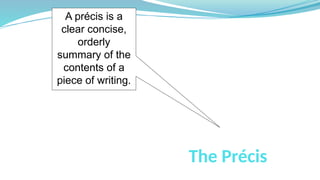
A précisis a
clear concise,
orderly
summary of the
contents of a
piece of writing.
5.
Principles of PrécisWriting
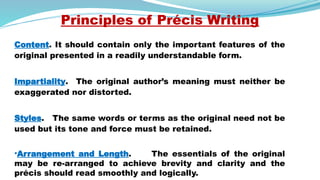
Content. It should contain only the important features of the
original presented in a readily understandable form.
Impartiality. The original author’s meaning must neither be
exaggerated nor distorted.
Styles. The same words or terms as the original need not be
used but its tone and force must be retained.
•Arrangement and Length. The essentials of the original
may be re-arranged to achieve brevity and clarity and the
précis should read smoothly and logically.
6.
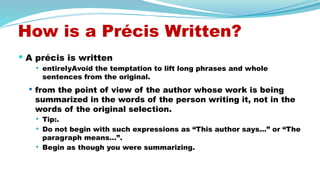
How is aPrécis Written?
A précis is written
entirelyAvoid the temptation to lift long phrases and whole
sentences from the original.
from the point of view of the author whose work is being
summarized in the words of the person writing it, not in the
words of the original selection.
Tip:.
Do not begin with such expressions as “This author says…” or “The
paragraph means…”.
Begin as though you were summarizing.
7.
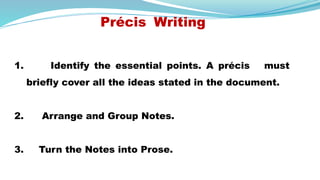
1. Identify theessential points. A précis must
briefly cover all the ideas stated in the document.
2. Arrange and Group Notes.
3. Turn the Notes into Prose.
Précis Writing
8.
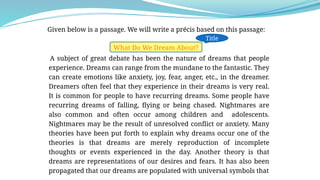
Given below isa passage. We will write a précis based on this passage:
What Do We Dream About?
A subject of great debate has been the nature of dreams that people
experience. Dreams can range from the mundane to the fantastic. They
can create emotions like anxiety, joy, fear, anger, etc., in the dreamer.
Dreamers often feel that they experience in their dreams is very real.
It is common for people to have recurring dreams. Some people have
recurring dreams of falling, flying or being chased. Nightmares are
also common and often occur among children and adolescents.
Nightmares may be the result of unresolved conflict or anxiety. Many
theories have been put forth to explain why dreams occur one of the
theories is that dreams are merely reproduction of incomplete
thoughts or events experienced in the day. Another theory is that
dreams are representations of our desires and fears. It has also been
propagated that our dreams are populated with universal symbols that
Title
9.
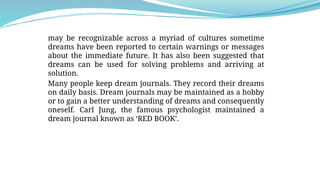
may be recognizableacross a myriad of cultures sometime
dreams have been reported to certain warnings or messages
about the immediate future. It has also been suggested that
dreams can be used for solving problems and arriving at
solution.
Many people keep dream journals. They record their dreams
on daily basis. Dream journals may be maintained as a hobby
or to gain a better understanding of dreams and consequently
oneself. Carl Jung, the famous psychologist maintained a
dream journal known as ‘RED BOOK’.
10.
Given below isa passage. We will write a précis based on this passage:
What Do We Dream About?
A subject of great debate has been the nature of dreams that people
experience. Dreams can range from the mundane to the fantastic. They
can create emotions like anxiety, joy, fear, anger, etc., in the dreamer.
Dreamers often feel that they experience in their dreams is very real.
It is common for people to have recurring dreams. Some people have
recurring dreams of falling, flying or being chased. Nightmares are
also common and often occur among children and adolescents.
Nightmares may be the result of unresolved conflict or anxiety. Many
theories have been put forth to explain why dreams occur one of the
theories is that dreams are merely reproduction of incomplete
thoughts or events experienced in the day. Another theory is that
dreams are representations of our desires and fears. It has also been
propagated that our dreams are populated with universal symbols that
Title
11.
may be recognizableacross a myriad of cultures sometime
dreams have been reported to certain warnings or messages
about the immediate future. It has also been suggested that
dreams can be used for solving problems and arriving at
solution.
Many people keep dream journals. They record their dreams
on daily basis. Dream journals may be maintained as a hobby
or to gain a better understanding of dreams and consequently
oneself. Carl Jung, the famous psychologist maintained a
dream journal known as ‘RED BOOK’.
12.
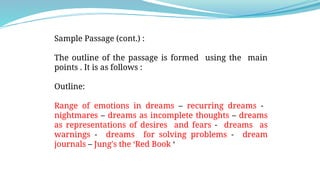
Sample Passage (cont.):
The outline of the passage is formed using the main
points . It is as follows :
Outline:
Range of emotions in dreams – recurring dreams -
nightmares – dreams as incomplete thoughts – dreams
as representations of desires and fears - dreams as
warnings - dreams for solving problems - dream
journals – Jung's the ‘Red Book ‘
13.
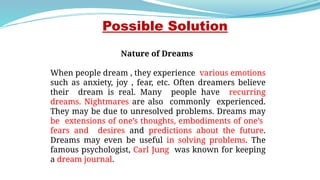
Nature of Dreams
Whenpeople dream , they experience various emotions
such as anxiety, joy , fear, etc. Often dreamers believe
their dream is real. Many people have recurring
dreams. Nightmares are also commonly experienced.
They may be due to unresolved problems. Dreams may
be extensions of one’s thoughts, embodiments of one’s
fears and desires and predictions about the future.
Dreams may even be useful in solving problems. The
famous psychologist, Carl Jung was known for keeping
a dream journal.
Possible Solution
What is aSummary?
A summary is a concise record of the
development or history of a subject
matter in file.
16.
1. It isshorter than the source
(document, an article, etc)
2. It repeats the ideas of the source
in different phrases and sentences.
3. Normally retained on the file to
which it refers, with an appropriate
reference on the minute sheet.
Key Features of a Summary
17.
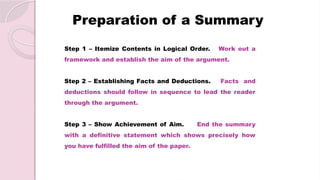
Preparation of aSummary
Step 1 – Itemize Contents in Logical Order. Work out a
framework and establish the aim of the argument.
Step 2 – Establishing Facts and Deductions. Facts and
deductions should follow in sequence to lead the reader
through the argument.
Step 3 – Show Achievement of Aim. End the summary
with a definitive statement which shows precisely how
you have fulfilled the aim of the paper.
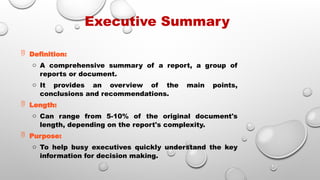
Executive Summary
Definition:
oA comprehensive summary of a report, a group of
reports or document.
o It provides an overview of the main points,
conclusions and recommendations.
Length:
o Can range from 5-10% of the original document's
length, depending on the report's complexity.
Purpose:
o To help busy executives quickly understand the key
information for decision making.
20.
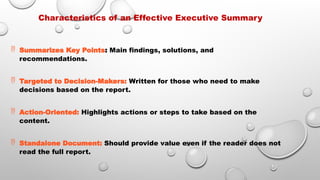
Characteristics of anEffective Executive Summary
Summarizes Key Points: Main findings, solutions, and
recommendations.
Targeted to Decision-Makers: Written for those who need to make
decisions based on the report.
Action-Oriented: Highlights actions or steps to take based on the
content.
Standalone Document: Should provide value even if the reader does not
read the full report.
21.
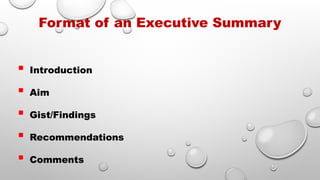
Introduction
Aim
Gist/Findings
Recommendations
Comments
Format of an Executive Summary
22.
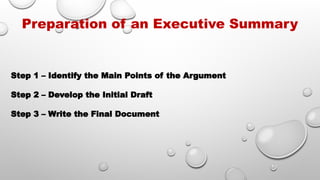
Preparation of anExecutive Summary
Step 1 – Identify the Main Points of the Argument
Step 2 – Develop the Initial Draft
Step 3 – Write the Final Document
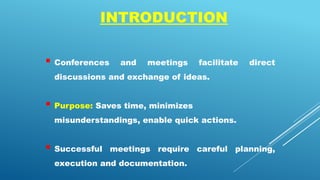
INTRODUCTION
Conferences andmeetings facilitate direct
discussions and exchange of ideas.
Purpose: Saves time, minimizes
misunderstandings, enable quick actions.
Successful meetings require careful planning,
execution and documentation.
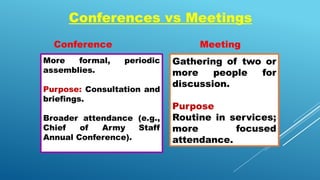
25.
More formal, periodic
assemblies.
Purpose:Consultation and
briefings.
Broader attendance (e.g.,
Chief of Army Staff
Annual Conference).
Gathering of two or
more people for
discussion.
Purpose
Routine in services;
more focused
attendance.
Conference Meeting
Conferences vs Meetings
26.
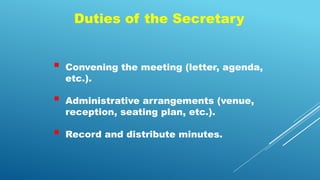
Duties of theSecretary
Convening the meeting (letter, agenda,
etc.).
Administrative arrangements (venue,
reception, seating plan, etc.).
Record and distribute minutes.
27.
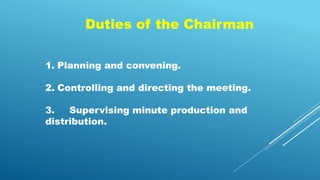
Duties of theChairman
1. Planning and convening.
2. Controlling and directing the meeting.
3. Supervising minute production and
distribution.
28.
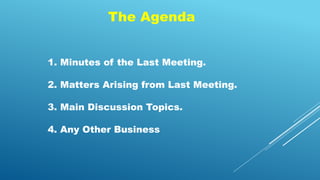
The Agenda
1. Minutesof the Last Meeting.
2. Matters Arising from Last Meeting.
3. Main Discussion Topics.
4. Any Other Business
29.
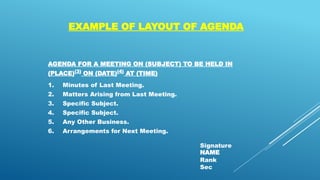
AGENDA FOR AMEETING ON (SUBJECT) TO BE HELD IN
(PLACE)(3)
ON (DATE)(4)
AT (TIME)
1. Minutes of Last Meeting.
2. Matters Arising from Last Meeting.
3. Specific Subject.
4. Specific Subject.
5. Any Other Business.
6. Arrangements for Next Meeting.
Signature
NAME
Rank
Sec
EXAMPLE OF LAYOUT OF AGENDA
30.
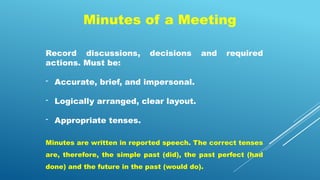
Minutes of aMeeting
Record discussions, decisions and required
actions. Must be:
- Accurate, brief, and impersonal.
- Logically arranged, clear layout.
- Appropriate tenses.
Minutes are written in reported speech. The correct tenses
are, therefore, the simple past (did), the past perfect (had
done) and the future in the past (would do).
31.
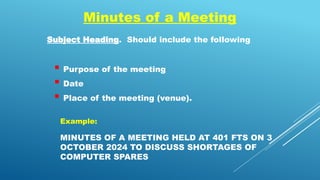
Minutes of aMeeting
Subject Heading. Should include the following
Purpose of the meeting
Date
Place of the meeting (venue).
Example:
MINUTES OF A MEETING HELD AT 401 FTS ON 3
OCTOBER 2024 TO DISCUSS SHORTAGES OF
COMPUTER SPARES
32.
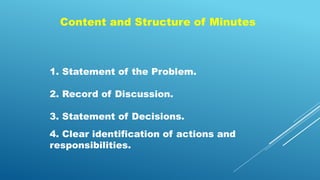
Content and Structureof Minutes
1. Statement of the Problem.
2. Record of Discussion.
3. Statement of Decisions.
4. Clear identification of actions and
responsibilities.
33.
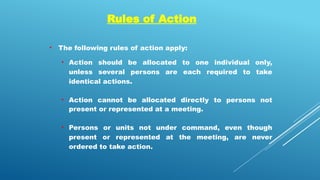
• The followingrules of action apply:
• Action should be allocated to one individual only,
unless several persons are each required to take
identical actions.
• Action cannot be allocated directly to persons not
present or represented at a meeting.
• Persons or units not under command, even though
present or represented at the meeting, are never
ordered to take action.
Rules of Action
34.
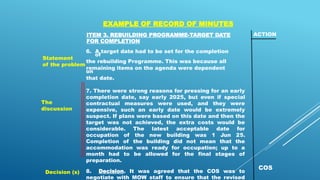
ITEM 3. REBUILDINGPROGRAMME-TARGET DATE
FOR COMPLETION
6. A target date had to be set for the completion
of
the rebuilding Programme. This was because all
remaining items on the agenda were dependent
on
that date.
7. There were strong reasons for pressing for an early
completion date, say early 2025, but even if special
contractual measures were used, and they were
expensive, such an early date would be extremely
suspect. If plans were based on this date and then the
target was not achieved, the extra costs would be
considerable. The latest acceptable date for
occupation of the new building was 1 Jun 25.
Completion of the building did not mean that the
accommodation was ready for occupation; up to a
month had to be allowed for the final stages of
preparation.
8. Decision. It was agreed that the COS was to
negotiate with MOW staff to ensure that the revised
ACTION
COS
Statement
of the problem
The
discussion
Decision (s)
EXAMPLE OF RECORD OF MINUTES
35.
Distribution and Approvalof Minutes
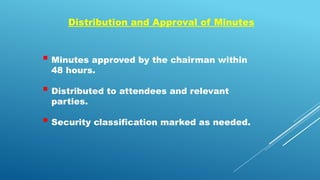
Minutes approved by the chairman within
48 hours.
Distributed to attendees and relevant
parties.
Security classification marked as needed.
36.
Summary
Effective meetingsrequire clear roles and
structured documentation.
Importance of agendas, proper conduct, and
accurate minutes.
Planning and organization are key to
successful meetings.









![What are dreams [Dr. Subrata Naskar]](https://cdn.slidesharecdn.com/ss_thumbnails/whataredreamsdr-150610175707-lva1-app6892-thumbnail.jpg?width=640&height=640&fit=bounds)


