

Abdul GHAFOOR, PARC, Islamabad, PAKISTAN;
ghafoor59pk@yahoo.com
Potential of plant genetic resources in
sustainable agriculture in changing climate:
Strategies and management
Background
Plant genetic resources
Sustainable agriculture
Changing climate
Strategies and management
Agriculture and Food Security
Global program of research
Concluding remarks
Future avenues
Outline
Background
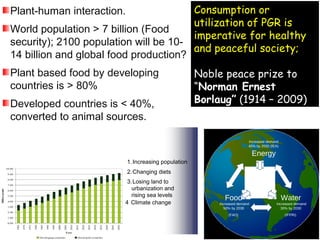
Plant-human interaction.
World population > 7 billion (Food
security); 2100 population will be 10-
14 billion and global food production?
Plant based food by developing
countries is > 80%
Developed countries is < 40%,
converted to animal sources.
Consumption or
utilization of PGR is
imperative for healthy
and peaceful society;
Noble peace prize to
“Norman Ernest
Borlaug” (1914 – 2009)
Increased demand
45% by 2030 (IEA)
Energy
Water
Increased demand
30% by 2030
(IFPRI)
Food
Increased demand
50% by 2030
(FAO)
Climate
Change
1.Increasing population
2.Changing diets
3.Losing land to
urbanization and
rising sea levels
4 Climate change
Current status of biodiversity
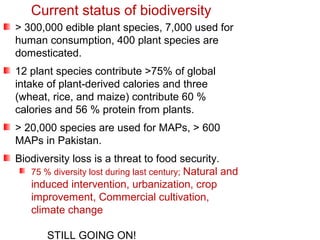
> 300,000 edible plant species, 7,000 used for
human consumption, 400 plant species are
domesticated.
12 plant species contribute >75% of global
intake of plant-derived calories and three
(wheat, rice, and maize) contribute 60 %
calories and 56 % protein from plants.
> 20,000 species are used for MAPs, > 600
MAPs in Pakistan.
Biodiversity loss is a threat to food security.
75 % diversity lost during last century; Natural and
induced intervention, urbanization, crop
improvement, Commercial cultivation,
climate change
STILL GOING ON!
Plant genetic resources
PGRFA
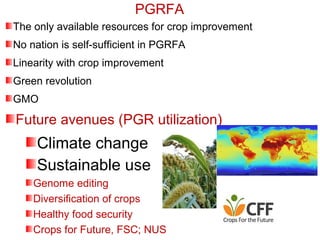
The only available resources for crop improvement
No nation is self-sufficient in PGRFA
Linearity with crop improvement
Green revolution
GMO
Future avenues (PGR utilization)
Climate change
Sustainable use
Genome editing
Diversification of crops
Healthy food security
Crops for Future, FSC; NUS
Challenges to PGR conservation and food
security
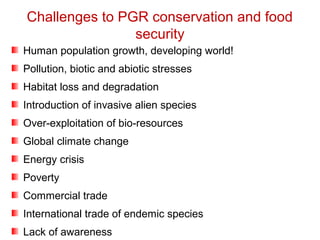
Human population growth, developing world!
Pollution, biotic and abiotic stresses
Habitat loss and degradation
Introduction of invasive alien species
Over-exploitation of bio-resources
Global climate change
Energy crisis
Poverty
Commercial trade
International trade of endemic species
Lack of awareness
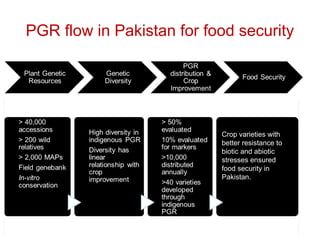
Crop varieties with
better resistance to
biotic and abiotic
stresses ensured
food security in
Pakistan.
PGR flow in Pakistan for food security
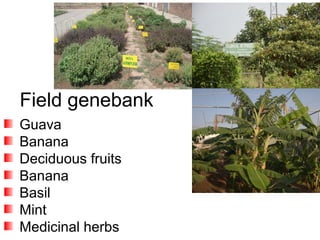
Field genebank
Guava
Banana
Deciduous fruits
Banana
Basil
Mint
Medicinal herbs
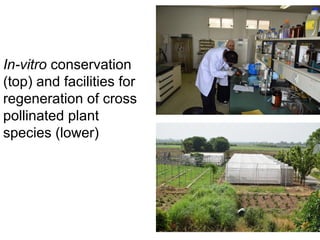
In-vitro conservation
(top) and facilities for
regeneration of cross
pollinated plant
species (lower)
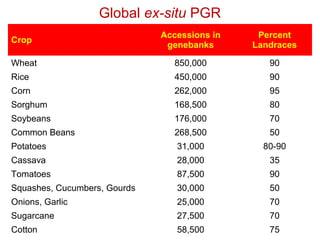
Global ex-situ PGR
Crop
Accessions in
genebanks
Percent
Landraces
Wheat 850,000 90
Rice 450,000 90
Corn 262,000 95
Sorghum 168,500 80
Soybeans 176,000 70
Common Beans 268,500 50
Potatoes 31,000 80-90
Cassava 28,000 35
Tomatoes 87,500 90
Squashes, Cucumbers, Gourds 30,000 50
Onions, Garlic 25,000 70
Sugarcane 27,500 70
Cotton 58,500 75
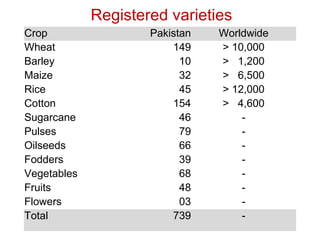
Sustainable agriculture
Crop Pakistan Worldwide
Wheat 149 > 10,000
Barley 10 > 1,200
Maize 32 > 6,500
Rice 45 > 12,000
Cotton 154 > 4,600
Sugarcane 46 -
Pulses 79 -
Oilseeds 66 -
Fodders 39 -
Vegetables 68 -
Fruits 48 -
Flowers 03 -
Total 739 -
Registered varieties
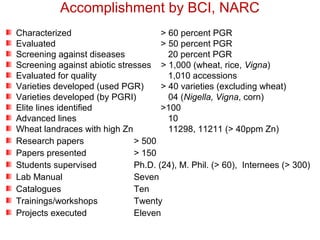
Accomplishment by BCI, NARC
Characterized > 60 percent PGR
Evaluated > 50 percent PGR
Screening against diseases 20 percent PGR
Screening against abiotic stresses > 1,000 (wheat, rice, Vigna)
Evaluated for quality 1,010 accessions
Varieties developed (used PGR) > 40 varieties (excluding wheat)
Varieties developed (by PGRI) 04 (Nigella, Vigna, corn)
Elite lines identified >100
Advanced lines 10
Wheat landraces with high Zn 11298, 11211 (> 40ppm Zn)
Research papers > 500
Papers presented > 150
Students supervised Ph.D. (24), M. Phil. (> 60), Internees (> 300)
Lab Manual Seven
Catalogues Ten
Trainings/workshops Twenty
Projects executed Eleven
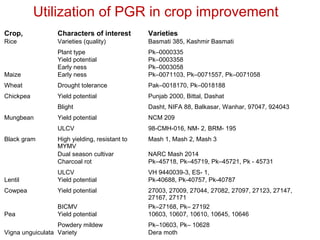
Crop, Characters of interest Varieties
Rice Varieties (quality) Basmati 385, Kashmir Basmati
Plant type Pk–0000335
Yield potential Pk–0003358
Early ness Pk–0003058
Maize Early ness Pk–0071103, Pk–0071557, Pk–0071058
Wheat Drought tolerance Pak–0018170, Pk–0018188
Chickpea Yield potential Punjab 2000, Bittal, Dashat
Blight Dasht, NIFA 88, Balkasar, Wanhar, 97047, 924043
Mungbean Yield potential NCM 209
ULCV 98-CMH-016, NM- 2, BRM- 195
Black gram High yielding, resistant to
MYMV
Mash 1, Mash 2, Mash 3
Dual season cultivar NARC Mash 2014
Charcoal rot Pk–45718, Pk–45719, Pk–45721, Pk - 45731
ULCV VH 9440039-3, ES- 1,
Lentil Yield potential Pk-40688, Pk-40757, Pk-40787
Cowpea Yield potential 27003, 27009, 27044, 27082, 27097, 27123, 27147,
27167, 27171
BICMV Pk–27168, Pk– 27192
Pea Yield potential 10603, 10607, 10610, 10645, 10646
Powdery mildew Pk–10603, Pk– 10628
Vigna unguiculata Variety Dera moth
Utilization of PGR in crop improvement
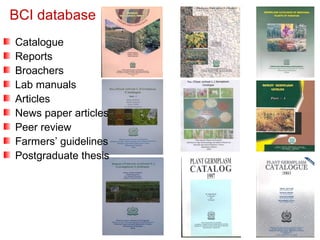
BCI database
Catalogue
Reports
Broachers
Lab manuals
Articles
News paper articles
Peer review
Farmers’ guidelines
Postgraduate thesis
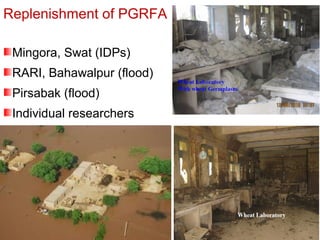
Replenishment of PGRFA
Mingora, Swat (IDPs)
RARI, Bahawalpur (flood)
Pirsabak (flood)
Individual researchers
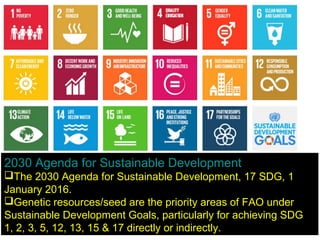
2030 Agenda for Sustainable Development
The 2030 Agenda for Sustainable Development, 17 SDG, 1
January 2016.
Genetic resources/seed are the priority areas of FAO under
Sustainable Development Goals, particularly for achieving SDG
1, 2, 3, 5, 12, 13, 15 & 17 directly or indirectly.
Changing climate
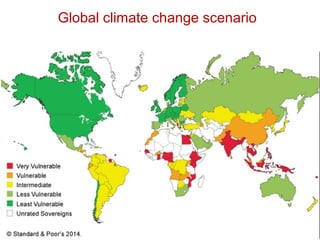
Global climate change scenario
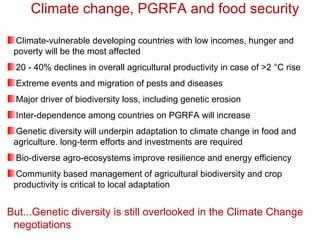
Climate-vulnerable developing countries with low incomes, hunger and
poverty will be the most affected
20 - 40% declines in overall agricultural productivity in case of >2 °C rise
Extreme events and migration of pests and diseases
Major driver of biodiversity loss, including genetic erosion
Inter-dependence among countries on PGRFA will increase
Genetic diversity will underpin adaptation to climate change in food and
agriculture. long-term efforts and investments are required
Bio-diverse agro-ecosystems improve resilience and energy efficiency
Community based management of agricultural biodiversity and crop
productivity is critical to local adaptation
But...Genetic diversity is still overlooked in the Climate Change
negotiations
Climate change, PGRFA and food security
Strategies and management
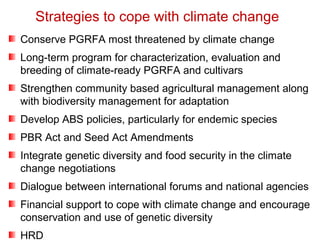
Conserve PGRFA most threatened by climate change
Long-term program for characterization, evaluation and
breeding of climate-ready PGRFA and cultivars
Strengthen community based agricultural management along
with biodiversity management for adaptation
Develop ABS policies, particularly for endemic species
PBR Act and Seed Act Amendments
Integrate genetic diversity and food security in the climate
change negotiations
Dialogue between international forums and national agencies
Financial support to cope with climate change and encourage
conservation and use of genetic diversity
HRD
Strategies to cope with climate change
Global program of research
Global commitments and compliance
ITPGRFA, CBD, NP and has ratified Kyoto Protocol.
The PBR Act 2015 approved and Access to Genetic
Resources and Benefit-sharing Act, 2012 is under process.
Germplasm is being shared under SMTA for R & D.
PGRFA shared under SMTA, MLS and ITPGRFA, ABS not
yet in practice.
World Earth Day [April 22].
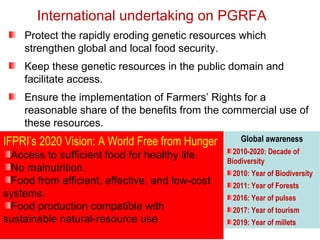
International undertaking on PGRFA
Protect the rapidly eroding genetic resources which
strengthen global and local food security.
Keep these genetic resources in the public domain and
facilitate access.
Ensure the implementation of Farmers’ Rights for a
reasonable share of the benefits from the commercial use of
these resources.
Global awareness
2010-2020: Decade of
Biodiversity
2010: Year of Biodiversity
2011: Year of Forests
2016: Year of pulses
2017: Year of tourism
2019: Year of millets
IFPRI’s 2020 Vision: A World Free from Hunger
Access to sufficient food for healthy life.
No malnutrition.
Food from efficient, effective, and low-cost
systems.
Food production compatible with
sustainable natural-resource use.
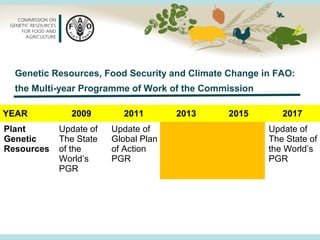
YEAR 2009 2011 2013 2015 2017
Plant
Genetic
Resources
Update of
The State
of the
World’s
PGR
Update of
Global Plan
of Action
PGR
Update of
The State of
the World’s
PGR
Genetic Resources, Food Security and Climate Change in FAO:
the Multi-year Programme of Work of the Commission
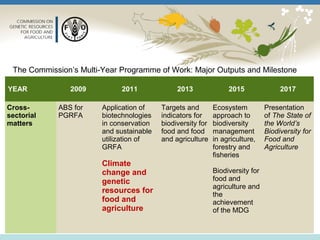
YEAR 2009 2011 2013 2015 2017
Cross-
sectorial
matters
ABS for
PGRFA
Application of
biotechnologies
in conservation
and sustainable
utilization of
GRFA
Climate
change and
genetic
resources for
food and
agriculture
Targets and
indicators for
biodiversity for
food and food
and agriculture
Ecosystem
approach to
biodiversity
management
in agriculture,
forestry and
fisheries
Biodiversity for
food and
agriculture and
the
achievement
of the MDG
Presentation
of The State of
the World’s
Biodiversity for
Food and
Agriculture
The Commission’s Multi-Year Programme of Work: Major Outputs and Milestone
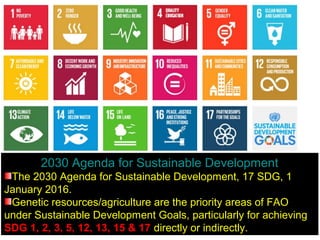
2030 Agenda for Sustainable Development
The 2030 Agenda for Sustainable Development, 17 SDG, 1
January 2016.
Genetic resources/agriculture are the priority areas of FAO
under Sustainable Development Goals, particularly for achieving
SDG 1, 2, 3, 5, 12, 13, 15 & 17 directly or indirectly.
Agriculture and Food Security
Challenges for food security in climate
change scenario
PGRFA/CWR gap filling, evaluation and utilization?
Knowledge of inter and intra-specific diversity
Inter and intra-species relationships
Strong breeding program and funding sources
Research infrastructure
Pakistan scenario? CWR scope for developing
PGRFA resilience to climate change – use in pre-
breeding……
“Use of CWR is limited due to high complexity of
traits, time-duration, linkage of desirable genes with
undesirable ones”
Unlocking genetic potential of CWR for benefit of
the society under climate change
1.Diversity assessment
2.Novel techniques [somatic hybridization, anther culture, embryo
rescue]
3.Advanced biotechnology [MAB, MAS, Mapping, QTL, genomics]
4.Introgression libraries
5.Association studies
6.Genetic transformation
7.Genome editing
Resulting in nutritious food security particularly
under the climate change scenario
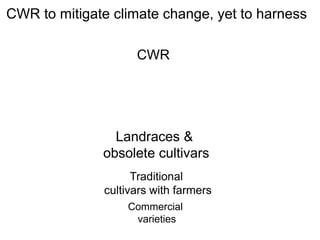
CWR
Landraces &
obsolete cultivars
Traditional
cultivars with farmers
Commercial
varieties
CWR to mitigate climate change, yet to harness
New era of CWR utilization
Utilization of CWR for stresses [heat, cold, drought,
waterlogging, salinity, diseases, pests, floods, allergens],
nutrition and quality
Climate change
Tracing ancestral phylogeny
Evolution and ethno-botany
Second generation food security
Expanding food basket
Concluding remarks
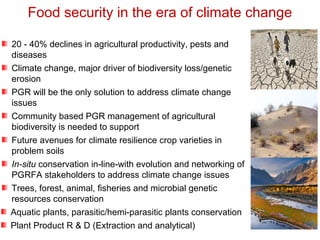
20 - 40% declines in agricultural productivity, pests and
diseases
Climate change, major driver of biodiversity loss/genetic
erosion
PGR will be the only solution to address climate change
issues
Community based PGR management of agricultural
biodiversity is needed to support
Future avenues for climate resilience crop varieties in
problem soils
In-situ conservation in-line-with evolution and networking of
PGRFA stakeholders to address climate change issues
Trees, forest, animal, fisheries and microbial genetic
resources conservation
Aquatic plants, parasitic/hemi-parasitic plants conservation
Plant Product R & D (Extraction and analytical)
Food security in the era of climate change
Integrated approach for PGR utilization for
developing climate resilience crop varieties
Era of third generation biotechnology/genetic engineering.
Traits specificity, largely because of the complexity of traits,
i.e., socio-economic traits, allergens.
Genetic variants created and selected by nature over millions
of years and conserved in genebanks, however remained
untapped! Biotech has promise.
Utilization of the CWR plants in genebanks.
Molecular mapping and ability to scan the genomes of wild
species for new and useful genes.
Are we prepared to unlock the genetic potential of hidden bio-
treasurers in the genebanks including CWR.
Extensive academic, research and public-private partnership
Mainstreaming biodiversity for sustainable agriculture and
food security particularly in the era of climate change
Regional networking for PGRFA stakeholders and sharing of
information & PGRFA
R & D on CFF to ensure nutritious food security
Understanding SDGs and international policies
Joint venture on PGRFA evaluation, utilization and genebank
management
Multi-disciplinary team work
Work together to achieve happy healthy farmers and
ecosystems in the ONLY LIVING GLOGE
Awareness for all
Take-home message
Future avenues
Future programs to safeguard food security
Multi-sectorial approaches (Regional coordination)
Mainstreaming PGRFA and climate change in national
programs
Global/regional networks on PGRFA and R & D on CWR to
address climate change issues
Participatory breeding approach, monitoring and early warning
systems on disasters & genetic erosion
Interactive database on PGRFA management and utilization
Training, education and raising awareness
Inter-continental collaborative projects on PGRFA evaluation
and utilization to solve the global issue of climate change
Future prospects
Gap filling of CWR, collect, characterize, document,
utilize.
Emerging demand for novel genes for biotic & abiotic
stresses, quality, climate resilience and bio-fortification.
Genome mapping and synteny of the genes sequenced
for encoding abiotic stress tolerance and can be utilized in
crop improvement.
Potential of genetic transformation from the tertiary gene
pool and/or beyond.
Big data handling, new breeding strategies and
bioinformatics tools are required to use the information
from omics for complex traits more effectively.
CWR faced the maximum load of climate effects, hence
Gene-pools for climate change threatened, and how can they
be conserved to ensure their continuing availability?
How do cultural practices affect diversity and how can farmers’
knowledge be used to identify landraces and crop varieties
suited for specific climatic conditions?
How can access to crop diversity local farmers be facilitated?
How crop diversity in production systems contribute to
productivity in face of progressive climate change?
What are major causes and challenges of climate change?
Can agriculture stand up to a 2º C warmer world?
PGR threatened by climate change, what strategy to collect
and conserve?
CWR use on the increase, but poorly conserved ex-situ and
under threat in-situ
Need to fill gaps, and explore novel genetic approaches
Still unsolved
 https://journals.plos.org/plosone/article?id=10.1371/journal.pone.0029845
 https://journals.plos.org/plosone/article?id=10.1371/journal.pone.0063107
 https://www.cell.com/trends/plant-science/fulltext/S1360-1385(10)00019-1
 http://www.fao.org/3/a-i3866e.pdf
 https://pdfs.semanticscholar.org/3d8d/946cfcdcaee7fc34dccb8200fcc2afcb48da.pdf
 https://nifa.usda.gov/sites/default/files/resources/Using%20Crop%20Genetic%20Resources%20to
 https://www.researchgate.net/publication/283006682_Plant_Genetic_Resources_and_Climate_Ch
 https://www.bioversityinternational.org/news/detail/plant-genetic-resources-and-climate-change/
 https://www.adb.org/sites/default/files/publication/357876/climate-change-profile-pakistan.pdf
 http://www.pmd.gov.pk/report_rnd.pdf
 http://unesco.org.pk/ns/documents/Workshop_Workbook/Session_1/1_Dr.Qamer-uz-Zaman.pdf
 https://en.wikipedia.org/wiki/Climate_change_and_agriculture
 http://re.indiaenvironmentportal.org.in/files/The%20impacts%20of%20climate%20change%20on
%20water.pdf
 https://www.ncbi.nlm.nih.gov/pmc/articles/PMC2148357/
 http://ecoethics.net/cyprus-institute.us/PDF/Rosensweig-Food-Supply.pdf
 https://19january2017snapshot.epa.gov/climate-impacts/climate-impacts-agriculture-and-food-
supply_.html
 https://www.unescap.org/sites/default/files/5.%20The-Impact-of-Climate-Change-on-the-
Agricultural-Sector.pdf
 https://www.sciencedirect.com/science/article/pii/B9780444636614000025
 http://www.fao.org/docs/up/easypol/778/climate-change_impacts_on_agric_food_security
_slides_077en.pdf
Make reading the habit for prosperous Pakistan
"Every time we lose a species we break a
life chain which has evolved over 3.5 billion
years"
(Jeffrey McNeely)

PGRFA for mitigating climate change

  • 1.
    Abdul GHAFOOR, PARC,Islamabad, PAKISTAN; ghafoor59pk@yahoo.com Potential of plant genetic resources in sustainable agriculture in changing climate: Strategies and management
  • 2.
    Background Plant genetic resources Sustainableagriculture Changing climate Strategies and management Agriculture and Food Security Global program of research Concluding remarks Future avenues Outline
  • 3.
  • 4.
    Plant-human interaction. World population> 7 billion (Food security); 2100 population will be 10- 14 billion and global food production? Plant based food by developing countries is > 80% Developed countries is < 40%, converted to animal sources. Consumption or utilization of PGR is imperative for healthy and peaceful society; Noble peace prize to “Norman Ernest Borlaug” (1914 – 2009) Increased demand 45% by 2030 (IEA) Energy Water Increased demand 30% by 2030 (IFPRI) Food Increased demand 50% by 2030 (FAO) Climate Change 1.Increasing population 2.Changing diets 3.Losing land to urbanization and rising sea levels 4 Climate change
  • 5.
    Current status ofbiodiversity > 300,000 edible plant species, 7,000 used for human consumption, 400 plant species are domesticated. 12 plant species contribute >75% of global intake of plant-derived calories and three (wheat, rice, and maize) contribute 60 % calories and 56 % protein from plants. > 20,000 species are used for MAPs, > 600 MAPs in Pakistan. Biodiversity loss is a threat to food security. 75 % diversity lost during last century; Natural and induced intervention, urbanization, crop improvement, Commercial cultivation, climate change STILL GOING ON!
  • 6.
  • 7.
    PGRFA The only availableresources for crop improvement No nation is self-sufficient in PGRFA Linearity with crop improvement Green revolution GMO Future avenues (PGR utilization) Climate change Sustainable use Genome editing Diversification of crops Healthy food security Crops for Future, FSC; NUS
  • 8.
    Challenges to PGRconservation and food security Human population growth, developing world! Pollution, biotic and abiotic stresses Habitat loss and degradation Introduction of invasive alien species Over-exploitation of bio-resources Global climate change Energy crisis Poverty Commercial trade International trade of endemic species Lack of awareness
  • 9.
    Crop varieties with betterresistance to biotic and abiotic stresses ensured food security in Pakistan. PGR flow in Pakistan for food security
  • 10.
  • 11.
    In-vitro conservation (top) andfacilities for regeneration of cross pollinated plant species (lower)
  • 12.
    Global ex-situ PGR Crop Accessionsin genebanks Percent Landraces Wheat 850,000 90 Rice 450,000 90 Corn 262,000 95 Sorghum 168,500 80 Soybeans 176,000 70 Common Beans 268,500 50 Potatoes 31,000 80-90 Cassava 28,000 35 Tomatoes 87,500 90 Squashes, Cucumbers, Gourds 30,000 50 Onions, Garlic 25,000 70 Sugarcane 27,500 70 Cotton 58,500 75
  • 13.
  • 14.
    Crop Pakistan Worldwide Wheat149 > 10,000 Barley 10 > 1,200 Maize 32 > 6,500 Rice 45 > 12,000 Cotton 154 > 4,600 Sugarcane 46 - Pulses 79 - Oilseeds 66 - Fodders 39 - Vegetables 68 - Fruits 48 - Flowers 03 - Total 739 - Registered varieties
  • 15.
    Accomplishment by BCI,NARC Characterized > 60 percent PGR Evaluated > 50 percent PGR Screening against diseases 20 percent PGR Screening against abiotic stresses > 1,000 (wheat, rice, Vigna) Evaluated for quality 1,010 accessions Varieties developed (used PGR) > 40 varieties (excluding wheat) Varieties developed (by PGRI) 04 (Nigella, Vigna, corn) Elite lines identified >100 Advanced lines 10 Wheat landraces with high Zn 11298, 11211 (> 40ppm Zn) Research papers > 500 Papers presented > 150 Students supervised Ph.D. (24), M. Phil. (> 60), Internees (> 300) Lab Manual Seven Catalogues Ten Trainings/workshops Twenty Projects executed Eleven
  • 16.
    Crop, Characters ofinterest Varieties Rice Varieties (quality) Basmati 385, Kashmir Basmati Plant type Pk–0000335 Yield potential Pk–0003358 Early ness Pk–0003058 Maize Early ness Pk–0071103, Pk–0071557, Pk–0071058 Wheat Drought tolerance Pak–0018170, Pk–0018188 Chickpea Yield potential Punjab 2000, Bittal, Dashat Blight Dasht, NIFA 88, Balkasar, Wanhar, 97047, 924043 Mungbean Yield potential NCM 209 ULCV 98-CMH-016, NM- 2, BRM- 195 Black gram High yielding, resistant to MYMV Mash 1, Mash 2, Mash 3 Dual season cultivar NARC Mash 2014 Charcoal rot Pk–45718, Pk–45719, Pk–45721, Pk - 45731 ULCV VH 9440039-3, ES- 1, Lentil Yield potential Pk-40688, Pk-40757, Pk-40787 Cowpea Yield potential 27003, 27009, 27044, 27082, 27097, 27123, 27147, 27167, 27171 BICMV Pk–27168, Pk– 27192 Pea Yield potential 10603, 10607, 10610, 10645, 10646 Powdery mildew Pk–10603, Pk– 10628 Vigna unguiculata Variety Dera moth Utilization of PGR in crop improvement
  • 17.
    BCI database Catalogue Reports Broachers Lab manuals Articles Newspaper articles Peer review Farmers’ guidelines Postgraduate thesis
  • 18.
    Replenishment of PGRFA Mingora,Swat (IDPs) RARI, Bahawalpur (flood) Pirsabak (flood) Individual researchers
  • 19.
    2030 Agenda forSustainable Development The 2030 Agenda for Sustainable Development, 17 SDG, 1 January 2016. Genetic resources/seed are the priority areas of FAO under Sustainable Development Goals, particularly for achieving SDG 1, 2, 3, 5, 12, 13, 15 & 17 directly or indirectly.
  • 20.
  • 21.
  • 22.
    Climate-vulnerable developing countrieswith low incomes, hunger and poverty will be the most affected 20 - 40% declines in overall agricultural productivity in case of >2 °C rise Extreme events and migration of pests and diseases Major driver of biodiversity loss, including genetic erosion Inter-dependence among countries on PGRFA will increase Genetic diversity will underpin adaptation to climate change in food and agriculture. long-term efforts and investments are required Bio-diverse agro-ecosystems improve resilience and energy efficiency Community based management of agricultural biodiversity and crop productivity is critical to local adaptation But...Genetic diversity is still overlooked in the Climate Change negotiations Climate change, PGRFA and food security
  • 23.
  • 24.
    Conserve PGRFA mostthreatened by climate change Long-term program for characterization, evaluation and breeding of climate-ready PGRFA and cultivars Strengthen community based agricultural management along with biodiversity management for adaptation Develop ABS policies, particularly for endemic species PBR Act and Seed Act Amendments Integrate genetic diversity and food security in the climate change negotiations Dialogue between international forums and national agencies Financial support to cope with climate change and encourage conservation and use of genetic diversity HRD Strategies to cope with climate change
  • 25.
  • 26.
    Global commitments andcompliance ITPGRFA, CBD, NP and has ratified Kyoto Protocol. The PBR Act 2015 approved and Access to Genetic Resources and Benefit-sharing Act, 2012 is under process. Germplasm is being shared under SMTA for R & D. PGRFA shared under SMTA, MLS and ITPGRFA, ABS not yet in practice. World Earth Day [April 22].
  • 27.
    International undertaking onPGRFA Protect the rapidly eroding genetic resources which strengthen global and local food security. Keep these genetic resources in the public domain and facilitate access. Ensure the implementation of Farmers’ Rights for a reasonable share of the benefits from the commercial use of these resources. Global awareness 2010-2020: Decade of Biodiversity 2010: Year of Biodiversity 2011: Year of Forests 2016: Year of pulses 2017: Year of tourism 2019: Year of millets IFPRI’s 2020 Vision: A World Free from Hunger Access to sufficient food for healthy life. No malnutrition. Food from efficient, effective, and low-cost systems. Food production compatible with sustainable natural-resource use.
  • 28.
    YEAR 2009 20112013 2015 2017 Plant Genetic Resources Update of The State of the World’s PGR Update of Global Plan of Action PGR Update of The State of the World’s PGR Genetic Resources, Food Security and Climate Change in FAO: the Multi-year Programme of Work of the Commission
  • 29.
    YEAR 2009 20112013 2015 2017 Cross- sectorial matters ABS for PGRFA Application of biotechnologies in conservation and sustainable utilization of GRFA Climate change and genetic resources for food and agriculture Targets and indicators for biodiversity for food and food and agriculture Ecosystem approach to biodiversity management in agriculture, forestry and fisheries Biodiversity for food and agriculture and the achievement of the MDG Presentation of The State of the World’s Biodiversity for Food and Agriculture The Commission’s Multi-Year Programme of Work: Major Outputs and Milestone
  • 30.
    2030 Agenda forSustainable Development The 2030 Agenda for Sustainable Development, 17 SDG, 1 January 2016. Genetic resources/agriculture are the priority areas of FAO under Sustainable Development Goals, particularly for achieving SDG 1, 2, 3, 5, 12, 13, 15 & 17 directly or indirectly.
  • 31.
  • 32.
    Challenges for foodsecurity in climate change scenario PGRFA/CWR gap filling, evaluation and utilization? Knowledge of inter and intra-specific diversity Inter and intra-species relationships Strong breeding program and funding sources Research infrastructure Pakistan scenario? CWR scope for developing PGRFA resilience to climate change – use in pre- breeding…… “Use of CWR is limited due to high complexity of traits, time-duration, linkage of desirable genes with undesirable ones”
  • 33.
    Unlocking genetic potentialof CWR for benefit of the society under climate change 1.Diversity assessment 2.Novel techniques [somatic hybridization, anther culture, embryo rescue] 3.Advanced biotechnology [MAB, MAS, Mapping, QTL, genomics] 4.Introgression libraries 5.Association studies 6.Genetic transformation 7.Genome editing Resulting in nutritious food security particularly under the climate change scenario
  • 34.
    CWR Landraces & obsolete cultivars Traditional cultivarswith farmers Commercial varieties CWR to mitigate climate change, yet to harness
  • 35.
    New era ofCWR utilization Utilization of CWR for stresses [heat, cold, drought, waterlogging, salinity, diseases, pests, floods, allergens], nutrition and quality Climate change Tracing ancestral phylogeny Evolution and ethno-botany Second generation food security Expanding food basket
  • 36.
  • 37.
    20 - 40%declines in agricultural productivity, pests and diseases Climate change, major driver of biodiversity loss/genetic erosion PGR will be the only solution to address climate change issues Community based PGR management of agricultural biodiversity is needed to support Future avenues for climate resilience crop varieties in problem soils In-situ conservation in-line-with evolution and networking of PGRFA stakeholders to address climate change issues Trees, forest, animal, fisheries and microbial genetic resources conservation Aquatic plants, parasitic/hemi-parasitic plants conservation Plant Product R & D (Extraction and analytical) Food security in the era of climate change
  • 38.
    Integrated approach forPGR utilization for developing climate resilience crop varieties Era of third generation biotechnology/genetic engineering. Traits specificity, largely because of the complexity of traits, i.e., socio-economic traits, allergens. Genetic variants created and selected by nature over millions of years and conserved in genebanks, however remained untapped! Biotech has promise. Utilization of the CWR plants in genebanks. Molecular mapping and ability to scan the genomes of wild species for new and useful genes. Are we prepared to unlock the genetic potential of hidden bio- treasurers in the genebanks including CWR. Extensive academic, research and public-private partnership
  • 39.
    Mainstreaming biodiversity forsustainable agriculture and food security particularly in the era of climate change Regional networking for PGRFA stakeholders and sharing of information & PGRFA R & D on CFF to ensure nutritious food security Understanding SDGs and international policies Joint venture on PGRFA evaluation, utilization and genebank management Multi-disciplinary team work Work together to achieve happy healthy farmers and ecosystems in the ONLY LIVING GLOGE Awareness for all Take-home message
  • 40.
  • 41.
    Future programs tosafeguard food security Multi-sectorial approaches (Regional coordination) Mainstreaming PGRFA and climate change in national programs Global/regional networks on PGRFA and R & D on CWR to address climate change issues Participatory breeding approach, monitoring and early warning systems on disasters & genetic erosion Interactive database on PGRFA management and utilization Training, education and raising awareness Inter-continental collaborative projects on PGRFA evaluation and utilization to solve the global issue of climate change
  • 42.
    Future prospects Gap fillingof CWR, collect, characterize, document, utilize. Emerging demand for novel genes for biotic & abiotic stresses, quality, climate resilience and bio-fortification. Genome mapping and synteny of the genes sequenced for encoding abiotic stress tolerance and can be utilized in crop improvement. Potential of genetic transformation from the tertiary gene pool and/or beyond. Big data handling, new breeding strategies and bioinformatics tools are required to use the information from omics for complex traits more effectively. CWR faced the maximum load of climate effects, hence
  • 43.
    Gene-pools for climatechange threatened, and how can they be conserved to ensure their continuing availability? How do cultural practices affect diversity and how can farmers’ knowledge be used to identify landraces and crop varieties suited for specific climatic conditions? How can access to crop diversity local farmers be facilitated? How crop diversity in production systems contribute to productivity in face of progressive climate change? What are major causes and challenges of climate change? Can agriculture stand up to a 2º C warmer world? PGR threatened by climate change, what strategy to collect and conserve? CWR use on the increase, but poorly conserved ex-situ and under threat in-situ Need to fill gaps, and explore novel genetic approaches Still unsolved
  • 44.
     https://journals.plos.org/plosone/article?id=10.1371/journal.pone.0029845  https://journals.plos.org/plosone/article?id=10.1371/journal.pone.0063107 https://www.cell.com/trends/plant-science/fulltext/S1360-1385(10)00019-1  http://www.fao.org/3/a-i3866e.pdf  https://pdfs.semanticscholar.org/3d8d/946cfcdcaee7fc34dccb8200fcc2afcb48da.pdf  https://nifa.usda.gov/sites/default/files/resources/Using%20Crop%20Genetic%20Resources%20to  https://www.researchgate.net/publication/283006682_Plant_Genetic_Resources_and_Climate_Ch  https://www.bioversityinternational.org/news/detail/plant-genetic-resources-and-climate-change/  https://www.adb.org/sites/default/files/publication/357876/climate-change-profile-pakistan.pdf  http://www.pmd.gov.pk/report_rnd.pdf  http://unesco.org.pk/ns/documents/Workshop_Workbook/Session_1/1_Dr.Qamer-uz-Zaman.pdf  https://en.wikipedia.org/wiki/Climate_change_and_agriculture  http://re.indiaenvironmentportal.org.in/files/The%20impacts%20of%20climate%20change%20on %20water.pdf  https://www.ncbi.nlm.nih.gov/pmc/articles/PMC2148357/  http://ecoethics.net/cyprus-institute.us/PDF/Rosensweig-Food-Supply.pdf  https://19january2017snapshot.epa.gov/climate-impacts/climate-impacts-agriculture-and-food- supply_.html  https://www.unescap.org/sites/default/files/5.%20The-Impact-of-Climate-Change-on-the- Agricultural-Sector.pdf  https://www.sciencedirect.com/science/article/pii/B9780444636614000025  http://www.fao.org/docs/up/easypol/778/climate-change_impacts_on_agric_food_security _slides_077en.pdf Make reading the habit for prosperous Pakistan
  • 45.
    "Every time welose a species we break a life chain which has evolved over 3.5 billion years" (Jeffrey McNeely)

Editor's Notes

  • #23 Significant production decreases are expected in regions that are already food insecure. - Developing countries in Africa, Asia and Latin America could experience a decline of between 20 and 40 percent in overall potential agricultural productivity if temperatures rise by more than 2 °C. Climate change will increase the variability of agricultural production across all areas. - Extreme weather events will be more frequent, in particular droughts and floods, which are already the dominant causes of acute food shortages in in sub-Saharan Africa and parts of South Asia. - The poorest regions with the highest levels of chronic undernourishment will also be exposed to the highest degree of instability in food production. - Climate change is also altering the distribution and intensity of animal and plant pests and diseases in agriculture, livestock, aquaculture and forestry. Agriculture, forestry and other land-use sectors: about 1/3 of global anthropogenic GHG emissions but also large technical mitigation potential (89 % of agriculture’s potential lies in soil and biomass carbon sequestration)
  • #25 The following actions should be pursued: Conservation and monitoring measures of the most threatened genetic diversity is urgently needed. The value of genetic diversity to confront climate change can only be realized if we improve our knowledge and use of such diversity, which requires long-term and sustained investments on characterization, evaluation and breeding of genetic resources for adaptation to climate change. Local management of agricultural biodiversity should include the strengthening of local institutions managing diversity and the development of practices to guarantee the provision of ecosystem services. Access and benefit-sharing policies should consider the growing interdependence among countries for genetic resources for food and agriculture due to climate change. The CBD is currently negotiating an International Regime on Access and Benefit-Sharing to be finalized by 2010. The FAO Commission on Genetic Resources for Food and Agriculture has recently reiterated the need for adequate treatment of genetic resources for food and agriculture in the International Regime. The issue of ABS will be discussed by the FAO Conference, in the context of the Report of the Commission.
  • #29 FAO is now integrating Genetic resources, food security and climate change into its intergovernmental agenda. With more 170 Member Countries, the Commission on Genetic Resources for Food and Agriculture is the FAO intergovernmental body specifically dealing with all biodiversity for food and agriculture. The Commission has developed a 10-year Multi-Year Programme of Work (MYPOW) for all genetic resources for food and agriculture: plant; animal; forest; aquatic; microorganisms and invertebrates. The MYPOW also includes cross-sectorial matters such as CLIMATE CHANGE. The next slides, which I will show you rapidly, include the main MYPOW outputs and milestones.
  • #30 The Commission has decided to give priority to Climate Change in its MYPOW, a major discussion will be held in next session of the Commission (CGRFA-13) in 2011.
  • #38 Significant production decreases are expected in regions that are already food insecure. - Developing countries in Africa, Asia and Latin America could experience a decline of between 20 and 40 percent in overall potential agricultural productivity if temperatures rise by more than 2 °C. Climate change will increase the variability of agricultural production across all areas. - Extreme weather events will be more frequent, in particular droughts and floods, which are already the dominant causes of acute food shortages in in sub-Saharan Africa and parts of South Asia. - The poorest regions with the highest levels of chronic undernourishment will also be exposed to the highest degree of instability in food production. - Climate change is also altering the distribution and intensity of animal and plant pests and diseases in agriculture, livestock, aquaculture and forestry. Agriculture, forestry and other land-use sectors: about 1/3 of global anthropogenic GHG emissions but also large technical mitigation potential (89 % of agriculture’s potential lies in soil and biomass carbon sequestration)