Resource Scheduling
for discovery and allocation in cloud computing
Ghazal Tashakor
Scheduling levels
 Multiple-core machine/OS (which
operating system decides about
scheduling simultaneously)
 Single-core machine/OS (which
operating system decides about
scheduling)
 The tasks of a Hadoop job (which
clusters decide about scheduling)
 The tasks of multiple Hadoop jobs
(which clusters decide about
Scheduling goals
 Good throughput or response time for
tasks(jobs)
 High utilization of resources
Single processor scheduling
Algorithms
Which tasks run When?
 First-In First-Out(FIFO)/FCFS (useful for batch
applications)
 Shortest Task First(STF)-priority scheduling
(useful for batch applications)
 Round-robin- fair(useful for interactive
applications)
 Hybrid Scheduling approaches(Combining all
above scheduling algorithms in hierarchical
approaches)
Cloud Scheduling for multi-
tenant systems
Cloud scheduling works with two types:
1. Jobs with One type-resource requirement-
(Hadoop Schedulers)
2. Jobs with multi-resource requirements (Dominant-
resource Scheduler-DRF)
Advantages of DRF
 Generalizes to multiple jobs
 Generalizes to more than 2 resource types
such as CPU, RAM, Network, Disk, etc
 Ensures that each job gets a fair share of
that type of resource which the job desires
the most – Hence fairness
Dominant- resource
Scheduler
 Dominant Resource Fairness (DRF)
1. Schedule VMs in a cluster.
2. Schedule Hadoop in a cluster.
 Also used in Mesos, an OS intended for cloud
environments
Hadoop YARN schedulers
1. Hadoop fair scheduler
2. Hadoop capacity scheduler( good for
hierarchical management)
Hadoop fair scheduler
Goal : All jobs get equal share of resources.
Solution: Divides cluster into pools(typically one
pool per user) and divides Resources equally
among pools (gives each user fair share of cluster).
 Fair share scheduling or FIFO/FCFS can be used
Within each pool (Configurable).
Hadoop capacity scheduler
This scheduler contains multiple queues which
each queue contains multiple jobs and guaranteed
portion of the cluster capacity.
Example:
 Queue 1 is given 80% of cluster for high priority
jobs.
 Queue 2 is given 20% of cluster for less important
jobs.
Facts:
 FIFO typically used for jobs within same queue.
 The portion of the cluster capacity should not be
fixed so we need Elasticity.
HCS Features
 Needs Elasticity capacity analyzing.
 Needs Elasticity dependencies
analyzing for hierarchical models:
Queues will be hierarchical and contain child sub-
queues so child sub-queues can share resources
equally.
Background: DaaS model for
cloud bursting
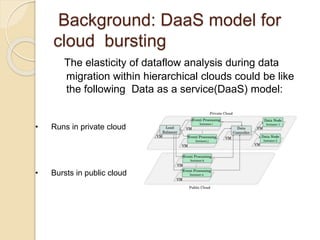
The elasticity of dataflow analysis during data
migration within hierarchical clouds could be like
the following Data as a service(DaaS) model:
• Runs in private cloud
• Bursts in public cloud
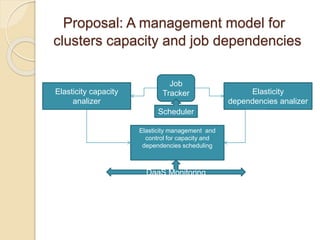
Proposal: A management model for
clusters capacity and job dependencies
Elasticity capacity
analizer
Elasticity
dependencies analizer
Elasticity management and
control for capacity and
dependencies scheduling
DaaS Monitoring
Job
Tracker
Scheduler

Resource scheduling

  • 1.
    Resource Scheduling for discoveryand allocation in cloud computing Ghazal Tashakor
  • 2.
    Scheduling levels  Multiple-coremachine/OS (which operating system decides about scheduling simultaneously)  Single-core machine/OS (which operating system decides about scheduling)  The tasks of a Hadoop job (which clusters decide about scheduling)  The tasks of multiple Hadoop jobs (which clusters decide about
  • 3.
    Scheduling goals  Goodthroughput or response time for tasks(jobs)  High utilization of resources
  • 4.
    Single processor scheduling Algorithms Whichtasks run When?  First-In First-Out(FIFO)/FCFS (useful for batch applications)  Shortest Task First(STF)-priority scheduling (useful for batch applications)  Round-robin- fair(useful for interactive applications)  Hybrid Scheduling approaches(Combining all above scheduling algorithms in hierarchical approaches)
  • 5.
    Cloud Scheduling formulti- tenant systems Cloud scheduling works with two types: 1. Jobs with One type-resource requirement- (Hadoop Schedulers) 2. Jobs with multi-resource requirements (Dominant- resource Scheduler-DRF)
  • 6.
    Advantages of DRF Generalizes to multiple jobs  Generalizes to more than 2 resource types such as CPU, RAM, Network, Disk, etc  Ensures that each job gets a fair share of that type of resource which the job desires the most – Hence fairness
  • 7.
    Dominant- resource Scheduler  DominantResource Fairness (DRF) 1. Schedule VMs in a cluster. 2. Schedule Hadoop in a cluster.  Also used in Mesos, an OS intended for cloud environments
  • 8.
    Hadoop YARN schedulers 1.Hadoop fair scheduler 2. Hadoop capacity scheduler( good for hierarchical management)
  • 9.
    Hadoop fair scheduler Goal: All jobs get equal share of resources. Solution: Divides cluster into pools(typically one pool per user) and divides Resources equally among pools (gives each user fair share of cluster).  Fair share scheduling or FIFO/FCFS can be used Within each pool (Configurable).
  • 10.
    Hadoop capacity scheduler Thisscheduler contains multiple queues which each queue contains multiple jobs and guaranteed portion of the cluster capacity. Example:  Queue 1 is given 80% of cluster for high priority jobs.  Queue 2 is given 20% of cluster for less important jobs. Facts:  FIFO typically used for jobs within same queue.  The portion of the cluster capacity should not be fixed so we need Elasticity.
  • 11.
    HCS Features  NeedsElasticity capacity analyzing.  Needs Elasticity dependencies analyzing for hierarchical models: Queues will be hierarchical and contain child sub- queues so child sub-queues can share resources equally.
  • 12.
    Background: DaaS modelfor cloud bursting The elasticity of dataflow analysis during data migration within hierarchical clouds could be like the following Data as a service(DaaS) model: • Runs in private cloud • Bursts in public cloud
  • 13.
    Proposal: A managementmodel for clusters capacity and job dependencies Elasticity capacity analizer Elasticity dependencies analizer Elasticity management and control for capacity and dependencies scheduling DaaS Monitoring Job Tracker Scheduler