Mohawk College Library
     and APA
             Your Librarian:
         Cynthia Williamson
Today

•   Thinking about how to find information
•   What’s in the library?
•   Library vs. Internet
•   APA info, tips and some practice
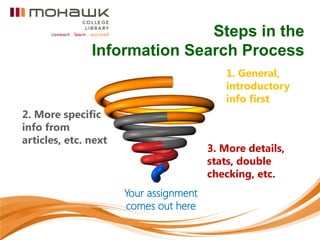
Steps in the
               Information Search Process
                                           1. General,
                                           introductory
                                           info first
2. More specific
info from
articles, etc. next
                                        3. More details,
                                        stats, double
                                        checking, etc.
                      Your assignment
                      comes out here
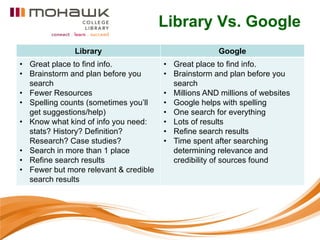
Library Vs. Google
              Library                                 Google
• Great place to find info.            • Great place to find info.
• Brainstorm and plan before you       • Brainstorm and plan before you
  search                                 search
• Fewer Resources                      • Millions AND millions of websites
• Spelling counts (sometimes you’ll    • Google helps with spelling
  get suggestions/help)                • One search for everything
• Know what kind of info you need:     • Lots of results
  stats? History? Definition?          • Refine search results
  Research? Case studies?              • Time spent after searching
• Search in more than 1 place            determining relevance and
• Refine search results                  credibility of sources found
• Fewer but more relevant & credible
  search results
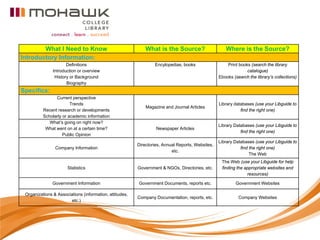
What I Need to Know                                  What is the Source?                     Where is the Source?
Introductory Information:
                      Definitions                                Encylopedias, books                  Print books (search the library
               Introduction or overview                                                                         catalogue)
                History or Background                                                             Ebooks (search the library’s collections)
                      Biography
Specifics:
                Current perspective
                        Trends                                                                    Library databases (use your Libguide to
                                                             Magazine and Journal Articles
          Recent research or developments                                                                    find the right one)
          Scholarly or academic information
             What’s going on right now?
                                                                                                  Library Databases (use your Libguide to
           What went on at a certain time?                        Newspaper Articles
                                                                                                             find the right one)
                    Public Opinion
                                                                                                  Library Databases (use your Libguide to
                                                         Directories, Annual Reports, Websites,
                Company Information                                                                          find the right one)
                                                                          etc.
                                                                                                                  The Web
                                                                                                   The Web (use your Libguide for help
                      Statistics                         Government & NGOs, Directories, etc.      finding the appropriate websites and
                                                                                                                resources)

               Government Information                    Government Documents, reports etc.               Government Websites

 Organizations & Associations (information, attitudes,
                                                         Company Documentation, reports, etc.               Company Websites
                       etc.)
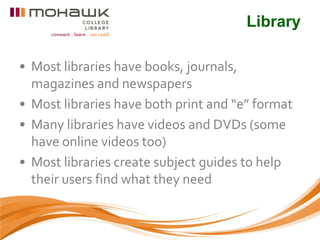
Library

• Most libraries have books, journals,
  magazines and newspapers
• Most libraries have both print and “e” format
• Many libraries have videos and DVDs (some
  have online videos too)
• Most libraries create subject guides to help
  their users find what they need
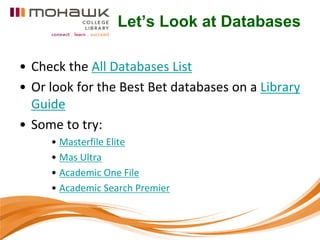
Let’s Look at Databases

• Check the All Databases List
• Or look for the Best Bet databases on a Library
  Guide
• Some to try:
     • Masterfile Elite
     • Mas Ultra
     • Academic One File
     • Academic Search Premier
APA

• APA provides a standardized way to format your
  paper
• APA provides a standardized and consistent
  way to acknowledge (cite) your information
  sources
Citing using APA style is
                              a two step process:

• “In-text” citation in the body of your paper (when you
  quote or paraphrase)

                    MATCHES
• a complete citation in the References list at the end of
  your paper
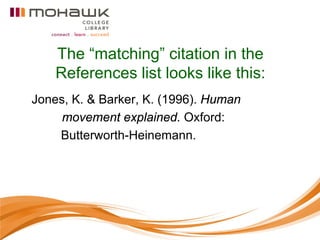
The “matching” citation in the
    References list looks like this:
Jones, K. & Barker, K. (1996). Human
     movement explained. Oxford:
    Butterworth-Heinemann.
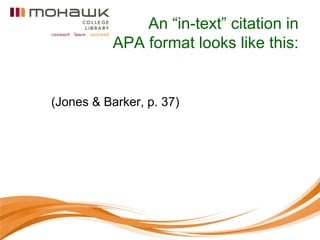
An “in-text” citation in
           APA format looks like this:


(Jones & Barker, p. 37)
Ingredients of a citation for your
                References List
Title        Author    Date      Publishing Info

  (Whether you’re photocopying, taking notes or
        cutting and pasting, make sure you
         ALWAYS get these 4 things!!)
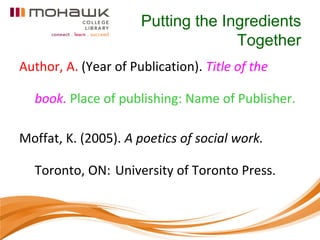
Putting the Ingredients
                                    Together
Author, A. (Year of Publication). Title of the

  book. Place of publishing: Name of Publisher.

Moffat, K. (2005). A poetics of social work.

  Toronto, ON: University of Toronto Press.
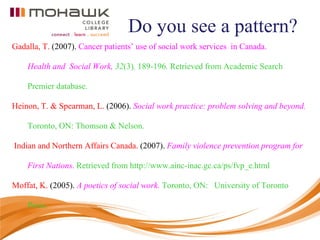
Do you see a pattern?
Gadalla, T. (2007). Cancer patients’ use of social work services in Canada.

    Health and Social Work, 32(3), 189-196. Retrieved from Academic Search

    Premier database.

Heinon, T. & Spearman, L. (2006). Social work practice: problem solving and beyond.

    Toronto, ON: Thomson & Nelson.

Indian and Northern Affairs Canada. (2007). Family violence prevention program for

    First Nations. Retrieved from http://www.ainc-inac.gc.ca/ps/fvp_e.html

Moffat, K. (2005). A poetics of social work. Toronto, ON: University of Toronto

    Press.
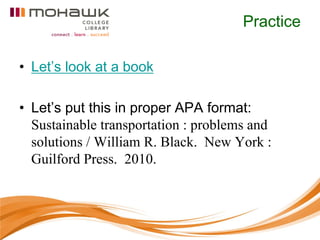
Practice

• Let’s look at a book

• Let’s put this in proper APA format:
  Sustainable transportation : problems and
  solutions / William R. Black. New York :
  Guilford Press. 2010.
Practice

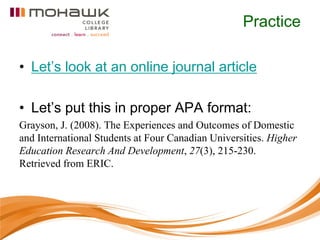
• Let’s look at an online journal article

• Let’s put this in proper APA format:
Grayson, J. (2008). The Experiences and Outcomes of Domestic
and International Students at Four Canadian Universities. Higher
Education Research And Development, 27(3), 215-230.
Retrieved from ERIC.
Practice

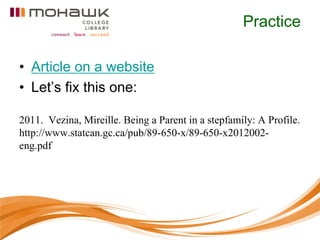
• Article on a website
• Let’s fix this one:

2011. Vezina, Mireille. Being a Parent in a stepfamily: A Profile.
http://www.statcan.gc.ca/pub/89-650-x/89-650-x2012002-
eng.pdf
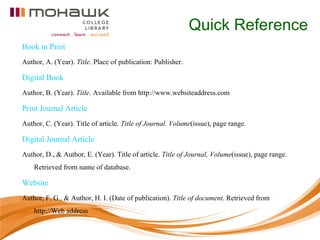
Quick Reference
Book in Print
Author, A. (Year). Title. Place of publication: Publisher.

Digital Book
Author, B. (Year). Title. Available from http://www.websiteaddress.com

Print Journal Article
Author, C. (Year). Title of article. Title of Journal. Volume(issue), page range.

Digital Journal Article
Author, D., & Author, E. (Year). Title of article. Title of Journal, Volume(issue), page range.
    Retrieved from name of database.

Website
Author, F. G., & Author, H. I. (Date of publication). Title of document. Retrieved from
    http://Web address
Questions??

       Need More Help??
Try the library’s APA Help guide.

Library and apa henrie winter 2013

  • 1.
    Mohawk College Library and APA Your Librarian: Cynthia Williamson
  • 2.
    Today • Thinking about how to find information • What’s in the library? • Library vs. Internet • APA info, tips and some practice
  • 3.
    Steps in the Information Search Process 1. General, introductory info first 2. More specific info from articles, etc. next 3. More details, stats, double checking, etc. Your assignment comes out here
  • 4.
    Library Vs. Google Library Google • Great place to find info. • Great place to find info. • Brainstorm and plan before you • Brainstorm and plan before you search search • Fewer Resources • Millions AND millions of websites • Spelling counts (sometimes you’ll • Google helps with spelling get suggestions/help) • One search for everything • Know what kind of info you need: • Lots of results stats? History? Definition? • Refine search results Research? Case studies? • Time spent after searching • Search in more than 1 place determining relevance and • Refine search results credibility of sources found • Fewer but more relevant & credible search results
  • 5.
    What I Needto Know What is the Source? Where is the Source? Introductory Information: Definitions Encylopedias, books Print books (search the library Introduction or overview catalogue) History or Background Ebooks (search the library’s collections) Biography Specifics: Current perspective Trends Library databases (use your Libguide to Magazine and Journal Articles Recent research or developments find the right one) Scholarly or academic information What’s going on right now? Library Databases (use your Libguide to What went on at a certain time? Newspaper Articles find the right one) Public Opinion Library Databases (use your Libguide to Directories, Annual Reports, Websites, Company Information find the right one) etc. The Web The Web (use your Libguide for help Statistics Government & NGOs, Directories, etc. finding the appropriate websites and resources) Government Information Government Documents, reports etc. Government Websites Organizations & Associations (information, attitudes, Company Documentation, reports, etc. Company Websites etc.)
  • 6.
    Library • Most librarieshave books, journals, magazines and newspapers • Most libraries have both print and “e” format • Many libraries have videos and DVDs (some have online videos too) • Most libraries create subject guides to help their users find what they need
  • 7.
    Let’s Look atDatabases • Check the All Databases List • Or look for the Best Bet databases on a Library Guide • Some to try: • Masterfile Elite • Mas Ultra • Academic One File • Academic Search Premier
  • 8.
    APA • APA providesa standardized way to format your paper • APA provides a standardized and consistent way to acknowledge (cite) your information sources
  • 9.
    Citing using APAstyle is a two step process: • “In-text” citation in the body of your paper (when you quote or paraphrase) MATCHES • a complete citation in the References list at the end of your paper
  • 10.
    The “matching” citationin the References list looks like this: Jones, K. & Barker, K. (1996). Human movement explained. Oxford: Butterworth-Heinemann.
  • 11.
    An “in-text” citationin APA format looks like this: (Jones & Barker, p. 37)
  • 12.
    Ingredients of acitation for your References List Title Author Date Publishing Info (Whether you’re photocopying, taking notes or cutting and pasting, make sure you ALWAYS get these 4 things!!)
  • 13.
    Putting the Ingredients Together Author, A. (Year of Publication). Title of the book. Place of publishing: Name of Publisher. Moffat, K. (2005). A poetics of social work. Toronto, ON: University of Toronto Press.
  • 14.
    Do you seea pattern? Gadalla, T. (2007). Cancer patients’ use of social work services in Canada. Health and Social Work, 32(3), 189-196. Retrieved from Academic Search Premier database. Heinon, T. & Spearman, L. (2006). Social work practice: problem solving and beyond. Toronto, ON: Thomson & Nelson. Indian and Northern Affairs Canada. (2007). Family violence prevention program for First Nations. Retrieved from http://www.ainc-inac.gc.ca/ps/fvp_e.html Moffat, K. (2005). A poetics of social work. Toronto, ON: University of Toronto Press.
  • 15.
    Practice • Let’s lookat a book • Let’s put this in proper APA format: Sustainable transportation : problems and solutions / William R. Black. New York : Guilford Press. 2010.
  • 16.
    Practice • Let’s lookat an online journal article • Let’s put this in proper APA format: Grayson, J. (2008). The Experiences and Outcomes of Domestic and International Students at Four Canadian Universities. Higher Education Research And Development, 27(3), 215-230. Retrieved from ERIC.
  • 17.
    Practice • Article ona website • Let’s fix this one: 2011. Vezina, Mireille. Being a Parent in a stepfamily: A Profile. http://www.statcan.gc.ca/pub/89-650-x/89-650-x2012002- eng.pdf
  • 18.
    Quick Reference Book inPrint Author, A. (Year). Title. Place of publication: Publisher. Digital Book Author, B. (Year). Title. Available from http://www.websiteaddress.com Print Journal Article Author, C. (Year). Title of article. Title of Journal. Volume(issue), page range. Digital Journal Article Author, D., & Author, E. (Year). Title of article. Title of Journal, Volume(issue), page range. Retrieved from name of database. Website Author, F. G., & Author, H. I. (Date of publication). Title of document. Retrieved from http://Web address
  • 19.
    Questions?? Need More Help?? Try the library’s APA Help guide.