
CAN EXCESSIVE USE OF SOCIAL MEDIA CONTRIBUTE
TO ADDICTIVE BEHAVIOURS OR MENTAL HEALTH
ISSUES
ABSTRACT:
Social Networking Sites (SNSs) are virtual communities where users can create individual
public profiles, interact with real life friends, and meet other people based on shared interests.
They are seen as a ‘global consumer phenomenon’ with an exponential rise in usage within the
last few years. Studies have proven that the excessive use or overuse of these SNSs create
anxiety and lead to mood modification and other mental illnesses. Therefore, this research is
intended to provide empirical and conceptual insight into the emerging Phenomenon of addiction
to SNSs by: (1) outlining SNS usage patterns, (2) examining factors for SNS usage, (3)
examining negative consequences of SNS usage,
(4)Exploring potential SNS addiction, and (5) exploring SNS addiction to mental illnesses. The
findings indicate that SNSs are predominantly used for social purposes, mostly related to the
maintenance of established offline networks. Moreover, extraverts appear to use social
networking sites for social enhancement, whereas introverts use it for social compensation, each
of which appears to be related to greater usage, as does low conscientiousness and high
narcissism. Negative correlates of SNS usage include the decrease in real life social community
participation and academic achievement, as well as relationship problems, each of which may be
indicative of potential addiction.
Introduction:
Undoubtedly, the developing and changing world system that we are involved in influences
every aspect of our lives. Not only in political, economic, or cultural sense but also changes
especially in new technologies influence the psychology of people as well and the changes that it
brings is the most common subject of researches. Internet addiction and types of addiction that
emerged via the developing communication technologies, is one of the most burning issues.
Objectives of the research:
• Comparative study of positive and negative aspects of social media.
• Examining the factors that lead to SNSs usage.
• Identify and categorize addictiveness to social media.
• Reasons for people to get addicted.
• Effects of social media on mental health.
Scope:
• The study relates to the effect of negative aspects of social media’s contribution to the
human behaviour on the youth population of the Bangalore.
• The research tries to cover all the youth of Bangalore by using a stratified sampling to
determine the sample size out of sample world (Bangalore Youth).
Definition of the Terms used:
• SNS: Social networking is a global revolution, enabling around a billion people
worldwide to stay in touch with their friends, share experiences and photographs and
exchange personal content. In many ways it has replaced the telephone and email.
Include Facebook, Twitter, Linkedin, Whatsapp mainly for research.
• Social Media: Social media are computer-mediated tools that allow people to create,
share or exchange information, ideas, and pictures/videos in virtual communities and
networks.
• Addiction: It is a psychological feeling of dependence. It is a state of being enslaved to a habit to
such a state that its cessation causes serious trauma.
• Socialization: It is a general term for the many different ways and processes by which children
come to be able to function as members of their social community. It is in part a process of
learning and in part a process of being taught, but modern views of socialisation also stress the
active role of children in making sense of their social world, and constructing their own ways of
being part of their social group.
• Online Gambling: the act of gambling using internet mainly SNSs.It is the act of playing
for stakes in the hope of winning.
• Mental Illness: It is a hostile feeling in the mind where its further stage leads to serious
trauma to the person.
Assumptions:
• Everyone is connected to Social Media (mainly the youth).
From secondary sources of data, that almost 96% of the youth is connected atleast any
one of the social networking sites directly, and almost 89% of the youth are connected to
more than one SNS. It doesn’t mean that the remaining 4% are not at all connected to
SNSs.
• Overuse/Addiction of anything has ill effects.
It is known from the ages that every object has a positive and a negative effect on users.
The negative sides of the object comes to picture, when it is overused. Similarly, SNSs
provide a medium to connect and explore the world, which is its positive side and the
over usage of these sites may cause mental health and behavioural problems.
2. LITERATURE REVIEW:
The article ‘Is Generation Y Addicted to Social Media?’ by Jaclyn Cabral
examined Generation Y’s psychological addiction to social media with specific
regard to Facebook, MySpace, Twitter and LinkedIn. The addiction was
interpreted using Griffiths’ six components that determine behavioral addiction:
salience, mood modification, tolerance, withdrawal, conflict and relapse. The
purposeof this study was to determine if Generation Y was in fact addicted to
social media becauseof their need to maintain relationships with their peers. The
results indicated that this sample of Generation Y suffers from three components,
tolerance, salience and relapse. They also suffers from intrapsychic conflict, but
not interpersonal conflict
The second article reviewed “SocialNetworking Addiction: Emerging Themes and
Issues” by Mark D Griffiths focused mainly on the disadvantages of Social Media
including SNSs. Researchers have suggested that the excessive use of new
technologies (and especially online social networking) may be particularly
problematic to young people. It is claimed that those people addicted to using
SNSs experience symptoms similar to those experienced by individuals who suffer
from addictions to substances orother behaviours. This has significant implications
for clinical practice because unlike other addictions, the goal of SNS addiction
treatment cannot be total abstinence from using the internet per se it is an integral
element of today’s professional and leisure culture. This has significant
implications for clinical practice because unlike other addictions, the goal of SNS
addiction treatment cannot be total abstinence from using the internet per se it is an
integral element of today’s professionaland leisure culture.
Ways Social Media Affects Our Mental Health
Social media is addictive.
Studies show that 63% of Americans log on to Facebook daily, and 40% log on multiple times
each day. People use the site for myriad reasons; however, it usually serves, on some level, the
same basic purposes: distraction and boredom relief. “Likes” and comments are positive
reinforcement for posting information, making it difficult for a person to stop. Researchers have
found this so common that they created a scale to measure this addiction: The Berge Facebook
Addiction Scale.
Social media makes us compare our lives with others’.
Posts on social media many times present an idealized version of what’s happening, what
something looks like, or how things are going. This can lead users to constantly compare
themselves to others and think less of their own lives. If things are going particularly well for
people in your newsfeed and you’re having a rough day, of course this will likely negatively
affect your mood. In fact, in 2012 a team of researchers in the UK surveyed users, 53% of whom
said social media had changed their behavior; 51% said it was negative behavior because of
decline in confidence they felt due to unfair comparisons to others.
Social media makes us restless.
Out of the same sample as the above example, two-thirds admitted to having difficultly relaxing
when unable to use their social media accounts.
Social media gives rise to cyberbullying.
Cyberbullying is an enormous concern, especially for adolescents. An organization that aims for
internet safety, called Enough is Enough, conducted a survey that found 95% of teenagers who
use social media have witnessed cyberbullying, and 33% have been victims themselves.
Social media glamorizes drug and alcohol use.
A study that explored the relationship between teenagers, social media, and drug use found that
70% of teenagers ages 12 to 17 use social media, and that those who interact with it on a daily
basis are five times more likely to use tobacco, three times more likely to use alcohol, and twice
as likely to use marijuana. In addition, 40% admitted they had been exposed to pictures of people
under the influence via social media, suggesting correlation between the two factors. Although a
correlation is all it is, it makes sense that social media would amp up the amount of peer pressure
to which teenagers are exposed.
Social media can make us unhappy.
A study from the University of Michigan collected data about Facebook users and how it
correlated with their moods. Simply put, they found that the more avid users were overall more
unhappy than those who used the site less. Over more time, avid users also reported lower
satisfaction in their lives overall.
Assumptions:
• Everyone is connected to Social Media (mainly the youth).
From secondary sources of data, that almost 96% of the youth is connected atleast any
one of the social networking sites directly, and almost 89% of the youth are connected to
more than one SNS. It doesn’t mean that the remaining 4% are not at all connected to
SNSs.
• Overuse/Addiction of anything has ill effects.
It is known from the ages that every object has a positive and a negative effect on users.
The negative sides of the object comes to picture, when it is overused. Similarly, SNSs
provide a medium to connect and explore the world, which is its positive side and the
over usage of these sites may cause mental health and behavioural problems.
3. HYPOTHESIS
• Excessive use of social media creates anxiety.
H0: Excessive use of social media does not create anxiety.
H1: Excessive use of social media creates anxiety.
• Excessive use of social media is responsible for dual personality disorder.
H0: Excessive use of social media is not responsible for dual personality disorder.
H1: Excessive use of social media is responsible for dual personality disorder.
• Excessive use of social media results in social awkwardness.
H0: Excessive use of social media does not result in social awkwardness.
H1: Excessive use of social media results in social awkwardness.
• Excessive use of social media leads to unproductivity/ reduced productivity
H0: Excessive use of social media does not lead to unproductivity/ reduced productivity.
H1: Excessive use of social media leads to unproductivity/ reduced productivity.
4. METHODOLOGY:
• Descriptive Research: We found out the characteristics of youth that lead to excessive
use and factors that evolve due to excessive use.
a) Factors that lead to excessive use
i) Cognitive-behavioral model: This model emphasizes that ‘abnormal’ social networking arises
from maladaptive cognitions and is amplified by various environmental factors,and eventually
leads to compulsive and/or addictive social networking.
ii) Social-Skill model: This model emphasizes that ‘abnormal’ social networking arises because
people lack self-presentational skills and prefer virtual communication to face-to-face interactions,
and it eventually leads to compulsive and/or addictive use of social networking.
iii) Social – Cognitive model: This model emphasizes that ‘abnormal’ social networking arises
due to the expectation of positive outcomes, combined with internet self-efficacy and deficient
internet self-regulation eventually leads to compulsive and/or addictive social networking behavior.
b) Factors that evolve due to excessive use
i) Mood modification: The behavior or the mood of people who got addicted to Social
media cannot be predicted. They may be angry while they are smiling.
ii) Tolerance: The addicted people cannot tolerate a small mistake that they see mainly
while using net. They are easily drawn into fight, though there is no reason for them to
fight.
iii) Withdrawal: When the addicted people are restricted to internet or when they reduce
usage, they feel withdrawal i.e., keep them away from others.
iv) Relapsing: They go to bad behavior and deteriorate in health.
v) Anxiety
vi) Depression
• EXPERIMENTAL RESEARCH: It is conducted to know the correlation between the
factors that influence the users and the factors that evolve in them after the addiction. We
used the online questionnaire method to know the relation and followed the following
procedure.
a) Division of youth into strata or quotas based on gender and then age
b) Preparation of separate questionnaires
c) Setting up the survey questionnaire on SNS and mailing
d) Collection of data.
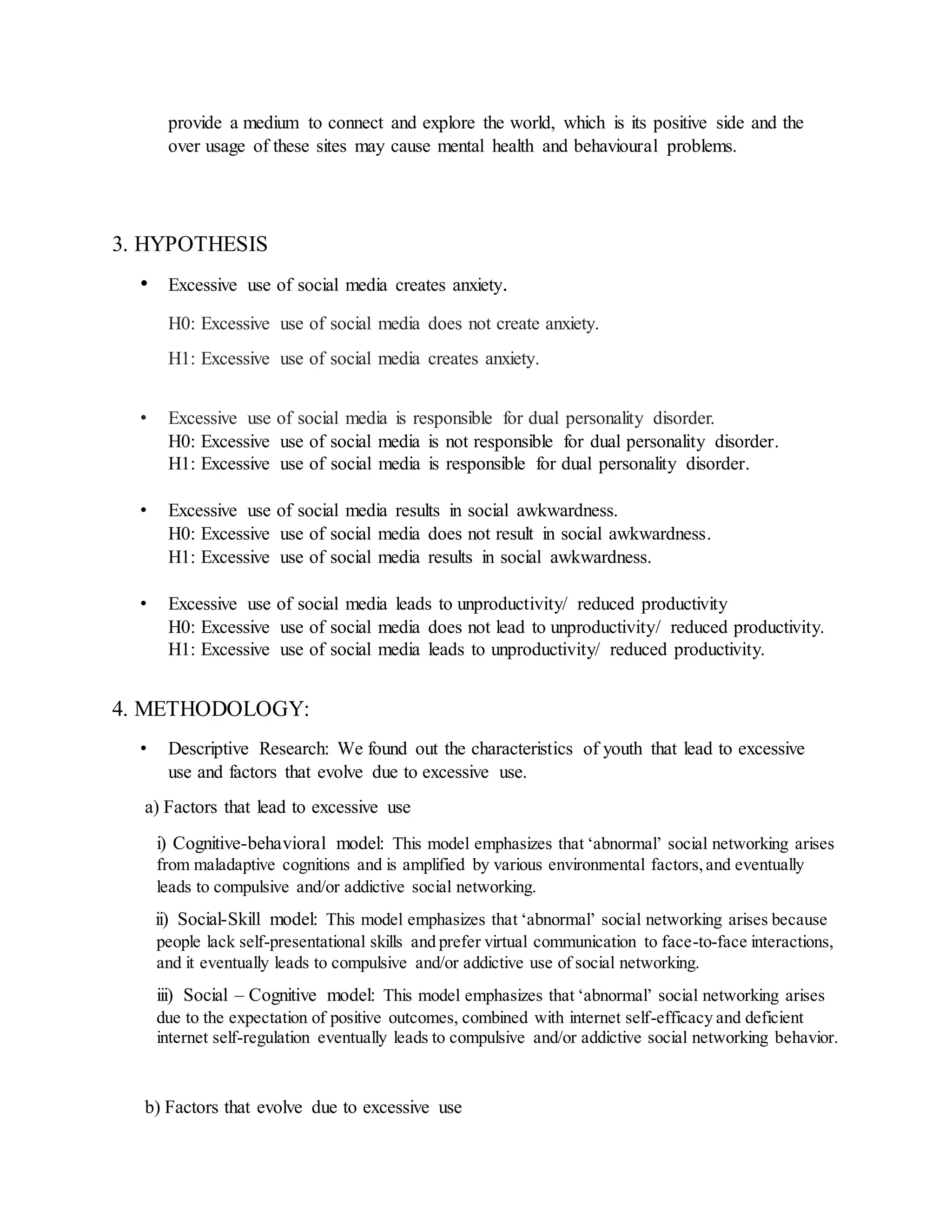
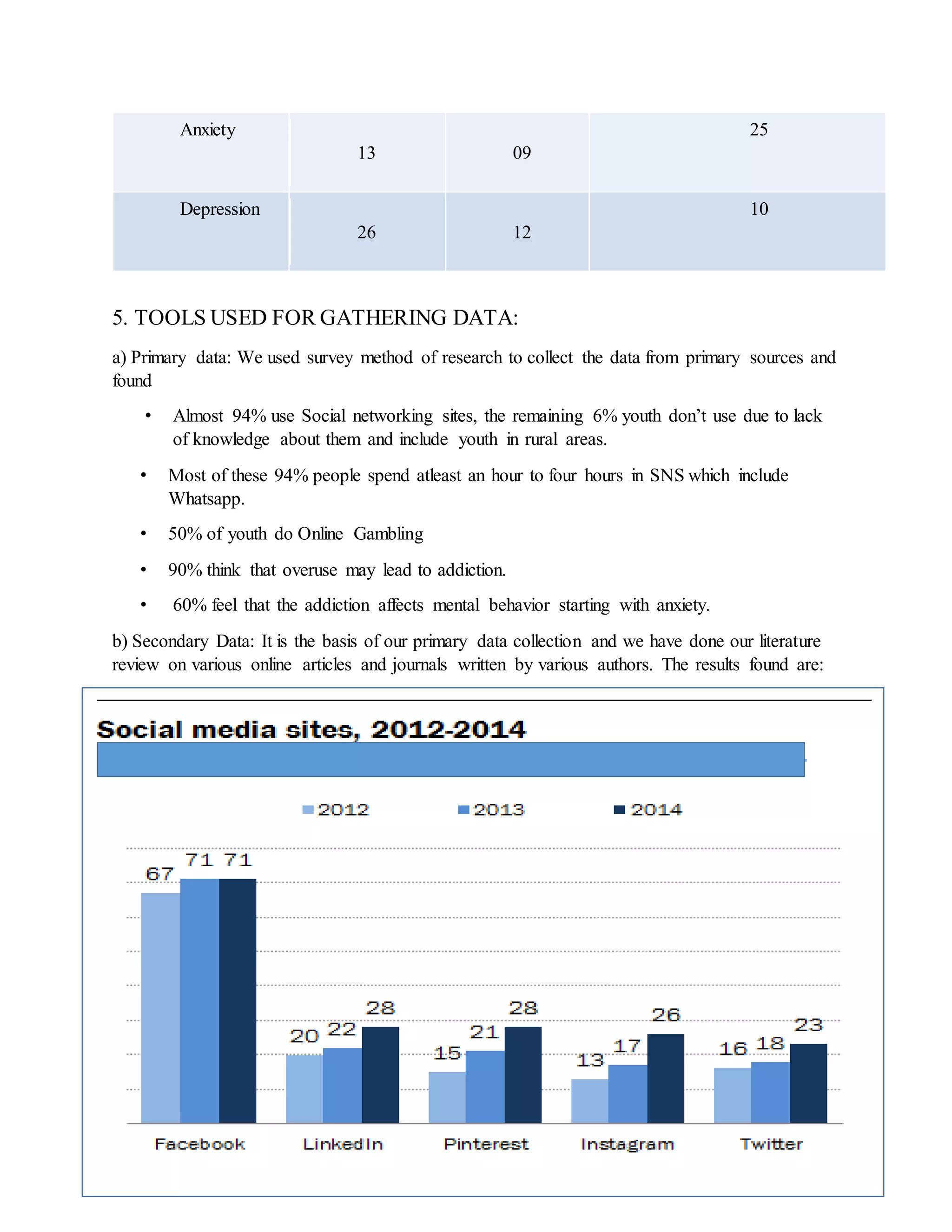
Result of the Experimental Research:
Cognitive-
Behaviour Social-
Skill
Social-Cognitive
Mood
Modification 20 24
16
In-tolerance
17 30
29
Withdrawal
24 26
20
Anxiety
13 09
25
Depression
26 12
10
5. TOOLS USED FOR GATHERING DATA:
a) Primary data: We used survey method of research to collect the data from primary sources and
found
• Almost 94% use Social networking sites, the remaining 6% youth don’t use due to lack
of knowledge about them and include youth in rural areas.
• Most of these 94% people spend atleast an hour to four hours in SNS which include
Whatsapp.
• 50% of youth do Online Gambling
• 90% think that overuse may lead to addiction.
• 60% feel that the addiction affects mental behavior starting with anxiety.
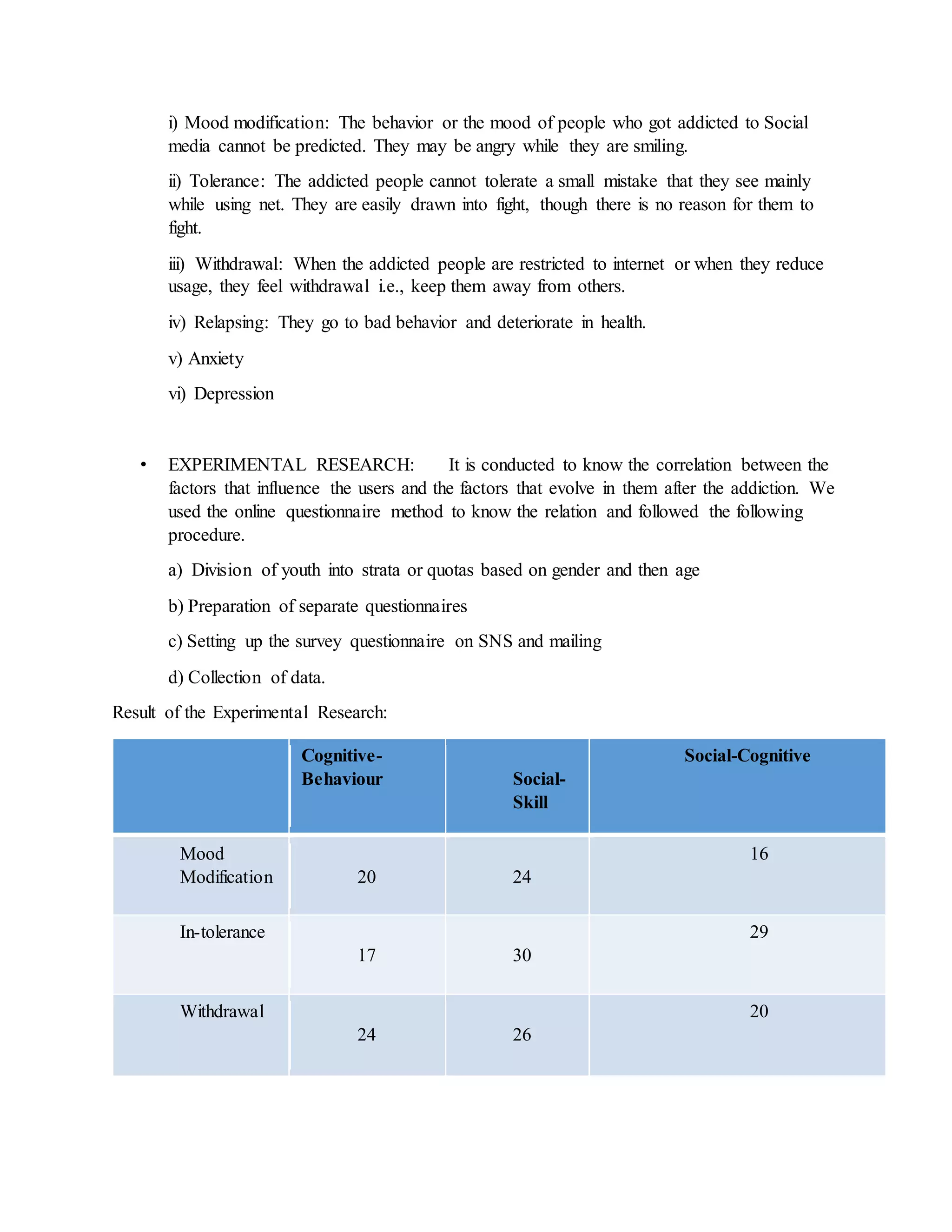
b) Secondary Data: It is the basis of our primary data collection and we have done our literature
review on various online articles and journals written by various authors. The results found are:
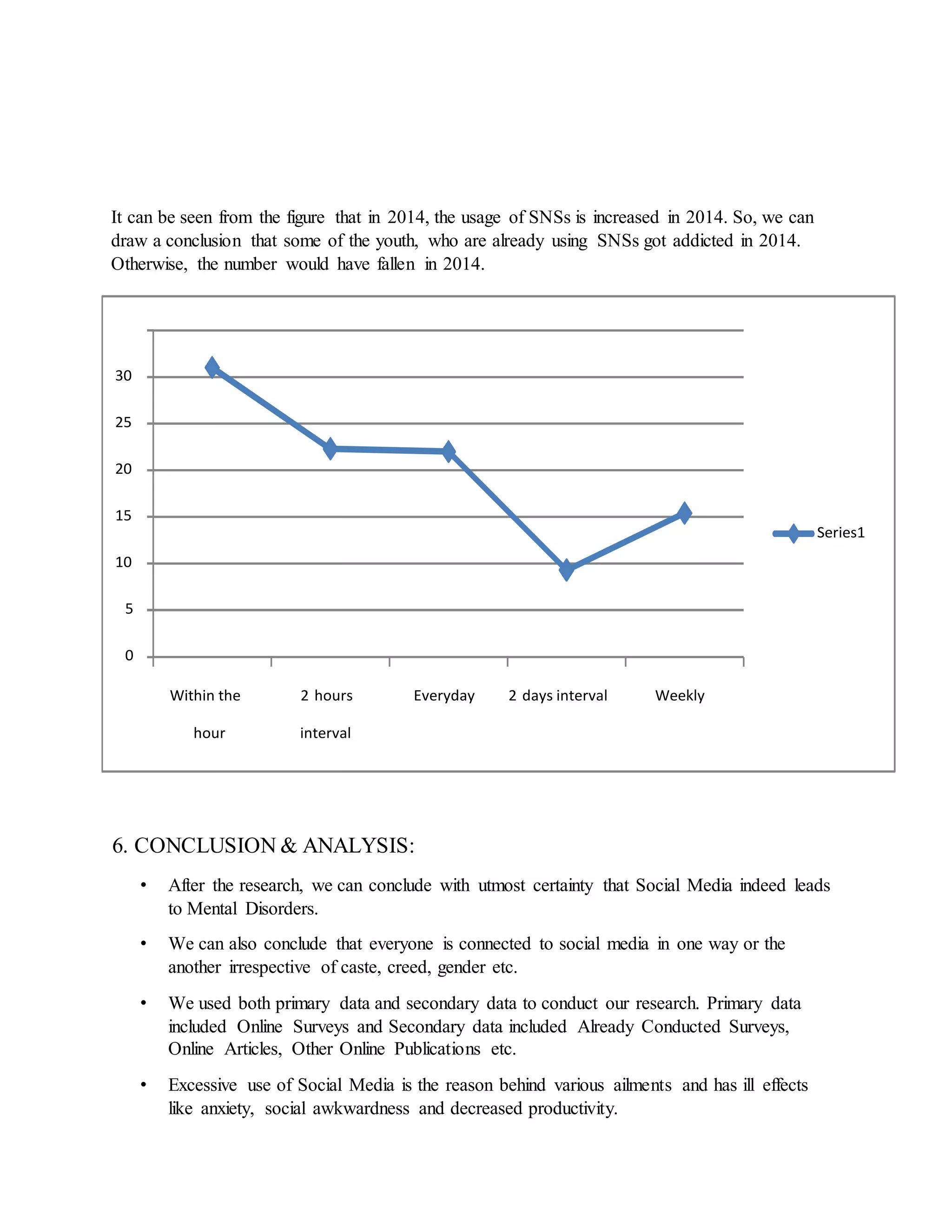
It can be seen from the figure that in 2014, the usage of SNSs is increased in 2014. So, we can
draw a conclusion that some of the youth, who are already using SNSs got addicted in 2014.
Otherwise, the number would have fallen in 2014.
6. CONCLUSION & ANALYSIS:
• After the research, we can conclude with utmost certainty that Social Media indeed leads
to Mental Disorders.
• We can also conclude that everyone is connected to social media in one way or the
another irrespective of caste, creed, gender etc.
• We used both primary data and secondary data to conduct our research. Primary data
included Online Surveys and Secondary data included Already Conducted Surveys,
Online Articles, Other Online Publications etc.
• Excessive use of Social Media is the reason behind various ailments and has ill effects
like anxiety, social awkwardness and decreased productivity.
0
5
10
15
20
25
30
Within the
hour
hours2
interval
Everyday 2 days interval Weekly
Series1
• Social Media was introduced to help people stay in touch with each other but it is turning
out to be a curse instead of a blessing.
Remedies and Solutions:
• Firewall: A Firewall is a filter which is put on by the Internet Service Provider to restrict
the use of a few websites. Social Networking Sites can be put under Firewall in order to
restrict it’s usage. Educational institutions usually put up such firewall to not let students
use SNS. For Example: Christ University.
• Counsellors: It’s high time to address the problems caused by Social Networking Sites as
they take up a substantial part of our day. Counsellors should be provided to the people
who are facing problems like anxiety, social awkwardness, dual personality disorder, bi
polar behaviour etc.
• Personality Development Classes: Our research also found out that the reason behind
excessive use of Social Media is that people often find it difficult to speak in public
and/or face-to-face. Instead of choosing Social Media as the last resort, people should
take up PD classes to be able to convey their thoughts properly.
RESEARCH CIA
Topic:CAN EXCESSIVE
USE OF SOCIAL MEDIA
CONTRIBUTE TO
ADDICTIVE BEHAVIOURS
OR MENTAL HEALTH
ISSUES
- Ayush (1310904)
Harsha (1310911)
Yash (1310919)
Ankush(1310948)
Devjit (1310949)
Amaan (1310950)
Prakhar (1310952)
Rounak (1310980)
Research report on exceesive use of social media lead to mental health issues

Research report on exceesive use of social media lead to mental health issues

  • 1.
    CAN EXCESSIVE USEOF SOCIAL MEDIA CONTRIBUTE TO ADDICTIVE BEHAVIOURS OR MENTAL HEALTH ISSUES ABSTRACT: Social Networking Sites (SNSs) are virtual communities where users can create individual public profiles, interact with real life friends, and meet other people based on shared interests. They are seen as a ‘global consumer phenomenon’ with an exponential rise in usage within the last few years. Studies have proven that the excessive use or overuse of these SNSs create anxiety and lead to mood modification and other mental illnesses. Therefore, this research is intended to provide empirical and conceptual insight into the emerging Phenomenon of addiction to SNSs by: (1) outlining SNS usage patterns, (2) examining factors for SNS usage, (3) examining negative consequences of SNS usage, (4)Exploring potential SNS addiction, and (5) exploring SNS addiction to mental illnesses. The findings indicate that SNSs are predominantly used for social purposes, mostly related to the maintenance of established offline networks. Moreover, extraverts appear to use social networking sites for social enhancement, whereas introverts use it for social compensation, each of which appears to be related to greater usage, as does low conscientiousness and high narcissism. Negative correlates of SNS usage include the decrease in real life social community participation and academic achievement, as well as relationship problems, each of which may be indicative of potential addiction. Introduction: Undoubtedly, the developing and changing world system that we are involved in influences every aspect of our lives. Not only in political, economic, or cultural sense but also changes especially in new technologies influence the psychology of people as well and the changes that it brings is the most common subject of researches. Internet addiction and types of addiction that emerged via the developing communication technologies, is one of the most burning issues. Objectives of the research: • Comparative study of positive and negative aspects of social media. • Examining the factors that lead to SNSs usage. • Identify and categorize addictiveness to social media. • Reasons for people to get addicted. • Effects of social media on mental health.
  • 2.
    Scope: • The studyrelates to the effect of negative aspects of social media’s contribution to the human behaviour on the youth population of the Bangalore. • The research tries to cover all the youth of Bangalore by using a stratified sampling to determine the sample size out of sample world (Bangalore Youth). Definition of the Terms used: • SNS: Social networking is a global revolution, enabling around a billion people worldwide to stay in touch with their friends, share experiences and photographs and exchange personal content. In many ways it has replaced the telephone and email. Include Facebook, Twitter, Linkedin, Whatsapp mainly for research. • Social Media: Social media are computer-mediated tools that allow people to create, share or exchange information, ideas, and pictures/videos in virtual communities and networks. • Addiction: It is a psychological feeling of dependence. It is a state of being enslaved to a habit to such a state that its cessation causes serious trauma. • Socialization: It is a general term for the many different ways and processes by which children come to be able to function as members of their social community. It is in part a process of learning and in part a process of being taught, but modern views of socialisation also stress the active role of children in making sense of their social world, and constructing their own ways of being part of their social group. • Online Gambling: the act of gambling using internet mainly SNSs.It is the act of playing for stakes in the hope of winning. • Mental Illness: It is a hostile feeling in the mind where its further stage leads to serious trauma to the person.
  • 3.
    Assumptions: • Everyone isconnected to Social Media (mainly the youth). From secondary sources of data, that almost 96% of the youth is connected atleast any one of the social networking sites directly, and almost 89% of the youth are connected to more than one SNS. It doesn’t mean that the remaining 4% are not at all connected to SNSs. • Overuse/Addiction of anything has ill effects. It is known from the ages that every object has a positive and a negative effect on users. The negative sides of the object comes to picture, when it is overused. Similarly, SNSs provide a medium to connect and explore the world, which is its positive side and the over usage of these sites may cause mental health and behavioural problems. 2. LITERATURE REVIEW: The article ‘Is Generation Y Addicted to Social Media?’ by Jaclyn Cabral examined Generation Y’s psychological addiction to social media with specific regard to Facebook, MySpace, Twitter and LinkedIn. The addiction was interpreted using Griffiths’ six components that determine behavioral addiction: salience, mood modification, tolerance, withdrawal, conflict and relapse. The purposeof this study was to determine if Generation Y was in fact addicted to social media becauseof their need to maintain relationships with their peers. The results indicated that this sample of Generation Y suffers from three components, tolerance, salience and relapse. They also suffers from intrapsychic conflict, but not interpersonal conflict The second article reviewed “SocialNetworking Addiction: Emerging Themes and Issues” by Mark D Griffiths focused mainly on the disadvantages of Social Media including SNSs. Researchers have suggested that the excessive use of new technologies (and especially online social networking) may be particularly problematic to young people. It is claimed that those people addicted to using SNSs experience symptoms similar to those experienced by individuals who suffer from addictions to substances orother behaviours. This has significant implications for clinical practice because unlike other addictions, the goal of SNS addiction treatment cannot be total abstinence from using the internet per se it is an integral element of today’s professional and leisure culture. This has significant implications for clinical practice because unlike other addictions, the goal of SNS addiction treatment cannot be total abstinence from using the internet per se it is an integral element of today’s professionaland leisure culture.
  • 4.
    Ways Social MediaAffects Our Mental Health Social media is addictive. Studies show that 63% of Americans log on to Facebook daily, and 40% log on multiple times each day. People use the site for myriad reasons; however, it usually serves, on some level, the same basic purposes: distraction and boredom relief. “Likes” and comments are positive reinforcement for posting information, making it difficult for a person to stop. Researchers have found this so common that they created a scale to measure this addiction: The Berge Facebook Addiction Scale. Social media makes us compare our lives with others’. Posts on social media many times present an idealized version of what’s happening, what something looks like, or how things are going. This can lead users to constantly compare themselves to others and think less of their own lives. If things are going particularly well for people in your newsfeed and you’re having a rough day, of course this will likely negatively affect your mood. In fact, in 2012 a team of researchers in the UK surveyed users, 53% of whom said social media had changed their behavior; 51% said it was negative behavior because of decline in confidence they felt due to unfair comparisons to others. Social media makes us restless. Out of the same sample as the above example, two-thirds admitted to having difficultly relaxing when unable to use their social media accounts. Social media gives rise to cyberbullying. Cyberbullying is an enormous concern, especially for adolescents. An organization that aims for internet safety, called Enough is Enough, conducted a survey that found 95% of teenagers who use social media have witnessed cyberbullying, and 33% have been victims themselves.
  • 5.
    Social media glamorizesdrug and alcohol use. A study that explored the relationship between teenagers, social media, and drug use found that 70% of teenagers ages 12 to 17 use social media, and that those who interact with it on a daily basis are five times more likely to use tobacco, three times more likely to use alcohol, and twice as likely to use marijuana. In addition, 40% admitted they had been exposed to pictures of people under the influence via social media, suggesting correlation between the two factors. Although a correlation is all it is, it makes sense that social media would amp up the amount of peer pressure to which teenagers are exposed. Social media can make us unhappy. A study from the University of Michigan collected data about Facebook users and how it correlated with their moods. Simply put, they found that the more avid users were overall more unhappy than those who used the site less. Over more time, avid users also reported lower satisfaction in their lives overall. Assumptions: • Everyone is connected to Social Media (mainly the youth). From secondary sources of data, that almost 96% of the youth is connected atleast any one of the social networking sites directly, and almost 89% of the youth are connected to more than one SNS. It doesn’t mean that the remaining 4% are not at all connected to SNSs. • Overuse/Addiction of anything has ill effects. It is known from the ages that every object has a positive and a negative effect on users. The negative sides of the object comes to picture, when it is overused. Similarly, SNSs
  • 6.
    provide a mediumto connect and explore the world, which is its positive side and the over usage of these sites may cause mental health and behavioural problems. 3. HYPOTHESIS • Excessive use of social media creates anxiety. H0: Excessive use of social media does not create anxiety. H1: Excessive use of social media creates anxiety. • Excessive use of social media is responsible for dual personality disorder. H0: Excessive use of social media is not responsible for dual personality disorder. H1: Excessive use of social media is responsible for dual personality disorder. • Excessive use of social media results in social awkwardness. H0: Excessive use of social media does not result in social awkwardness. H1: Excessive use of social media results in social awkwardness. • Excessive use of social media leads to unproductivity/ reduced productivity H0: Excessive use of social media does not lead to unproductivity/ reduced productivity. H1: Excessive use of social media leads to unproductivity/ reduced productivity. 4. METHODOLOGY: • Descriptive Research: We found out the characteristics of youth that lead to excessive use and factors that evolve due to excessive use. a) Factors that lead to excessive use i) Cognitive-behavioral model: This model emphasizes that ‘abnormal’ social networking arises from maladaptive cognitions and is amplified by various environmental factors,and eventually leads to compulsive and/or addictive social networking. ii) Social-Skill model: This model emphasizes that ‘abnormal’ social networking arises because people lack self-presentational skills and prefer virtual communication to face-to-face interactions, and it eventually leads to compulsive and/or addictive use of social networking. iii) Social – Cognitive model: This model emphasizes that ‘abnormal’ social networking arises due to the expectation of positive outcomes, combined with internet self-efficacy and deficient internet self-regulation eventually leads to compulsive and/or addictive social networking behavior. b) Factors that evolve due to excessive use
  • 7.
    i) Mood modification:The behavior or the mood of people who got addicted to Social media cannot be predicted. They may be angry while they are smiling. ii) Tolerance: The addicted people cannot tolerate a small mistake that they see mainly while using net. They are easily drawn into fight, though there is no reason for them to fight. iii) Withdrawal: When the addicted people are restricted to internet or when they reduce usage, they feel withdrawal i.e., keep them away from others. iv) Relapsing: They go to bad behavior and deteriorate in health. v) Anxiety vi) Depression • EXPERIMENTAL RESEARCH: It is conducted to know the correlation between the factors that influence the users and the factors that evolve in them after the addiction. We used the online questionnaire method to know the relation and followed the following procedure. a) Division of youth into strata or quotas based on gender and then age b) Preparation of separate questionnaires c) Setting up the survey questionnaire on SNS and mailing d) Collection of data. Result of the Experimental Research: Cognitive- Behaviour Social- Skill Social-Cognitive Mood Modification 20 24 16 In-tolerance 17 30 29 Withdrawal 24 26 20
  • 8.
    Anxiety 13 09 25 Depression 26 12 10 5.TOOLS USED FOR GATHERING DATA: a) Primary data: We used survey method of research to collect the data from primary sources and found • Almost 94% use Social networking sites, the remaining 6% youth don’t use due to lack of knowledge about them and include youth in rural areas. • Most of these 94% people spend atleast an hour to four hours in SNS which include Whatsapp. • 50% of youth do Online Gambling • 90% think that overuse may lead to addiction. • 60% feel that the addiction affects mental behavior starting with anxiety. b) Secondary Data: It is the basis of our primary data collection and we have done our literature review on various online articles and journals written by various authors. The results found are:
  • 9.
    It can beseen from the figure that in 2014, the usage of SNSs is increased in 2014. So, we can draw a conclusion that some of the youth, who are already using SNSs got addicted in 2014. Otherwise, the number would have fallen in 2014. 6. CONCLUSION & ANALYSIS: • After the research, we can conclude with utmost certainty that Social Media indeed leads to Mental Disorders. • We can also conclude that everyone is connected to social media in one way or the another irrespective of caste, creed, gender etc. • We used both primary data and secondary data to conduct our research. Primary data included Online Surveys and Secondary data included Already Conducted Surveys, Online Articles, Other Online Publications etc. • Excessive use of Social Media is the reason behind various ailments and has ill effects like anxiety, social awkwardness and decreased productivity. 0 5 10 15 20 25 30 Within the hour hours2 interval Everyday 2 days interval Weekly Series1
  • 10.
    • Social Mediawas introduced to help people stay in touch with each other but it is turning out to be a curse instead of a blessing. Remedies and Solutions: • Firewall: A Firewall is a filter which is put on by the Internet Service Provider to restrict the use of a few websites. Social Networking Sites can be put under Firewall in order to restrict it’s usage. Educational institutions usually put up such firewall to not let students use SNS. For Example: Christ University. • Counsellors: It’s high time to address the problems caused by Social Networking Sites as they take up a substantial part of our day. Counsellors should be provided to the people who are facing problems like anxiety, social awkwardness, dual personality disorder, bi polar behaviour etc. • Personality Development Classes: Our research also found out that the reason behind excessive use of Social Media is that people often find it difficult to speak in public and/or face-to-face. Instead of choosing Social Media as the last resort, people should take up PD classes to be able to convey their thoughts properly.
  • 11.
    RESEARCH CIA Topic:CAN EXCESSIVE USEOF SOCIAL MEDIA CONTRIBUTE TO ADDICTIVE BEHAVIOURS OR MENTAL HEALTH ISSUES - Ayush (1310904) Harsha (1310911) Yash (1310919) Ankush(1310948) Devjit (1310949) Amaan (1310950) Prakhar (1310952) Rounak (1310980)