



By Rida Zaman
Sub-Topics
Monetary policy refers to the actions
undertaken by a nation's central
bank to control money supply and
achieve sustainable economic
growth.
Definition
6
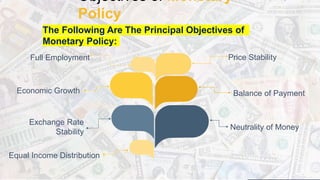
Price Stability
Exchange Rate
Stability
Balance of Payment
Full Employment
Economic Growth
Neutrality of Money
Objectives of Monetary
Policy
The Following Are The Principal Objectives of
Monetary Policy:
Equal Income Distribution
Full Employment
• Full Employment has been ranked among the foremost
objectives of monetary policy.
• It is an important goal not only because unemployment leads
to wastage of potential output, but also because of the loss of
social standing and self-respect.
Price Stability
• One of the policy objectives of monetary policy is to stabilize
the price level.
• Both economics and favor this policy because fluctuations in
price bring uncertainty and instability to the economy.
Economic Growth
• One of the most important objectives of monetary policy in
recent years has been the rapid economic growth of an
economy.
• Economic growth is defined as “the process where by the
real per capita income of a country increases over a long
period of time.”
Balance of Payment
Another objective of monetary policy since the 1950s has
been to maintain equilibrium in the balance of payments.
Exchange Rate Stability
• Exchange rate is the price of a home currency expressed in terms of any
foreign currency.
• If the exchange rate is very volatile leading to frequent ups and downs in the
exchange rate, the international community might lose confidence in our
economy.
• The monetary policy aims at maintaining the relative stability in the
exchange rate.
Neutrality of Money
• Economist such as Wicksted, Robertson has always considered money as a
passive factor.
• According to them, money should play only a role of medium of exchange
and not more than that.
• Therefore, the monetary policy should regulate the supply of
money.
Equal Income Distribution
Many economists used to justify the role of the fiscal policy is maintaining
economic equality. However in recent years economists have given the opinion
that the monetary policy can help and play a supplementary role in attaining an
economic equality.
Types of Monetary Policy?
Monetary policy design
changes as per the goals set
for the monetary policy and
theemerging economic
scenario.
1. Expansionary Monetary
Policy
2. Contractionary Monetary
Policy
3. Countercyclical Monetary
Policy
4. Rule Based Monetary Policy
5. Discretionary Monetary
Policy
15
Expansionary Monetary Policy
Many economists used to justify the role of the fiscal policy is
maintaining economic equality. However in recent years
economists have given the opinion that the monetary policy
can help and play a supplementary role in attaining an
economic equality.
Contractionary Monetary Policy
• Contractionary or tight monetary policy aims at preventing
inflation by contracting the money supply.
• Contraction in money supply is achieved by increasing the
policy rates, increasing the reserve requirements and
purchasing the government securities from the market.
Countercyclical Monetary Policy
Countercyclical policy aims at moderating the cyclical fluctuations in
the economy and stabilizing the economy around its trend path by
following countercyclical measures.
Rule Based Monetary Policy
• Under rule-based policy money supply and related
variables are controlled by predetermined rules, norms and
standards.
• The central bank authorities cannot use their discretion to
change the values of these variables.
Discretionary Monetary Policy
Discretionary Monetary Policy allows the central bank greater
autonomy in the conduct of monetary policy.
Under such a policy rather than getting constrained by the pre-set rule,
the central banks, after assessing the emerging economic scenario
and using its own judgment, can change the values of money supply
and the related variables.
TOOLS OF MONETRY POLICY
22
• O p e n M a r k e t O p e r a t i o n s
• B a n k R a t e
• C a s h R e s e r ve R e q u i r e m e n t
• L i q u i d i t y R a t i o
• S p e c i a l D e p o s i t
Quantitative
Tools
• C r e d i t
R a t i o n i n g
• C r e d i t C e i l i n g
• M o r a l
P e r s u a s i o n
• D i r e c t Ac t i o n
• Ad v e r t i s e m e n t
Qualitative Tools
• Control Inflation or Deflation
• Availability of the Supply of
money and Credit
• Integrated Interest Rate
Structure
• Effective Central Banking
• Long-Term Loans for
Industrial Development
• Creation of Financial
Institutions
SIGNIFICANCE OF MONETARY
POLICY
24
THANK YOU

Monetary Policy

  • 1.
  • 2.
  • 4.
    Monetary policy refersto the actions undertaken by a nation's central bank to control money supply and achieve sustainable economic growth. Definition
  • 6.
    6 Price Stability Exchange Rate Stability Balanceof Payment Full Employment Economic Growth Neutrality of Money Objectives of Monetary Policy The Following Are The Principal Objectives of Monetary Policy: Equal Income Distribution
  • 7.
    Full Employment • FullEmployment has been ranked among the foremost objectives of monetary policy. • It is an important goal not only because unemployment leads to wastage of potential output, but also because of the loss of social standing and self-respect.
  • 8.
    Price Stability • Oneof the policy objectives of monetary policy is to stabilize the price level. • Both economics and favor this policy because fluctuations in price bring uncertainty and instability to the economy.
  • 9.
    Economic Growth • Oneof the most important objectives of monetary policy in recent years has been the rapid economic growth of an economy. • Economic growth is defined as “the process where by the real per capita income of a country increases over a long period of time.”
  • 10.
    Balance of Payment Anotherobjective of monetary policy since the 1950s has been to maintain equilibrium in the balance of payments.
  • 11.
    Exchange Rate Stability •Exchange rate is the price of a home currency expressed in terms of any foreign currency. • If the exchange rate is very volatile leading to frequent ups and downs in the exchange rate, the international community might lose confidence in our economy. • The monetary policy aims at maintaining the relative stability in the exchange rate.
  • 12.
    Neutrality of Money •Economist such as Wicksted, Robertson has always considered money as a passive factor. • According to them, money should play only a role of medium of exchange and not more than that. • Therefore, the monetary policy should regulate the supply of money.
  • 13.
    Equal Income Distribution Manyeconomists used to justify the role of the fiscal policy is maintaining economic equality. However in recent years economists have given the opinion that the monetary policy can help and play a supplementary role in attaining an economic equality.
  • 15.
    Types of MonetaryPolicy? Monetary policy design changes as per the goals set for the monetary policy and theemerging economic scenario. 1. Expansionary Monetary Policy 2. Contractionary Monetary Policy 3. Countercyclical Monetary Policy 4. Rule Based Monetary Policy 5. Discretionary Monetary Policy 15
  • 16.
    Expansionary Monetary Policy Manyeconomists used to justify the role of the fiscal policy is maintaining economic equality. However in recent years economists have given the opinion that the monetary policy can help and play a supplementary role in attaining an economic equality.
  • 17.
    Contractionary Monetary Policy •Contractionary or tight monetary policy aims at preventing inflation by contracting the money supply. • Contraction in money supply is achieved by increasing the policy rates, increasing the reserve requirements and purchasing the government securities from the market.
  • 18.
    Countercyclical Monetary Policy Countercyclicalpolicy aims at moderating the cyclical fluctuations in the economy and stabilizing the economy around its trend path by following countercyclical measures.
  • 19.
    Rule Based MonetaryPolicy • Under rule-based policy money supply and related variables are controlled by predetermined rules, norms and standards. • The central bank authorities cannot use their discretion to change the values of these variables.
  • 20.
    Discretionary Monetary Policy DiscretionaryMonetary Policy allows the central bank greater autonomy in the conduct of monetary policy. Under such a policy rather than getting constrained by the pre-set rule, the central banks, after assessing the emerging economic scenario and using its own judgment, can change the values of money supply and the related variables.
  • 22.
    TOOLS OF MONETRYPOLICY 22 • O p e n M a r k e t O p e r a t i o n s • B a n k R a t e • C a s h R e s e r ve R e q u i r e m e n t • L i q u i d i t y R a t i o • S p e c i a l D e p o s i t Quantitative Tools • C r e d i t R a t i o n i n g • C r e d i t C e i l i n g • M o r a l P e r s u a s i o n • D i r e c t Ac t i o n • Ad v e r t i s e m e n t Qualitative Tools
  • 24.
    • Control Inflationor Deflation • Availability of the Supply of money and Credit • Integrated Interest Rate Structure • Effective Central Banking • Long-Term Loans for Industrial Development • Creation of Financial Institutions SIGNIFICANCE OF MONETARY POLICY 24
  • 25.

Editor's Notes

  • #4 Monetary policy refers to the actions undertaken by a nation's central bank to control money supply and achieve sustainable economic growth
  • #16 1 aims at encouraging spending on goods and services by expanding the supply of credit and money by lowering the policy rates (bank rate or repo rate), lowering the reserve requirements and purchasing the government securities from the market. 2 aims at preventing inflation by contracting the money supply. 3 aims at moderating the cyclical fluctuations in the economy and stabilizing the economy around its trend path by following countercyclical measures. 4 Under rule based policy money supply and related variables are controlled by predetermined rules, norms and standards. 5 Discretionary Monetary Policy allows the central bank greater autonomy in the conduct of monetary policy.