RESEARCH & RESEARCH METHODOLOGY
by
Dr. Mohmed Amin Mir
Assistant Professor
PG Department of Commerce
Islamia College of Science & Commerce (Autonomous with CPE Status)
Srinagar - 190002, Jammu & Kashmir, India
+91-9797178402
Email: aamin.icsc@gmail.com
@ Copy Rights Reserved with the Author
In common man’s language research refers to ‘search
for Knowledge’
Always begins with a question/ problem
Its purpose is to find answers to questions through
the application of systematic & scientific methods
Meticulous & methodical investigation into a specific
area
Systematic inquiry of facts which have already been
established
Research is the basis for innovation, R & D
CONCEPT OF RESEARCH
Art of scientific & purposeful investigation
Process of collecting relevant information
Searching for truth/ new knowledge about any topic
Investigation using systematic and scientific method
Movement from known to unknown
RESEARCH IS WIDE ENOUGH TO INCLUDE
Process of exploring answers to questions/problems
Systematic efforts to gain new knowledge
Careful consideration of study regarding a particular
issue/concern/problem using scientific method
Systematic inquiry/effort to describe, explain, predict
& control the observed phenomenon
RESEARCH IS WIDE ENOUGH TO INCLUDE
Pursuit of truth with the help of:
Investigation
Survey
Experimentation
Comparison/ case study
Observation etc.
Find out solution to problems through application of
knowledge
Research involves both inductive & deductive methods
RESEARCH IS WIDE ENOUGH TO INCLUDE
Investigation using systematic & scientific procedures by
searching again & again to find out the truth
‘Systematic effort to gain new knowledge’. REDMAN & MORY
‘Comprises of:
Defining & redefining problems
Formulating hypothesis or suggested solutions
Making deductions & reaching conclusions &
At last carefully testing the conclusions to determine
whether they are fit for formulating hypothesis’. CLIFFORD
WOODY
EXAMPLE: ‘Effect of childhood marriage on the health of women’.
RESEARCH IS WIDE ENOUGH TO INCLUDE
Research needs:
1. Identifying & defining a problem
2. Formulating a hypothesis
3. Developing a research design
4. Collection of data on relevant variables
5. Analyzing & interpreting the results
6. Reaching conclusions
7. Research report
It is conducted to serve diverse range of purposes:
Enhancing knowledge of the researcher (helps in enhancing & developing
analytical thinking ability)
Developing theories & finding out solutions to problems
Revising facts
RESEARCH IS WIDE ENOUGH TO INCLUDE
If an organization is incurring losses, it may be because of several factors:
Reduction in demand
Inefficient employees
Lack of co-ordination among different departments
Absence of effective management
Sub-standard Quality of products
Ineffective marketing strategies
Selection of wrong market etc.
Since the organizations cannot focus on all these areas, therefore, it needs to
find out the REAL CAUSE OF LOSSES.
In such situations, org needs to conduct research to find out ROOT CASUE of
the problem
For Examples
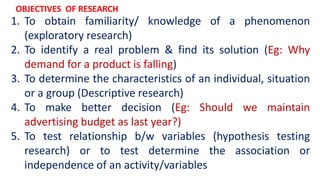
1. To obtain familiarity/ knowledge of a phenomenon
(exploratory research)
2. To identify a real problem & find its solution (Eg: Why
demand for a product is falling)
3. To determine the characteristics of an individual, situation
or a group (Descriptive research)
4. To make better decision (Eg: Should we maintain
advertising budget as last year?)
5. To test relationship b/w variables (hypothesis testing
research) or to test determine the association or
independence of an activity/variables
OBJECTIVES OF RESEARCH
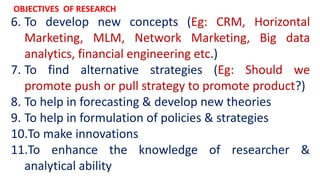
6. To develop new concepts (Eg: CRM, Horizontal
Marketing, MLM, Network Marketing, Big data
analytics, financial engineering etc.)
7. To find alternative strategies (Eg: Should we
promote push or pull strategy to promote product?)
8. To help in forecasting & develop new theories
9. To help in formulation of policies & strategies
10.To make innovations
11.To enhance the knowledge of researcher &
analytical ability
OBJECTIVES OF RESEARCH
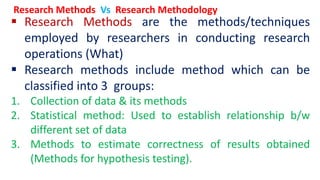
 Research Methods are the methods/techniques
employed by researchers in conducting research
operations (What)
 Research methods include method which can be
classified into 3 groups:
1. Collection of data & its methods
2. Statistical method: Used to establish relationship b/w
different set of data
3. Methods to estimate correctness of results obtained
(Methods for hypothesis testing).
Research Methods Vs Research Methodology
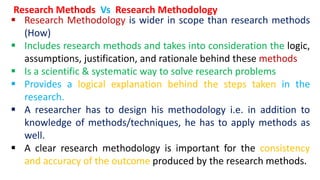
 Research Methodology is wider in scope than research methods
(How)
 Includes research methods and takes into consideration the logic,
assumptions, justification, and rationale behind these methods
 Is a scientific & systematic way to solve research problems
 Provides a logical explanation behind the steps taken in the
research.
 A researcher has to design his methodology i.e. in addition to
knowledge of methods/techniques, he has to apply methods as
well.
 A clear research methodology is important for the consistency
and accuracy of the outcome produced by the research methods.
Research Methods Vs Research Methodology
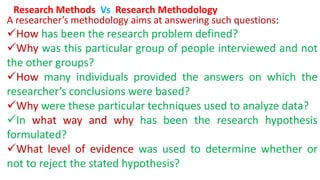
A researcher’s methodology aims at answering such questions:
How has been the research problem defined?
Why was this particular group of people interviewed and not
the other groups?
How many individuals provided the answers on which the
researcher’s conclusions were based?
Why were these particular techniques used to analyze data?
In what way and why has been the research hypothesis
formulated?
What level of evidence was used to determine whether or
not to reject the stated hypothesis?
Research Methods Vs Research Methodology
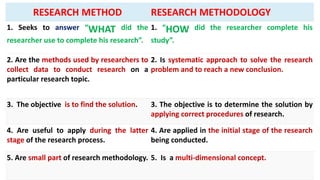
RESEARCH METHOD RESEARCH METHODOLOGY
1. Seeks to answer “WHAT did the
researcher use to complete his research”.
1. “HOW did the researcher complete his
study”.
2. Are the methods used by researchers to
collect data to conduct research on a
particular research topic.
2. Is systematic approach to solve the research
problem and to reach a new conclusion.
3. The objective is to find the solution. 3. The objective is to determine the solution by
applying correct procedures of research.
4. Are useful to apply during the latter
stage of the research process.
4. Are applied in the initial stage of the research
being conducted.
5. Are small part of research methodology. 5. Is a multi-dimensional concept.
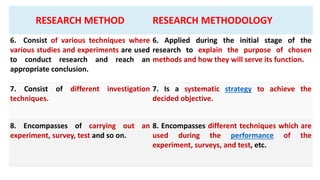
RESEARCH METHOD RESEARCH METHODOLOGY
6. Consist of various techniques where
various studies and experiments are used
to conduct research and reach an
appropriate conclusion.
6. Applied during the initial stage of the
research to explain the purpose of chosen
methods and how they will serve its function.
7. Consist of different investigation
techniques.
7. Is a systematic strategy to achieve the
decided objective.
8. Encompasses of carrying out an
experiment, survey, test and so on.
8. Encompasses different techniques which are
used during the performance of the
experiment, surveys, and test, etc.
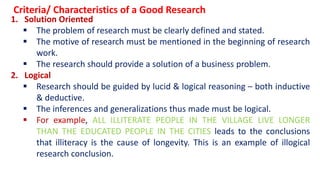
1. Solution Oriented
 The problem of research must be clearly defined and stated.
 The motive of research must be mentioned in the beginning of research
work.
 The research should provide a solution of a business problem.
2. Logical
 Research should be guided by lucid & logical reasoning – both inductive
& deductive.
 The inferences and generalizations thus made must be logical.
 For example, ALL ILLITERATE PEOPLE IN THE VILLAGE LIVE LONGER
THAN THE EDUCATED PEOPLE IN THE CITIES leads to the conclusions
that illiteracy is the cause of longevity. This is an example of illogical
research conclusion.
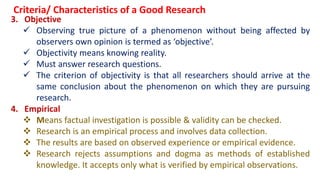
Criteria/ Characteristics of a Good Research
3. Objective
 Observing true picture of a phenomenon without being affected by
observers own opinion is termed as ‘objective’.
 Objectivity means knowing reality.
 Must answer research questions.
 The criterion of objectivity is that all researchers should arrive at the
same conclusion about the phenomenon on which they are pursuing
research.
4. Empirical
 Means factual investigation is possible & validity can be checked.
 Research is an empirical process and involves data collection.
 The results are based on observed experience or empirical evidence.
 Research rejects assumptions and dogma as methods of established
knowledge. It accepts only what is verified by empirical observations.
Criteria/ Characteristics of a Good Research
5. Replicable & Verifiable
 Research conducted be repeated by any number of time.
 Researcher can verify the results by repeating the study & thereby
delivering a sound decision making framework.
 A researcher should be able to get approximately the same results by using
an identical methodology by conducting investigation on a population
characteristics identical to the one in the earlier study. The results of a
research are subjective to verifications.
 For building a sound basis for decision making one verifies the research
results by replicating the study.
6. Impartiality & Free from Personal Bias: A dishonest research may select
data items of individuals to draw conclusions to his favour. This brings bias
into research, which affects the objective of the study.
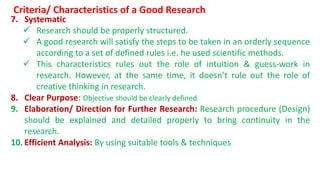
Criteria/ Characteristics of a Good Research
7. Systematic
 Research should be properly structured.
 A good research will satisfy the steps to be taken in an orderly sequence
according to a set of defined rules i.e. he used scientific methods.
 This characteristics rules out the role of intuition & guess-work in
research. However, at the same time, it doesn’t rule out the role of
creative thinking in research.
8. Clear Purpose: Objective should be clearly defined
9. Elaboration/ Direction for Further Research: Research procedure (Design)
should be explained and detailed properly to bring continuity in the
research.
10. Efficient Analysis: By using suitable tools & techniques
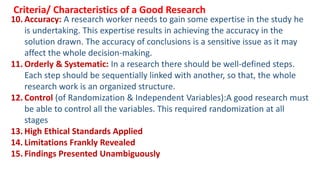
Criteria/ Characteristics of a Good Research
10. Accuracy: A research worker needs to gain some expertise in the study he
is undertaking. This expertise results in achieving the accuracy in the
solution drawn. The accuracy of conclusions is a sensitive issue as it may
affect the whole decision-making.
11. Orderly & Systematic: In a research there should be well-defined steps.
Each step should be sequentially linked with another, so that, the whole
research work is an organized structure.
12. Control (of Randomization & Independent Variables):A good research must
be able to control all the variables. This required randomization at all
stages
13. High Ethical Standards Applied
14. Limitations Frankly Revealed
15. Findings Presented Unambiguously
Criteria/ Characteristics of a Good Research

RESEARCH METHODOLOGY - INTRODUCTION

  • 1.
    RESEARCH & RESEARCHMETHODOLOGY by Dr. Mohmed Amin Mir Assistant Professor PG Department of Commerce Islamia College of Science & Commerce (Autonomous with CPE Status) Srinagar - 190002, Jammu & Kashmir, India +91-9797178402 Email: aamin.icsc@gmail.com @ Copy Rights Reserved with the Author
  • 2.
    In common man’slanguage research refers to ‘search for Knowledge’ Always begins with a question/ problem Its purpose is to find answers to questions through the application of systematic & scientific methods Meticulous & methodical investigation into a specific area Systematic inquiry of facts which have already been established Research is the basis for innovation, R & D CONCEPT OF RESEARCH
  • 3.
    Art of scientific& purposeful investigation Process of collecting relevant information Searching for truth/ new knowledge about any topic Investigation using systematic and scientific method Movement from known to unknown RESEARCH IS WIDE ENOUGH TO INCLUDE
  • 4.
    Process of exploringanswers to questions/problems Systematic efforts to gain new knowledge Careful consideration of study regarding a particular issue/concern/problem using scientific method Systematic inquiry/effort to describe, explain, predict & control the observed phenomenon RESEARCH IS WIDE ENOUGH TO INCLUDE
  • 5.
    Pursuit of truthwith the help of: Investigation Survey Experimentation Comparison/ case study Observation etc. Find out solution to problems through application of knowledge Research involves both inductive & deductive methods RESEARCH IS WIDE ENOUGH TO INCLUDE
  • 6.
    Investigation using systematic& scientific procedures by searching again & again to find out the truth ‘Systematic effort to gain new knowledge’. REDMAN & MORY ‘Comprises of: Defining & redefining problems Formulating hypothesis or suggested solutions Making deductions & reaching conclusions & At last carefully testing the conclusions to determine whether they are fit for formulating hypothesis’. CLIFFORD WOODY EXAMPLE: ‘Effect of childhood marriage on the health of women’. RESEARCH IS WIDE ENOUGH TO INCLUDE
  • 7.
    Research needs: 1. Identifying& defining a problem 2. Formulating a hypothesis 3. Developing a research design 4. Collection of data on relevant variables 5. Analyzing & interpreting the results 6. Reaching conclusions 7. Research report It is conducted to serve diverse range of purposes: Enhancing knowledge of the researcher (helps in enhancing & developing analytical thinking ability) Developing theories & finding out solutions to problems Revising facts RESEARCH IS WIDE ENOUGH TO INCLUDE
  • 8.
    If an organizationis incurring losses, it may be because of several factors: Reduction in demand Inefficient employees Lack of co-ordination among different departments Absence of effective management Sub-standard Quality of products Ineffective marketing strategies Selection of wrong market etc. Since the organizations cannot focus on all these areas, therefore, it needs to find out the REAL CAUSE OF LOSSES. In such situations, org needs to conduct research to find out ROOT CASUE of the problem For Examples
  • 9.
    1. To obtainfamiliarity/ knowledge of a phenomenon (exploratory research) 2. To identify a real problem & find its solution (Eg: Why demand for a product is falling) 3. To determine the characteristics of an individual, situation or a group (Descriptive research) 4. To make better decision (Eg: Should we maintain advertising budget as last year?) 5. To test relationship b/w variables (hypothesis testing research) or to test determine the association or independence of an activity/variables OBJECTIVES OF RESEARCH
  • 10.
    6. To developnew concepts (Eg: CRM, Horizontal Marketing, MLM, Network Marketing, Big data analytics, financial engineering etc.) 7. To find alternative strategies (Eg: Should we promote push or pull strategy to promote product?) 8. To help in forecasting & develop new theories 9. To help in formulation of policies & strategies 10.To make innovations 11.To enhance the knowledge of researcher & analytical ability OBJECTIVES OF RESEARCH
  • 11.
     Research Methodsare the methods/techniques employed by researchers in conducting research operations (What)  Research methods include method which can be classified into 3 groups: 1. Collection of data & its methods 2. Statistical method: Used to establish relationship b/w different set of data 3. Methods to estimate correctness of results obtained (Methods for hypothesis testing). Research Methods Vs Research Methodology
  • 12.
     Research Methodologyis wider in scope than research methods (How)  Includes research methods and takes into consideration the logic, assumptions, justification, and rationale behind these methods  Is a scientific & systematic way to solve research problems  Provides a logical explanation behind the steps taken in the research.  A researcher has to design his methodology i.e. in addition to knowledge of methods/techniques, he has to apply methods as well.  A clear research methodology is important for the consistency and accuracy of the outcome produced by the research methods. Research Methods Vs Research Methodology
  • 13.
    A researcher’s methodologyaims at answering such questions: How has been the research problem defined? Why was this particular group of people interviewed and not the other groups? How many individuals provided the answers on which the researcher’s conclusions were based? Why were these particular techniques used to analyze data? In what way and why has been the research hypothesis formulated? What level of evidence was used to determine whether or not to reject the stated hypothesis? Research Methods Vs Research Methodology
  • 14.
    RESEARCH METHOD RESEARCHMETHODOLOGY 1. Seeks to answer “WHAT did the researcher use to complete his research”. 1. “HOW did the researcher complete his study”. 2. Are the methods used by researchers to collect data to conduct research on a particular research topic. 2. Is systematic approach to solve the research problem and to reach a new conclusion. 3. The objective is to find the solution. 3. The objective is to determine the solution by applying correct procedures of research. 4. Are useful to apply during the latter stage of the research process. 4. Are applied in the initial stage of the research being conducted. 5. Are small part of research methodology. 5. Is a multi-dimensional concept.
  • 15.
    RESEARCH METHOD RESEARCHMETHODOLOGY 6. Consist of various techniques where various studies and experiments are used to conduct research and reach an appropriate conclusion. 6. Applied during the initial stage of the research to explain the purpose of chosen methods and how they will serve its function. 7. Consist of different investigation techniques. 7. Is a systematic strategy to achieve the decided objective. 8. Encompasses of carrying out an experiment, survey, test and so on. 8. Encompasses different techniques which are used during the performance of the experiment, surveys, and test, etc.
  • 16.
    1. Solution Oriented The problem of research must be clearly defined and stated.  The motive of research must be mentioned in the beginning of research work.  The research should provide a solution of a business problem. 2. Logical  Research should be guided by lucid & logical reasoning – both inductive & deductive.  The inferences and generalizations thus made must be logical.  For example, ALL ILLITERATE PEOPLE IN THE VILLAGE LIVE LONGER THAN THE EDUCATED PEOPLE IN THE CITIES leads to the conclusions that illiteracy is the cause of longevity. This is an example of illogical research conclusion. Criteria/ Characteristics of a Good Research
  • 17.
    3. Objective  Observingtrue picture of a phenomenon without being affected by observers own opinion is termed as ‘objective’.  Objectivity means knowing reality.  Must answer research questions.  The criterion of objectivity is that all researchers should arrive at the same conclusion about the phenomenon on which they are pursuing research. 4. Empirical  Means factual investigation is possible & validity can be checked.  Research is an empirical process and involves data collection.  The results are based on observed experience or empirical evidence.  Research rejects assumptions and dogma as methods of established knowledge. It accepts only what is verified by empirical observations. Criteria/ Characteristics of a Good Research
  • 18.
    5. Replicable &Verifiable  Research conducted be repeated by any number of time.  Researcher can verify the results by repeating the study & thereby delivering a sound decision making framework.  A researcher should be able to get approximately the same results by using an identical methodology by conducting investigation on a population characteristics identical to the one in the earlier study. The results of a research are subjective to verifications.  For building a sound basis for decision making one verifies the research results by replicating the study. 6. Impartiality & Free from Personal Bias: A dishonest research may select data items of individuals to draw conclusions to his favour. This brings bias into research, which affects the objective of the study. Criteria/ Characteristics of a Good Research
  • 19.
    7. Systematic  Researchshould be properly structured.  A good research will satisfy the steps to be taken in an orderly sequence according to a set of defined rules i.e. he used scientific methods.  This characteristics rules out the role of intuition & guess-work in research. However, at the same time, it doesn’t rule out the role of creative thinking in research. 8. Clear Purpose: Objective should be clearly defined 9. Elaboration/ Direction for Further Research: Research procedure (Design) should be explained and detailed properly to bring continuity in the research. 10. Efficient Analysis: By using suitable tools & techniques Criteria/ Characteristics of a Good Research
  • 20.
    10. Accuracy: Aresearch worker needs to gain some expertise in the study he is undertaking. This expertise results in achieving the accuracy in the solution drawn. The accuracy of conclusions is a sensitive issue as it may affect the whole decision-making. 11. Orderly & Systematic: In a research there should be well-defined steps. Each step should be sequentially linked with another, so that, the whole research work is an organized structure. 12. Control (of Randomization & Independent Variables):A good research must be able to control all the variables. This required randomization at all stages 13. High Ethical Standards Applied 14. Limitations Frankly Revealed 15. Findings Presented Unambiguously Criteria/ Characteristics of a Good Research