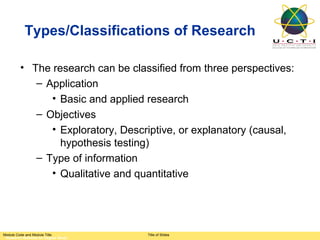
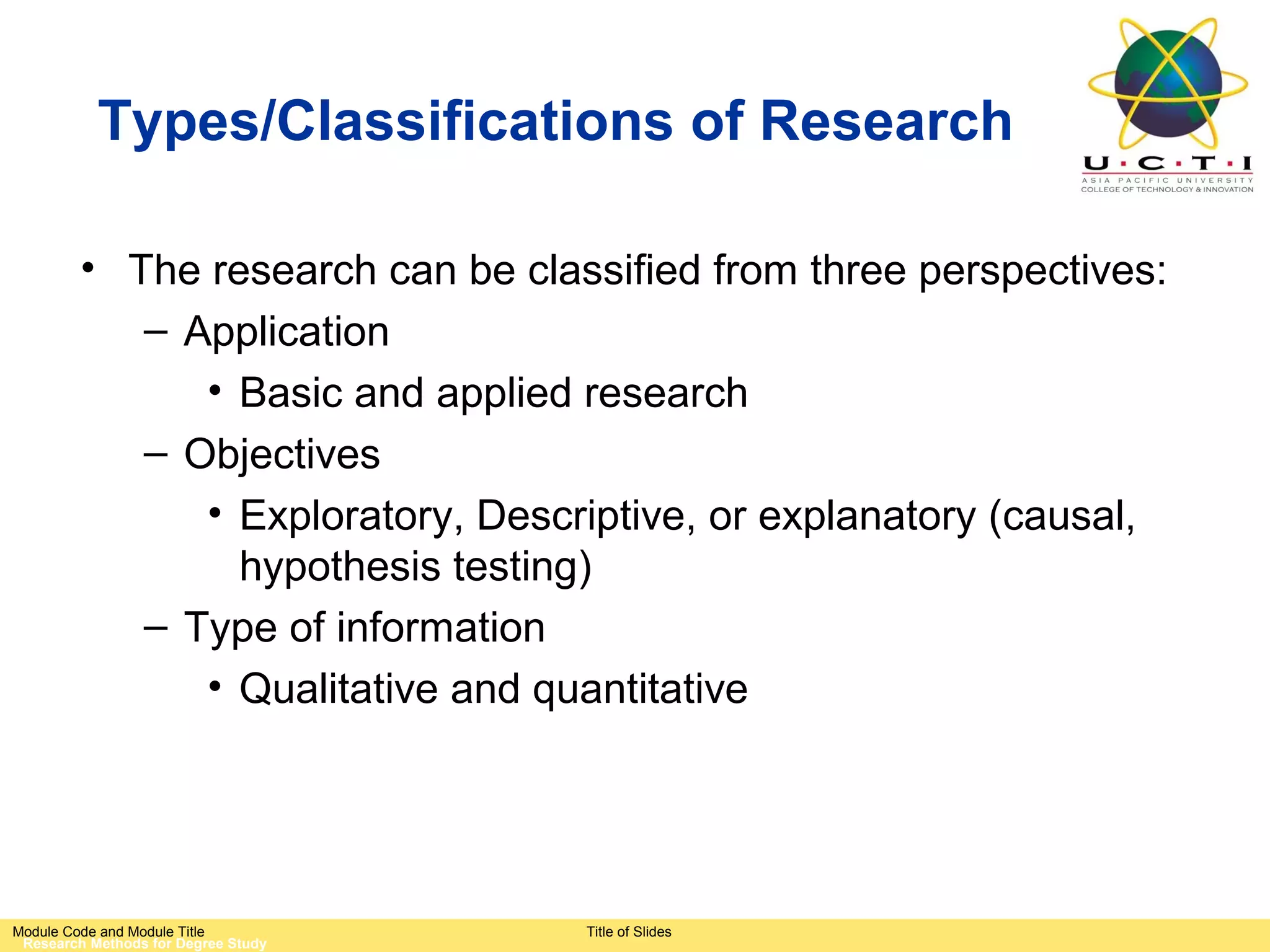



Types/Classifications of Research

         • The research can be classified from three perspectives:
            – Application
               • Basic and applied research
            – Objectives
               • Exploratory, Descriptive, or explanatory (causal,
                 hypothesis testing)
            – Type of information
               • Qualitative and quantitative


Module Code and Module Title         Title of Slides
 Research Methods for Degree Study
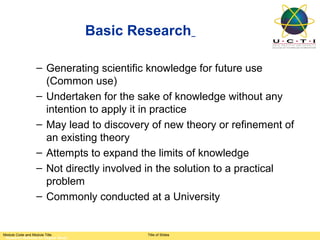
Basic Research

                 – Generating scientific knowledge for future use
                   (Common use)
                 – Undertaken for the sake of knowledge without any
                   intention to apply it in practice
                 – May lead to discovery of new theory or refinement of
                   an existing theory
                 – Attempts to expand the limits of knowledge
                 – Not directly involved in the solution to a practical
                   problem
                 – Commonly conducted at a University


Module Code and Module Title                 Title of Slides
 Research Methods for Degree Study
Applied Research

                 – Carried on to find solution to a real life problem and
                   action oriented
                 – Seeks an immediate and practical results
                 – May indirectly contribute to the development of
                   theoretical knowledge by leading to a discovery of
                   new facts or testing of a theory or to conceptual clarity
                 – Conducted when a decision must be made about a
                   specific real-life problem


Module Code and Module Title                  Title of Slides
 Research Methods for Degree Study
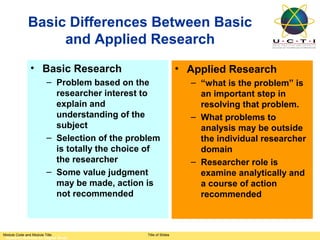
Basic Differences Between Basic
                  and Applied Research
              • Basic Research                                 • Applied Research
                      – Problem based on the                     – “what is the problem” is
                        researcher interest to                     an important step in
                        explain and                                resolving that problem.
                        understanding of the                     – What problems to
                        subject                                    analysis may be outside
                      – Selection of the problem                   the individual researcher
                        is totally the choice of                   domain
                        the researcher                           – Researcher role is
                      – Some value judgment                        examine analytically and
                        may be made, action is                     a course of action
                        not recommended                            recommended


Module Code and Module Title                 Title of Slides
 Research Methods for Degree Study
Exploratory Studies

         •     To clarify ambiguous problems
         •     To get better understanding of an issue
         •     To provide information for further analysis
         •     To identify information/data required
         •     As a preliminary research
         •     To exhaust inexpensive & time saving
               resources

Module Code and Module Title                   Title of Slides
 Research Methods for Degree Study
Descriptive Studies

         • To describe a characteristic of a
           population or phenomenon
         • Seeks answers to who, what, when, where
           and how questions
         • To gather accurate info
         • It is based on previous understanding of
           the problem


Module Code and Module Title                   Title of Slides
 Research Methods for Degree Study
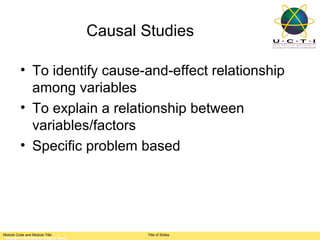
Causal Studies

         • To identify cause-and-effect relationship
           among variables
         • To explain a relationship between
           variables/factors
         • Specific problem based


Module Code and Module Title                Title of Slides
 Research Methods for Degree Study
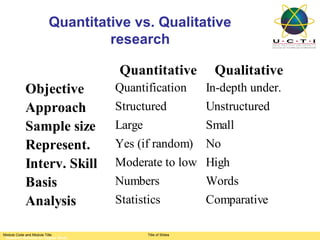
Quantitative vs. Qualitative
                                 research

                                     Quantitative            Qualitative
           Objective                 Quantification         In-depth under.
           Approach                  Structured             Unstructured
           Sample size               Large                  Small
           Represent.                Yes (if random)        No
           Interv. Skill             Moderate to low        High
           Basis                     Numbers                Words
           Analysis                  Statistics             Comparative

Module Code and Module Title              Title of Slides
 Research Methods for Degree Study
BM 040
Research                                                   Chapter 6
Methodology
                                          Research Ethnics


Benjamin Chan
Bsc. Human Development (UPM)
Msc. Human Development (UPM)
PhD Candidate (UM)

                                     1      2              3    4    5    6        7
 Benjamin.chan@ucti.edu.my           8      9              10   11   12   13       14

                                                                               9
                                                9
Module Code and Module Title             Title of Slides
 Research Methods for Degree Study
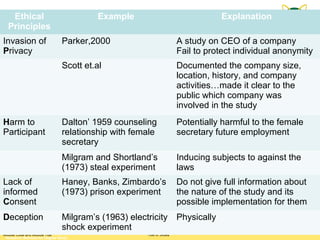
Ethical                               Example                                    Explanation
  Principles
Invasion of                    Parker,2000                             A study on CEO of a company
Privacy                                                                Fail to protect individual anonymity
                               Scott et.al                             Documented the company size,
                                                                       location, history, and company
                                                                       activities…made it clear to the
                                                                       public which company was
                                                                       involved in the study
Harm to                        Dalton’ 1959 counseling                 Potentially harmful to the female
Participant                    relationship with female                secretary future employment
                               secretary
                               Milgram and Shortland’s                 Inducing subjects to against the
                               (1973) steal experiment                 laws
Lack of                        Haney, Banks, Zimbardo’s                Do not give full information about
informed                       (1973) prison experiment                the nature of the study and its
Consent                                                                possible implementation for them
Deception                      Milgram’s (1963) electricity            Physically
                               shock experiment
Module Code and Module Title                         Title of Slides
 Research Methods for Degree Study
BM 040
Research                                                   Chapter 7
Methodology
                                     Measurement and Scaling
                                     Concepts, Questionnaire
                                             Design
Benjamin Chan
Bsc. Human Development (UPM)
Msc. Human Development (UPM)
PhD Candidate (UM)

                                     1      2              3    4    5    6         7
 Benjamin.chan@ucti.edu.my           8      9              10   11   12   13        14

                                                                               11
                                               11
Module Code and Module Title             Title of Slides
 Research Methods for Degree Study
Module Code and Module Title         Title of Slides
 Research Methods for Degree Study
Module Code and Module Title         Title of Slides
 Research Methods for Degree Study
BM 040
Research                                                   Chapter 8
Methodology
                                                           Sampling


Benjamin Chan
Bsc. Human Development (UPM)
Msc. Human Development (UPM)
PhD Candidate (UM)

                                     1      2              3    4    5    6         7
 Benjamin.chan@ucti.edu.my           8      9              10   11   12   13        14

                                                                               14
                                               14
Module Code and Module Title             Title of Slides
 Research Methods for Degree Study
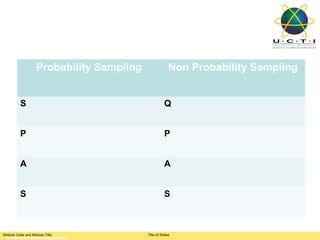
Probability Sampling                 Non Probability Sampling


         S                                         Q


         P                                         P


         A                                         A


         S                                         S


Module Code and Module Title            Title of Slides
 Research Methods for Degree Study
Qualitative Analysis
           The process of interpreting data collected during
            the course of qualitative research
           The analysis of data depends on its type.


Module Code and Module Title                 Title of Slides
 Research Methods for Degree Study
Quantitative Analysis

        The process of presenting and
         interpreting numeric data collected
         during the course of quantitative
         research
        Often contain descriptive statistic
         and inferential statistic.


Module Code and Module Title                 Title of Slides
 Research Methods for Degree Study
Qualitative vs. Quantitative Analysis
            An intelligent way of differentiating Qualitative
            research from Quantitative research is: that largely

            1.Qualitative research is exploratory, while
            Quantitative research is descriptive, predictive and
            conclusive.

            2.Quantitative data is measurable while Qualitative
            data can not be put into a context that can be
            graphed or displayed as a mathematical term.


Module Code and Module Title                Title of Slides
 Research Methods for Degree Study
What factors determine the most appropriate
  statistical techniques?
       Research objectives / questions / purpose of
        your study
       Measurement scales you used in your research
        instrument
       Research design of your studies.
       Nature of your data –meeting normally and / or
        equality of variance assumptions for parametric
        tests.
Module Code and Module Title         Title of Slides
 Research Methods for Degree Study
MSA-UCSI
BM 040
Research
Methodology
   08.10.2011
                                            Chapter 15

                                         Introduction to
Benjamin Chan
                                             Harvard
Y.F
Benjamin Y.F. Chan
Bsc. (UPM) (Human Development)
 B.S.       (Human Development)
      Human Development
                                           Referencing
 M.S. (UPM)
(UPM)
 PhD Candidate (UPM) (Institute of
 Gerontology)
Msc. Human Development
(UPM)
 Room No : A 2- 6
PhD Candidate (UM)
 Department of Resource MGM & Consumer
 Studies
 Faculty of Human Ecology
 University Putra Malaysia
Benjamin.chan@ucti.edu.m
 Tel : 603 8946 7097
                   y
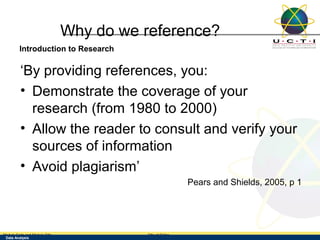
Why do we reference?
        Introduction to Research

         ‘By providing references, you:
         • Demonstrate the coverage of your
           research (from 1980 to 2000)
         • Allow the reader to consult and verify your
           sources of information
         • Avoid plagiarism’
                                                          Pears and Shields, 2005, p 1


Module Code and Module Title            Title of Slides
 Data Analysis
 Research Methods for Degree Study
Why do we reference?
        Introduction to Research


       1. To avoid plagiarism
       2. To show you have read a piece of work
          and understood it
       3. To show courtesy to the original author
       4. To track your reading / note-taking
       5. To back up an argument

         http://library.apiit.edu.my/harvard-referencing
Module Code and Module Title                 Title of Slides
 Data Analysis
 Research Methods for Degree Study
Revision for Chi-square Analysis

• A chi-square test of independence was conducted to
  assess whether the grade received by students (A, B+,
  B, C and below) is related to their gender (male and
  female) or not. Data collected from a randomly selected
  sample. Interpret the results based on Table 1, Table 2
  and Table 3.
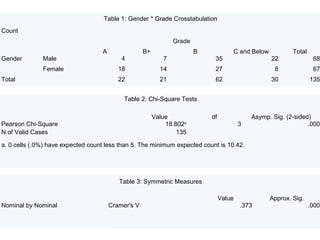
Table 1: Gender * Grade Crosstabulation
Count
                                                                Grade
                                   A                B+                  B            C and Below           Total
Gender        Male                         4                7                35                     22              68
              Female                      18               14                27                      8              67
Total                                     22               21                62                     30             135


                                            Table 2: Chi-Square Tests

                                                         Value              df               Asymp. Sig. (2-sided)
Pearson Chi-Square                                           18.802a                     3                       .000
N of Valid Cases                                                 135

a. 0 cells (.0%) have expected count less than 5. The minimum expected count is 10.42.


                                          Table 3: Symmetric Measures

                                                                                 Value             Approx. Sig.
Nominal by Nominal                     Cramer's V                                        .373                      .000
Answer
1. A chi-square test of independence was conducted to assess
   whether the grade received by students (A, B+, B, C and
   below) is related to their gender (male and female)
2. The finding of crosstabs analysis for grade and gender was
   found to be correlated or related [Pearson χ2 (3, N = 135) =
   18.802, p≤ 0.01]
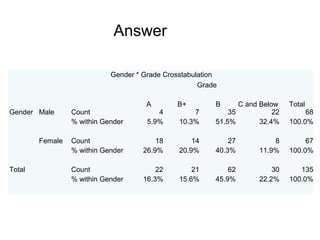
3. A close inspection of Table 1 for pattern of relationship
   reveals that the majority (83.9%) of the male students
   obtained grades between “B” to “C and below”, while the
   majority (88.1%) of female students obtained grade between
   A to B
4. This suggests that, in general, the female students
   performed better in the test compared to male
5. The Cramer’s V value obtained (V = 0.373) indicates that
   the strength or magnitude relationship between grade and
   gender is at moderate level
Answer

                            Gender * Grade Crosstabulation
                                                     Grade

                                      A       B+         B      C and Below    Total
Gender Male      Count                   4         7         35           22        68
                 % within Gender      5.9%     10.3%     51.5%        32.4%    100.0%

        Female   Count                   18        14        27           8         67
                 % within Gender     26.9%     20.9%     40.3%        11.9%    100.0%

Total            Count                   22        21        62           30      135
                 % within Gender     16.3%     15.6%     45.9%        22.2%    100.0%

Research method final

  • 1.
    Types/Classifications of Research • The research can be classified from three perspectives: – Application • Basic and applied research – Objectives • Exploratory, Descriptive, or explanatory (causal, hypothesis testing) – Type of information • Qualitative and quantitative Module Code and Module Title Title of Slides Research Methods for Degree Study
  • 2.
    Basic Research – Generating scientific knowledge for future use (Common use) – Undertaken for the sake of knowledge without any intention to apply it in practice – May lead to discovery of new theory or refinement of an existing theory – Attempts to expand the limits of knowledge – Not directly involved in the solution to a practical problem – Commonly conducted at a University Module Code and Module Title Title of Slides Research Methods for Degree Study
  • 3.
    Applied Research – Carried on to find solution to a real life problem and action oriented – Seeks an immediate and practical results – May indirectly contribute to the development of theoretical knowledge by leading to a discovery of new facts or testing of a theory or to conceptual clarity – Conducted when a decision must be made about a specific real-life problem Module Code and Module Title Title of Slides Research Methods for Degree Study
  • 4.
    Basic Differences BetweenBasic and Applied Research • Basic Research • Applied Research – Problem based on the – “what is the problem” is researcher interest to an important step in explain and resolving that problem. understanding of the – What problems to subject analysis may be outside – Selection of the problem the individual researcher is totally the choice of domain the researcher – Researcher role is – Some value judgment examine analytically and may be made, action is a course of action not recommended recommended Module Code and Module Title Title of Slides Research Methods for Degree Study
  • 5.
    Exploratory Studies • To clarify ambiguous problems • To get better understanding of an issue • To provide information for further analysis • To identify information/data required • As a preliminary research • To exhaust inexpensive & time saving resources Module Code and Module Title Title of Slides Research Methods for Degree Study
  • 6.
    Descriptive Studies • To describe a characteristic of a population or phenomenon • Seeks answers to who, what, when, where and how questions • To gather accurate info • It is based on previous understanding of the problem Module Code and Module Title Title of Slides Research Methods for Degree Study
  • 7.
    Causal Studies • To identify cause-and-effect relationship among variables • To explain a relationship between variables/factors • Specific problem based Module Code and Module Title Title of Slides Research Methods for Degree Study
  • 8.
    Quantitative vs. Qualitative research Quantitative Qualitative Objective Quantification In-depth under. Approach Structured Unstructured Sample size Large Small Represent. Yes (if random) No Interv. Skill Moderate to low High Basis Numbers Words Analysis Statistics Comparative Module Code and Module Title Title of Slides Research Methods for Degree Study
  • 9.
    BM 040 Research Chapter 6 Methodology Research Ethnics Benjamin Chan Bsc. Human Development (UPM) Msc. Human Development (UPM) PhD Candidate (UM) 1 2 3 4 5 6 7 Benjamin.chan@ucti.edu.my 8 9 10 11 12 13 14 9 9 Module Code and Module Title Title of Slides Research Methods for Degree Study
  • 10.
    Ethical Example Explanation Principles Invasion of Parker,2000 A study on CEO of a company Privacy Fail to protect individual anonymity Scott et.al Documented the company size, location, history, and company activities…made it clear to the public which company was involved in the study Harm to Dalton’ 1959 counseling Potentially harmful to the female Participant relationship with female secretary future employment secretary Milgram and Shortland’s Inducing subjects to against the (1973) steal experiment laws Lack of Haney, Banks, Zimbardo’s Do not give full information about informed (1973) prison experiment the nature of the study and its Consent possible implementation for them Deception Milgram’s (1963) electricity Physically shock experiment Module Code and Module Title Title of Slides Research Methods for Degree Study
  • 11.
    BM 040 Research Chapter 7 Methodology Measurement and Scaling Concepts, Questionnaire Design Benjamin Chan Bsc. Human Development (UPM) Msc. Human Development (UPM) PhD Candidate (UM) 1 2 3 4 5 6 7 Benjamin.chan@ucti.edu.my 8 9 10 11 12 13 14 11 11 Module Code and Module Title Title of Slides Research Methods for Degree Study
  • 12.
    Module Code andModule Title Title of Slides Research Methods for Degree Study
  • 13.
    Module Code andModule Title Title of Slides Research Methods for Degree Study
  • 14.
    BM 040 Research Chapter 8 Methodology Sampling Benjamin Chan Bsc. Human Development (UPM) Msc. Human Development (UPM) PhD Candidate (UM) 1 2 3 4 5 6 7 Benjamin.chan@ucti.edu.my 8 9 10 11 12 13 14 14 14 Module Code and Module Title Title of Slides Research Methods for Degree Study
  • 15.
    Probability Sampling Non Probability Sampling S Q P P A A S S Module Code and Module Title Title of Slides Research Methods for Degree Study
  • 16.
    Qualitative Analysis  The process of interpreting data collected during the course of qualitative research  The analysis of data depends on its type. Module Code and Module Title Title of Slides Research Methods for Degree Study
  • 17.
    Quantitative Analysis  The process of presenting and interpreting numeric data collected during the course of quantitative research  Often contain descriptive statistic and inferential statistic. Module Code and Module Title Title of Slides Research Methods for Degree Study
  • 18.
    Qualitative vs. QuantitativeAnalysis An intelligent way of differentiating Qualitative research from Quantitative research is: that largely 1.Qualitative research is exploratory, while Quantitative research is descriptive, predictive and conclusive. 2.Quantitative data is measurable while Qualitative data can not be put into a context that can be graphed or displayed as a mathematical term. Module Code and Module Title Title of Slides Research Methods for Degree Study
  • 19.
    What factors determinethe most appropriate statistical techniques? Research objectives / questions / purpose of your study Measurement scales you used in your research instrument Research design of your studies. Nature of your data –meeting normally and / or equality of variance assumptions for parametric tests. Module Code and Module Title Title of Slides Research Methods for Degree Study
  • 20.
    MSA-UCSI BM 040 Research Methodology 08.10.2011 Chapter 15 Introduction to Benjamin Chan Harvard Y.F Benjamin Y.F. Chan Bsc. (UPM) (Human Development) B.S. (Human Development) Human Development Referencing M.S. (UPM) (UPM) PhD Candidate (UPM) (Institute of Gerontology) Msc. Human Development (UPM) Room No : A 2- 6 PhD Candidate (UM) Department of Resource MGM & Consumer Studies Faculty of Human Ecology University Putra Malaysia Benjamin.chan@ucti.edu.m Tel : 603 8946 7097 y
  • 21.
    Why do wereference? Introduction to Research ‘By providing references, you: • Demonstrate the coverage of your research (from 1980 to 2000) • Allow the reader to consult and verify your sources of information • Avoid plagiarism’ Pears and Shields, 2005, p 1 Module Code and Module Title Title of Slides Data Analysis Research Methods for Degree Study
  • 22.
    Why do wereference? Introduction to Research 1. To avoid plagiarism 2. To show you have read a piece of work and understood it 3. To show courtesy to the original author 4. To track your reading / note-taking 5. To back up an argument http://library.apiit.edu.my/harvard-referencing Module Code and Module Title Title of Slides Data Analysis Research Methods for Degree Study
  • 23.
    Revision for Chi-squareAnalysis • A chi-square test of independence was conducted to assess whether the grade received by students (A, B+, B, C and below) is related to their gender (male and female) or not. Data collected from a randomly selected sample. Interpret the results based on Table 1, Table 2 and Table 3.
  • 24.
    Table 1: Gender* Grade Crosstabulation Count Grade A B+ B C and Below Total Gender Male 4 7 35 22 68 Female 18 14 27 8 67 Total 22 21 62 30 135 Table 2: Chi-Square Tests Value df Asymp. Sig. (2-sided) Pearson Chi-Square 18.802a 3 .000 N of Valid Cases 135 a. 0 cells (.0%) have expected count less than 5. The minimum expected count is 10.42. Table 3: Symmetric Measures Value Approx. Sig. Nominal by Nominal Cramer's V .373 .000
  • 25.
    Answer 1. A chi-squaretest of independence was conducted to assess whether the grade received by students (A, B+, B, C and below) is related to their gender (male and female) 2. The finding of crosstabs analysis for grade and gender was found to be correlated or related [Pearson χ2 (3, N = 135) = 18.802, p≤ 0.01] 3. A close inspection of Table 1 for pattern of relationship reveals that the majority (83.9%) of the male students obtained grades between “B” to “C and below”, while the majority (88.1%) of female students obtained grade between A to B 4. This suggests that, in general, the female students performed better in the test compared to male 5. The Cramer’s V value obtained (V = 0.373) indicates that the strength or magnitude relationship between grade and gender is at moderate level
  • 26.
    Answer Gender * Grade Crosstabulation Grade A B+ B C and Below Total Gender Male Count 4 7 35 22 68 % within Gender 5.9% 10.3% 51.5% 32.4% 100.0% Female Count 18 14 27 8 67 % within Gender 26.9% 20.9% 40.3% 11.9% 100.0% Total Count 22 21 62 30 135 % within Gender 16.3% 15.6% 45.9% 22.2% 100.0%