DEFINITION OF RESEARCH
“Research is a process of steps used
to collect and analyze information
to increase our understanding of ato increase our understanding of a
topic (or) issue”
- Creswell
TEN ASPECTS OF EDUCATIONAL
RESEARCH BY GRAY ANDERSON
1. To solve a problem.
2. Gathering new data from primary (or)
using existing data for new purpose.
3. Based upon observable experience.3. Based upon observable experience.
4. Demands accurate observation and
description.
5. Employs carefully designed procedures
and rigorous analysis.
TEN ASPECTS OF EDUCATIONAL
RESEARCH BY GRAY ANDERSON
6. Emphasizes the development of generalization,
principles and theories that will help in
understanding ,prediction and control.
7. Requires expertise.
8. Attempts to find an objective, unbiased solution for
the problem.
9. Deliberate and unhurried activity which is
directional but often refines the problem.
10. Carefully recorded and reported to other persons
interested in the problem.
BASIC RESEARCH
 Another names pure research, fundamental research
and discovery research.
 It is executed without thought of a practical end goal.
 It focuses on search for truth or the development of
educational theories.educational theories.
 Researchers with this back ground usually perform
this research as part of their graduate or doctoral
work.
 It arises out of curiosity. It lays down as foundation for
advancement in knowledge that lead to applied gains
later on.
APPLIED RESEARCH
 It is a form of systematic inquiry involving the
practical application of science.
 It deals with solving practical problems and generally
employs empirical methodologies.employs empirical methodologies.
 Applied research is done in messy real world hence
research protocols may need to be relaxed.
 The goal is to determine the applicability of
educational theory and principles by testing with
specific hypothesis.
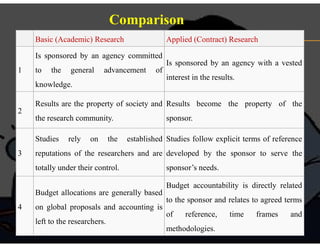
Comparison
Basic (Academic) Research Applied (Contract) Research
1
Is sponsored by an agency committed
to the general advancement of
knowledge.
Is sponsored by an agency with a vested
interest in the results.
2
Results are the property of society and
the research community.
Results become the property of the
sponsor.
3
Studies rely on the established
reputations of the researchers and are
totally under their control.
Studies follow explicit terms of reference
developed by the sponsor to serve the
sponsor’s needs.
4
Budget allocations are generally based
on global proposals and accounting is
left to the researchers.
Budget accountability is directly related
to the sponsor and relates to agreed terms
of reference, time frames and
methodologies.
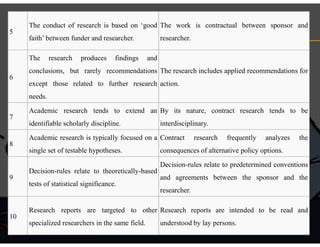
5
The conduct of research is based on ‘good
faith’ between funder and researcher.
The work is contractual between sponsor and
researcher.
6
The research produces findings and
conclusions, but rarely recommendations
except those related to further research
needs.
The research includes applied recommendations for
action.
7
Academic research tends to extend an
identifiable scholarly discipline.
By its nature, contract research tends to be
interdisciplinary.identifiable scholarly discipline. interdisciplinary.
8
Academic research is typically focused on a
single set of testable hypotheses.
Contract research frequently analyzes the
consequences of alternative policy options.
9
Decision-rules relate to theoretically-based
tests of statistical significance.
Decision-rules relate to predetermined conventions
and agreements between the sponsor and the
researcher.
10
Research reports are targeted to other
specialized researchers in the same field.
Research reports are intended to be read and
understood by lay persons.
UTHANK
NSS Training college
Ottapalam.
Asst Professor
Dr K S Sajan

Basic research ppt

  • 2.
    DEFINITION OF RESEARCH “Researchis a process of steps used to collect and analyze information to increase our understanding of ato increase our understanding of a topic (or) issue” - Creswell
  • 3.
    TEN ASPECTS OFEDUCATIONAL RESEARCH BY GRAY ANDERSON 1. To solve a problem. 2. Gathering new data from primary (or) using existing data for new purpose. 3. Based upon observable experience.3. Based upon observable experience. 4. Demands accurate observation and description. 5. Employs carefully designed procedures and rigorous analysis.
  • 4.
    TEN ASPECTS OFEDUCATIONAL RESEARCH BY GRAY ANDERSON 6. Emphasizes the development of generalization, principles and theories that will help in understanding ,prediction and control. 7. Requires expertise. 8. Attempts to find an objective, unbiased solution for the problem. 9. Deliberate and unhurried activity which is directional but often refines the problem. 10. Carefully recorded and reported to other persons interested in the problem.
  • 5.
    BASIC RESEARCH  Anothernames pure research, fundamental research and discovery research.  It is executed without thought of a practical end goal.  It focuses on search for truth or the development of educational theories.educational theories.  Researchers with this back ground usually perform this research as part of their graduate or doctoral work.  It arises out of curiosity. It lays down as foundation for advancement in knowledge that lead to applied gains later on.
  • 6.
    APPLIED RESEARCH  Itis a form of systematic inquiry involving the practical application of science.  It deals with solving practical problems and generally employs empirical methodologies.employs empirical methodologies.  Applied research is done in messy real world hence research protocols may need to be relaxed.  The goal is to determine the applicability of educational theory and principles by testing with specific hypothesis.
  • 7.
    Comparison Basic (Academic) ResearchApplied (Contract) Research 1 Is sponsored by an agency committed to the general advancement of knowledge. Is sponsored by an agency with a vested interest in the results. 2 Results are the property of society and the research community. Results become the property of the sponsor. 3 Studies rely on the established reputations of the researchers and are totally under their control. Studies follow explicit terms of reference developed by the sponsor to serve the sponsor’s needs. 4 Budget allocations are generally based on global proposals and accounting is left to the researchers. Budget accountability is directly related to the sponsor and relates to agreed terms of reference, time frames and methodologies.
  • 8.
    5 The conduct ofresearch is based on ‘good faith’ between funder and researcher. The work is contractual between sponsor and researcher. 6 The research produces findings and conclusions, but rarely recommendations except those related to further research needs. The research includes applied recommendations for action. 7 Academic research tends to extend an identifiable scholarly discipline. By its nature, contract research tends to be interdisciplinary.identifiable scholarly discipline. interdisciplinary. 8 Academic research is typically focused on a single set of testable hypotheses. Contract research frequently analyzes the consequences of alternative policy options. 9 Decision-rules relate to theoretically-based tests of statistical significance. Decision-rules relate to predetermined conventions and agreements between the sponsor and the researcher. 10 Research reports are targeted to other specialized researchers in the same field. Research reports are intended to be read and understood by lay persons.
  • 9.