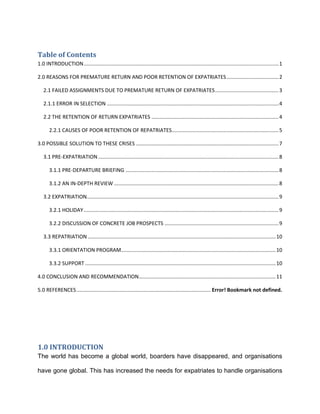
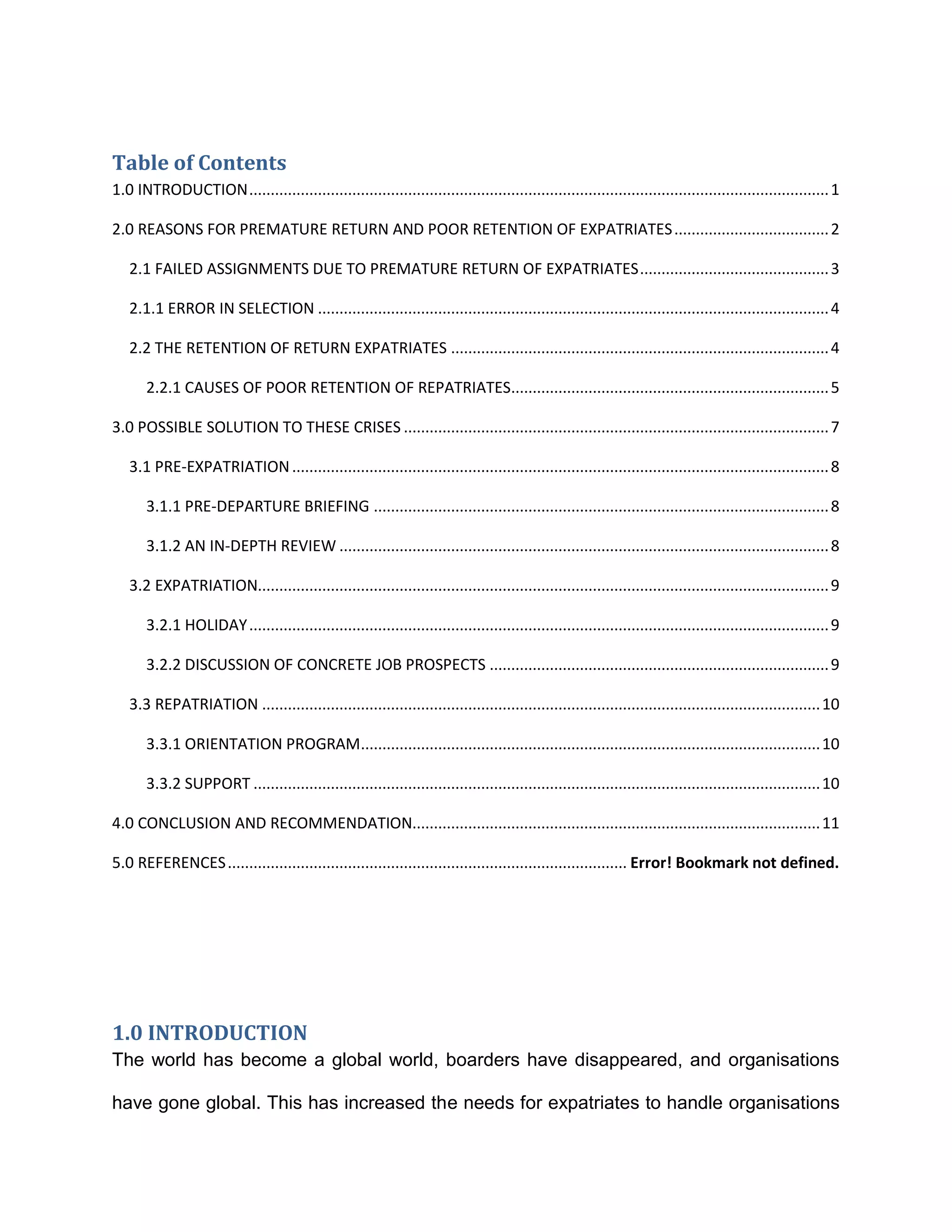
Table of Contents
1.0 INTRODUCTION ....................................................................................................................................... 1

2.0 REASONS FOR PREMATURE RETURN AND POOR RETENTION OF EXPATRIATES .................................... 2

   2.1 FAILED ASSIGNMENTS DUE TO PREMATURE RETURN OF EXPATRIATES ............................................ 3

   2.1.1 ERROR IN SELECTION ....................................................................................................................... 4

   2.2 THE RETENTION OF RETURN EXPATRIATES ........................................................................................ 4

       2.2.1 CAUSES OF POOR RETENTION OF REPATRIATES.......................................................................... 5

3.0 POSSIBLE SOLUTION TO THESE CRISES ................................................................................................... 7

   3.1 PRE-EXPATRIATION ............................................................................................................................. 8

       3.1.1 PRE-DEPARTURE BRIEFING .......................................................................................................... 8

       3.1.2 AN IN-DEPTH REVIEW .................................................................................................................. 8

   3.2 EXPATRIATION..................................................................................................................................... 9

       3.2.1 HOLIDAY ....................................................................................................................................... 9

       3.2.2 DISCUSSION OF CONCRETE JOB PROSPECTS ............................................................................... 9

   3.3 REPATRIATION .................................................................................................................................. 10

       3.3.1 ORIENTATION PROGRAM........................................................................................................... 10

       3.3.2 SUPPORT .................................................................................................................................... 10

4.0 CONCLUSION AND RECOMMENDATION............................................................................................... 11

5.0 REFERENCES ............................................................................................. Error! Bookmark not defined.


1.0 INTRODUCTION
The world has become a global world, boarders have disappeared, and organisations

have gone global. This has increased the needs for expatriates to handle organisations
international assignments abroad which require expert hands (Downes and Thomas,

1999). Expatriates are used by Multi-national corporations (MNCs) in order to get expert

hands into the new market the companies are penetrating or to give training to their

staffs in the new market. Moreover, some of the MNCs prefer their expertises to handle

their managerial positions, in order for them to remain competitive in the market due to

their experts’ competencies in the field (Forster, 2000).


However, Hiltrop (1999) revealed that Human Resource Management (HRM) crises

tend to be compound complex when it comes to the international realm. The study

further established that MNCs success or failure in the international business can be

determined by the management of their international human resources. For MNCs,

inability to communicate, control and organise their activities in the international

business environment can lead the companies into a more complex crisis. Some of the

major crises that are facing MNCs consist of: premature return of expatriates due to

failure in their assignments and the poor retention of returnee expatriates due to poor

repatriation.


2.0 REASONS FOR PREMATURE RETURN AND POOR RETENTION OF
EXPATRIATES
MNCs have been having one problem or the other regarding their international

assignments. Some of the major problems are premature return and poor retention of

expatriates. This report will examine the causes for premature and poor retention of

expatriates and suggest possible solutions to these problems.
2.1 FAILED ASSIGNMENTS DUE TO PREMATURE
RETURN OF EXPATRIATES
In international human resource, failed assignments due to premature return of

expatriates are famous among the MNCs (Riusala, 2000). This issue has become an

international crisis, and a number of studies have recognized the causes of this failure.

In case of premature return of expatriates, Riusala (2000) identified that the causes

could be as a result lack of cross-cultural adjustment by the expatriates, their spouse or

family. Another study by Grant and Heijltjes (2000) added that this problem can result

from poor performance of the expatriates. Furthermore, in a study by Black and

Gregersen (1997), the study established that 10% to 20% of Americans expatriates

overseas come back prematurely as a result of lack of pleasure from their jobs which

arise due to cultural differences. Moreso, the study further stated that one-third of the

expatriates that stayed for longer period did not carry out the job satisfactorily as to the

expectations of their companies.


However, when an international assignment is yet to be completed, MNCs have an

obligatory duty to resend another batch of expatriates to finish the assignment (Pucik

and Saba, 1998), this process required both direct and indirect costs which is at the

expense of the MNCs. The following are some of the costs involved in the process of

resending another batch of expatriates to finish the assignment:


DIRECT COSTS

These include costs such as salary, training costs, travel, and relocation expenses.

These costs are incurred directly by the MNC that sent them for the assignment. All

these costs are at the expense of the MNC and since the assignment is not complete,
this is a loss to the company. The company need to incur another cost to make sure the

assignment is done. The company have to rearrange, reselect and resend another

batch of expatriates to complete the assignment.


INDIRECT COSTS

These are costs that are not in monetary form. It includes cost such as loss of market

share, having problem with the host country and demands by the host country that their

nationals should replace parent country nationals (Forster, 2000). Though, these costs

might sound irrelevant but the impact affects the overall profitability performance of the

MNC.


2.1.1 ERROR IN SELECTION
Another major cause of expatriates’ failure is due to selection problem (Harvey and

Noviceivic, 2001). Traditionally, expatriates are been select based on their technical

expertise, whereas other imperative interpersonal factors of the expatriates are been

neglected (Suutari and Brewster, 1998).


For example, according to Clarke and Hammer (1995) stated that interpersonal

competence support in the cultural adaptation of the expatriates and their family also

make them to feel at home which need to be given consideration.


2.2 THE RETENTION OF RETURN EXPATRIATES
Another crises faced by MNCs is their inability to retain expatriates upon their arrival to

their home country (Downes and Thomas, 1999). A number of researches have shown

that 25% of expatriates who complete their foreign assignments prefer to depart their
company upon their return (Solomon, 1998; Hammer et al, 1998). Meanwhile, studies

have shown that it cost more than $1.2 million in losing one repatriate employee

(Forster, 2000). However, MNCs that are investing in international career development

policies for the benefit of their expatriates are more likely to have lower rates of

repatriate turnover compared to MNCs without such policies.

Repatriation programs assist in the development of company’s policy and job

description for repatriates together with financial and career development and family

orientation are programs that can assist as part of the overall process of career

development and international human resource management (Hauser, 1999).            This

problem needs to be resolved in order to guide against disenchantment and high

repatriates turnover (Haines and Saba, 1999).


2.2.1 CAUSES OF POOR RETENTION OF REPATRIATES

REVERSE CULTURE SHOCK

For a number of years in the host country, most of the expatriates experience what one

repatriate called a “Transforming procedure” as reported by Jan Nelson (employee

benefit News, November, 2005). At first, when expatriates are deployed to different

countries, they absorb different cultures that are different from their home country

culture. They learn these cultures and abide by it to enjoy their stay abroad. Some of

them even forget their own culture to enjoy their stay while abroad. However, this has a

great effect on them when they get back to their home country. To the extent that some

of the repatriates cannot cover the cultural differences between them and the people

they share similar culture with back home.
MISLEADING MEMORIES

Another problem why most repatriates find it difficult to stay with their companies is the

issue of memories misleading. While on the assignment abroad, most of the expatriates

miss their home, so much so that, with time their memory develops its natural banal

certainty. Homesick expatriates have in their mind everything concerning the general

environment and the tradition of their home country, not can be equate to what is in their

minds (Andreason and Kinneer, 2004). When they get back home, the pleasant

traditions and sharp memories quickly surrender to the natural facts. The certainty they

have come across is not equivalent to the traditions their mind has experienced. When

their Ideology is defeated by certainty, expatriates can feel miserable and diminished.


CHANGE HAPPENS

Changes are about to happened. People change, so does the society. This is one of the

factors that affect repatriates to stay at the home country office. Since they left for

foreign land a lot of changes have occurred and this might be totally different from how

they left the company. It is not just the new buildings around the offices, newly

constructed roads, the new machines the company just acquired. It is about the people.

The office will be totally strange to the repatriates. Some of their old friends are no

longer working with the same company and the company has replaced them with new

staffs. The repatriates will find the office uncomfortable as the new faces in the office

are strange, so they will prefer to leave for another company than to stay with the formal

employer.
UNWELCOME LIFESTYLE CHANGES

In reality, changing one lifestyle may be necessitated by current situation.           Most

expatriates while on foreign assignment with their family were able to live in a semi-

luxury apartment that they cannot afford in their home country. For instance, a repatriate

after seven years of staying abroad, returned back to the United States and make a

confession that, the most difficult thing for her to adjust to after her resettlement back in

the US was the lack of house help. The lifestyle most of the expatriates enjoyed while

abroad is so enormous and they find it difficult to adjust to their normal life when they

return. Their employers are not ready to pay them that kind of money for them to be

able to continue with the luxurious lifestyle


LONELINESS

Finally, even when expatriates decide to stay with their employers when they return

from foreign assignment, they complain about loneliness. This affects their performance

because the motivation is more over there. So they prefer to leave the company for a

new company that perhaps they can start afresh making new friends and get

acclimatize.


3.0 POSSIBLE SOLUTION TO THESE CRISES
Goes the popular saying that for every problem there must be a solution, using critical

thinking to find solution to the entire problems, one can see that the causes of the

problems are straightforward and there solution must be straightforward. MNCs need to

close the gap between probability and certainty.        Expatriates are considered to be
successful when they return back to their home country, they gain access to a job which

identifies all the recent gained international skills, experiences minimal cross-culture

readjustment difficulties and reports low turnover intentions (Sullivan, 2002). Whereas

MNCs can achieve expatriate that are willing to finish foreign assignments and at same

time prefer to stay after they return from oversea assignment, only if MNCs can

implement just a little plan for the expatriates.

The suggested solutions to the above crises are categories into three stages, which are

pre-expatriation, Expatriation and the Repatriation.


3.1 PRE-EXPATRIATION
3.1.1 PRE-DEPARTURE BRIEFING

MNCs should organize talk and meeting with all the expatriates before they depart for

the assignment. The company should allow the expatriate to bring their family that is

accompanying them on the trip. The meeting should focus more on the issues that are

relating to the expatriate experience while on assignment abroad. The issue of

expatriates returning home without completing the assignment should be seriously

focused on. This talk and meeting will prepare them (expatriates) ahead those

challenges and while they occur the expatriate will know how to handle it.


3.1.2 AN IN-DEPTH REVIEW

A comprehensive examination of the expatriate’s goals and responsibilities irrespective

of where they are deployed to should include establishing written procedures in which

expatriates performance and progress are monitored. Meanwhile, care must be taken
not to obstruct assessment functions of the host country office. However, host country

offices do not always have people suitable to manage expatriates and give them job

descriptions and expectations. This guide is supposed to spell out how expatriates will

be evaluated based on their performance and this process will assist expatriates to

maintain cordial relationship and connect with their home country management,

because the evaluation will be sent back to their home country office.

This review will establish communication between expatriates and their home office

management, and the more the communication, the easier for the expatriates to return

to their home country and still mingle.


3.2 EXPATRIATION
This is the second stage plan to find solution to the crises between the MNCs and their

expatriates. Assuming that in the pre-expatriation stage, good plans have already been

laid down. While on the assignment, the activities will be carried out as planned.


3.2.1 HOLIDAY

It has been established that the more contact with home country the better and easier

for expatriate to perform as expected. Therefore, it will be a better idea to allow the

expatriates to visit their home country with their family often. This will make them to still

get use to their home country cultural traditions.


3.2.2 DISCUSSION OF CONCRETE JOB PROSPECTS

Shortly before the expatriates return back to their home country, MNCs should make

arrangement for relevant and a suitable job for the expatriates before they return where
their skills will be relevant. This will motivate them and they will like to continue working

with the company.


3.3 REPATRIATION
If the above two stages have been properly established, then there should be no

unpleasant experiences. However, companies must make preparation to welcome them

and re-orientate them. The following are some of the step to be taken that will make

them feel at home:


3.3.1 ORIENTATION PROGRAM

MNCs should make sure that shortly after the arrival of the expatriates; they should be

invited for orientation program together with their family. The program should include

talk on expatriate experience while abroad, their feeling as repatriate, they should be

given permission to share their experience, lecture should be given to them about how

to adapt back to their home country culture and they should be encouraged.


3.3.2 SUPPORT

One of the major complaints of the repatriates are issue concerning the talent and skill

they acquired while on the assignment abroad that is not put into use when they return.

MNCs should give them support to make sure that repatriate feel valued and

opportunities is given to them to discharge their talents and skills.
4.0 CONCLUSION AND RECOMMENDATION
MNCs can overcome these crises if proper planning is set to rectify these problems.

The solutions will save MNCs a lot costs both direct and indirect costs and their

expertises will return back to their company. Those problems occur because there is no

plan to tackle their existence.

This report will conclude that there is no problem without a solution and these problems

can be rectified with little effort planning. MNCs should start from selection of

employees that will go for foreign assignment, proper screening should be carried out to

ensure that not only technical competence is considered, other factors such as year of

experience, how long has the employee stayed offshore before, can the employee

adapt to other people’s culture and so on. These are some of the other factors to be put

into consideration during employee selection for foreign assignment.

Finally, if other suggested solutions can be adhered to there is possibility that these

crises will be totally overcome.

Ihrm assignment

  • 1.
    Table of Contents 1.0INTRODUCTION ....................................................................................................................................... 1 2.0 REASONS FOR PREMATURE RETURN AND POOR RETENTION OF EXPATRIATES .................................... 2 2.1 FAILED ASSIGNMENTS DUE TO PREMATURE RETURN OF EXPATRIATES ............................................ 3 2.1.1 ERROR IN SELECTION ....................................................................................................................... 4 2.2 THE RETENTION OF RETURN EXPATRIATES ........................................................................................ 4 2.2.1 CAUSES OF POOR RETENTION OF REPATRIATES.......................................................................... 5 3.0 POSSIBLE SOLUTION TO THESE CRISES ................................................................................................... 7 3.1 PRE-EXPATRIATION ............................................................................................................................. 8 3.1.1 PRE-DEPARTURE BRIEFING .......................................................................................................... 8 3.1.2 AN IN-DEPTH REVIEW .................................................................................................................. 8 3.2 EXPATRIATION..................................................................................................................................... 9 3.2.1 HOLIDAY ....................................................................................................................................... 9 3.2.2 DISCUSSION OF CONCRETE JOB PROSPECTS ............................................................................... 9 3.3 REPATRIATION .................................................................................................................................. 10 3.3.1 ORIENTATION PROGRAM........................................................................................................... 10 3.3.2 SUPPORT .................................................................................................................................... 10 4.0 CONCLUSION AND RECOMMENDATION............................................................................................... 11 5.0 REFERENCES ............................................................................................. Error! Bookmark not defined. 1.0 INTRODUCTION The world has become a global world, boarders have disappeared, and organisations have gone global. This has increased the needs for expatriates to handle organisations
  • 2.
    international assignments abroadwhich require expert hands (Downes and Thomas, 1999). Expatriates are used by Multi-national corporations (MNCs) in order to get expert hands into the new market the companies are penetrating or to give training to their staffs in the new market. Moreover, some of the MNCs prefer their expertises to handle their managerial positions, in order for them to remain competitive in the market due to their experts’ competencies in the field (Forster, 2000). However, Hiltrop (1999) revealed that Human Resource Management (HRM) crises tend to be compound complex when it comes to the international realm. The study further established that MNCs success or failure in the international business can be determined by the management of their international human resources. For MNCs, inability to communicate, control and organise their activities in the international business environment can lead the companies into a more complex crisis. Some of the major crises that are facing MNCs consist of: premature return of expatriates due to failure in their assignments and the poor retention of returnee expatriates due to poor repatriation. 2.0 REASONS FOR PREMATURE RETURN AND POOR RETENTION OF EXPATRIATES MNCs have been having one problem or the other regarding their international assignments. Some of the major problems are premature return and poor retention of expatriates. This report will examine the causes for premature and poor retention of expatriates and suggest possible solutions to these problems.
  • 3.
    2.1 FAILED ASSIGNMENTSDUE TO PREMATURE RETURN OF EXPATRIATES In international human resource, failed assignments due to premature return of expatriates are famous among the MNCs (Riusala, 2000). This issue has become an international crisis, and a number of studies have recognized the causes of this failure. In case of premature return of expatriates, Riusala (2000) identified that the causes could be as a result lack of cross-cultural adjustment by the expatriates, their spouse or family. Another study by Grant and Heijltjes (2000) added that this problem can result from poor performance of the expatriates. Furthermore, in a study by Black and Gregersen (1997), the study established that 10% to 20% of Americans expatriates overseas come back prematurely as a result of lack of pleasure from their jobs which arise due to cultural differences. Moreso, the study further stated that one-third of the expatriates that stayed for longer period did not carry out the job satisfactorily as to the expectations of their companies. However, when an international assignment is yet to be completed, MNCs have an obligatory duty to resend another batch of expatriates to finish the assignment (Pucik and Saba, 1998), this process required both direct and indirect costs which is at the expense of the MNCs. The following are some of the costs involved in the process of resending another batch of expatriates to finish the assignment: DIRECT COSTS These include costs such as salary, training costs, travel, and relocation expenses. These costs are incurred directly by the MNC that sent them for the assignment. All these costs are at the expense of the MNC and since the assignment is not complete,
  • 4.
    this is aloss to the company. The company need to incur another cost to make sure the assignment is done. The company have to rearrange, reselect and resend another batch of expatriates to complete the assignment. INDIRECT COSTS These are costs that are not in monetary form. It includes cost such as loss of market share, having problem with the host country and demands by the host country that their nationals should replace parent country nationals (Forster, 2000). Though, these costs might sound irrelevant but the impact affects the overall profitability performance of the MNC. 2.1.1 ERROR IN SELECTION Another major cause of expatriates’ failure is due to selection problem (Harvey and Noviceivic, 2001). Traditionally, expatriates are been select based on their technical expertise, whereas other imperative interpersonal factors of the expatriates are been neglected (Suutari and Brewster, 1998). For example, according to Clarke and Hammer (1995) stated that interpersonal competence support in the cultural adaptation of the expatriates and their family also make them to feel at home which need to be given consideration. 2.2 THE RETENTION OF RETURN EXPATRIATES Another crises faced by MNCs is their inability to retain expatriates upon their arrival to their home country (Downes and Thomas, 1999). A number of researches have shown that 25% of expatriates who complete their foreign assignments prefer to depart their
  • 5.
    company upon theirreturn (Solomon, 1998; Hammer et al, 1998). Meanwhile, studies have shown that it cost more than $1.2 million in losing one repatriate employee (Forster, 2000). However, MNCs that are investing in international career development policies for the benefit of their expatriates are more likely to have lower rates of repatriate turnover compared to MNCs without such policies. Repatriation programs assist in the development of company’s policy and job description for repatriates together with financial and career development and family orientation are programs that can assist as part of the overall process of career development and international human resource management (Hauser, 1999). This problem needs to be resolved in order to guide against disenchantment and high repatriates turnover (Haines and Saba, 1999). 2.2.1 CAUSES OF POOR RETENTION OF REPATRIATES REVERSE CULTURE SHOCK For a number of years in the host country, most of the expatriates experience what one repatriate called a “Transforming procedure” as reported by Jan Nelson (employee benefit News, November, 2005). At first, when expatriates are deployed to different countries, they absorb different cultures that are different from their home country culture. They learn these cultures and abide by it to enjoy their stay abroad. Some of them even forget their own culture to enjoy their stay while abroad. However, this has a great effect on them when they get back to their home country. To the extent that some of the repatriates cannot cover the cultural differences between them and the people they share similar culture with back home.
  • 6.
    MISLEADING MEMORIES Another problemwhy most repatriates find it difficult to stay with their companies is the issue of memories misleading. While on the assignment abroad, most of the expatriates miss their home, so much so that, with time their memory develops its natural banal certainty. Homesick expatriates have in their mind everything concerning the general environment and the tradition of their home country, not can be equate to what is in their minds (Andreason and Kinneer, 2004). When they get back home, the pleasant traditions and sharp memories quickly surrender to the natural facts. The certainty they have come across is not equivalent to the traditions their mind has experienced. When their Ideology is defeated by certainty, expatriates can feel miserable and diminished. CHANGE HAPPENS Changes are about to happened. People change, so does the society. This is one of the factors that affect repatriates to stay at the home country office. Since they left for foreign land a lot of changes have occurred and this might be totally different from how they left the company. It is not just the new buildings around the offices, newly constructed roads, the new machines the company just acquired. It is about the people. The office will be totally strange to the repatriates. Some of their old friends are no longer working with the same company and the company has replaced them with new staffs. The repatriates will find the office uncomfortable as the new faces in the office are strange, so they will prefer to leave for another company than to stay with the formal employer.
  • 7.
    UNWELCOME LIFESTYLE CHANGES Inreality, changing one lifestyle may be necessitated by current situation. Most expatriates while on foreign assignment with their family were able to live in a semi- luxury apartment that they cannot afford in their home country. For instance, a repatriate after seven years of staying abroad, returned back to the United States and make a confession that, the most difficult thing for her to adjust to after her resettlement back in the US was the lack of house help. The lifestyle most of the expatriates enjoyed while abroad is so enormous and they find it difficult to adjust to their normal life when they return. Their employers are not ready to pay them that kind of money for them to be able to continue with the luxurious lifestyle LONELINESS Finally, even when expatriates decide to stay with their employers when they return from foreign assignment, they complain about loneliness. This affects their performance because the motivation is more over there. So they prefer to leave the company for a new company that perhaps they can start afresh making new friends and get acclimatize. 3.0 POSSIBLE SOLUTION TO THESE CRISES Goes the popular saying that for every problem there must be a solution, using critical thinking to find solution to the entire problems, one can see that the causes of the problems are straightforward and there solution must be straightforward. MNCs need to close the gap between probability and certainty. Expatriates are considered to be
  • 8.
    successful when theyreturn back to their home country, they gain access to a job which identifies all the recent gained international skills, experiences minimal cross-culture readjustment difficulties and reports low turnover intentions (Sullivan, 2002). Whereas MNCs can achieve expatriate that are willing to finish foreign assignments and at same time prefer to stay after they return from oversea assignment, only if MNCs can implement just a little plan for the expatriates. The suggested solutions to the above crises are categories into three stages, which are pre-expatriation, Expatriation and the Repatriation. 3.1 PRE-EXPATRIATION 3.1.1 PRE-DEPARTURE BRIEFING MNCs should organize talk and meeting with all the expatriates before they depart for the assignment. The company should allow the expatriate to bring their family that is accompanying them on the trip. The meeting should focus more on the issues that are relating to the expatriate experience while on assignment abroad. The issue of expatriates returning home without completing the assignment should be seriously focused on. This talk and meeting will prepare them (expatriates) ahead those challenges and while they occur the expatriate will know how to handle it. 3.1.2 AN IN-DEPTH REVIEW A comprehensive examination of the expatriate’s goals and responsibilities irrespective of where they are deployed to should include establishing written procedures in which expatriates performance and progress are monitored. Meanwhile, care must be taken
  • 9.
    not to obstructassessment functions of the host country office. However, host country offices do not always have people suitable to manage expatriates and give them job descriptions and expectations. This guide is supposed to spell out how expatriates will be evaluated based on their performance and this process will assist expatriates to maintain cordial relationship and connect with their home country management, because the evaluation will be sent back to their home country office. This review will establish communication between expatriates and their home office management, and the more the communication, the easier for the expatriates to return to their home country and still mingle. 3.2 EXPATRIATION This is the second stage plan to find solution to the crises between the MNCs and their expatriates. Assuming that in the pre-expatriation stage, good plans have already been laid down. While on the assignment, the activities will be carried out as planned. 3.2.1 HOLIDAY It has been established that the more contact with home country the better and easier for expatriate to perform as expected. Therefore, it will be a better idea to allow the expatriates to visit their home country with their family often. This will make them to still get use to their home country cultural traditions. 3.2.2 DISCUSSION OF CONCRETE JOB PROSPECTS Shortly before the expatriates return back to their home country, MNCs should make arrangement for relevant and a suitable job for the expatriates before they return where
  • 10.
    their skills willbe relevant. This will motivate them and they will like to continue working with the company. 3.3 REPATRIATION If the above two stages have been properly established, then there should be no unpleasant experiences. However, companies must make preparation to welcome them and re-orientate them. The following are some of the step to be taken that will make them feel at home: 3.3.1 ORIENTATION PROGRAM MNCs should make sure that shortly after the arrival of the expatriates; they should be invited for orientation program together with their family. The program should include talk on expatriate experience while abroad, their feeling as repatriate, they should be given permission to share their experience, lecture should be given to them about how to adapt back to their home country culture and they should be encouraged. 3.3.2 SUPPORT One of the major complaints of the repatriates are issue concerning the talent and skill they acquired while on the assignment abroad that is not put into use when they return. MNCs should give them support to make sure that repatriate feel valued and opportunities is given to them to discharge their talents and skills.
  • 11.
    4.0 CONCLUSION ANDRECOMMENDATION MNCs can overcome these crises if proper planning is set to rectify these problems. The solutions will save MNCs a lot costs both direct and indirect costs and their expertises will return back to their company. Those problems occur because there is no plan to tackle their existence. This report will conclude that there is no problem without a solution and these problems can be rectified with little effort planning. MNCs should start from selection of employees that will go for foreign assignment, proper screening should be carried out to ensure that not only technical competence is considered, other factors such as year of experience, how long has the employee stayed offshore before, can the employee adapt to other people’s culture and so on. These are some of the other factors to be put into consideration during employee selection for foreign assignment. Finally, if other suggested solutions can be adhered to there is possibility that these crises will be totally overcome.