Research Hypothesis
------
What, Why, How?
By
Dr. Muhammad Ilyas Khan,
Department of Education,
Hazara University Mansehra
5/5/2021
Dr. Muhammad Ilyas Khan, Hazara University Mansehra, Email:
drmuhammadilyaskhan7@gmail.com
Research Hypothesis: What?
• Hypothesis: A tentative explanation, prediction or proposition
formulated for testing/exploring empirically.
• Research Hypotheses are generally based on assumed
relationships between variables in a research study.
• In other words, hypotheses state the assumed relationship
between independent and dependent variables before the
actual existence or otherwise of this relationship is empirically
established in a research study. Also called educated guess.
• Examples:
• Socio-economic status of students affects their self-esteem
• There is significant relationship between teachers’ teaching
style and students’ classroom participation.
5/5/2021
Dr. Muhammad Ilyas Khan, Hazara University Mansehra, Email:
drmuhammadilyaskhan7@gmail.com
Research Hypothesis: What?
• Hypotheses could be accepted or rejected once
empirical studies have been conducted.
• Acceptance or rejection of research hypotheses have
no bearing on the value of the research project.
• Good hypotheses should indicate relationship
between variables clearly.
• Good hypotheses should be presented in precise
language.
• Good hypotheses should be representative of the
research objectives.
• Should be testable empirically.
5/5/2021
Dr. Muhammad Ilyas Khan, Hazara University Mansehra, Email:
drmuhammadilyaskhan7@gmail.com
Research Hypothesis: Why?
• Gives direction and focus to the research process
• Generally, requires the researcher to do sufficient
reading and reflection around the topic before
formulating and refining hypotheses.
• Gives tentative answers to our research questions.
• Helps in giving direction to the process of data
collection, analysis and interpretation.
5/5/2021
Dr. Muhammad Ilyas Khan, Hazara University Mansehra, Email:
drmuhammadilyaskhan7@gmail.com
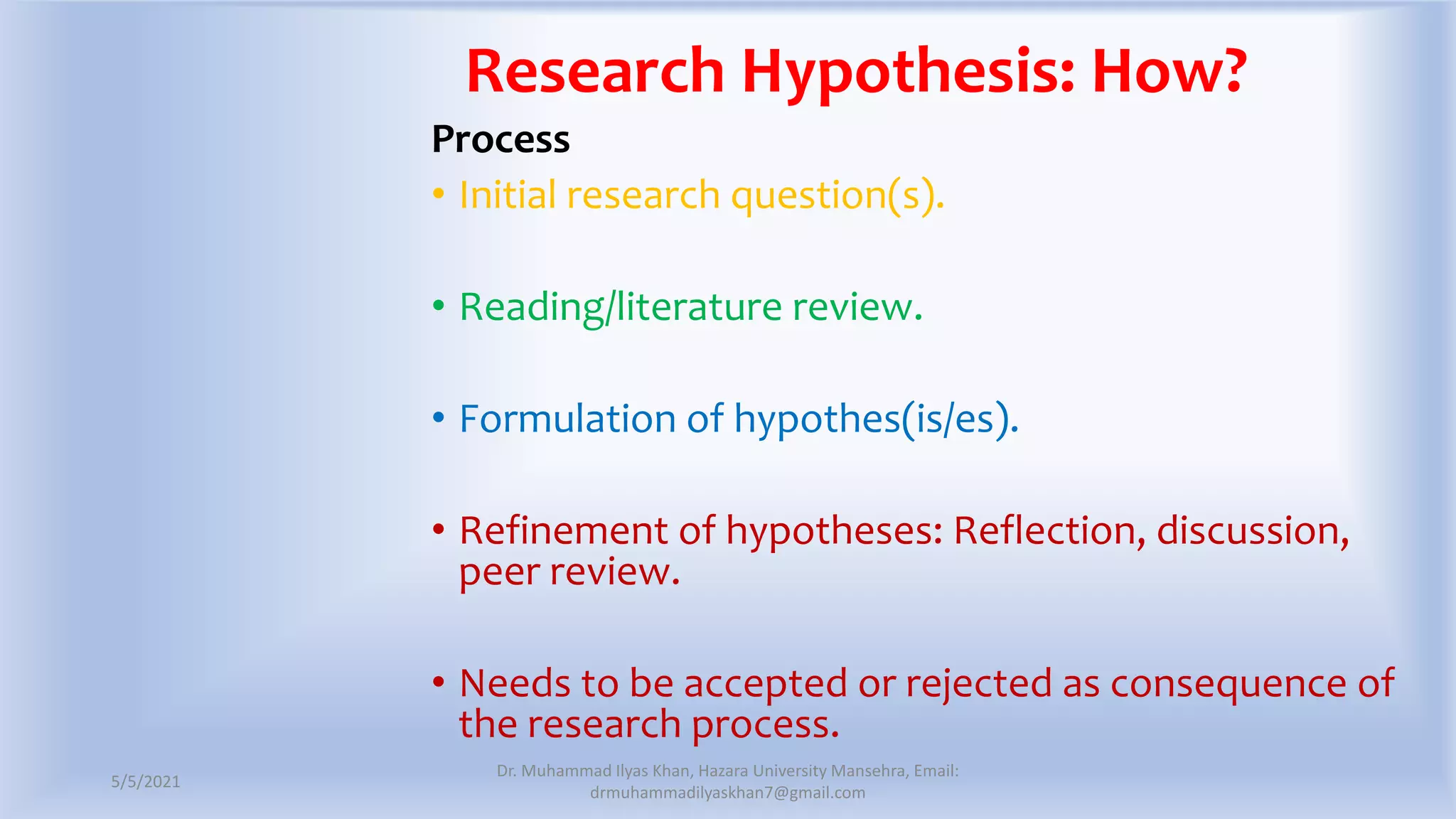
Research Hypothesis: How?
Process
• Initial research question(s).
• Reading/literature review.
• Formulation of hypothes(is/es).
• Refinement of hypotheses: Reflection, discussion,
peer review.
• Needs to be accepted or rejected as consequence of
the research process.
5/5/2021
Dr. Muhammad Ilyas Khan, Hazara University Mansehra, Email:
drmuhammadilyaskhan7@gmail.com
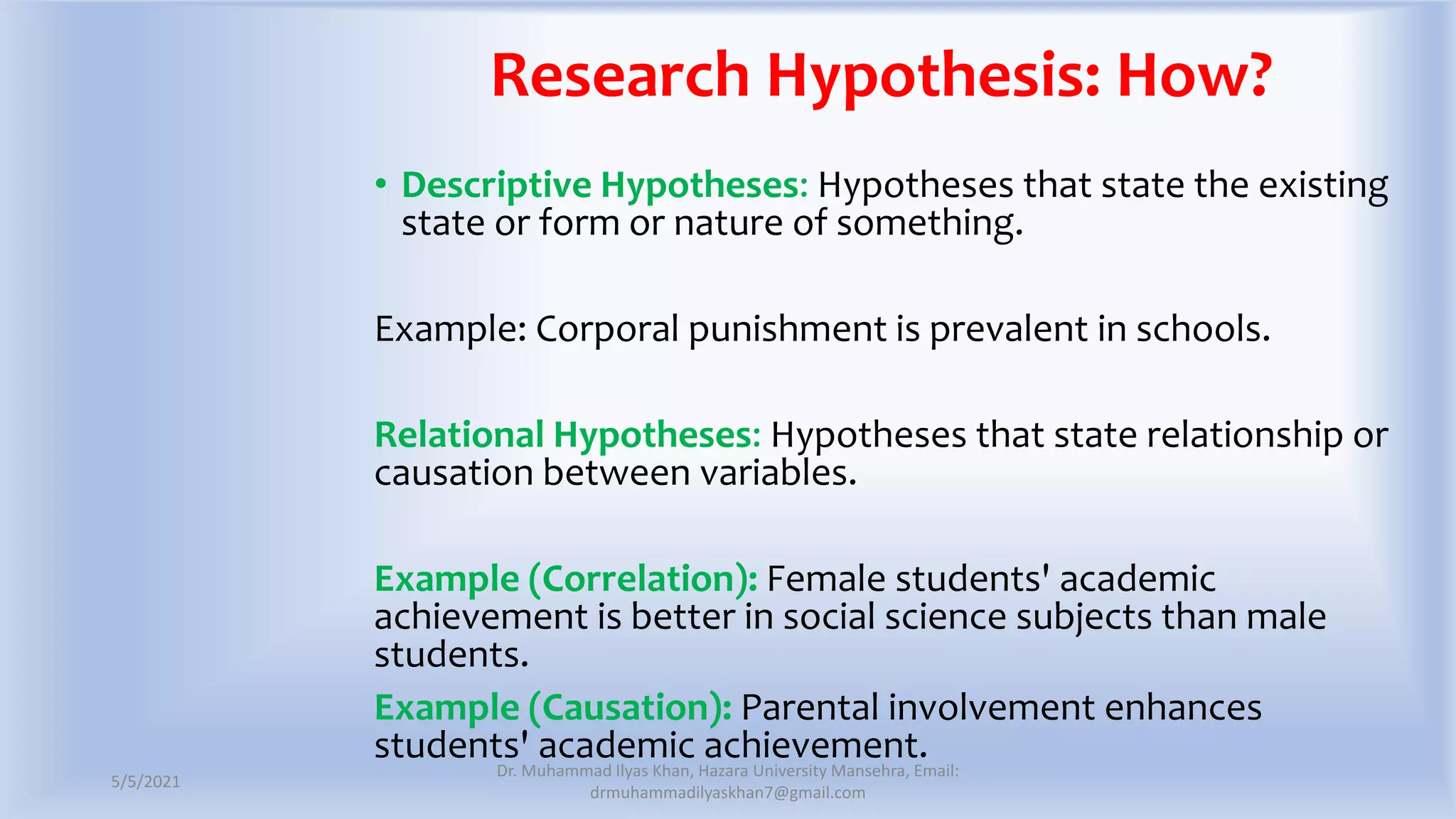
Research Hypothesis: How?
• Descriptive Hypotheses: Hypotheses that state the existing
state or form or nature of something.
Example: Corporal punishment is prevalent in schools.
Relational Hypotheses: Hypotheses that state relationship or
causation between variables.
Example (Correlation): Female students' academic
achievement is better in social science subjects than male
students.
Example (Causation): Parental involvement enhances
students' academic achievement.
5/5/2021
Dr. Muhammad Ilyas Khan, Hazara University Mansehra, Email:
drmuhammadilyaskhan7@gmail.com
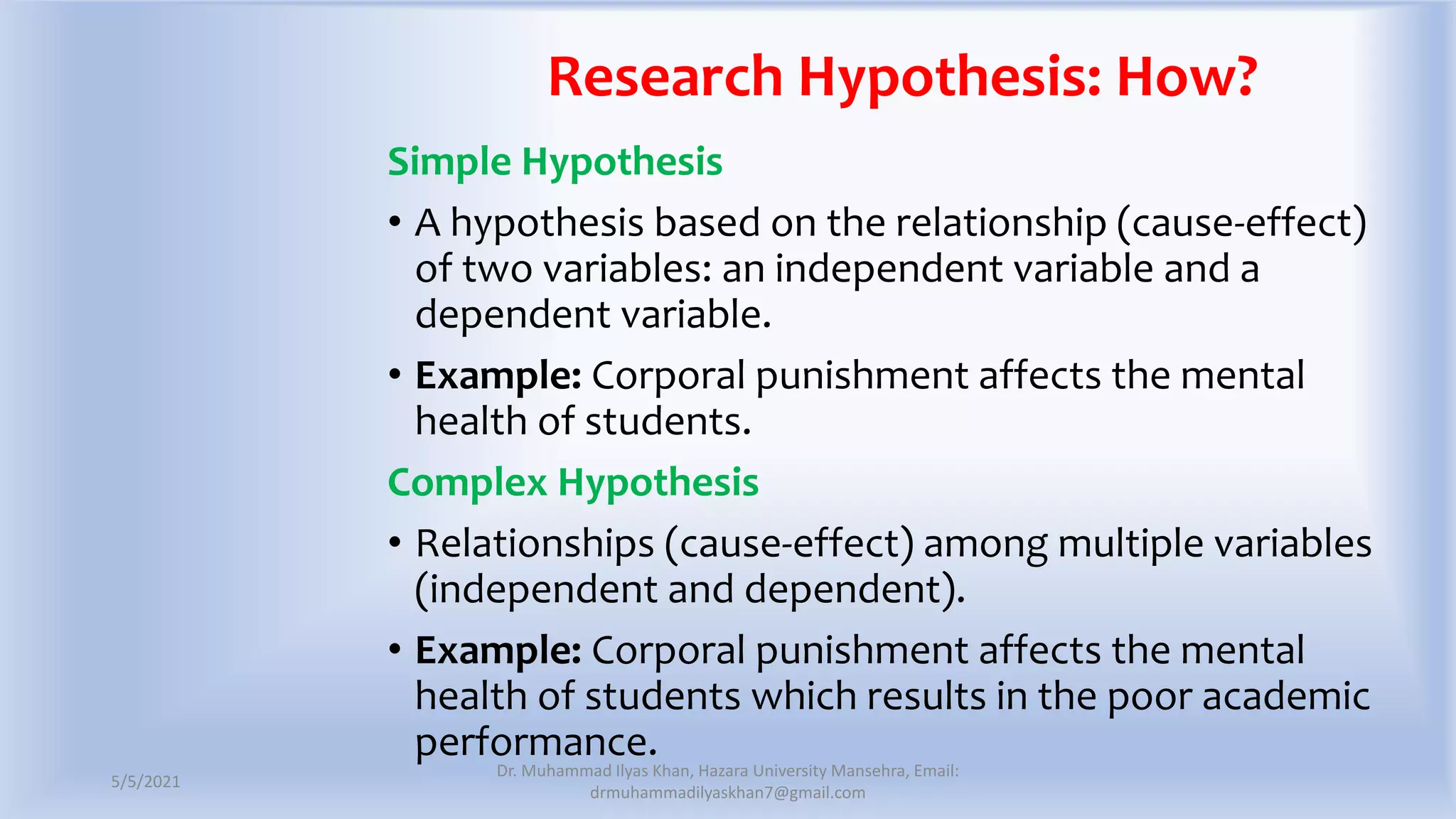
Research Hypothesis: How?
Simple Hypothesis
• A hypothesis based on the relationship (cause-effect)
of two variables: an independent variable and a
dependent variable.
• Example: Corporal punishment affects the mental
health of students.
Complex Hypothesis
• Relationships (cause-effect) among multiple variables
(independent and dependent).
• Example: Corporal punishment affects the mental
health of students which results in the poor academic
performance.
5/5/2021
Dr. Muhammad Ilyas Khan, Hazara University Mansehra, Email:
drmuhammadilyaskhan7@gmail.com
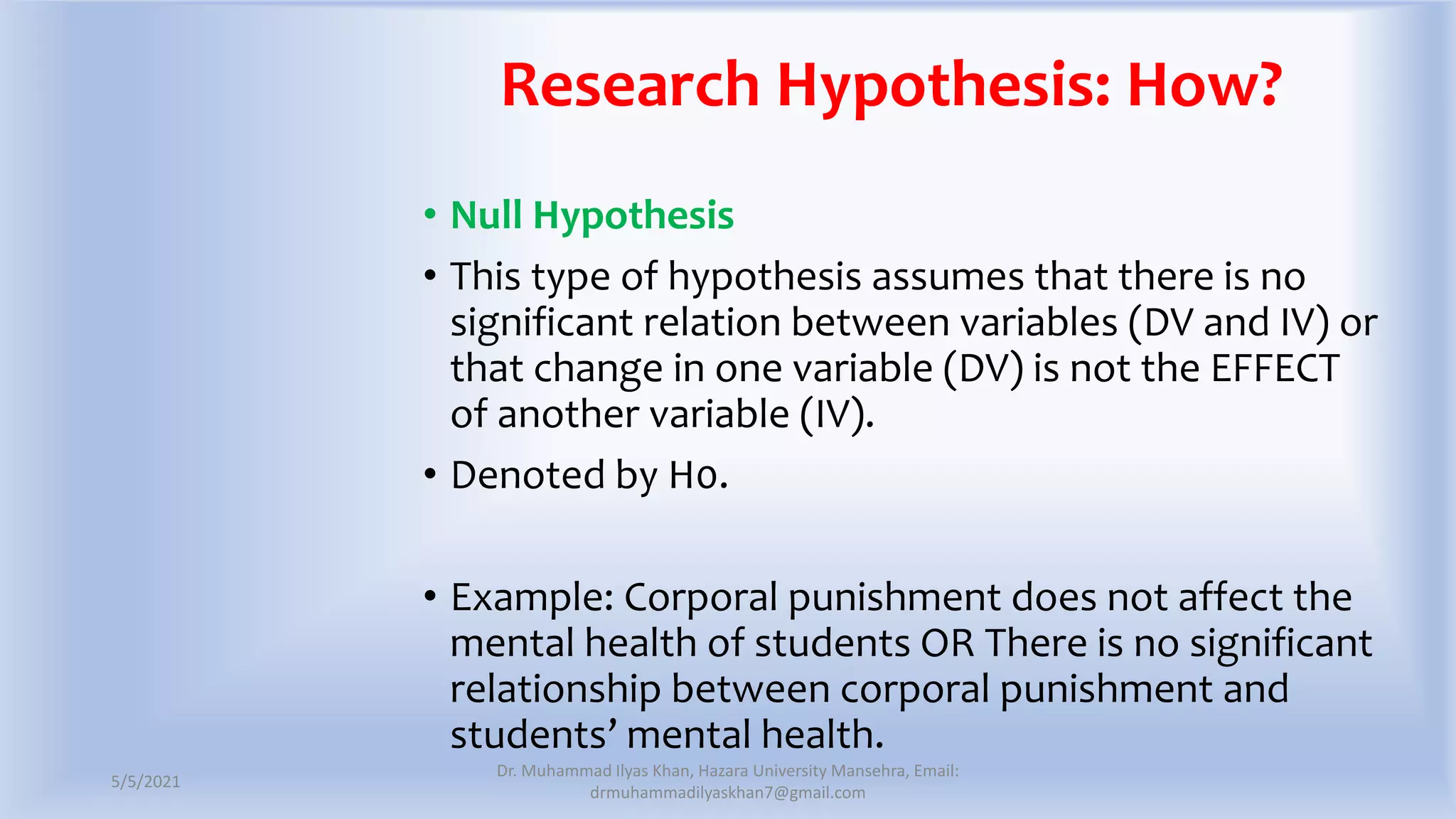
Research Hypothesis: How?
• Null Hypothesis
• This type of hypothesis assumes that there is no
significant relation between variables (DV and IV) or
that change in one variable (DV) is not the EFFECT
of another variable (IV).
• Denoted by H0.
• Example: Corporal punishment does not affect the
mental health of students OR There is no significant
relationship between corporal punishment and
students’ mental health.
5/5/2021
Dr. Muhammad Ilyas Khan, Hazara University Mansehra, Email:
drmuhammadilyaskhan7@gmail.com
Research Hypothesis: How?
• Alternative Hypothesis
• This type of hypothesis assumes that there is significant relation
between variables (DV and IV) or that one variable (DV) is the
CONSEQUENCE of another variable (IV).
• Denoted by H1.
• Examples:
(Non-directional) :
• There is significant relationship between corporal punishment and
mental health of students
• Corporal punishment affects students’ mental health.
• (Directional):
• There is significantly positive relationship between corporal
punishment and mental health of students.
• Corporal punishment negatively affects students’ mental health.
5/5/2021
Dr. Muhammad Ilyas Khan, Hazara University Mansehra, Email:
drmuhammadilyaskhan7@gmail.com

Research hypotheses what, why, how

  • 1.
    Research Hypothesis ------ What, Why,How? By Dr. Muhammad Ilyas Khan, Department of Education, Hazara University Mansehra 5/5/2021 Dr. Muhammad Ilyas Khan, Hazara University Mansehra, Email: drmuhammadilyaskhan7@gmail.com
  • 2.
    Research Hypothesis: What? •Hypothesis: A tentative explanation, prediction or proposition formulated for testing/exploring empirically. • Research Hypotheses are generally based on assumed relationships between variables in a research study. • In other words, hypotheses state the assumed relationship between independent and dependent variables before the actual existence or otherwise of this relationship is empirically established in a research study. Also called educated guess. • Examples: • Socio-economic status of students affects their self-esteem • There is significant relationship between teachers’ teaching style and students’ classroom participation. 5/5/2021 Dr. Muhammad Ilyas Khan, Hazara University Mansehra, Email: drmuhammadilyaskhan7@gmail.com
  • 3.
    Research Hypothesis: What? •Hypotheses could be accepted or rejected once empirical studies have been conducted. • Acceptance or rejection of research hypotheses have no bearing on the value of the research project. • Good hypotheses should indicate relationship between variables clearly. • Good hypotheses should be presented in precise language. • Good hypotheses should be representative of the research objectives. • Should be testable empirically. 5/5/2021 Dr. Muhammad Ilyas Khan, Hazara University Mansehra, Email: drmuhammadilyaskhan7@gmail.com
  • 4.
    Research Hypothesis: Why? •Gives direction and focus to the research process • Generally, requires the researcher to do sufficient reading and reflection around the topic before formulating and refining hypotheses. • Gives tentative answers to our research questions. • Helps in giving direction to the process of data collection, analysis and interpretation. 5/5/2021 Dr. Muhammad Ilyas Khan, Hazara University Mansehra, Email: drmuhammadilyaskhan7@gmail.com
  • 5.
    Research Hypothesis: How? Process •Initial research question(s). • Reading/literature review. • Formulation of hypothes(is/es). • Refinement of hypotheses: Reflection, discussion, peer review. • Needs to be accepted or rejected as consequence of the research process. 5/5/2021 Dr. Muhammad Ilyas Khan, Hazara University Mansehra, Email: drmuhammadilyaskhan7@gmail.com
  • 6.
    Research Hypothesis: How? •Descriptive Hypotheses: Hypotheses that state the existing state or form or nature of something. Example: Corporal punishment is prevalent in schools. Relational Hypotheses: Hypotheses that state relationship or causation between variables. Example (Correlation): Female students' academic achievement is better in social science subjects than male students. Example (Causation): Parental involvement enhances students' academic achievement. 5/5/2021 Dr. Muhammad Ilyas Khan, Hazara University Mansehra, Email: drmuhammadilyaskhan7@gmail.com
  • 7.
    Research Hypothesis: How? SimpleHypothesis • A hypothesis based on the relationship (cause-effect) of two variables: an independent variable and a dependent variable. • Example: Corporal punishment affects the mental health of students. Complex Hypothesis • Relationships (cause-effect) among multiple variables (independent and dependent). • Example: Corporal punishment affects the mental health of students which results in the poor academic performance. 5/5/2021 Dr. Muhammad Ilyas Khan, Hazara University Mansehra, Email: drmuhammadilyaskhan7@gmail.com
  • 8.
    Research Hypothesis: How? •Null Hypothesis • This type of hypothesis assumes that there is no significant relation between variables (DV and IV) or that change in one variable (DV) is not the EFFECT of another variable (IV). • Denoted by H0. • Example: Corporal punishment does not affect the mental health of students OR There is no significant relationship between corporal punishment and students’ mental health. 5/5/2021 Dr. Muhammad Ilyas Khan, Hazara University Mansehra, Email: drmuhammadilyaskhan7@gmail.com
  • 9.
    Research Hypothesis: How? •Alternative Hypothesis • This type of hypothesis assumes that there is significant relation between variables (DV and IV) or that one variable (DV) is the CONSEQUENCE of another variable (IV). • Denoted by H1. • Examples: (Non-directional) : • There is significant relationship between corporal punishment and mental health of students • Corporal punishment affects students’ mental health. • (Directional): • There is significantly positive relationship between corporal punishment and mental health of students. • Corporal punishment negatively affects students’ mental health. 5/5/2021 Dr. Muhammad Ilyas Khan, Hazara University Mansehra, Email: drmuhammadilyaskhan7@gmail.com