Research Design
Ulysses Labilles
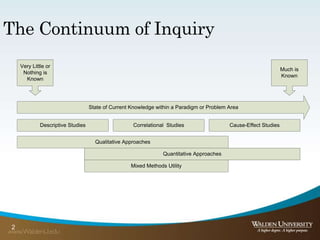
The Continuum of Inquiry
2
State of Current Knowledge within a Paradigm or Problem Area
Very Little or
Nothing is
Known
Much is
Known
Descriptive Studies Correlational Studies Cause-Effect Studies
Qualitative Approaches
Quantitative Approaches
Mixed Methods Utility
Research
Methods
Day 2
Quantitative Studies
4
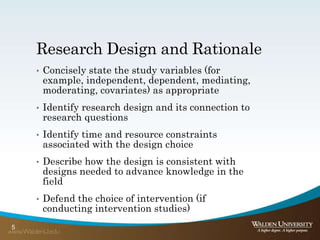
Research Design and Rationale
• Concisely state the study variables (for
example, independent, dependent, mediating,
moderating, covariates) as appropriate
• Identify research design and its connection to
research questions
• Identify time and resource constraints
associated with the design choice
• Describe how the design is consistent with
designs needed to advance knowledge in the
field
• Defend the choice of intervention (if
conducting intervention studies)
5
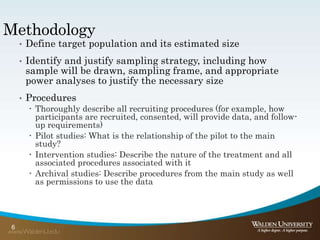
Methodology
• Define target population and its estimated size
• Identify and justify sampling strategy, including how
sample will be drawn, sampling frame, and appropriate
power analyses to justify the necessary size
• Procedures
 Thoroughly describe all recruiting procedures (for example, how
participants are recruited, consented, will provide data, and follow-
up requirements)
 Pilot studies: What is the relationship of the pilot to the main
study?
 Intervention studies: Describe the nature of the treatment and all
associated procedures associated with it
 Archival studies: Describe procedures from the main study as well
as permissions to use the data
6
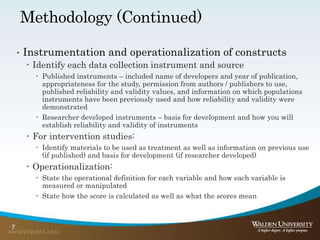
Methodology (Continued)
• Instrumentation and operationalization of constructs
 Identify each data collection instrument and source
 Published instruments – included name of developers and year of publication,
appropriateness for the study, permission from authors / publishers to use,
published reliability and validity values, and information on which populations
instruments have been previously used and how reliability and validity were
demonstrated
 Researcher developed instruments – basis for development and how you will
establish reliability and validity of instruments
 For intervention studies:
 Identify materials to be used as treatment as well as information on previous use
(if published) and basis for development (if researcher developed)
 Operationalization:
 State the operational definition for each variable and how each variable is
measured or manipulated
 State how the score is calculated as well as what the scores mean
7
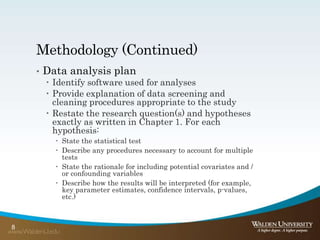
Methodology (Continued)
• Data analysis plan
 Identify software used for analyses
 Provide explanation of data screening and
cleaning procedures appropriate to the study
 Restate the research question(s) and hypotheses
exactly as written in Chapter 1. For each
hypothesis:
 State the statistical test
 Describe any procedures necessary to account for multiple
tests
 State the rationale for including potential covariates and /
or confounding variables
 Describe how the results will be interpreted (for example,
key parameter estimates, confidence intervals, p-values,
etc.)
8
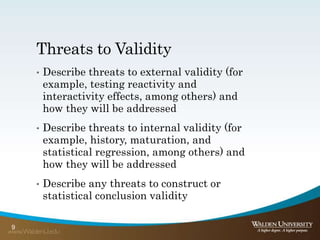
Threats to Validity
• Describe threats to external validity (for
example, testing reactivity and
interactivity effects, among others) and
how they will be addressed
• Describe threats to internal validity (for
example, history, maturation, and
statistical regression, among others) and
how they will be addressed
• Describe any threats to construct or
statistical conclusion validity
9
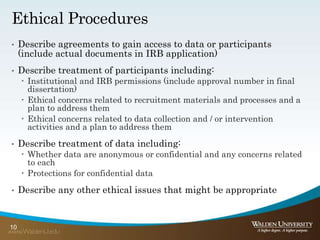
Ethical Procedures
• Describe agreements to gain access to data or participants
(include actual documents in IRB application)
• Describe treatment of participants including:
 Institutional and IRB permissions (include approval number in final
dissertation)
 Ethical concerns related to recruitment materials and processes and a
plan to address them
 Ethical concerns related to data collection and / or intervention
activities and a plan to address them
• Describe treatment of data including:
 Whether data are anonymous or confidential and any concerns related
to each
 Protections for confidential data
• Describe any other ethical issues that might be appropriate
10
Continuum
of Steps
Review of
Theories/Lite
rature
Question 1 Question 2 Question 3
The Researcher Andersen, 1993;
Constas, 1992;
Gwaltney, 1991
What is the researcher’s
motivation for engaging in
the work?
To what extent is the researcher
aware of other work that has
misrepresented the community?
What are the researcher’s intentions
regarding the data once the work is
complete? Was the community
considered in this decision?
Access/Rapport Dillard, 2000
Kershaw, 1990
What is the extent of the
researcher’s knowledge of
methods of developing
rapport within the cultural
context?
How will the researcher be
accountable to the community?
How will the researcher negotiate
challenges to access/rapport?
Development of the
Research Questions)
Andersen, 1993;
Carter, 2003;
Stanfield, 1993
To what extent are the
research questions
grounded in the cultural
context?
Is the researcher’s own
knowledge of the cultural context
sufficient to develop questions?
In what ways do the research questions
go beyond dominant group notions?
Data Collection
Methods
Brayboy & Deyhle,
2000
Carter, 2003
Are the methods ethical
within the cultural context?
To what extent do the tools
privilege a particular perspective?
Do the tools encourage co-construction
of the work (if that is culturally
appropriate)?
Data
Collection/Analysis
(Triangulation)
Creswell, 1998
Tillman, 2002
How have the methods
generated practical
knowledge?
Are there contradictions between
the group’s understandings and
“objective reality”
Has the researcher considered the extent
of his or her own specific cultural
knowledge of the group?
Data
Collection/Analysis
(Peer Review)
Constas, 1992 Are the methods grounded
in the cultural context?
Have the methods been validated
within the community?
How public is the analysis of the data?
Data
Collection/Analysis
(Member-checking)
Tillman, 2002 Are the findings
representative and relevant
of the reality of community
life from the perspective of
the members?
Will these findings empower the
group?
(post)
Have the self-defined experiences of the
group been included appropriately and
accurately?
Data
Collection/Analysis
Tillman, 2002 Does the researcher have
adequate cultural
What has been discussed about
power relations? What actions
How did the researcher determine the
appropriate length of time to remain in
© 2004 Hopson, R. and Sekayi, D.
LaFin
12
https://onenationsecho.com/

Research design

  • 1.
  • 2.
    The Continuum ofInquiry 2 State of Current Knowledge within a Paradigm or Problem Area Very Little or Nothing is Known Much is Known Descriptive Studies Correlational Studies Cause-Effect Studies Qualitative Approaches Quantitative Approaches Mixed Methods Utility
  • 3.
  • 4.
  • 5.
    Research Design andRationale • Concisely state the study variables (for example, independent, dependent, mediating, moderating, covariates) as appropriate • Identify research design and its connection to research questions • Identify time and resource constraints associated with the design choice • Describe how the design is consistent with designs needed to advance knowledge in the field • Defend the choice of intervention (if conducting intervention studies) 5
  • 6.
    Methodology • Define targetpopulation and its estimated size • Identify and justify sampling strategy, including how sample will be drawn, sampling frame, and appropriate power analyses to justify the necessary size • Procedures  Thoroughly describe all recruiting procedures (for example, how participants are recruited, consented, will provide data, and follow- up requirements)  Pilot studies: What is the relationship of the pilot to the main study?  Intervention studies: Describe the nature of the treatment and all associated procedures associated with it  Archival studies: Describe procedures from the main study as well as permissions to use the data 6
  • 7.
    Methodology (Continued) • Instrumentationand operationalization of constructs  Identify each data collection instrument and source  Published instruments – included name of developers and year of publication, appropriateness for the study, permission from authors / publishers to use, published reliability and validity values, and information on which populations instruments have been previously used and how reliability and validity were demonstrated  Researcher developed instruments – basis for development and how you will establish reliability and validity of instruments  For intervention studies:  Identify materials to be used as treatment as well as information on previous use (if published) and basis for development (if researcher developed)  Operationalization:  State the operational definition for each variable and how each variable is measured or manipulated  State how the score is calculated as well as what the scores mean 7
  • 8.
    Methodology (Continued) • Dataanalysis plan  Identify software used for analyses  Provide explanation of data screening and cleaning procedures appropriate to the study  Restate the research question(s) and hypotheses exactly as written in Chapter 1. For each hypothesis:  State the statistical test  Describe any procedures necessary to account for multiple tests  State the rationale for including potential covariates and / or confounding variables  Describe how the results will be interpreted (for example, key parameter estimates, confidence intervals, p-values, etc.) 8
  • 9.
    Threats to Validity •Describe threats to external validity (for example, testing reactivity and interactivity effects, among others) and how they will be addressed • Describe threats to internal validity (for example, history, maturation, and statistical regression, among others) and how they will be addressed • Describe any threats to construct or statistical conclusion validity 9
  • 10.
    Ethical Procedures • Describeagreements to gain access to data or participants (include actual documents in IRB application) • Describe treatment of participants including:  Institutional and IRB permissions (include approval number in final dissertation)  Ethical concerns related to recruitment materials and processes and a plan to address them  Ethical concerns related to data collection and / or intervention activities and a plan to address them • Describe treatment of data including:  Whether data are anonymous or confidential and any concerns related to each  Protections for confidential data • Describe any other ethical issues that might be appropriate 10
  • 11.
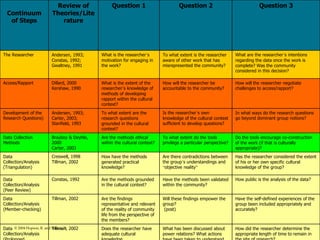
    Continuum of Steps Review of Theories/Lite rature Question1 Question 2 Question 3 The Researcher Andersen, 1993; Constas, 1992; Gwaltney, 1991 What is the researcher’s motivation for engaging in the work? To what extent is the researcher aware of other work that has misrepresented the community? What are the researcher’s intentions regarding the data once the work is complete? Was the community considered in this decision? Access/Rapport Dillard, 2000 Kershaw, 1990 What is the extent of the researcher’s knowledge of methods of developing rapport within the cultural context? How will the researcher be accountable to the community? How will the researcher negotiate challenges to access/rapport? Development of the Research Questions) Andersen, 1993; Carter, 2003; Stanfield, 1993 To what extent are the research questions grounded in the cultural context? Is the researcher’s own knowledge of the cultural context sufficient to develop questions? In what ways do the research questions go beyond dominant group notions? Data Collection Methods Brayboy & Deyhle, 2000 Carter, 2003 Are the methods ethical within the cultural context? To what extent do the tools privilege a particular perspective? Do the tools encourage co-construction of the work (if that is culturally appropriate)? Data Collection/Analysis (Triangulation) Creswell, 1998 Tillman, 2002 How have the methods generated practical knowledge? Are there contradictions between the group’s understandings and “objective reality” Has the researcher considered the extent of his or her own specific cultural knowledge of the group? Data Collection/Analysis (Peer Review) Constas, 1992 Are the methods grounded in the cultural context? Have the methods been validated within the community? How public is the analysis of the data? Data Collection/Analysis (Member-checking) Tillman, 2002 Are the findings representative and relevant of the reality of community life from the perspective of the members? Will these findings empower the group? (post) Have the self-defined experiences of the group been included appropriately and accurately? Data Collection/Analysis Tillman, 2002 Does the researcher have adequate cultural What has been discussed about power relations? What actions How did the researcher determine the appropriate length of time to remain in © 2004 Hopson, R. and Sekayi, D.
  • 12.

Editor's Notes

  • #4 Will explain how the literature exploration is the first kind of detective work that is part of the dissertation process. The student uses each material to provide clues to the core information to build the case for the study. As the researcher reads the literature, she is looking for essential information/evidence.
  • #12 This can be removed and added as a handout.