TUE, IEC/Library
Leon Osinski, Data steward
Presentation for Fontys University of Applied Sciences, 31-01-2019
Research data management at TU Eindhoven
Available under CC BY license, which permits unrestricted
use, distribution, and reproduction in any medium,
provided the original author and source are credited
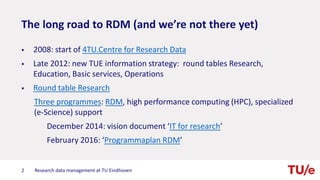
The long road to RDM (and we’re not there yet)
 2008: start of 4TU.Centre for Research Data
 Late 2012: new TUE information strategy: round tables Research,
Education, Basic services, Operations
 Round table Research
Three programmes: RDM, high performance computing (HPC), specialized
(e-Science) support
December 2014: vision document ‘IT for research’
February 2016: ‘Programmaplan RDM’
Research data management at TU Eindhoven2
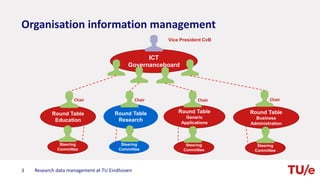
Organisation information management
Research data management at TU Eindhoven3
Vice President CvB
ICT
Governanceboard
Round Table
Education
Chair
Round Table
Research
Chair
Round Table
Generic
Applications
Chair
Round Table
Business
Administration
Chair
Steering
Committee
Steering
Committee
Steering
Committee
Steering
Committee
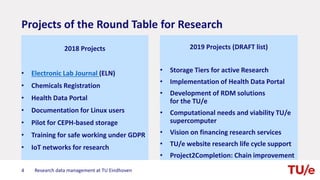
Projects of the Round Table for Research
2018 Projects
• Electronic Lab Journal (ELN)
• Chemicals Registration
• Health Data Portal
• Documentation for Linux users
• Pilot for CEPH-based storage
• Training for safe working under GDPR
• IoT networks for research
Research data management at TU Eindhoven4
2019 Projects (DRAFT list)
• Storage Tiers for active Research
• Implementation of Health Data Portal
• Development of RDM solutions
for the TU/e
• Computational needs and viability TU/e
supercomputer
• Vision on financing research services
• TU/e website research life cycle support
• Project2Completion: Chain improvement
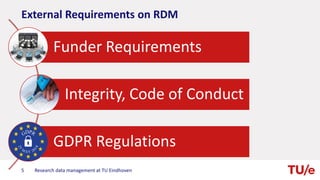
External Requirements on RDM
5
Funder Requirements
Integrity, Code of Conduct
GDPR Regulations
Research data management at TU Eindhoven
Funder Requirements
NWO requirements:
• write a data management paragraph (as part of the research proposal)
• make a data management plan or DMP (based on FAIR principles) within 4 months and
get it approved by the funding institution. Living document during the research.
Example questions that should be answered:
i. - how do you store and backup data safely and securely?
ii. - how do you document data and make it findable (metadata)
iii. - how do share data after the project, do you make it open access?
• deposit relevant research data in a trusted repository
• make your research data “as open as possible, as closed as necessary”.
Horizon 2020 requirements: similar requirement as NWO, but there are subtle differences
Horizon Europe requirements: more strict on data quality and more focus on open access
6 Research data management at TU Eindhoven
Integrity, Code of Conduct
• The Netherlands Code of Conduct for Scientific Integrity endorsed by 6 umbrella
organizations, including the VSNU, and is effective from October 1, 2018.
• The Code of Conduct requires all research data to remain available for reproducibility
checks for a minimum of 10 years
• Derived from this, TU/e has its own Code of Scientific Conduct. In it it is stated that:
“Open and unbiased communication is essential for science and engineering. For
academic staff and students, this entails that: (…)
They make accessible, after publication, research data for re-use by colleagues.
The TU/e code also requires that after publication, all information needed for
intersubjective testing of results and processes (e.g. to reproduce results) is published.
• All academic staff and master’s students at TU/e are asked to sign the TU/e Code.
7 Research data management at TU Eindhoven
GDPR Regulations
• General Data Protection Regulation: European Law
• As of 25 May 2018, the TU/e is expected to be compliant with GDPR
• GDPR regulates processing of personal data
• Personal Data is data that can be related to an identifiable natural person
• Do you collect or handle Personal Data in your research?
Get in touch with a Data Steward. They can help you to take additional measures,
such as:
- how to conduct and implement a PIA
- how to safely store and transfer sensitive data
• General GDPR training for researchers is under development. To be given at each
faculty, starting February 2019.
8 Research data management at TU Eindhoven
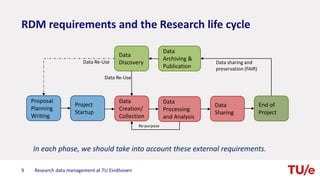
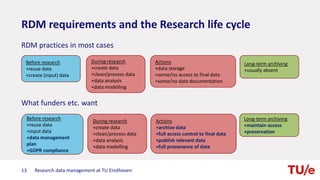
RDM requirements and the Research life cycle
Research data management at TU Eindhoven9
Proposal
Planning
Writing
Project
Startup
Data
Creation/
Collection
Data
Processing
and Analysis
Data
Sharing
End of
Project
Data
Discovery
Data
Archiving &
Publication
Data Re-Use
Data Re-Use
Data sharing and
preservation (FAIR)
In each phase, we should take into account these external requirements.
Re-purpose
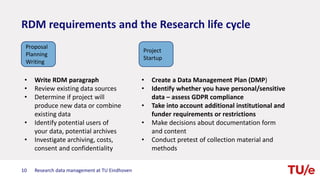
RDM requirements and the Research life cycle
Research data management at TU Eindhoven10
Proposal
Planning
Writing
Project
Startup
• Write RDM paragraph
• Review existing data sources
• Determine if project will
produce new data or combine
existing data
• Identify potential users of
your data, potential archives
• Investigate archiving, costs,
consent and confidentiality
• Create a Data Management Plan (DMP)
• Identify whether you have personal/sensitive
data – assess GDPR compliance
• Take into account additional institutional and
funder requirements or restrictions
• Make decisions about documentation form
and content
• Conduct pretest of collection material and
methods
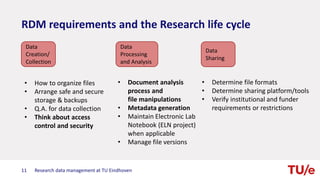
RDM requirements and the Research life cycle
Research data management at TU Eindhoven11
Data
Creation/
Collection
Data
Processing
and Analysis
Data
Sharing
• How to organize files
• Arrange safe and secure
storage & backups
• Q.A. for data collection
• Think about access
control and security
• Document analysis
process and
file manipulations
• Metadata generation
• Maintain Electronic Lab
Notebook (ELN project)
when applicable
• Manage file versions
• Determine file formats
• Determine sharing platform/tools
• Verify institutional and funder
requirements or restrictions
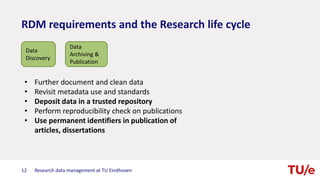
RDM requirements and the Research life cycle
Research data management at TU Eindhoven12
Data
Discovery
Data
Archiving &
Publication
• Further document and clean data
• Revisit metadata use and standards
• Deposit data in a trusted repository
• Perform reproducibility check on publications
• Use permanent identifiers in publication of
articles, dissertations
RDM requirements and the Research life cycle
RDM practices in most cases
What funders etc. want
13
Before research
+reuse data
+create (input) data
During research
+create data
+clean/process data
+data analysis
+data modelling
Actions
+data storage
+some/no access to final data
+some/no data documentation
Long-term archiving
+usually absent
Before research
+reuse data
+input data
+data management
plan
+GDPR compliance
During research
+create data
+clean/process data
+data analysis
+data modelling
Actions
+archive data
+full access control to final data
+publish relevant data
+full provenance of data
Long-term archiving
+maintain access
+preservation
Research data management at TU Eindhoven
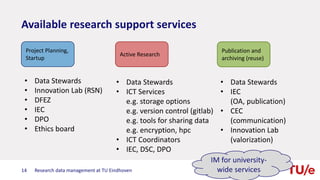
Available research support services
Research data management at TU Eindhoven14
Project Planning,
Startup
Publication and
archiving (reuse)
Active Research
• Data Stewards
• Innovation Lab (RSN)
• DFEZ
• IEC
• DPO
• Ethics board
• Data Stewards
• ICT Services
e.g. storage options
e.g. version control (gitlab)
e.g. tools for sharing data
e.g. encryption, hpc
• ICT Coordinators
• IEC, DSC, DPO
• Data Stewards
• IEC
(OA, publication)
• CEC
(communication)
• Innovation Lab
(valorization)
IM for university-
wide services
Data stewards
Data stewardship is the management and oversight of the institutional’s data assets,
including research data
Poster Data stewardship at TU/e
Research data management at TU Eindhoven15
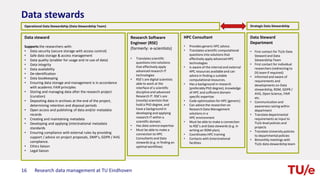
Data stewards
16
Data steward
Supports the researchers with:
• Data security (secure storage with access control)
• Safe data storage & access management
• Data quality (enabler for usage and re-use of data)
• Data integrity
• Data availability
• De-identification
• Data bookkeeping
• Ensuring data storage and management is in accordance
with academic FAIR principles
• Storing and managing data after the research project
(curation)
• Depositing data in archives at the end of the project,
determining retention and disposal periods
• Open access and publishing of data and/or metadata
records
• Creating and maintaining metadata
• Developing and applying (inter)national metadata
standards
• Ensuring compliance with external rules by providing
support / advice on project proposals, DMP’s, GDPR / AVG
compliance.
• Ethics liaison
• Legal liaison
Research Software
Engineer (RSE)
(formerly: e-scientists)
• Translates scientific
questions into solutions
that effectively apply
advanced research IT
technologies
• RSE’s are digital scientists
able to work at the
interface of a scientific
discipline and advanced
Research IT. RSE’s are
(mostly) scientists that
hold a PhD degree, and
have a background in
developing and applying
research IT within a
scientific domain.
• Has data science expertise
• Must be able to make a
connection to HPC
Consultants and Data
stewards (e.g. in finding an
optimal workflow).
HPC Consultant
• Provides generic HPC advice.
• Translates scientific computational
questions into solutions that
effectively apply advanced HPC
technologies
• Is aware of the internal and external
HPC resources available and can
advice in finding a suitable
computational resources.
• Has a background in research
(preferably PhD degree), knowledge
of HPC and sufficient domain
specific expertise
• Code optimization for HPC (generic)
• Can advice the researcher on
Research Data Management
solutions in a
HPC environment
• Must be able to make a connection
to RSE’s and Data stewards (e.g. in
writing an RDM plan).
• Coordinates HPC training
• Contacts with (inter)national
facilities
Data Steward
Department
• First contact for TU/e Data
Steward and Data
Stewardship Team
• First contact for individual
researchers (redirecting to
DS team if required)
• Informed and aware of
requirements and
developments on Data
stewardship, RDM, GDPR /
AVG, Open Science, FAIR
etc.
• Communication and
awareness raising within
department
• Translate departmental
requirements as input to
TU/e level policies and
projects
• Translate University policies
to departmental policies
• Bimonthly meetings with
TU/e data stewardship team
Operational Data Stewardship (Data Stewardship Team) Strategic Data Stewardship
Research data management at TU Eindhoven
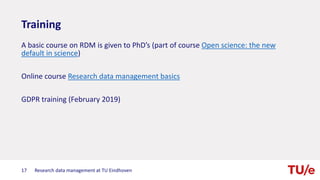
Training
A basic course on RDM is given to PhD’s (part of course Open science: the new
default in science)
Online course Research data management basics
GDPR training (February 2019)
Research data management at TU Eindhoven17
Good RDM: not only externally motivated!
• It reduces risk of data loss
• It can improve your research workflow
• It can help you get recognized for your work
• It can lead to novel insights
• It promotes scientific integrity and quality of data (combat scientific fraud)
• It reduces the need for duplication of research and data
• It puts public-funded research results in the public sphere
• It promotes collaboration as your results are findable for other researchers
• Businesses and other organisations can also profit from research (data)
• By making research results more accessible, it contributes to better and more efficient
science overall!
18 Research data management at TU Eindhoven
Open science community Eindhoven
19 Research data management at TU Eindhoven

Research data management at TU Eindhoven

  • 1.
    TUE, IEC/Library Leon Osinski,Data steward Presentation for Fontys University of Applied Sciences, 31-01-2019 Research data management at TU Eindhoven Available under CC BY license, which permits unrestricted use, distribution, and reproduction in any medium, provided the original author and source are credited
  • 2.
    The long roadto RDM (and we’re not there yet)  2008: start of 4TU.Centre for Research Data  Late 2012: new TUE information strategy: round tables Research, Education, Basic services, Operations  Round table Research Three programmes: RDM, high performance computing (HPC), specialized (e-Science) support December 2014: vision document ‘IT for research’ February 2016: ‘Programmaplan RDM’ Research data management at TU Eindhoven2
  • 3.
    Organisation information management Researchdata management at TU Eindhoven3 Vice President CvB ICT Governanceboard Round Table Education Chair Round Table Research Chair Round Table Generic Applications Chair Round Table Business Administration Chair Steering Committee Steering Committee Steering Committee Steering Committee
  • 4.
    Projects of theRound Table for Research 2018 Projects • Electronic Lab Journal (ELN) • Chemicals Registration • Health Data Portal • Documentation for Linux users • Pilot for CEPH-based storage • Training for safe working under GDPR • IoT networks for research Research data management at TU Eindhoven4 2019 Projects (DRAFT list) • Storage Tiers for active Research • Implementation of Health Data Portal • Development of RDM solutions for the TU/e • Computational needs and viability TU/e supercomputer • Vision on financing research services • TU/e website research life cycle support • Project2Completion: Chain improvement
  • 5.
    External Requirements onRDM 5 Funder Requirements Integrity, Code of Conduct GDPR Regulations Research data management at TU Eindhoven
  • 6.
    Funder Requirements NWO requirements: •write a data management paragraph (as part of the research proposal) • make a data management plan or DMP (based on FAIR principles) within 4 months and get it approved by the funding institution. Living document during the research. Example questions that should be answered: i. - how do you store and backup data safely and securely? ii. - how do you document data and make it findable (metadata) iii. - how do share data after the project, do you make it open access? • deposit relevant research data in a trusted repository • make your research data “as open as possible, as closed as necessary”. Horizon 2020 requirements: similar requirement as NWO, but there are subtle differences Horizon Europe requirements: more strict on data quality and more focus on open access 6 Research data management at TU Eindhoven
  • 7.
    Integrity, Code ofConduct • The Netherlands Code of Conduct for Scientific Integrity endorsed by 6 umbrella organizations, including the VSNU, and is effective from October 1, 2018. • The Code of Conduct requires all research data to remain available for reproducibility checks for a minimum of 10 years • Derived from this, TU/e has its own Code of Scientific Conduct. In it it is stated that: “Open and unbiased communication is essential for science and engineering. For academic staff and students, this entails that: (…) They make accessible, after publication, research data for re-use by colleagues. The TU/e code also requires that after publication, all information needed for intersubjective testing of results and processes (e.g. to reproduce results) is published. • All academic staff and master’s students at TU/e are asked to sign the TU/e Code. 7 Research data management at TU Eindhoven
  • 8.
    GDPR Regulations • GeneralData Protection Regulation: European Law • As of 25 May 2018, the TU/e is expected to be compliant with GDPR • GDPR regulates processing of personal data • Personal Data is data that can be related to an identifiable natural person • Do you collect or handle Personal Data in your research? Get in touch with a Data Steward. They can help you to take additional measures, such as: - how to conduct and implement a PIA - how to safely store and transfer sensitive data • General GDPR training for researchers is under development. To be given at each faculty, starting February 2019. 8 Research data management at TU Eindhoven
  • 9.
    RDM requirements andthe Research life cycle Research data management at TU Eindhoven9 Proposal Planning Writing Project Startup Data Creation/ Collection Data Processing and Analysis Data Sharing End of Project Data Discovery Data Archiving & Publication Data Re-Use Data Re-Use Data sharing and preservation (FAIR) In each phase, we should take into account these external requirements. Re-purpose
  • 10.
    RDM requirements andthe Research life cycle Research data management at TU Eindhoven10 Proposal Planning Writing Project Startup • Write RDM paragraph • Review existing data sources • Determine if project will produce new data or combine existing data • Identify potential users of your data, potential archives • Investigate archiving, costs, consent and confidentiality • Create a Data Management Plan (DMP) • Identify whether you have personal/sensitive data – assess GDPR compliance • Take into account additional institutional and funder requirements or restrictions • Make decisions about documentation form and content • Conduct pretest of collection material and methods
  • 11.
    RDM requirements andthe Research life cycle Research data management at TU Eindhoven11 Data Creation/ Collection Data Processing and Analysis Data Sharing • How to organize files • Arrange safe and secure storage & backups • Q.A. for data collection • Think about access control and security • Document analysis process and file manipulations • Metadata generation • Maintain Electronic Lab Notebook (ELN project) when applicable • Manage file versions • Determine file formats • Determine sharing platform/tools • Verify institutional and funder requirements or restrictions
  • 12.
    RDM requirements andthe Research life cycle Research data management at TU Eindhoven12 Data Discovery Data Archiving & Publication • Further document and clean data • Revisit metadata use and standards • Deposit data in a trusted repository • Perform reproducibility check on publications • Use permanent identifiers in publication of articles, dissertations
  • 13.
    RDM requirements andthe Research life cycle RDM practices in most cases What funders etc. want 13 Before research +reuse data +create (input) data During research +create data +clean/process data +data analysis +data modelling Actions +data storage +some/no access to final data +some/no data documentation Long-term archiving +usually absent Before research +reuse data +input data +data management plan +GDPR compliance During research +create data +clean/process data +data analysis +data modelling Actions +archive data +full access control to final data +publish relevant data +full provenance of data Long-term archiving +maintain access +preservation Research data management at TU Eindhoven
  • 14.
    Available research supportservices Research data management at TU Eindhoven14 Project Planning, Startup Publication and archiving (reuse) Active Research • Data Stewards • Innovation Lab (RSN) • DFEZ • IEC • DPO • Ethics board • Data Stewards • ICT Services e.g. storage options e.g. version control (gitlab) e.g. tools for sharing data e.g. encryption, hpc • ICT Coordinators • IEC, DSC, DPO • Data Stewards • IEC (OA, publication) • CEC (communication) • Innovation Lab (valorization) IM for university- wide services
  • 15.
    Data stewards Data stewardshipis the management and oversight of the institutional’s data assets, including research data Poster Data stewardship at TU/e Research data management at TU Eindhoven15
  • 16.
    Data stewards 16 Data steward Supportsthe researchers with: • Data security (secure storage with access control) • Safe data storage & access management • Data quality (enabler for usage and re-use of data) • Data integrity • Data availability • De-identification • Data bookkeeping • Ensuring data storage and management is in accordance with academic FAIR principles • Storing and managing data after the research project (curation) • Depositing data in archives at the end of the project, determining retention and disposal periods • Open access and publishing of data and/or metadata records • Creating and maintaining metadata • Developing and applying (inter)national metadata standards • Ensuring compliance with external rules by providing support / advice on project proposals, DMP’s, GDPR / AVG compliance. • Ethics liaison • Legal liaison Research Software Engineer (RSE) (formerly: e-scientists) • Translates scientific questions into solutions that effectively apply advanced research IT technologies • RSE’s are digital scientists able to work at the interface of a scientific discipline and advanced Research IT. RSE’s are (mostly) scientists that hold a PhD degree, and have a background in developing and applying research IT within a scientific domain. • Has data science expertise • Must be able to make a connection to HPC Consultants and Data stewards (e.g. in finding an optimal workflow). HPC Consultant • Provides generic HPC advice. • Translates scientific computational questions into solutions that effectively apply advanced HPC technologies • Is aware of the internal and external HPC resources available and can advice in finding a suitable computational resources. • Has a background in research (preferably PhD degree), knowledge of HPC and sufficient domain specific expertise • Code optimization for HPC (generic) • Can advice the researcher on Research Data Management solutions in a HPC environment • Must be able to make a connection to RSE’s and Data stewards (e.g. in writing an RDM plan). • Coordinates HPC training • Contacts with (inter)national facilities Data Steward Department • First contact for TU/e Data Steward and Data Stewardship Team • First contact for individual researchers (redirecting to DS team if required) • Informed and aware of requirements and developments on Data stewardship, RDM, GDPR / AVG, Open Science, FAIR etc. • Communication and awareness raising within department • Translate departmental requirements as input to TU/e level policies and projects • Translate University policies to departmental policies • Bimonthly meetings with TU/e data stewardship team Operational Data Stewardship (Data Stewardship Team) Strategic Data Stewardship Research data management at TU Eindhoven
  • 17.
    Training A basic courseon RDM is given to PhD’s (part of course Open science: the new default in science) Online course Research data management basics GDPR training (February 2019) Research data management at TU Eindhoven17
  • 18.
    Good RDM: notonly externally motivated! • It reduces risk of data loss • It can improve your research workflow • It can help you get recognized for your work • It can lead to novel insights • It promotes scientific integrity and quality of data (combat scientific fraud) • It reduces the need for duplication of research and data • It puts public-funded research results in the public sphere • It promotes collaboration as your results are findable for other researchers • Businesses and other organisations can also profit from research (data) • By making research results more accessible, it contributes to better and more efficient science overall! 18 Research data management at TU Eindhoven
  • 19.
    Open science communityEindhoven 19 Research data management at TU Eindhoven