WEBINAR: Research Data Services
WEBINAR: Supporting Data Literacy
The webinar starts at 1400 CET
Join the conversation: #LIBERWebinar
Speakers
Robin Rice
University of Edinburgh
R.Rice@ed.ac.uk
Moderating
Birgit Schmidt
Goettingen State and University Library
bschmidt@sub.uni-goettingen.de
Rob Grim
Erasmus University Rotterdam
grim@ubib.eur.nl
John Southall
Bodleian Libraries
john.southall@bodleian.ox.ac.uk
Supporting Data Literacy:
Theory and Practice
LIBER Webinar
Robin Rice & John Southall
(Universities of Edinburgh and Oxford)
12 December 2017
Overview – the theory side of things
• Why is data literacy important today?
• Data literacy within library instruction
• The Data lifecycle and RDM training
• Understanding the mechanics of data
• What has statistical literacy got to do with it?
• What about data science?
• What data skills do librarians have/need?
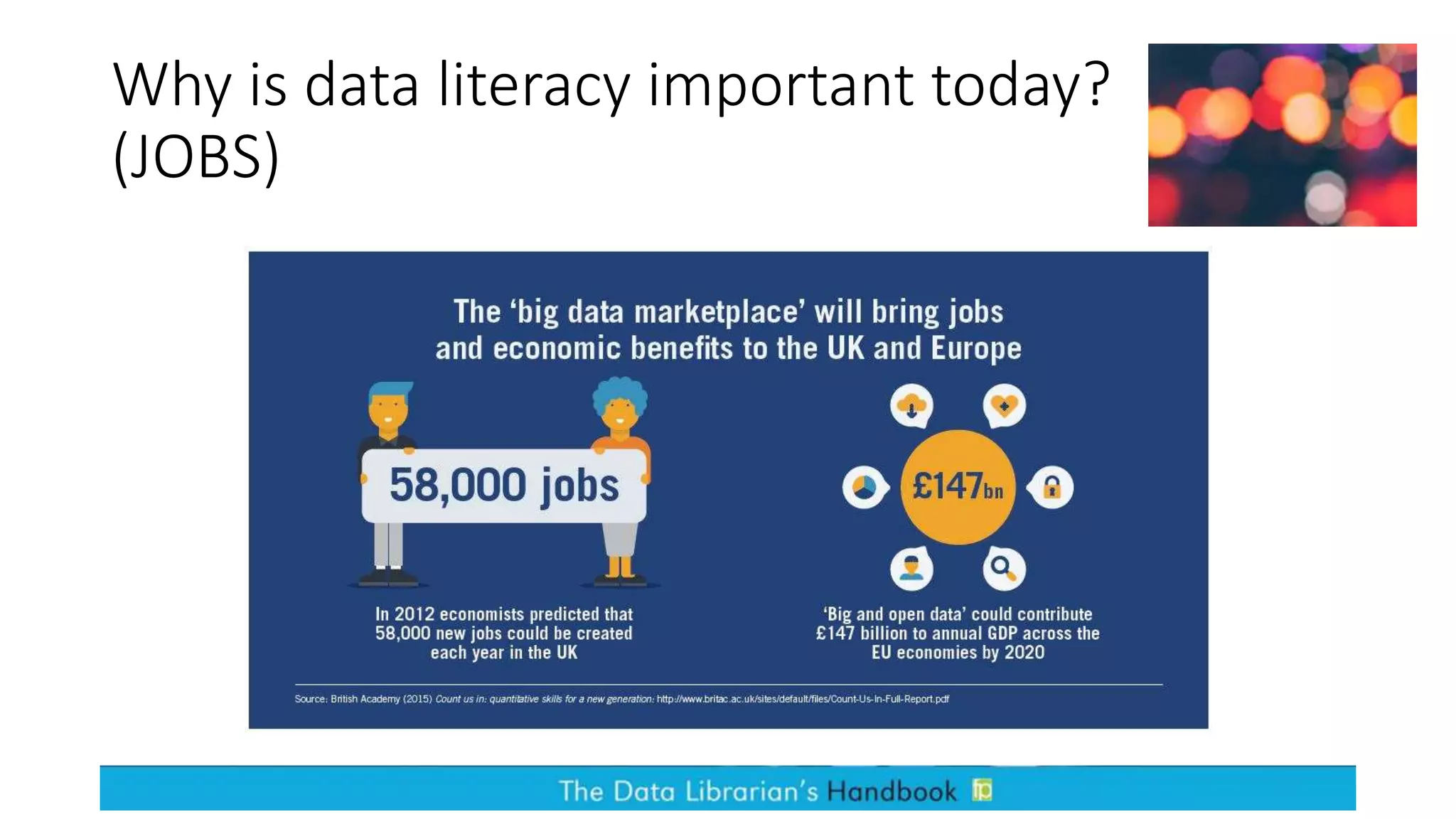
Why is data literacy important today?
(JOBS)
You say you want a (data) revolution…
The number of people with these skills [Core Data Experts] needed to effectively operate the EOSC is, we estimate,
likely exceeding half a million within a decade. https://joinup.ec.europa.eu/news/500000-data-scientists-need
(Nov. 2016)
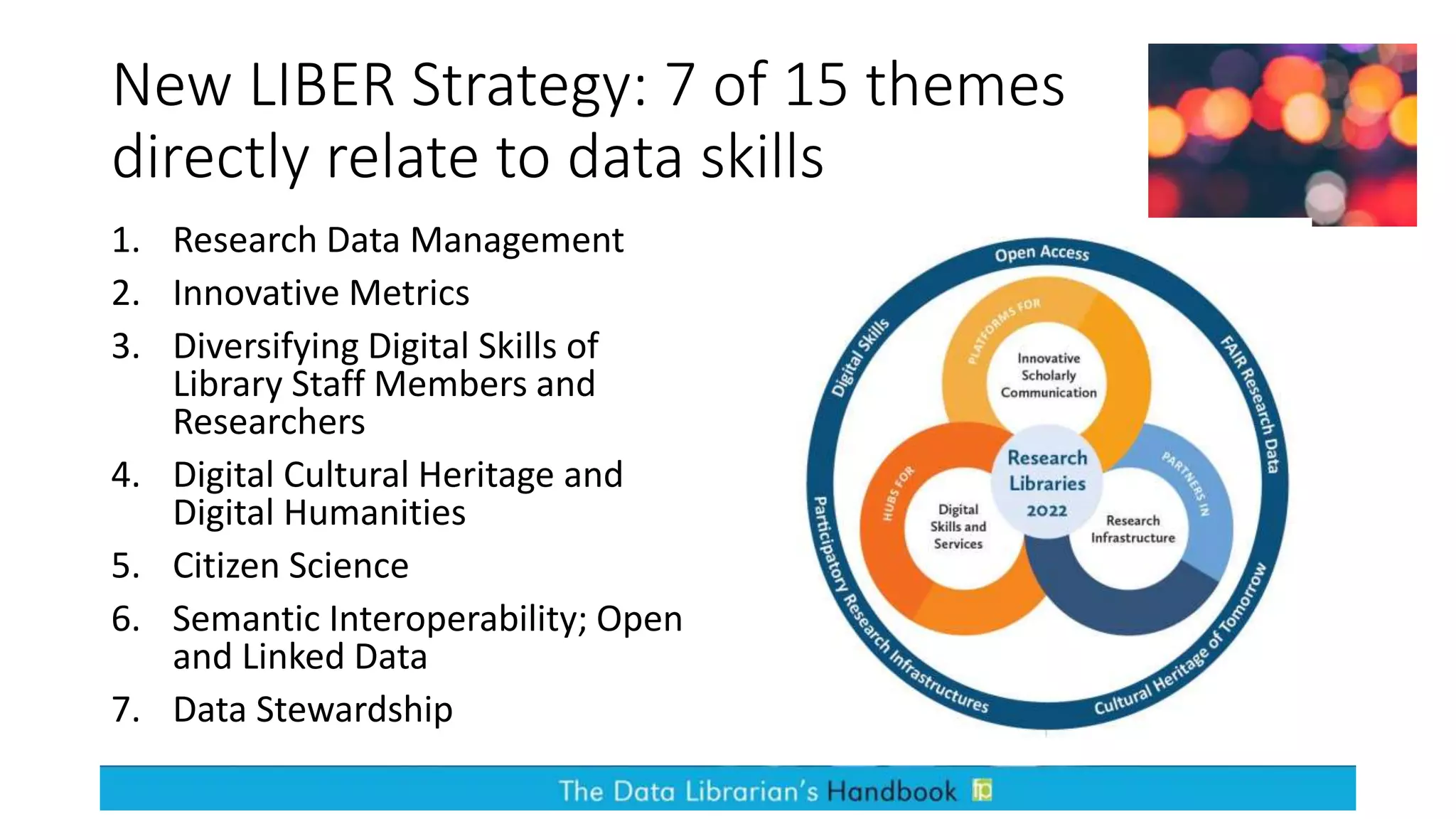
New LIBER Strategy: 7 of 15 themes
directly relate to data skills
1. Research Data Management
2. Innovative Metrics
3. Diversifying Digital Skills of
Library Staff Members and
Researchers
4. Digital Cultural Heritage and
Digital Humanities
5. Citizen Science
6. Semantic Interoperability; Open
and Linked Data
7. Data Stewardship
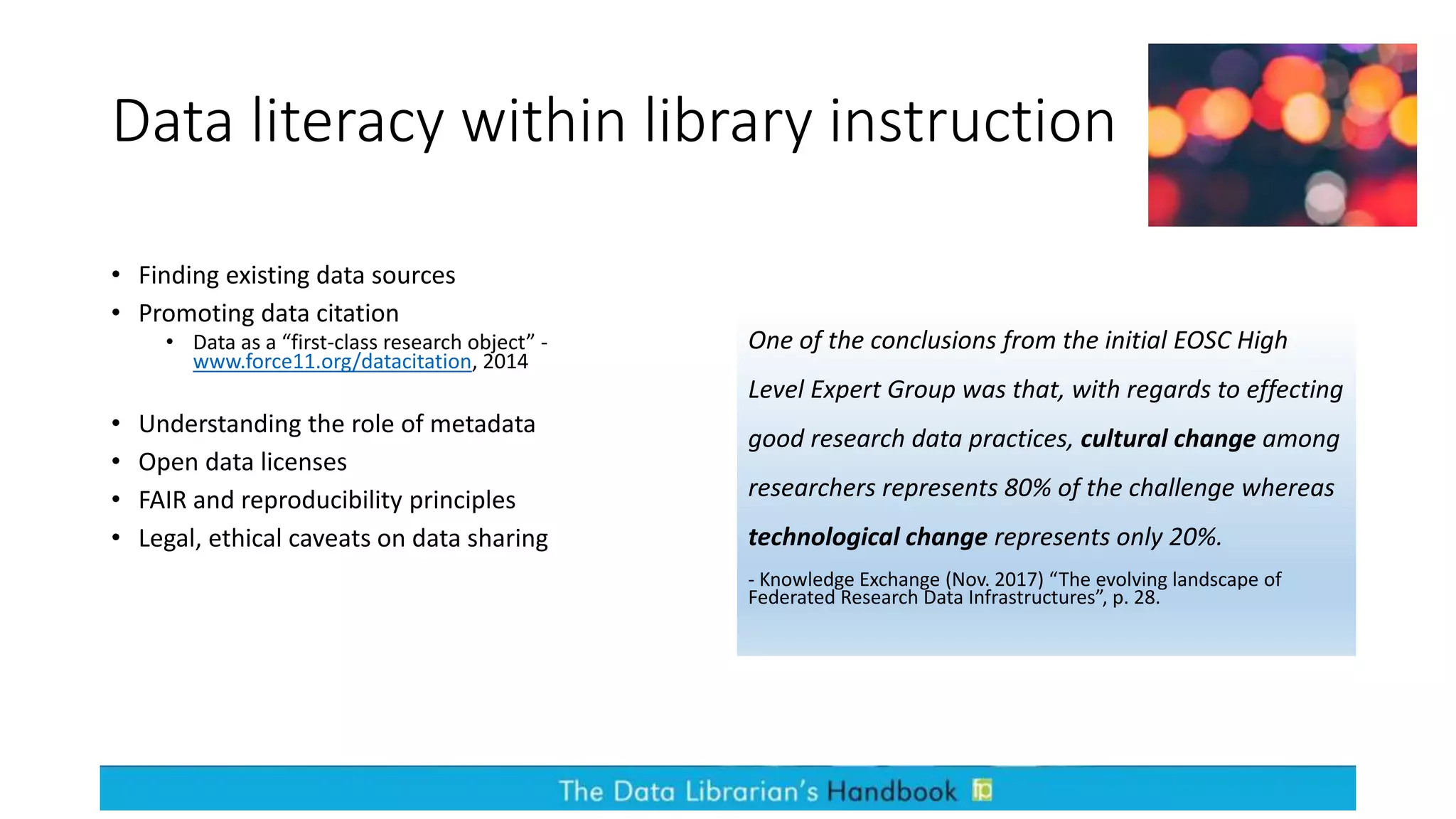
Data literacy within library instruction
• Finding existing data sources
• Promoting data citation
• Data as a “first-class research object” -
www.force11.org/datacitation, 2014
• Understanding the role of metadata
• Open data licenses
• FAIR and reproducibility principles
• Legal, ethical caveats on data sharing
One of the conclusions from the initial EOSC High
Level Expert Group was that, with regards to effecting
good research data practices, cultural change among
researchers represents 80% of the challenge whereas
technological change represents only 20%.
- Knowledge Exchange (Nov. 2017) “The evolving landscape of
Federated Research Data Infrastructures”, p. 28.
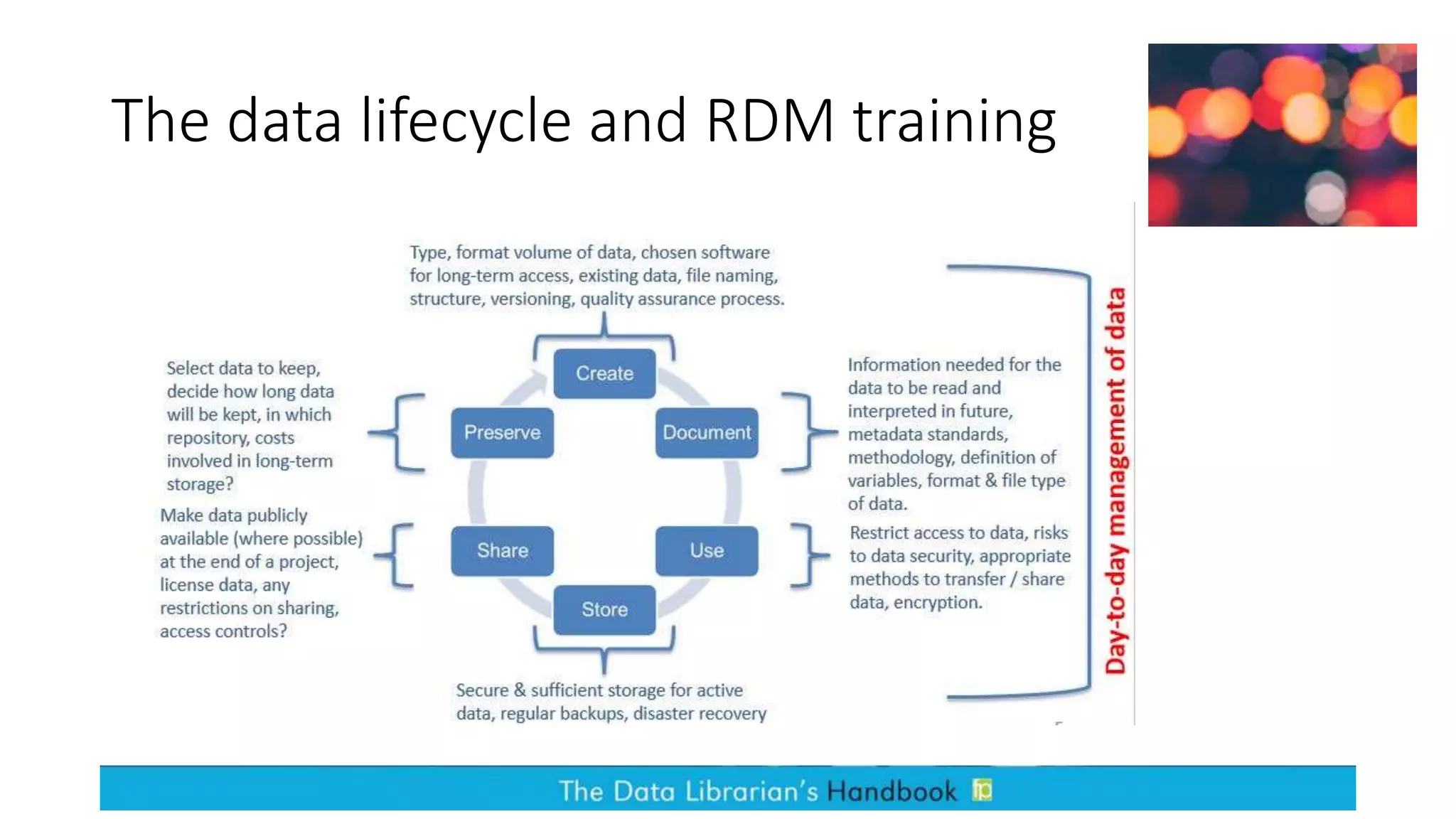
The data lifecycle and RDM training
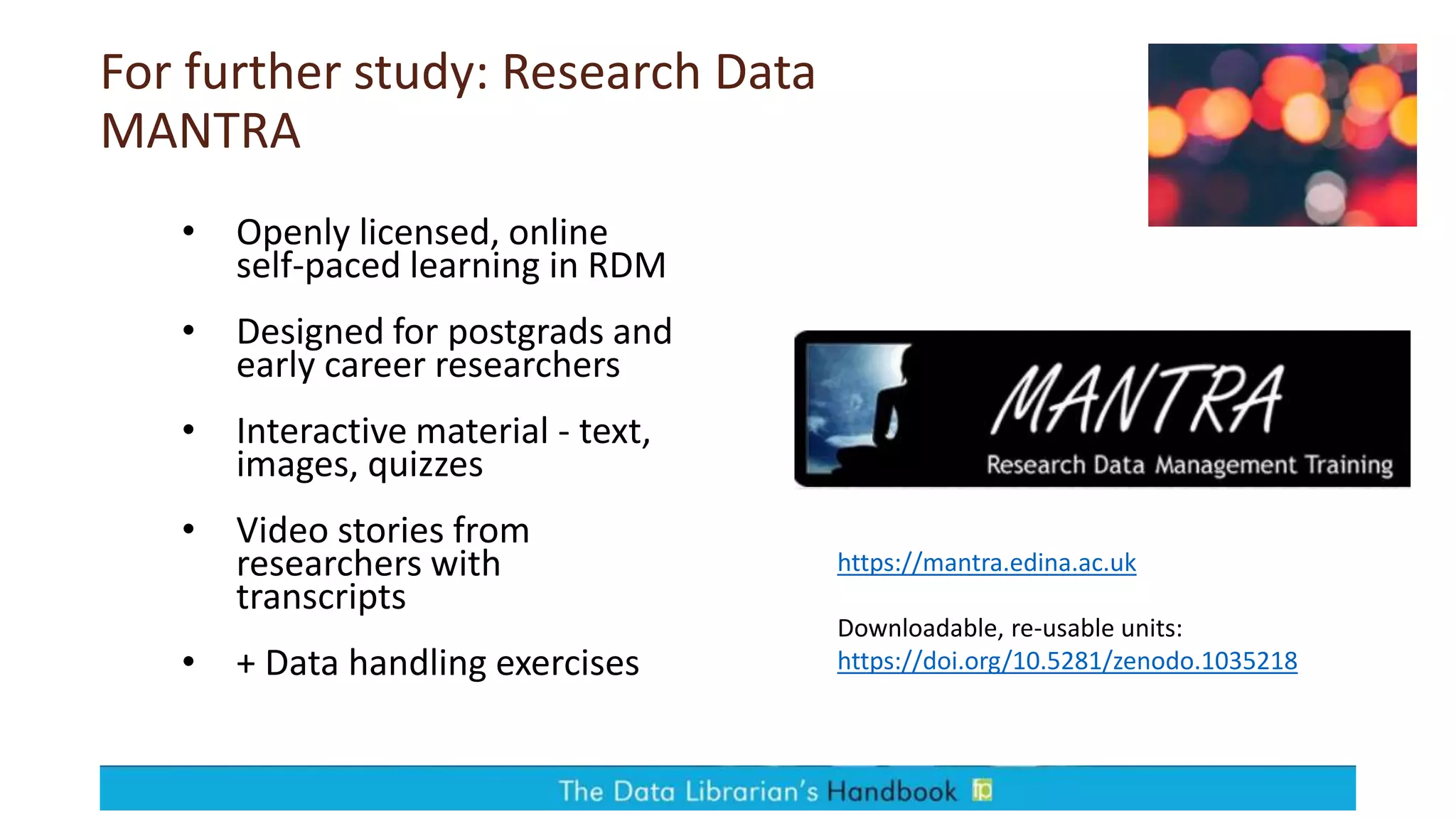
For further study: Research Data
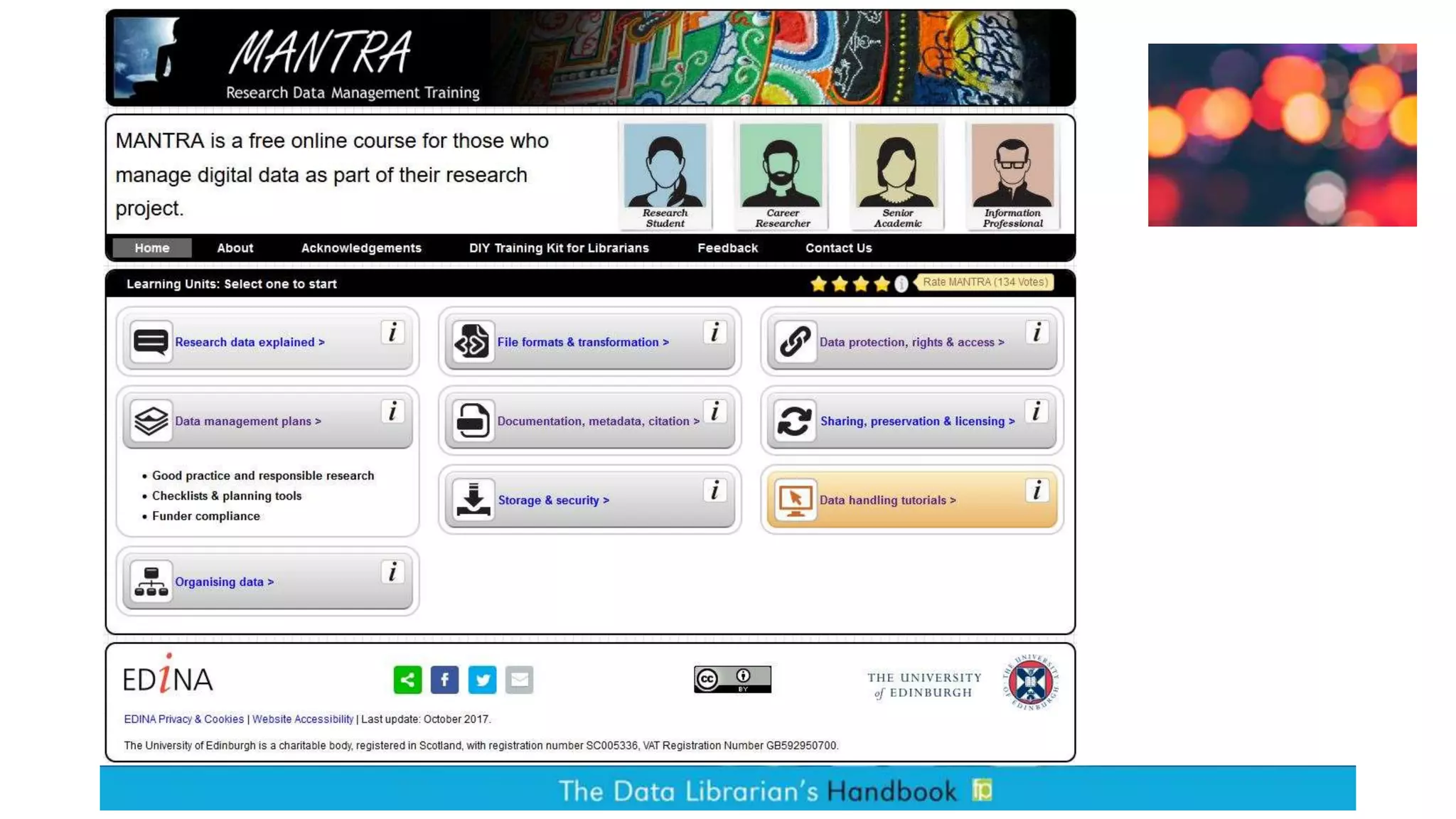
MANTRA
• Openly licensed, online
self-paced learning in RDM
• Designed for postgrads and
early career researchers
• Interactive material - text,
images, quizzes
• Video stories from
researchers with
transcripts
• + Data handling exercises
https://mantra.edina.ac.uk
Downloadable, re-usable units:
https://doi.org/10.5281/zenodo.1035218
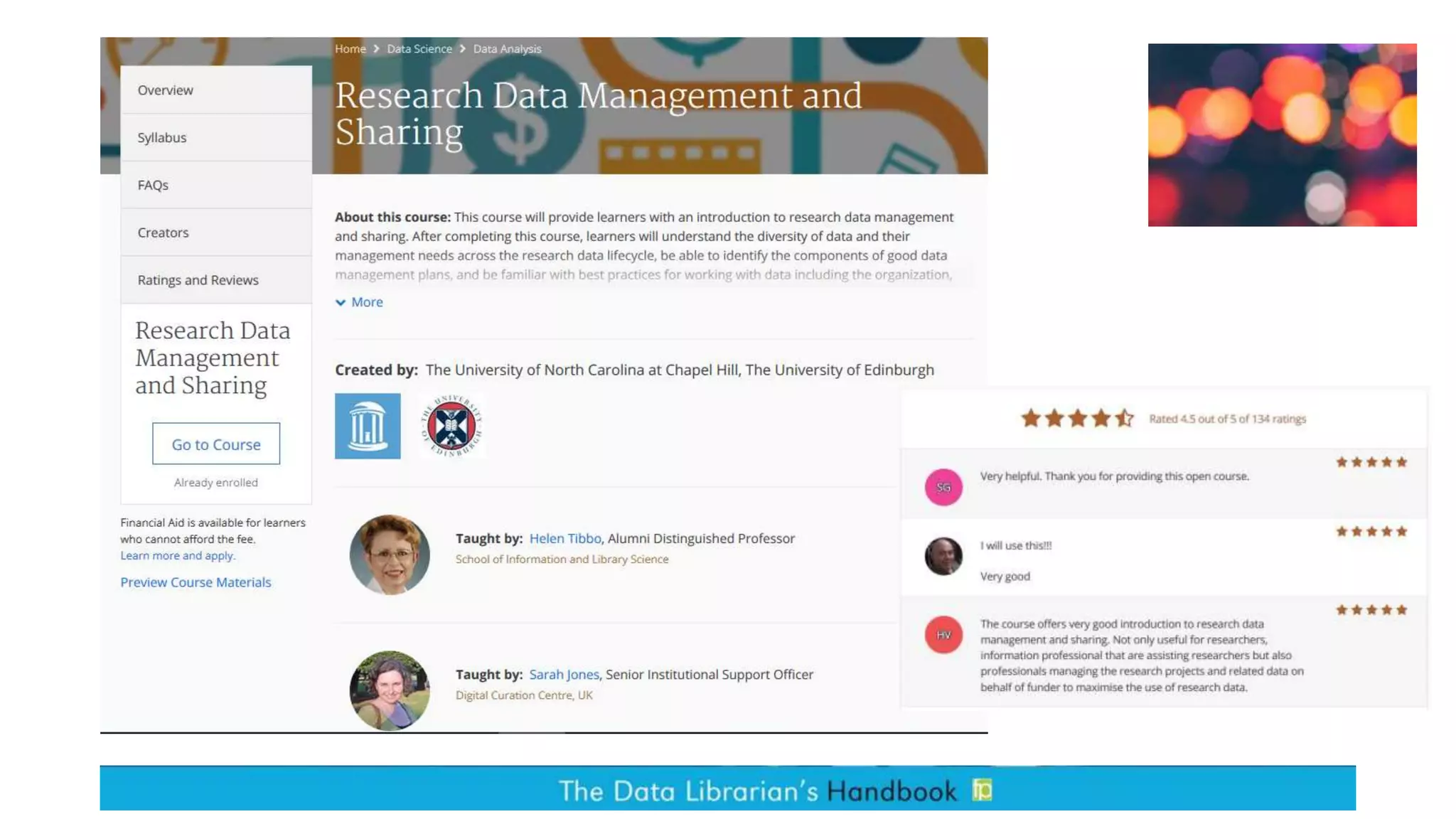
Research Data Mgmt & Sharing MOOC
(Coursera)
Collaboration with UNC-Chapel Hill CRADLE project
• Understanding Research Data
• Data Management Planning
• Working with Data
• Sharing Data
• Archiving Data
• www.coursera.org/learn/data-management
Understanding the mechanics of data
• Data structures and formats
• Rectangular datasets
• databases
• Images
• Audiovisual
• Text
• Big/streaming data
• Open formats and digital
preservation
• Software code – languages and
tools for manipulating data
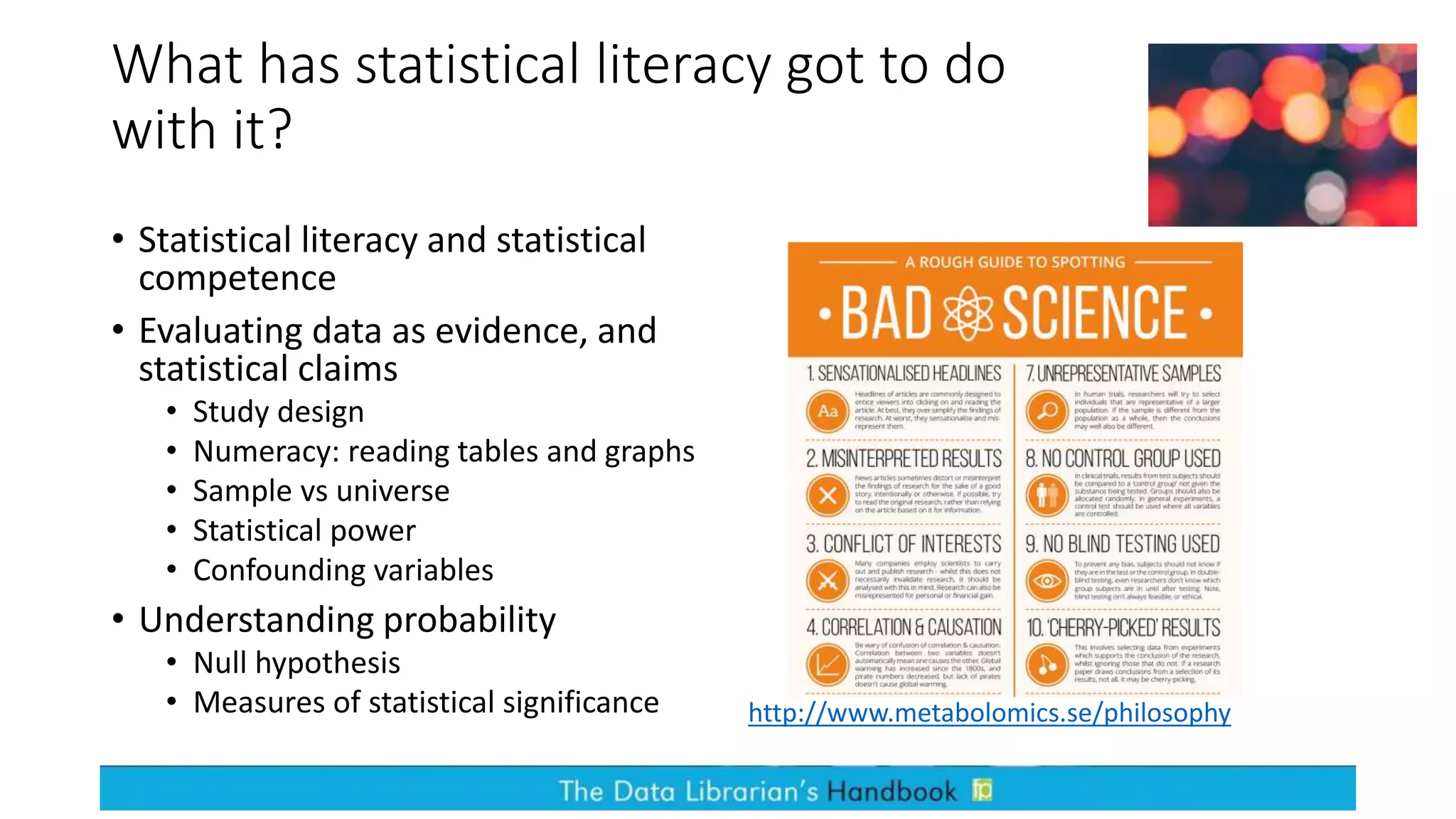
What has statistical literacy got to do
with it?
• Statistical literacy and statistical
competence
• Evaluating data as evidence, and
statistical claims
• Study design
• Numeracy: reading tables and graphs
• Sample vs universe
• Statistical power
• Confounding variables
• Understanding probability
• Null hypothesis
• Measures of statistical significance http://www.metabolomics.se/philosophy
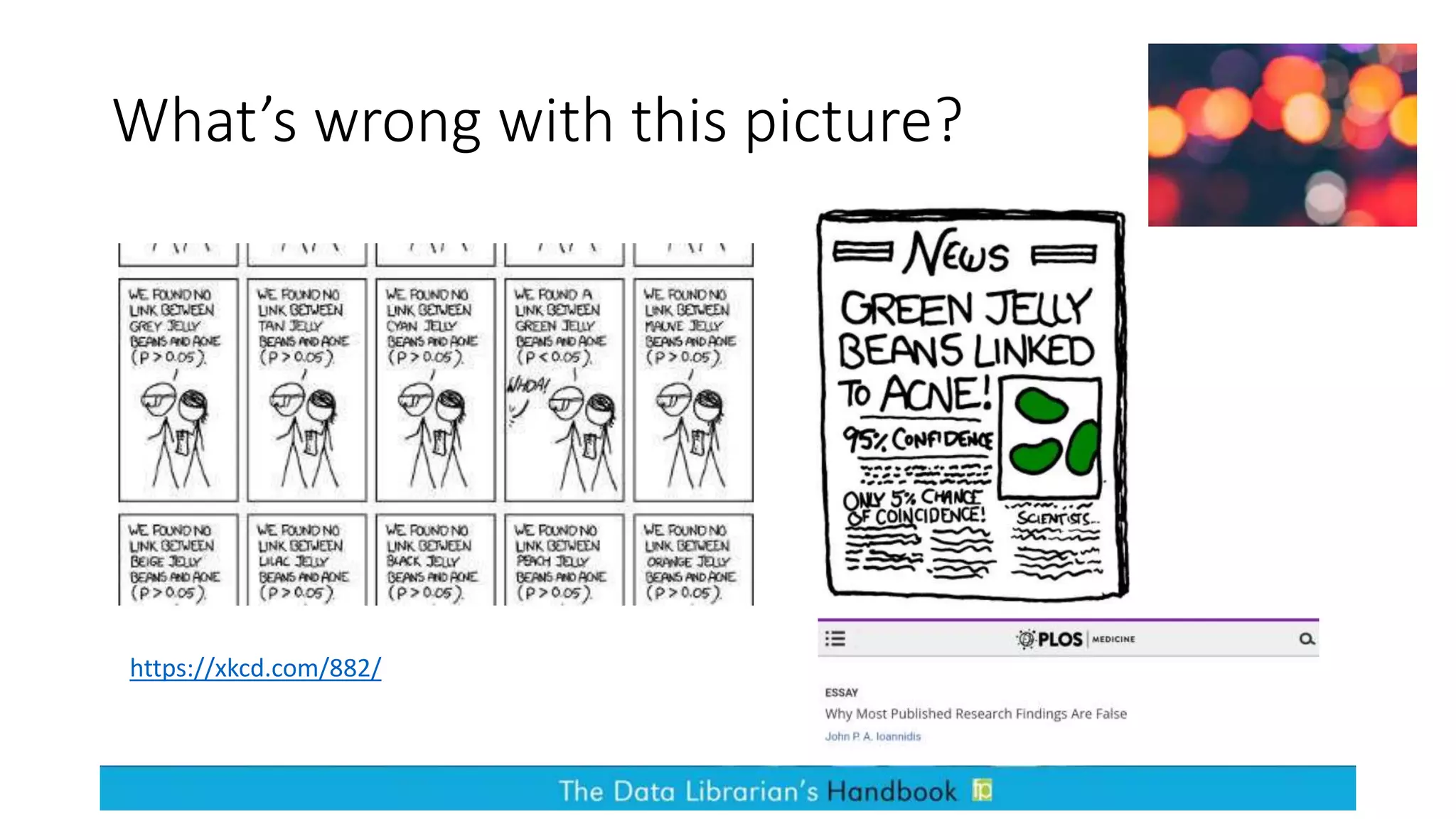
What’s wrong with this picture?
https://xkcd.com/882/
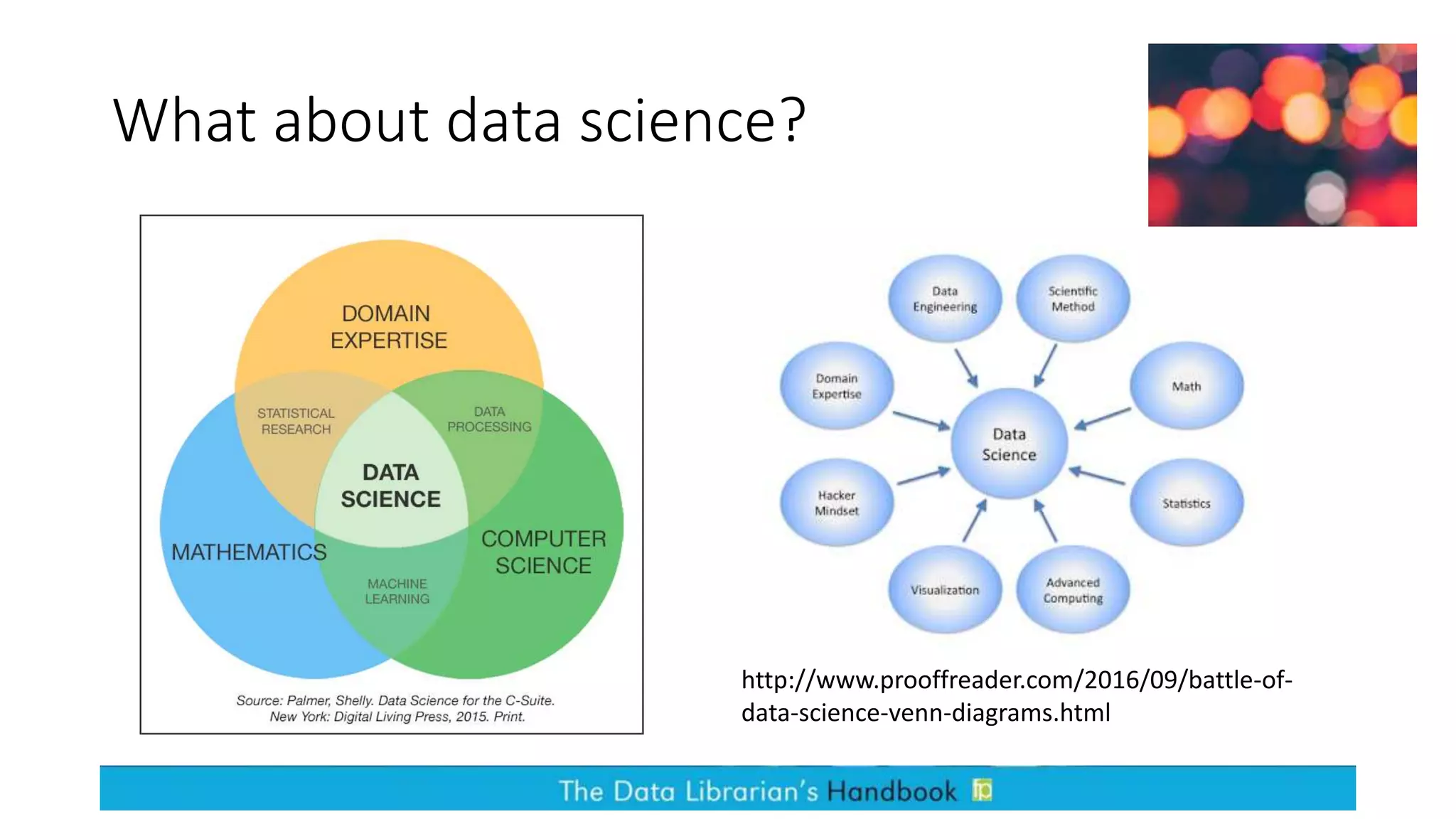
What about data science?
http://www.prooffreader.com/2016/09/battle-of-
data-science-venn-diagrams.html
What data skills do librarians
have / need?
• Many librarians come from a non-scientific, non-quantitative academic
background(?)
• Critical thinking goes a long way
• Skilling up is always an option
• Try some coding/working at the command line
• Many attributes of librarians are needed for data-driven science, scholarship
• Advocacy for FAIR principles, policy input, helping to drive culture change
• Curation of content and metadata
• Facilitating inter-disciplinary work, digital preservation, appraisal
• Match-making (researchers and data / repositories; helping students who are stuck)
• Helping join-up the data landscape – many disciplines/infrastructures operating in silos
Library service metrics
• What data do you need to wrangle / analyse to make your services data-driven?
Overview – putting ideas into practice
• Reskilling Librarians at the Bodleian
• Engagement with wider RDM support
• Embedding RDM training and the role of the Bodleian
• Termly briefings at the Bodleian
• New roles
Reskilling Librarians at the Bodleian
• Programme of simple introduction to RDM sessions;
• Geared to the particular landscape of University of Oxford
• ‘Bodleian Libraries’ as decentralised network of around 60 libraries
• Builds on existing training at Oxford
• Across divisions – discipline agnostic
• High proportion of part time staff
• Run twice termly – to increase availability
Training Delivery and feedback
• Integrated with staff development system;
• Advertised along other staff training
• Make use of existing booking and feedback mechanisms
• Included in training record of each participant
• Feedback
• Improved familiarity with RDM as a subject
• Greater awareness of its place in day to day activity
• Some less sure – but happy to be informed
• Variation due to discipline? e.g Natural Sciences more self contained and less
reliant on library advice with data handling/ advocating sharing?
• Overall more confident
Engagement with wider RDM support
• Building on reskilling
• From awareness to involvement
• Increasing engagement – dealing with research questions which are RDM questions
• Beyond citation and bibliographic management to data citation and management
• Promoting the usefulness of DMPs as good practice tool
• ORA-Data – our data repository
• Advocating its use
• Top-level understanding how it works and can be contacted
• Build on their existing understanding of resource access and licensing
• Research Data Oxford
• Promoting use of the RDM infrastructure at Oxford
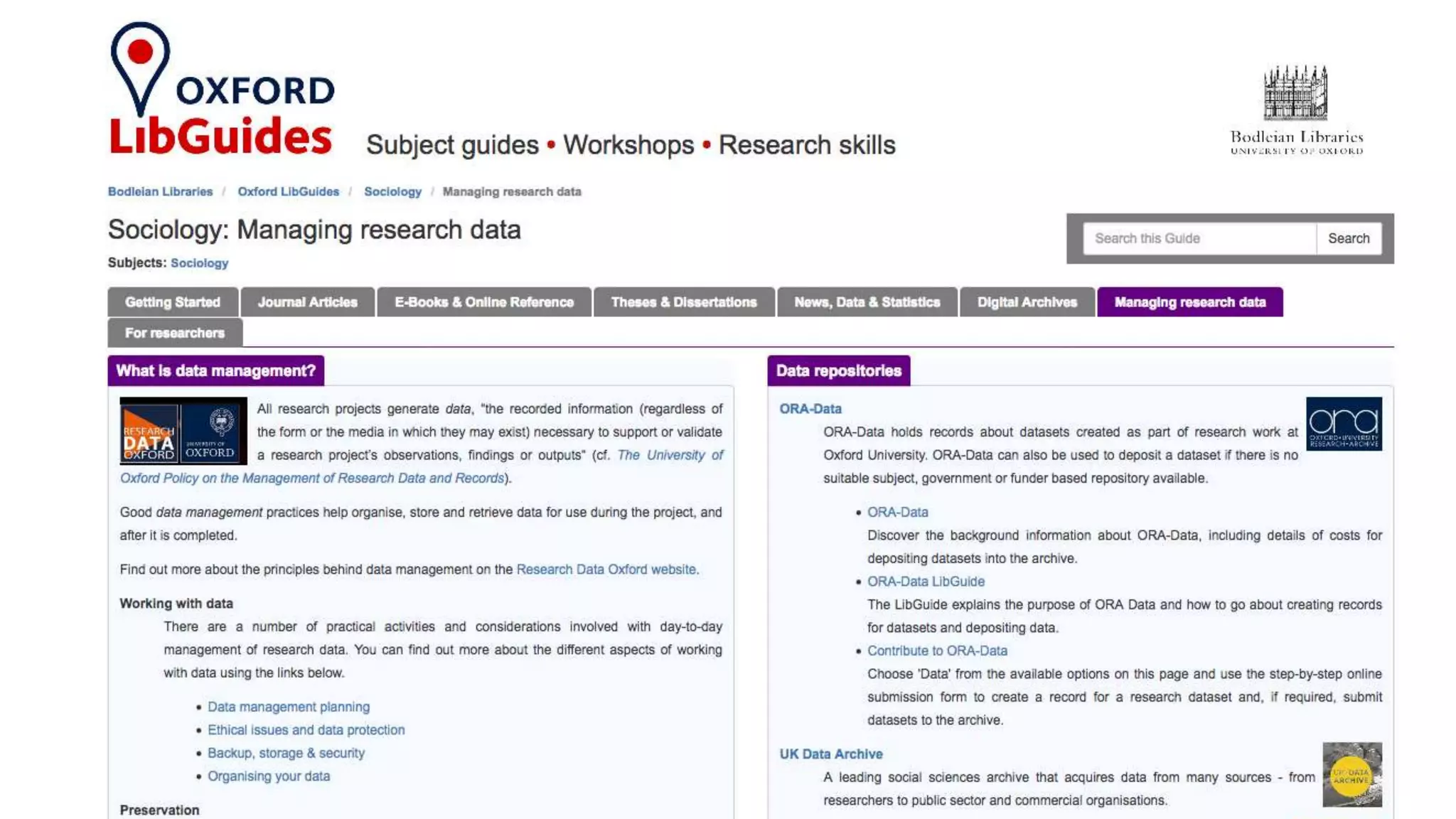
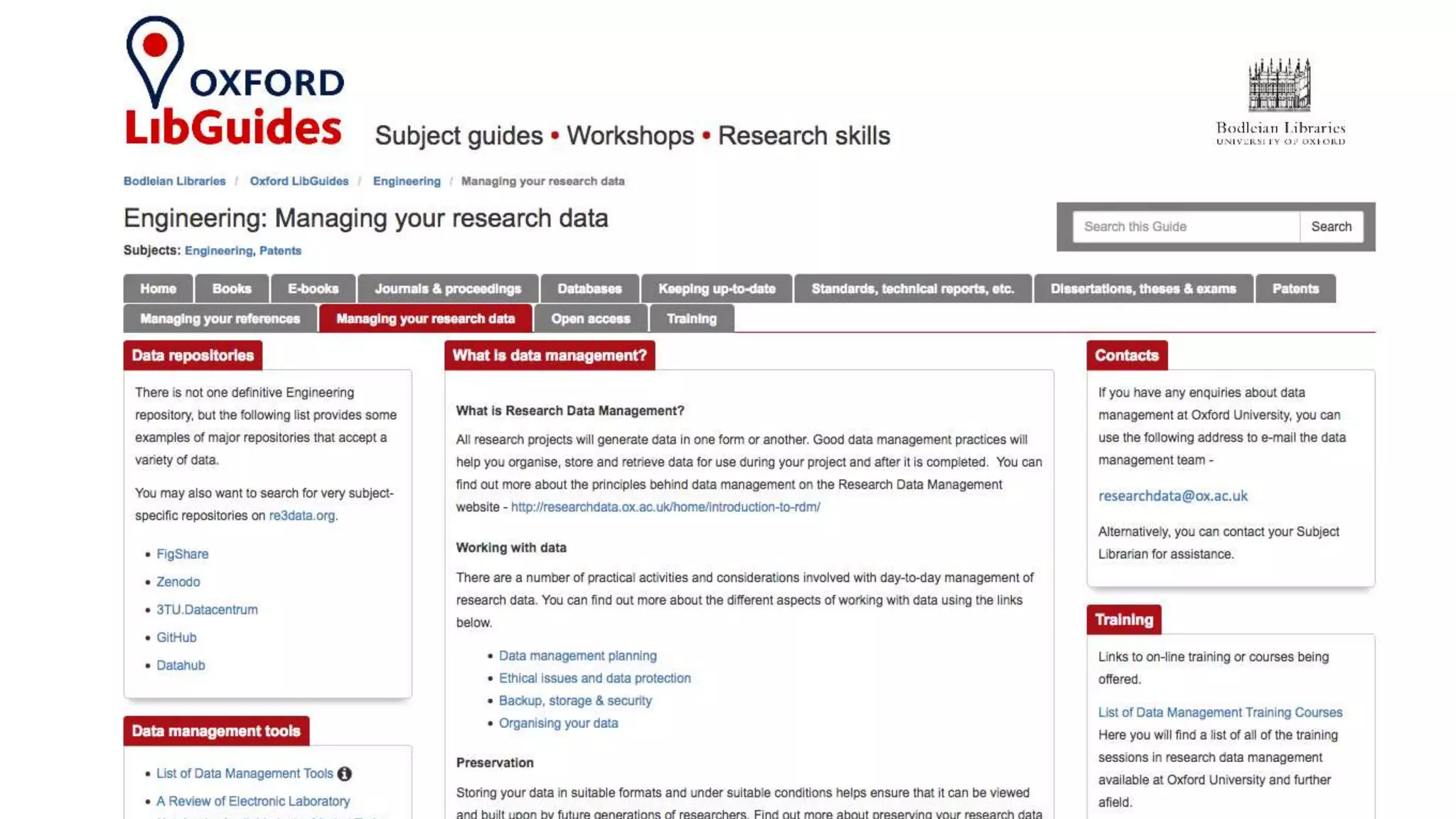
• Integrating RDO with library/subject consultant managed ‘libguides’
3bPic of lib guide with rdm tab
• Voluntary take up
• More being rolled out
3bPic of lib guide with rdm tab
• Voluntary take up
• More being rolled out
Embedding RDM training and the role
of the Bodleian
• Next steps - Refining initial training
• Look for gaps for further innovation
• Use existing intelligence gathering and sharing infrastructure
• Subject consultant network at University of Oxford
• E.g. staff training for Medical Sciences Division librarians
• New ‘bespoke ‘training’
• More focussed covering RDM themes for specific events – goals – deadlines
• E.g. presentations as part of workshops for post-graduates applying for ESRC funding
• E.g. briefings to departmental administrators on latest Wellcome Trust and Horizon
2020 RDM policy
• This is promoting RDM issues through meeting needs specific to an
institution
• Establishing the Bodleian as first point of contact for RDM
Termly briefings at the Bodleian
• Keeping data management in view of the Bodleian
• Keep it relevant to needs of librarians and readers
• Another way to keep training content up to date
• Termly data briefings
• Short meetings held every term: Michaelmas, Hilary and Trinity
• Include invited speakers from ‘data centric’ researchers at Oxford
• Update librarians on RDO and ORA-Data
• Hear about their interests and concerns
• Another way to keep training content up to date
• Create a dialogue on data access, management and preservation
New roles
• Data Stewards
• Need for data continued data administration after a project
• A data sharing co-pilot
• Currently defined on a case by case basis – departmental or library based
• Solution to particular cases which has created a useful precedent
• Identified and recruited through day to day library interaction – consultative
committees at Oxford
• Or through specialised knowledge of Bodleian subject consultants
Meeting reader demand
• Financial Data specialist
• Role under development
• Filling identified gap – need for library based support in data handling
• Recent expertise in finding and handling financial data
• Integrate with current training and research interviews
• Department of Economics
• Said Business School
• Accommodating wider use and demand of data across disciplines
• e.g ‘financial data’ also being used by;
• Sociology – History – Geography – Social Policy – Medicine – Migration Studies – Education
etc.
• More support needed to allow proper re-use
• Funders emphasise role of data creators in preparing for sharing and re-use
• Academic Libraries will play a key role in delivering it
• Supporting data handling becomes another facet of data literacy
Over to you – questions, comments
R.Rice@ed.ac.uk
John.Southall@bodleian.ox.ac.uk
WEBINAR: Research Data Services
Questions?
Type your questions in the chat box. Rob and Birgit will pose
questions to the speakers.
Unanswered questions will be covered in a blog post. This
will be published after the webinar.
We’ll email a link to the recording shortly.

LIBER Webinar: Supporting Data Literacy

  • 1.
    WEBINAR: Research DataServices WEBINAR: Supporting Data Literacy The webinar starts at 1400 CET Join the conversation: #LIBERWebinar
  • 2.
    Speakers Robin Rice University ofEdinburgh R.Rice@ed.ac.uk Moderating Birgit Schmidt Goettingen State and University Library bschmidt@sub.uni-goettingen.de Rob Grim Erasmus University Rotterdam grim@ubib.eur.nl John Southall Bodleian Libraries john.southall@bodleian.ox.ac.uk
  • 3.
    Supporting Data Literacy: Theoryand Practice LIBER Webinar Robin Rice & John Southall (Universities of Edinburgh and Oxford) 12 December 2017
  • 4.
    Overview – thetheory side of things • Why is data literacy important today? • Data literacy within library instruction • The Data lifecycle and RDM training • Understanding the mechanics of data • What has statistical literacy got to do with it? • What about data science? • What data skills do librarians have/need?
  • 5.
    Why is dataliteracy important today? (JOBS)
  • 6.
    You say youwant a (data) revolution… The number of people with these skills [Core Data Experts] needed to effectively operate the EOSC is, we estimate, likely exceeding half a million within a decade. https://joinup.ec.europa.eu/news/500000-data-scientists-need (Nov. 2016)
  • 7.
    New LIBER Strategy:7 of 15 themes directly relate to data skills 1. Research Data Management 2. Innovative Metrics 3. Diversifying Digital Skills of Library Staff Members and Researchers 4. Digital Cultural Heritage and Digital Humanities 5. Citizen Science 6. Semantic Interoperability; Open and Linked Data 7. Data Stewardship
  • 8.
    Data literacy withinlibrary instruction • Finding existing data sources • Promoting data citation • Data as a “first-class research object” - www.force11.org/datacitation, 2014 • Understanding the role of metadata • Open data licenses • FAIR and reproducibility principles • Legal, ethical caveats on data sharing One of the conclusions from the initial EOSC High Level Expert Group was that, with regards to effecting good research data practices, cultural change among researchers represents 80% of the challenge whereas technological change represents only 20%. - Knowledge Exchange (Nov. 2017) “The evolving landscape of Federated Research Data Infrastructures”, p. 28.
  • 9.
    The data lifecycleand RDM training
  • 10.
    For further study:Research Data MANTRA • Openly licensed, online self-paced learning in RDM • Designed for postgrads and early career researchers • Interactive material - text, images, quizzes • Video stories from researchers with transcripts • + Data handling exercises https://mantra.edina.ac.uk Downloadable, re-usable units: https://doi.org/10.5281/zenodo.1035218
  • 12.
    Research Data Mgmt& Sharing MOOC (Coursera) Collaboration with UNC-Chapel Hill CRADLE project • Understanding Research Data • Data Management Planning • Working with Data • Sharing Data • Archiving Data • www.coursera.org/learn/data-management
  • 14.
    Understanding the mechanicsof data • Data structures and formats • Rectangular datasets • databases • Images • Audiovisual • Text • Big/streaming data • Open formats and digital preservation • Software code – languages and tools for manipulating data
  • 15.
    What has statisticalliteracy got to do with it? • Statistical literacy and statistical competence • Evaluating data as evidence, and statistical claims • Study design • Numeracy: reading tables and graphs • Sample vs universe • Statistical power • Confounding variables • Understanding probability • Null hypothesis • Measures of statistical significance http://www.metabolomics.se/philosophy
  • 16.
    What’s wrong withthis picture? https://xkcd.com/882/
  • 17.
    What about datascience? http://www.prooffreader.com/2016/09/battle-of- data-science-venn-diagrams.html
  • 18.
    What data skillsdo librarians have / need? • Many librarians come from a non-scientific, non-quantitative academic background(?) • Critical thinking goes a long way • Skilling up is always an option • Try some coding/working at the command line • Many attributes of librarians are needed for data-driven science, scholarship • Advocacy for FAIR principles, policy input, helping to drive culture change • Curation of content and metadata • Facilitating inter-disciplinary work, digital preservation, appraisal • Match-making (researchers and data / repositories; helping students who are stuck) • Helping join-up the data landscape – many disciplines/infrastructures operating in silos Library service metrics • What data do you need to wrangle / analyse to make your services data-driven?
  • 19.
    Overview – puttingideas into practice • Reskilling Librarians at the Bodleian • Engagement with wider RDM support • Embedding RDM training and the role of the Bodleian • Termly briefings at the Bodleian • New roles
  • 20.
    Reskilling Librarians atthe Bodleian • Programme of simple introduction to RDM sessions; • Geared to the particular landscape of University of Oxford • ‘Bodleian Libraries’ as decentralised network of around 60 libraries • Builds on existing training at Oxford • Across divisions – discipline agnostic • High proportion of part time staff • Run twice termly – to increase availability
  • 21.
    Training Delivery andfeedback • Integrated with staff development system; • Advertised along other staff training • Make use of existing booking and feedback mechanisms • Included in training record of each participant • Feedback • Improved familiarity with RDM as a subject • Greater awareness of its place in day to day activity • Some less sure – but happy to be informed • Variation due to discipline? e.g Natural Sciences more self contained and less reliant on library advice with data handling/ advocating sharing? • Overall more confident
  • 22.
    Engagement with widerRDM support • Building on reskilling • From awareness to involvement • Increasing engagement – dealing with research questions which are RDM questions • Beyond citation and bibliographic management to data citation and management • Promoting the usefulness of DMPs as good practice tool • ORA-Data – our data repository • Advocating its use • Top-level understanding how it works and can be contacted • Build on their existing understanding of resource access and licensing • Research Data Oxford • Promoting use of the RDM infrastructure at Oxford • Integrating RDO with library/subject consultant managed ‘libguides’
  • 23.
    3bPic of libguide with rdm tab • Voluntary take up • More being rolled out
  • 24.
    3bPic of libguide with rdm tab • Voluntary take up • More being rolled out
  • 25.
    Embedding RDM trainingand the role of the Bodleian • Next steps - Refining initial training • Look for gaps for further innovation • Use existing intelligence gathering and sharing infrastructure • Subject consultant network at University of Oxford • E.g. staff training for Medical Sciences Division librarians • New ‘bespoke ‘training’ • More focussed covering RDM themes for specific events – goals – deadlines • E.g. presentations as part of workshops for post-graduates applying for ESRC funding • E.g. briefings to departmental administrators on latest Wellcome Trust and Horizon 2020 RDM policy • This is promoting RDM issues through meeting needs specific to an institution • Establishing the Bodleian as first point of contact for RDM
  • 26.
    Termly briefings atthe Bodleian • Keeping data management in view of the Bodleian • Keep it relevant to needs of librarians and readers • Another way to keep training content up to date • Termly data briefings • Short meetings held every term: Michaelmas, Hilary and Trinity • Include invited speakers from ‘data centric’ researchers at Oxford • Update librarians on RDO and ORA-Data • Hear about their interests and concerns • Another way to keep training content up to date • Create a dialogue on data access, management and preservation
  • 27.
    New roles • DataStewards • Need for data continued data administration after a project • A data sharing co-pilot • Currently defined on a case by case basis – departmental or library based • Solution to particular cases which has created a useful precedent • Identified and recruited through day to day library interaction – consultative committees at Oxford • Or through specialised knowledge of Bodleian subject consultants
  • 28.
    Meeting reader demand •Financial Data specialist • Role under development • Filling identified gap – need for library based support in data handling • Recent expertise in finding and handling financial data • Integrate with current training and research interviews • Department of Economics • Said Business School • Accommodating wider use and demand of data across disciplines • e.g ‘financial data’ also being used by; • Sociology – History – Geography – Social Policy – Medicine – Migration Studies – Education etc. • More support needed to allow proper re-use • Funders emphasise role of data creators in preparing for sharing and re-use • Academic Libraries will play a key role in delivering it • Supporting data handling becomes another facet of data literacy
  • 29.
    Over to you– questions, comments R.Rice@ed.ac.uk John.Southall@bodleian.ox.ac.uk
  • 30.
    WEBINAR: Research DataServices Questions? Type your questions in the chat box. Rob and Birgit will pose questions to the speakers. Unanswered questions will be covered in a blog post. This will be published after the webinar. We’ll email a link to the recording shortly.

Editor's Notes

  • #7 “According to Barend Mons [in the forward], the science system is in landslide transition from data-sparse to data-saturated. Meanwhile, scholarly communication, data management methodologies, reward systems and training curricula do not adapt quickly enough if at all to this revolution. Researchers, funders and publishers keep each other hostage in a deadly embrace by continuing to conduct, publish, fund and judge science in the same way as in the past century.” https://joinup.ec.europa.eu/news/500000-data-scientists-need (Nov. 2016)
  • #9 Finding existing data sources Search strategies Data repositories and archives Judging data quality for re-use Promoting data citation Data as a “first-class research object” - www.force11.org/datacitation, 2014 Human and machine-readable citations (e.g. DataCite DOIs) Understanding metadata Minimum information standards, DC Linking own publications with data
  • #17 Science is innately sceptical – hypothesis testing is about proving the likelihood results are NOT due to chance. Important to understand the danger of chasing P values (p-hacking); reasons for the Publication Bias, etc. John P.A. Ioannidis, Why most published research findings are fasl
  • #22 Moving from top down monologue to a more useful dialogue
  • #26 Example of refining training – more targeted and less disipline agnostic e.g. MSD sessions – draw on subj con knolwedge of audinece – when to atrract etc Bespoke training will not be seen as such by the participants but rather as meeting their needs in filling gaps in knowledge to meet project deadlines or better realise the objectives of an event
  • #27 Sustaining discussion of data literacy by librarians
  • #29 Builds towards conclusion Supporting data handling becomes another facet of data literacy
  • #30 Science, scholarship is changing. Better to have librarians involved. LIBER strategy reminder.