Research Data Management for Postgraduates
Lynn Woolfrey
lynn.woolfrey@uct.ac.za
Ulwazi Knowledge Commons, Chancellor Oppenheimer Library
University of Cape Town, 27 March, 2014
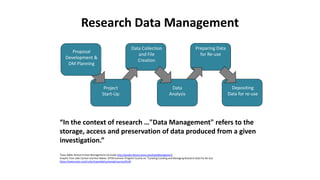
Research Data Management
Preparing Data
for Re-use
Data Collection
and File
Creation
Depositing
Data for re-use
Data
Analysis
Project
Start-Up
Proposal
Development &
DM Planning
“In the context of research …"Data Management" refers to the
storage, access and preservation of data produced from a given
investigation.”
Texas A&M, Research Data Management Lib Guide http://guides.library.tamu.edu/DataManagement
Graphic from Jake Carlson and Ron Nakao. ICPSR Summer Program Course on “Curating Curating and Managing Research Data for Re-Use
https://www.icpsr.umich.edu/icpsrweb/sumprog/courses/0149
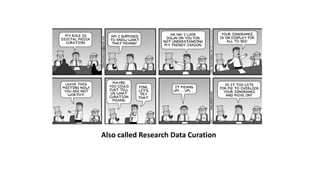
Also called Research Data Curation
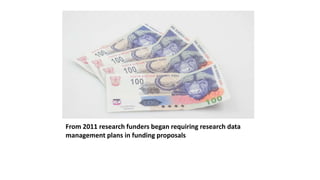
From 2011 research funders began requiring research data
management plans in funding proposals
UCT is creating policy and infrastructure for the long-term
preservation of UCT research output and its underlying data
WHY SHOULD WE DO IT?
Research Data Management
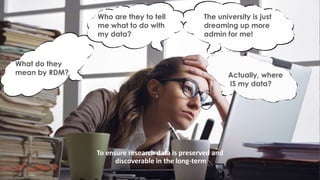
Actually, where
IS my data?
What do they
mean by RDM?
Who are they to tell
me what to do with
my data?
The university is just
dreaming up more
admin for me!
To ensure research data is preserved and
discoverable in the long-term
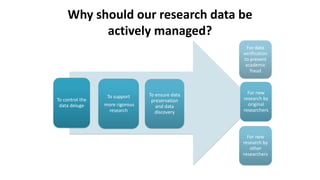
To control the
data deluge
To support
more rigorous
research
To ensure data
preservation
and data
discovery
For new
research by
original
researchers
For new
research by
other
researchers
For data
verification
to prevent
academic
fraud
Why should our research data be
actively managed?
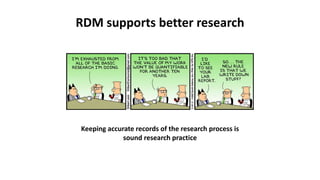
RDM supports better research
Keeping accurate records of the research process is
sound research practice
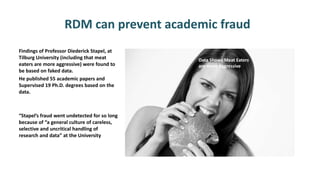
RDM can prevent academic fraud
Findings of Professor Diederick Stapel, at
Tilburg University (including that meat
eaters are more aggressive) were found to
be based on faked data.
He published 55 academic papers and
Supervised 19 Ph.D. degrees based on the
data.
“Stapel’s fraud went undetected for so long
because of “a general culture of careless,
selective and uncritical handling of
research and data” at the University
Data Shows Meat Eaters
are more Aggressive
RDM enables data re-use
Research funders want to maximise returns on their
investment in research by encouraging data re-use
HOW TO WRITE A RESEARCH DATA MANAGEMENT PLAN
Research Data Management
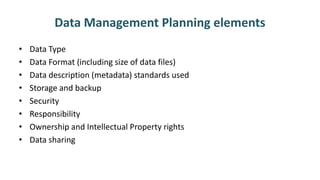
Data Management Planning elements
• Data Type
• Data Format (including size of data files)
• Data description (metadata) standards used
• Storage and backup
• Security
• Responsibility
• Ownership and Intellectual Property rights
• Data sharing
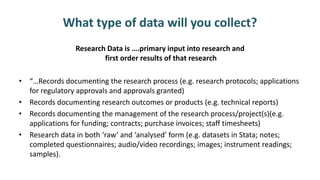
What type of data will you collect?
Research Data is ….primary input into research and
first order results of that research
• “…Records documenting the research process (e.g. research protocols; applications
for regulatory approvals and approvals granted)
• Records documenting research outcomes or products (e.g. technical reports)
• Records documenting the management of the research process/project(s)(e.g.
applications for funding; contracts; purchase invoices; staff timesheets)
• Research data in both ‘raw’ and ‘analysed’ form (e.g. datasets in Stata; notes;
completed questionnaires; audio/video recordings; images; instrument readings;
samples).
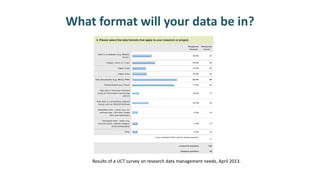
What format will your data be in?
Results of a UCT survey on research data management needs, April 2013.
How much data will you collect?
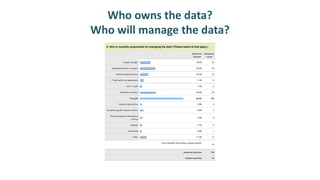
Who owns the data?
Who will manage the data?
What standards will you use to
describe your data?
Standards for file naming,
versioning, metadata
http://www.dcc.ac.uk/resources
http://www.icpsr.umich.edu/icpsrweb/content/datamanagement/index.html
http://surveynetwork.org/;www.ddialliance.org
http://www.datafirst.uct.ac.za/catalog
How will your data be stored?
• How will data be stored and backed up during the project?
• How will data be selected for longer-term preservation?
• How much space will you need for your data?
• In which repository will the data be held?
• How long will the data be retained?
• How will data security be handled during the project for access by
collaborators and data transfer from the field to storage?
• How will you deal with confidential data during the project?
• How will data authenticity be assured?
How will your data be shared?
“*If Intellectual Property rights don’t apply+ the data generated
from this research must become available to other researchers
working in the same field (National Research Foundation:
Acceptance of grant conditions 2010).”
Plan for data sharing now
Your research reputation will in future be linked to making
your well-organised research data available to the academic
community once you complete your research. This will be
done through the coupling of data sharing to academic
recognition, and through increased citations from Linked
Open Data.
Web-tools for Data Management
Planning
https://dmponline.dcc.ac.uk/
http://www.data-archive.ac.uk/create-manage
https://dmp.cdlib.org/
Questions?
Questions?

Data management woolfrey

  • 1.
    Research Data Managementfor Postgraduates Lynn Woolfrey lynn.woolfrey@uct.ac.za Ulwazi Knowledge Commons, Chancellor Oppenheimer Library University of Cape Town, 27 March, 2014
  • 2.
    Research Data Management PreparingData for Re-use Data Collection and File Creation Depositing Data for re-use Data Analysis Project Start-Up Proposal Development & DM Planning “In the context of research …"Data Management" refers to the storage, access and preservation of data produced from a given investigation.” Texas A&M, Research Data Management Lib Guide http://guides.library.tamu.edu/DataManagement Graphic from Jake Carlson and Ron Nakao. ICPSR Summer Program Course on “Curating Curating and Managing Research Data for Re-Use https://www.icpsr.umich.edu/icpsrweb/sumprog/courses/0149
  • 3.
    Also called ResearchData Curation
  • 4.
    From 2011 researchfunders began requiring research data management plans in funding proposals
  • 5.
    UCT is creatingpolicy and infrastructure for the long-term preservation of UCT research output and its underlying data
  • 6.
    WHY SHOULD WEDO IT? Research Data Management
  • 7.
    Actually, where IS mydata? What do they mean by RDM? Who are they to tell me what to do with my data? The university is just dreaming up more admin for me! To ensure research data is preserved and discoverable in the long-term
  • 8.
    To control the datadeluge To support more rigorous research To ensure data preservation and data discovery For new research by original researchers For new research by other researchers For data verification to prevent academic fraud Why should our research data be actively managed?
  • 9.
    RDM supports betterresearch Keeping accurate records of the research process is sound research practice
  • 10.
    RDM can preventacademic fraud Findings of Professor Diederick Stapel, at Tilburg University (including that meat eaters are more aggressive) were found to be based on faked data. He published 55 academic papers and Supervised 19 Ph.D. degrees based on the data. “Stapel’s fraud went undetected for so long because of “a general culture of careless, selective and uncritical handling of research and data” at the University Data Shows Meat Eaters are more Aggressive
  • 11.
    RDM enables datare-use Research funders want to maximise returns on their investment in research by encouraging data re-use
  • 12.
    HOW TO WRITEA RESEARCH DATA MANAGEMENT PLAN Research Data Management
  • 13.
    Data Management Planningelements • Data Type • Data Format (including size of data files) • Data description (metadata) standards used • Storage and backup • Security • Responsibility • Ownership and Intellectual Property rights • Data sharing
  • 14.
    What type ofdata will you collect? Research Data is ….primary input into research and first order results of that research • “…Records documenting the research process (e.g. research protocols; applications for regulatory approvals and approvals granted) • Records documenting research outcomes or products (e.g. technical reports) • Records documenting the management of the research process/project(s)(e.g. applications for funding; contracts; purchase invoices; staff timesheets) • Research data in both ‘raw’ and ‘analysed’ form (e.g. datasets in Stata; notes; completed questionnaires; audio/video recordings; images; instrument readings; samples).
  • 15.
    What format willyour data be in? Results of a UCT survey on research data management needs, April 2013.
  • 16.
    How much datawill you collect?
  • 17.
    Who owns thedata? Who will manage the data?
  • 18.
    What standards willyou use to describe your data?
  • 19.
    Standards for filenaming, versioning, metadata http://www.dcc.ac.uk/resources http://www.icpsr.umich.edu/icpsrweb/content/datamanagement/index.html http://surveynetwork.org/;www.ddialliance.org http://www.datafirst.uct.ac.za/catalog
  • 20.
    How will yourdata be stored? • How will data be stored and backed up during the project? • How will data be selected for longer-term preservation? • How much space will you need for your data? • In which repository will the data be held? • How long will the data be retained? • How will data security be handled during the project for access by collaborators and data transfer from the field to storage? • How will you deal with confidential data during the project? • How will data authenticity be assured?
  • 21.
    How will yourdata be shared? “*If Intellectual Property rights don’t apply+ the data generated from this research must become available to other researchers working in the same field (National Research Foundation: Acceptance of grant conditions 2010).”
  • 22.
    Plan for datasharing now Your research reputation will in future be linked to making your well-organised research data available to the academic community once you complete your research. This will be done through the coupling of data sharing to academic recognition, and through increased citations from Linked Open Data.
  • 23.
    Web-tools for DataManagement Planning https://dmponline.dcc.ac.uk/ http://www.data-archive.ac.uk/create-manage https://dmp.cdlib.org/
  • 24.

Editor's Notes

  • #4 http://dilbert.com/strips/comic/2011-10-30/
  • #5 http://www.nsf.gov/eng/general/dmp.jsp
  • #10 http://dilbert.com/strips/comic/2010-05-28
  • #11 http://www.nytimes.com/2013/04/28/magazine/diederik-stapels-audacious-academic-fraud.html?pagewanted=all&_r=0
  • #15 (Blue Ribbon Task Group report, 2010)” http://brtf.sdsc.edu/biblio/BRTF_Final_Report.pdf
  • #16 Woolfrey, L. 2013. UCT Research Data Management Needs Survey Report.