Inquiry-Based Learning

                                How It Looks,
                               Sounds and Feels
http://www.suhsd.k12.ca.us/suh/---suhionline/inquirybased.htm
http://www.thirteen.org/edonline/concept2class/inquiry/index_sub1.html


 How does Inquiry Lessons differ from
 the traditional approach?

In general, the traditional approach to
learning is focused on mastery of content,
with less emphasis on the development of
skills and the nurturing of inquiring attitudes.
The current system of education is teacher
centered, with the teacher focused on giving
out information about "what is known."
Students are the receivers of information, and
the teacher is the dispenser. Much of the
assessment of the learner is focused on the
importance of "one right answer." Traditional
education is more concerned with preparation
for the next grade level and in-school success
than with helping a student learn to learn
throughout life.
What Is Inquiry and Why Do It?

          Inquiry-based Learning
    The inquiry approach is more focused on using
    and learning content as a means to develop
    information-processing and problem-solving
    skills. The system is more student centered, with
    the teacher as a facilitator of learning. There is
    more emphasis on "how we come to know" and
    less on "what we know." Students are more
    involved in the construction of knowledge
    through active involvement. The more interested
    and engaged students are by a subject or project,
    the easier it will be for them to construct in-
    depth knowledge of it. Learning becomes almost
    effortless when something fascinates students
    and reflects their interests and goals.
Definitions from Students
 “When you do stuff that is
real.”
 “It is like projects and things
that take a long time.”
 “When kids work in groups or
with partners and make big
things.”
 “It’s fun!”
Five Characteristics
         of
   Inquiry-Based
      Learning
1. Bloom’s Taxonomy

Inquiry-based Learning
asks questions that come
from the higher levels of
Bloom’s Taxonomy.
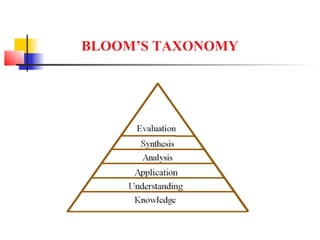
BLOOM’S TAXONOMY
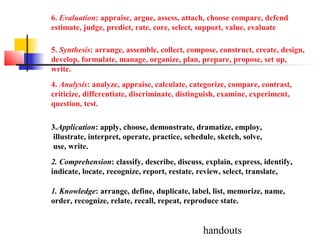
6. Evaluation: appraise, argue, assess, attach, choose compare, defend
estimate, judge, predict, rate, core, select, support, value, evaluate

5. Synthesis: arrange, assemble, collect, compose, construct, create, design,
develop, formulate, manage, organize, plan, prepare, propose, set up,
write.
4. Analysis: analyze, appraise, calculate, categorize, compare, contrast,
criticize, differentiate, discriminate, distinguish, examine, experiment,
question, test.

3.Application: apply, choose, demonstrate, dramatize, employ,
 illustrate, interpret, operate, practice, schedule, sketch, solve,
 use, write.
2. Comprehension: classify, describe, discuss, explain, express, identify,
indicate, locate, recognize, report, restate, review, select, translate,

1. Knowledge: arrange, define, duplicate, label, list, memorize, name,
order, recognize, relate, recall, repeat, reproduce state.


                                                handouts
.
2. Asks Questions that Motivate


    Inquiry-Based Learning
    involves questions that
    are interesting and
    motivating to students.
3. Utilizes wide variety of resources


Inquiry-based Learning
utilizes a wide variety of
resources so students
can gather information
and form opinions.
        Inquiry in the Classroom
4. Teacher as Facilitator

Teachers play a new
role as guide or
facilitator
Teacher as Guide

 What does facilitating a class really
mean?
Rather than teach content, you will manage team member
interactions so that teams stay focused and make progress.
With your careful encouragement, each team's problem, plan of
action, and outcome will emerge on its own, the unique
product of its members' collective strengths and interests. In
your role of facilitator, you will begin by briefing students on
their projects they will be doing. When team work begins, you
will spend most of your time observing team members to
determine what problems they are having working together and
completing their assignments.
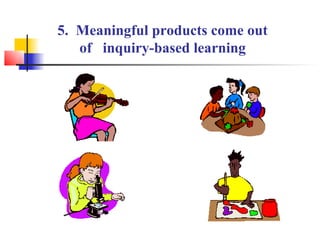
5. Meaningful products come out
   of inquiry-based learning
Learning in the Classroom


 Cooperative Learning
 Teamwork
 Excitement
 Presenting
 Movement
Five Kinds of Questions Need to be
Asked in Inquiry-based Learning

1.Inference Questions
2.Interpretation Questions
3.Transfer Questions
4.Questions about Hypotheses
5.Reflective Questions

The Art of Questioning by Denise Wolf
Research project for the Rockefeller Foundation.
Inference Questions…


 Ask students to go
beyond the immediately
available information.
 Ask students to look for
clues, examine them and
decide if they have a role
in the question.
Examples of Inference Questions


 “What conclusions can you
draw by looking at this
photograph?”

 “How did the author feel about the
character in the story?”
Interpretation Questions…


 Ask students to predict what
consequences may occur as a
result of a given scenario.

 Ask students to combine
past knowledge of situations
and new factual information.
Examples…
“You found that Sports Illustrated
actually had more tobacco ads than
any other magazine we looked at.
What does that say about Sports
Illustrated?”

“We read and loved two books by
Hill. What patterns did you see that
you think might be present in the
third book?”
Transfer Questions…

Ask students to take their
knowledge and apply it to new
situations.

Ask students to expand their
thinking.
Examples…

“We found many patterns in math
today. Now let’s look at our Language
Arts lesson on adverbs. Let’s see
what patterns you find there?”
“We learned how to make Inspiration
webs from paragraphs in our
textbook. Now let’s try going the other
way and making a web and then
writing a paragraph from it.”
Questions about Hypotheses…

 Ask students to predict
outcomes and carry out tests to
discover new knowledge.

 Questions are often seen in
science, but belong in all
disciplines.
Example:
“How can we find out
if Energizer batteries
really last the longest?”
Reflective Questions…

Ask students to look again at
the beliefs they have and the
evidence that supports them.

Lead students back into
investigation.
Examples…
 “How do we really know
that there are no aliens out
there?”
 “How do we know that
the show on TV was telling
the truth?”
Where do You Begin?

Examine your lessons
Listen to the questions you ask.
Start with small projects and
slowly expand.
Remember, children who are not
used to thinking may not know how
to approach problems. Be the
guide.
Planning an Inquiry Lesson
1.Think of a topic or standard you
might teach in your area.

2.Write down several questions you
might ask to motivate your students.

3. Label the type of question it is as
explained in this PowerPoint
presentation.
Inquiry-based Learning in Classrooms


http://www.thirteen.org/edonline/concept2class/inquiry/demonstration
Students Doing Inquiry-based Learning


  Students view themselves as learners in the
  process of learning.


*They look forward to learning.
*They demonstrate a desire to learn more.
*They seek to collaborate and work cooperatively
with teacher and peers.
*They are more confident in learning, demonstrate
a willingness to modify ideas and take calculated
risks, and display appropriate skepticism.


http://www.thirteen.org/edonline/concept2class/inquiry/index_sub2.html
Students accept an "invitation to
 learn" and willingly engage in an
 exploration process.

 *They exhibit curiosity and ponder
observations.

*They move around, selecting and
using the materials they need.

*They confer with their classmates and
teacher about observations and
questions.

*They try out some of their own ideas.
Students raise questions, propose
explanations, and use observations.

 *They ask questions (verbally and
through actions).
*They use questions that lead them to
activities generating further questions
or ideas.
*They observe critically, as opposed to
casually looking or listening.
*They value and apply questions as an
important part of learning.
*They make connections to previous
ideas.
Students plan and carry out
learning activities.


*They design ways to try out their ideas,
not always expecting to be told what to
do.
*They plan ways to verify, extend,
confirm, or discard ideas.
*They carry out activities by: using
materials, observing, evaluating, and
recording information.
*They sort out information and decide
what is important.
*They see detail, detect sequences and
events, notice change, and detect
differences and similarities.
Students communicate using a
variety of methods.


*They express ideas in a variety of ways,
including journals, drawing, reports,
graphing, and so forth.
*They listen, speak, and write about
learning activities with parents, teacher,
and peers.
*They use the language of learning,
apply the skills of processing
information, and develop their own
"ground rules" appropriate for the
discipline.
Students critique their
 learning practices.

*They use indicators to assess
their own work.
*They recognize and report their
strengths and weaknesses.
*They reflect on their learning
with their teacher and their
peers.
The importance of inquiry
learning is that students learn
how to continue learning. This is
something they can take with
them throughout life -- beyond
parental help and security,
beyond a textbook, beyond the
time of a master teacher, beyond
school -- to a time when they will
often be alone in their learning.

Inquiry basednew

  • 1.
    Inquiry-Based Learning How It Looks, Sounds and Feels http://www.suhsd.k12.ca.us/suh/---suhionline/inquirybased.htm
  • 2.
    http://www.thirteen.org/edonline/concept2class/inquiry/index_sub1.html How doesInquiry Lessons differ from the traditional approach? In general, the traditional approach to learning is focused on mastery of content, with less emphasis on the development of skills and the nurturing of inquiring attitudes. The current system of education is teacher centered, with the teacher focused on giving out information about "what is known." Students are the receivers of information, and the teacher is the dispenser. Much of the assessment of the learner is focused on the importance of "one right answer." Traditional education is more concerned with preparation for the next grade level and in-school success than with helping a student learn to learn throughout life.
  • 3.
    What Is Inquiryand Why Do It? Inquiry-based Learning The inquiry approach is more focused on using and learning content as a means to develop information-processing and problem-solving skills. The system is more student centered, with the teacher as a facilitator of learning. There is more emphasis on "how we come to know" and less on "what we know." Students are more involved in the construction of knowledge through active involvement. The more interested and engaged students are by a subject or project, the easier it will be for them to construct in- depth knowledge of it. Learning becomes almost effortless when something fascinates students and reflects their interests and goals.
  • 4.
    Definitions from Students “When you do stuff that is real.”  “It is like projects and things that take a long time.”  “When kids work in groups or with partners and make big things.”  “It’s fun!”
  • 5.
    Five Characteristics of Inquiry-Based Learning
  • 6.
    1. Bloom’s Taxonomy Inquiry-basedLearning asks questions that come from the higher levels of Bloom’s Taxonomy.
  • 7.
  • 8.
    6. Evaluation: appraise,argue, assess, attach, choose compare, defend estimate, judge, predict, rate, core, select, support, value, evaluate 5. Synthesis: arrange, assemble, collect, compose, construct, create, design, develop, formulate, manage, organize, plan, prepare, propose, set up, write. 4. Analysis: analyze, appraise, calculate, categorize, compare, contrast, criticize, differentiate, discriminate, distinguish, examine, experiment, question, test. 3.Application: apply, choose, demonstrate, dramatize, employ, illustrate, interpret, operate, practice, schedule, sketch, solve, use, write. 2. Comprehension: classify, describe, discuss, explain, express, identify, indicate, locate, recognize, report, restate, review, select, translate, 1. Knowledge: arrange, define, duplicate, label, list, memorize, name, order, recognize, relate, recall, repeat, reproduce state. handouts
  • 9.
    . 2. Asks Questionsthat Motivate Inquiry-Based Learning involves questions that are interesting and motivating to students.
  • 10.
    3. Utilizes widevariety of resources Inquiry-based Learning utilizes a wide variety of resources so students can gather information and form opinions. Inquiry in the Classroom
  • 11.
    4. Teacher asFacilitator Teachers play a new role as guide or facilitator
  • 12.
    Teacher as Guide What does facilitating a class really mean? Rather than teach content, you will manage team member interactions so that teams stay focused and make progress. With your careful encouragement, each team's problem, plan of action, and outcome will emerge on its own, the unique product of its members' collective strengths and interests. In your role of facilitator, you will begin by briefing students on their projects they will be doing. When team work begins, you will spend most of your time observing team members to determine what problems they are having working together and completing their assignments.
  • 13.
    5. Meaningful productscome out of inquiry-based learning
  • 14.
    Learning in theClassroom  Cooperative Learning  Teamwork  Excitement  Presenting  Movement
  • 15.
    Five Kinds ofQuestions Need to be Asked in Inquiry-based Learning 1.Inference Questions 2.Interpretation Questions 3.Transfer Questions 4.Questions about Hypotheses 5.Reflective Questions The Art of Questioning by Denise Wolf Research project for the Rockefeller Foundation.
  • 16.
    Inference Questions…  Askstudents to go beyond the immediately available information.  Ask students to look for clues, examine them and decide if they have a role in the question.
  • 17.
    Examples of InferenceQuestions  “What conclusions can you draw by looking at this photograph?”  “How did the author feel about the character in the story?”
  • 18.
    Interpretation Questions…  Askstudents to predict what consequences may occur as a result of a given scenario.  Ask students to combine past knowledge of situations and new factual information.
  • 19.
    Examples… “You found thatSports Illustrated actually had more tobacco ads than any other magazine we looked at. What does that say about Sports Illustrated?” “We read and loved two books by Hill. What patterns did you see that you think might be present in the third book?”
  • 20.
    Transfer Questions… Ask studentsto take their knowledge and apply it to new situations. Ask students to expand their thinking.
  • 21.
    Examples… “We found manypatterns in math today. Now let’s look at our Language Arts lesson on adverbs. Let’s see what patterns you find there?” “We learned how to make Inspiration webs from paragraphs in our textbook. Now let’s try going the other way and making a web and then writing a paragraph from it.”
  • 22.
    Questions about Hypotheses… Ask students to predict outcomes and carry out tests to discover new knowledge.  Questions are often seen in science, but belong in all disciplines.
  • 23.
    Example: “How can wefind out if Energizer batteries really last the longest?”
  • 24.
    Reflective Questions… Ask studentsto look again at the beliefs they have and the evidence that supports them. Lead students back into investigation.
  • 25.
    Examples…  “How dowe really know that there are no aliens out there?”  “How do we know that the show on TV was telling the truth?”
  • 26.
    Where do YouBegin? Examine your lessons Listen to the questions you ask. Start with small projects and slowly expand. Remember, children who are not used to thinking may not know how to approach problems. Be the guide.
  • 27.
    Planning an InquiryLesson 1.Think of a topic or standard you might teach in your area. 2.Write down several questions you might ask to motivate your students. 3. Label the type of question it is as explained in this PowerPoint presentation.
  • 28.
    Inquiry-based Learning inClassrooms http://www.thirteen.org/edonline/concept2class/inquiry/demonstration
  • 29.
    Students Doing Inquiry-basedLearning Students view themselves as learners in the process of learning. *They look forward to learning. *They demonstrate a desire to learn more. *They seek to collaborate and work cooperatively with teacher and peers. *They are more confident in learning, demonstrate a willingness to modify ideas and take calculated risks, and display appropriate skepticism. http://www.thirteen.org/edonline/concept2class/inquiry/index_sub2.html
  • 30.
    Students accept an"invitation to learn" and willingly engage in an exploration process. *They exhibit curiosity and ponder observations. *They move around, selecting and using the materials they need. *They confer with their classmates and teacher about observations and questions. *They try out some of their own ideas.
  • 31.
    Students raise questions,propose explanations, and use observations. *They ask questions (verbally and through actions). *They use questions that lead them to activities generating further questions or ideas. *They observe critically, as opposed to casually looking or listening. *They value and apply questions as an important part of learning. *They make connections to previous ideas.
  • 32.
    Students plan andcarry out learning activities. *They design ways to try out their ideas, not always expecting to be told what to do. *They plan ways to verify, extend, confirm, or discard ideas. *They carry out activities by: using materials, observing, evaluating, and recording information. *They sort out information and decide what is important. *They see detail, detect sequences and events, notice change, and detect differences and similarities.
  • 33.
    Students communicate usinga variety of methods. *They express ideas in a variety of ways, including journals, drawing, reports, graphing, and so forth. *They listen, speak, and write about learning activities with parents, teacher, and peers. *They use the language of learning, apply the skills of processing information, and develop their own "ground rules" appropriate for the discipline.
  • 34.
    Students critique their learning practices. *They use indicators to assess their own work. *They recognize and report their strengths and weaknesses. *They reflect on their learning with their teacher and their peers.
  • 35.
    The importance ofinquiry learning is that students learn how to continue learning. This is something they can take with them throughout life -- beyond parental help and security, beyond a textbook, beyond the time of a master teacher, beyond school -- to a time when they will often be alone in their learning.

Editor's Notes

  • #2 .
  • #6 Inquiry y -based learning is a difficult thing to define.  There are characteristics that educators agree are present in all or most Inquiry Based lessons The following is a list of five main components of IQBL
  • #7 We all remember comprehension, application, analysis, synthesis, and evaluation.  While those are kinds of metacognition, classifying the questions teachers ask becomes an an even more significant thing as the teacher sets the learning environment and expectations.
  • #10 We all know how excited kids get when they are asked to write book reports.  When they are asked to present are view as a news anchor that will be video tapped the feeling changes.  We are not merely entertaining our students.  Life poses problems in real everyday context.  By guiding students through those same scenarios we allow them to learn to solve problems in a supported environment with the help of their peers and their teacher.
  • #11 The Internet is just not the safe place we would like it to be.  We have the responsibility of keeping our students away from offensive material and safe from other users.  We can do this by selecting the sites ahead of time.  Reviewing the links on those pages and providing a “hotlist” of sites that students are allowed to look for information.
  • #12 Standard  classroom  teacher provides a list of things to fill in.  Write as paragraph IQBL Classroom   What would you want to know?   List questions ….. Provide resources………     Guide to a product that shows what they have learned.
  • #15 Cooperative Learning is a very important part of Inquiry-based Learning. Interaction between kids Gives new roles to kids Excitement  discovery   aha  celebrate learning! Presentations    Communication skills ……..  Language…….. Movement
  • #17 The act of reasoning from factual knowledge or evidence. Inductive Reasoning : Given detailed, concrete, factual information, the learner then forms a general, probable, predictive conclusion.  Example : Details- Red-cheeked faces, heavy coats, mittens, sniffling, boots, clear blue sky? Conclusion- It’s a very cold day in winter in MN.  Deductive Reasoning : Given a general truth, the learner then reasons through to a factual, concrete, detail.  Example : Conclusion- It’s below zero outside that day 
  • #21 Key to learning