Academic Writing
Learning Objectives
Understand what is meant by academic
writing
Awareness of academic conventions
and practices
Learn how to develop argument in your
writing
Awareness of plagiarism and use
appropriate use of references/citations
Resources
PURPOSE OF ACADEMIC WRITING
The word “essay” is derived from the Latin
verb “exigere”, which means to:
Examine
Test
Drive out
Other purposes
Discover knowledge
Make a point
Persuade the reader
Share information
Synthesize Information
Analyze a topic
Document your observations
All of the above
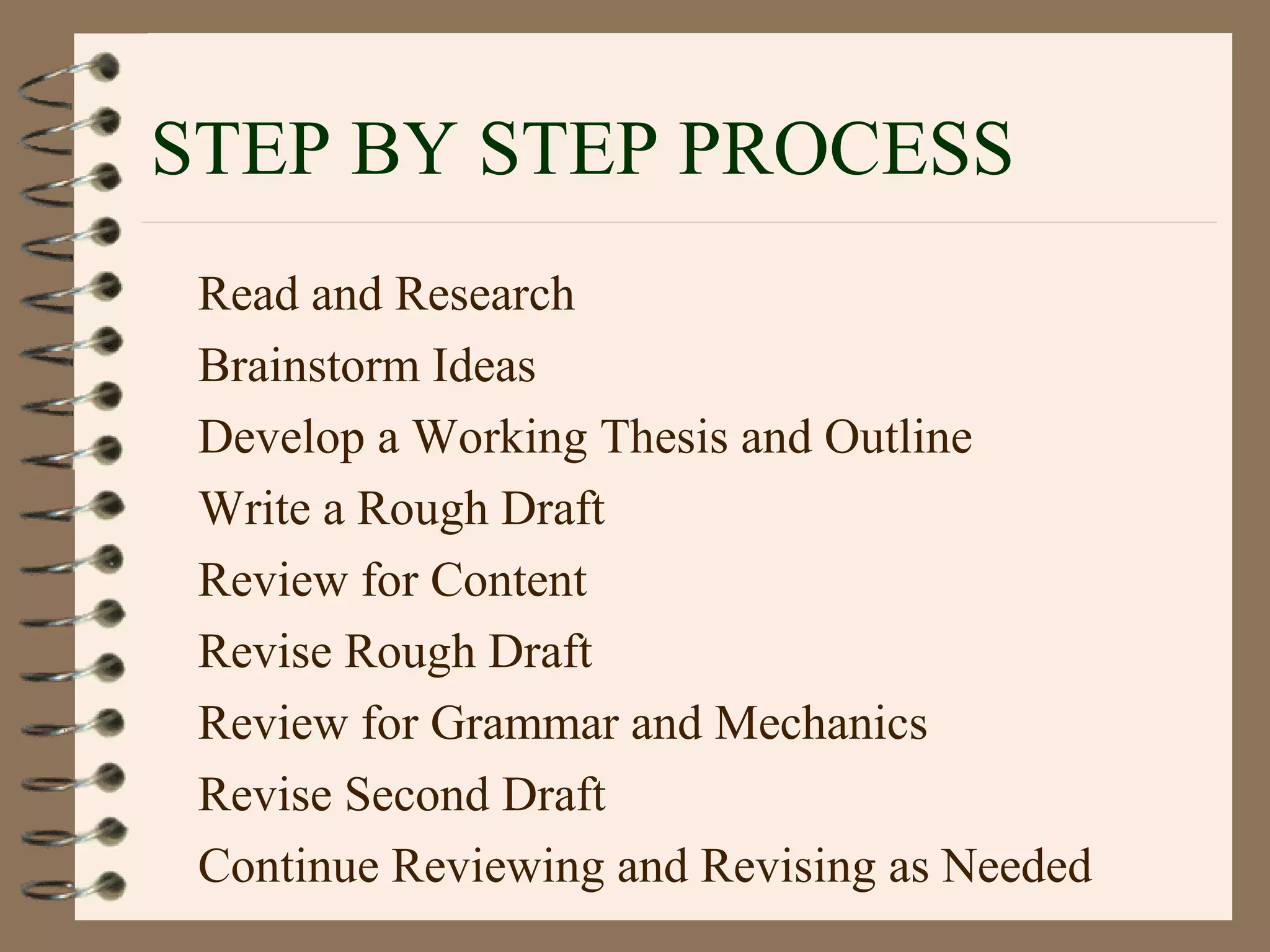
STEP BY STEP PROCESS
Read and Research
Brainstorm Ideas
Develop a Working Thesis and Outline
Write a Rough Draft
Review for Content
Revise Rough Draft
Review for Grammar and Mechanics
Revise Second Draft
Continue Reviewing and Revising as Needed
Ideas to write
Read texts related to your topic
Use brainstorming techniques like:
– Listing ideas
– Clustering or mind mapping
– Free writing
Discuss the issue with others
Research the topic
Developing an outline
Once you establish a thesis, use it to help
you develop an outline of the paper
An outline will:
– Help you organize your ideas
– Keep you focused
– Save time
For every main point, you’ll need several
supporting details
Paragraph Level Concern
Effective paragraphs are:
Well-developed
They avoid making assumptions.
Cohesive
Their ideas connect to one another (transitions).
Coherent
They clarify the logic of the paragraph (topic
sentences).
Topic Sentence
A topic sentence accomplishes the following tasks:
Expresses a claim (not a fact) that supports the thesis
Indicates the content of the paragraph (central idea)
Creates a transition from the previous paragraph
Maintain proper pacing (long/short sentences, etc.).
 Ex: “Although previous studies of weather patterns have focused
on rain and wind, this study proposes an analysis of tornado
formation.”
 Ex: “However, these studies have neglected the importance of
tornado formation.”
 Ex (Avoid): “Tornado formation is a major problem.”
Transitional Words and Phrases
Transitions signal relation between sentences, paragraphs
Know relationship between the sentences/paragraphs!
Addition (furthermore, more importantly, additionally, etc.)
Contrast (however, conversely, on the other hand, etc.)
Time Order (previously, subsequently, simultaneously, etc.)
Avoid multiple transitions/introductory clauses
“On the other hand, however, although the study…”
“Furthermore, where the study subsequently did…”
Avoid beginning with coordinating conjunctions (for, and, nor,
but, or, yet, so)
Referencing Sources
Citations/references allude to previous work or valuable
sources.
Know the conventions of your field.
Style Guides, Published Work, Etc.
Follow the guidelines for particular journals when
publishing
Know how and when to use references, quotations.
Avoid quoting to start/end paragraph.
Work quotes into your own sentences.
Sentence Level Concern
Effective sentences will:
Use active voice and clear, strong verbs.
Build a balanced hierarchy of ideas.
Use punctuation and quotes effectively.
Remember: The goal is to make your
reader understand (and be persuaded by)
your prose.
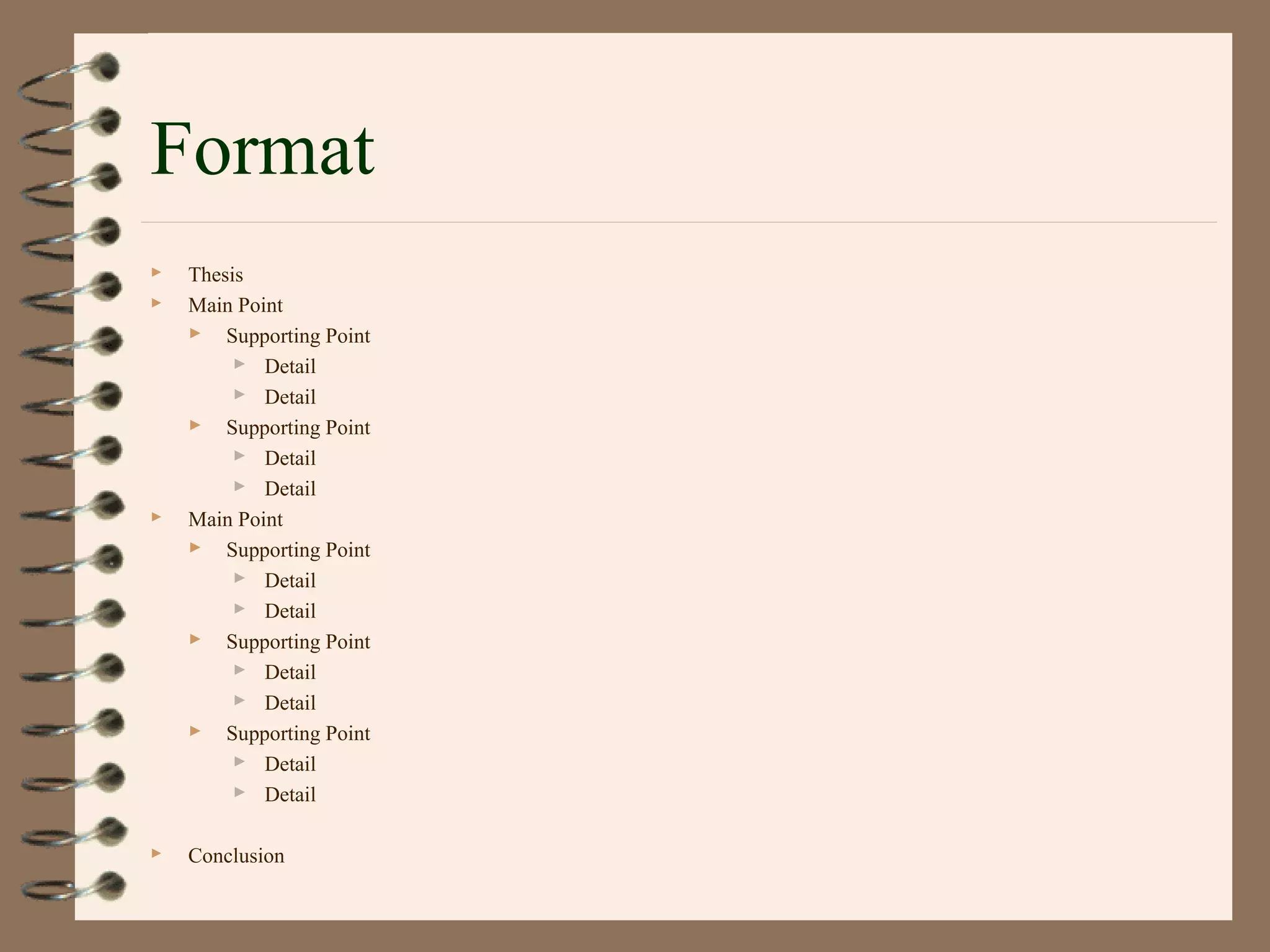
Format
 Thesis
 Main Point
 Supporting Point
 Detail
 Detail
 Supporting Point
 Detail
 Detail
 Main Point
 Supporting Point
 Detail
 Detail
 Supporting Point
 Detail
 Detail
 Supporting Point
 Detail
 Detail
 Conclusion
Writing in an academic way
Being critical and analytical
Using language in a precise & subject-
specific way
Adopting a position or claim - thesis
Drawing on and citing a range of
authors & arguments
Remaining objective
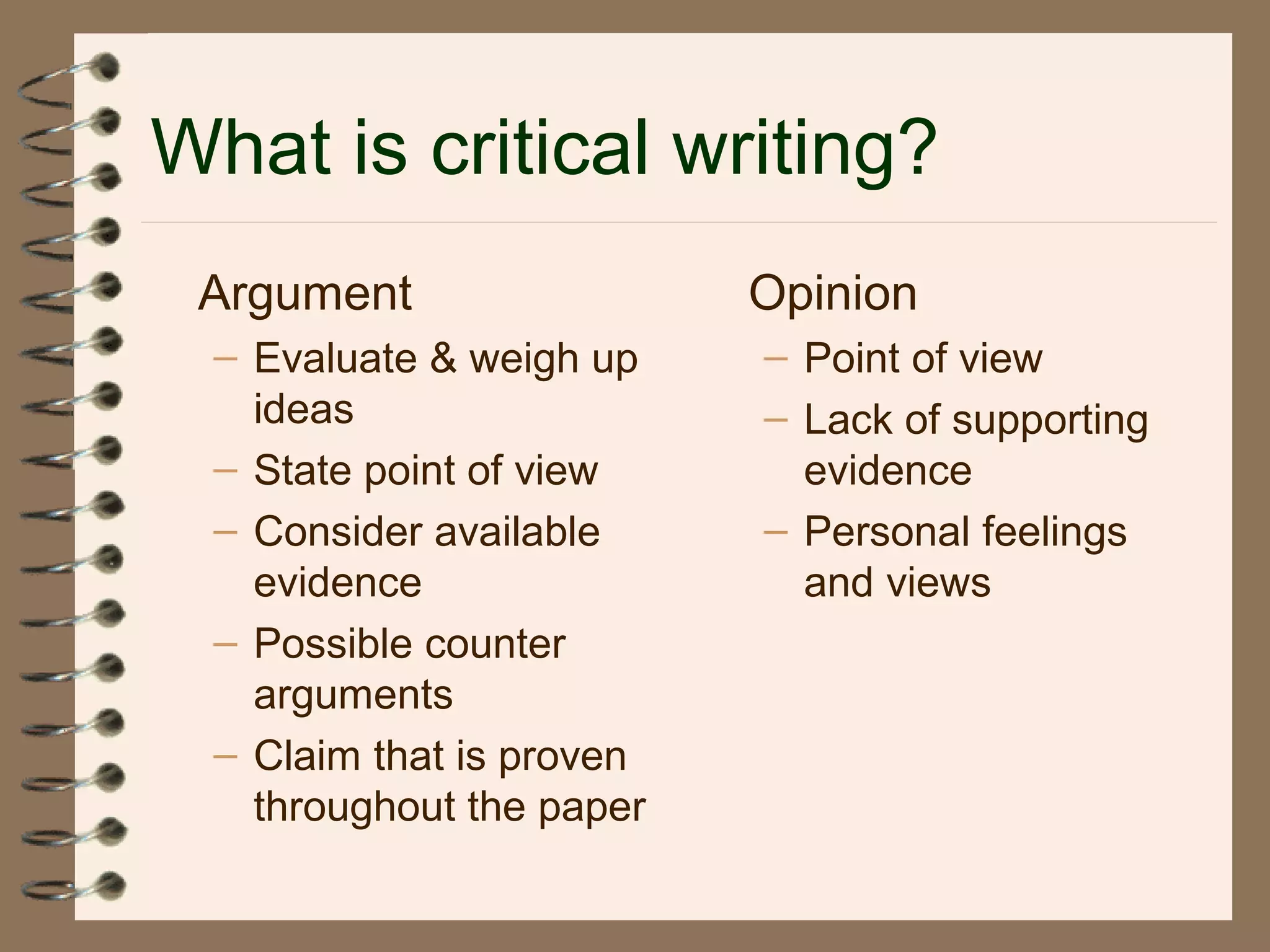
What is critical writing?
Argument
– Evaluate & weigh up
ideas
– State point of view
– Consider available
evidence
– Possible counter
arguments
– Claim that is proven
throughout the paper
Opinion
– Point of view
– Lack of supporting
evidence
– Personal feelings
and views
Thesis Statements
Which thesis statement is the most effective for an
argument about the need for V-chips in television
sets?
Parents, often too busy to watch television shows with
their families, can monitor their children’s viewing habits
with the aid of the V-chip.
To help parents monitor their children’s viewing habits,
the V-chip should be a required feature for television
sets sold in the U.S.
This paper will describe a V-chip and examine the uses
of the V-chip in American-made television sets.
Steps in constructing argument
Analyse topic
Write down your working thesis
– Your point of view in relation to topic
– Keep thesis prominent
Organise your argument
Develop argument
Document points and claims
Reference or bibliography
Another useful strategy to organize
information is to use the PIE formula
PIE
– P = Point = The main point you want to make
– I = Illustration = A quote or paraphrase from
the text
– E = Explanation = Your explanation about what
the quote or paraphrase means
Use transition words or sentences to bridge ideas so the
reader does not get confused
First
Second
In addition
Nevertheless
In contrast
Furthermore
Therefore
Etc.
Re-state your thesis statement in a different
way.
Make a strong closing comment.
Leave the reader with a closing thought.
Academic Conventions -Avoid
Avoid using personal pronouns like “I”,
“We”, and “You”.
Avoid not use contractions like “isn’t”,
“they’re”, “wasn’t”, etc.
Avoid slang
Avoid a personal tone
Avoid vague ideas
Avoid plagiarism
Academic Conventions -Do
Do address both sides of an argument
Do cite your sources
Do use a formal tone
Do take a stand
Do use concrete details
Do give yourself time to develop your paper
Supporting points are examples or pieces of evidence that support the
claim you have made in your topic sentence.
They can be:
– Facts
– Examples
– Anecdotes (Stories)
– Expert Testimony
– Quotes
– Observations
– Statistics
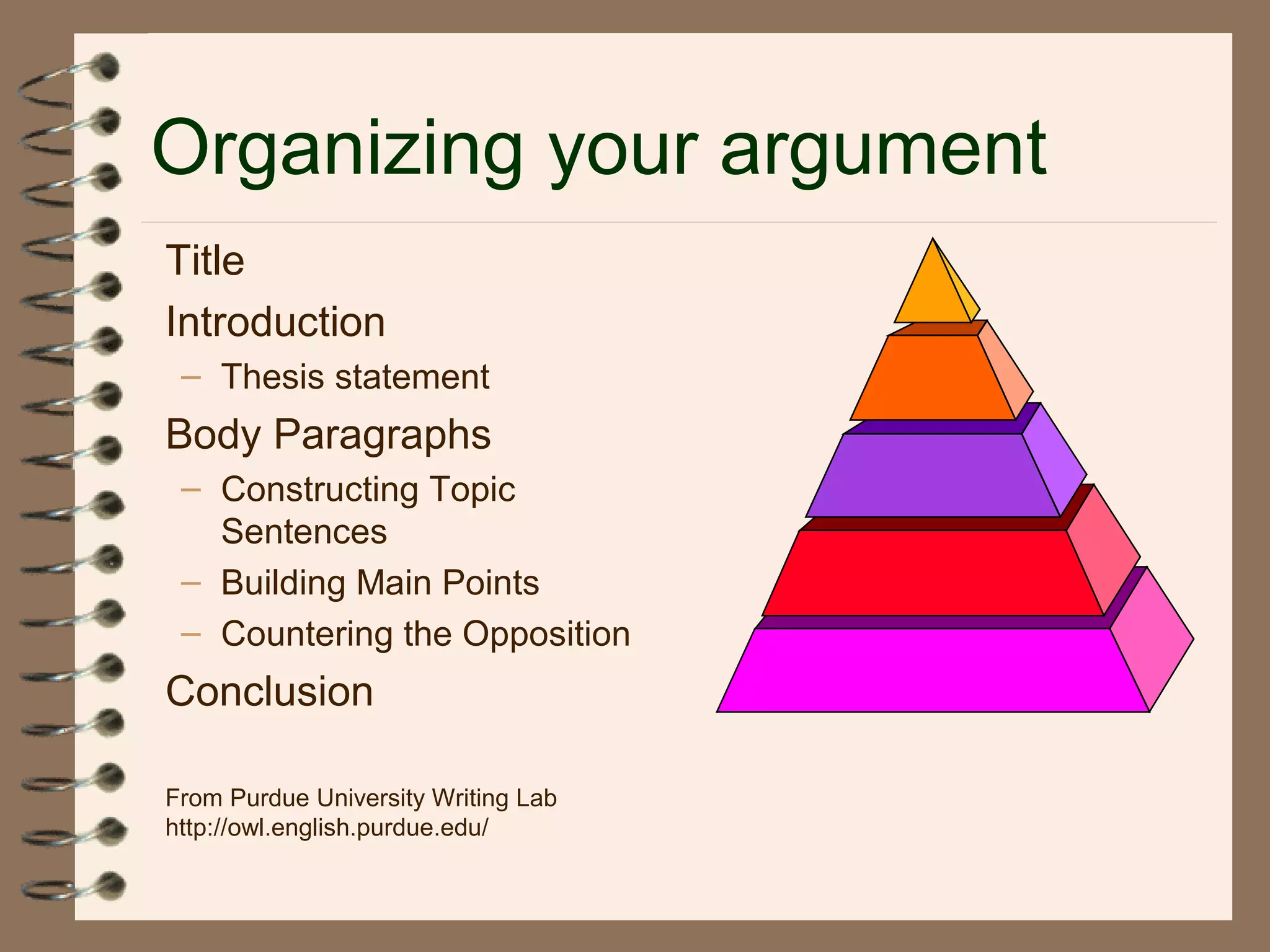
Organizing your argument
Title
Introduction
– Thesis statement
Body Paragraphs
– Constructing Topic
Sentences
– Building Main Points
– Countering the Opposition
Conclusion
From Purdue University Writing Lab
http://owl.english.purdue.edu/
Develop your argument
Use body paragraphs & topic sentences
Use source material – reliable evidence
Show line of reasoning
– link points
– central guiding line
Show awareness of complexities
– Counter arguments, relativism
Your conclusions
– based on evidence
– No new claims
Signposting your line of
reasoning
Indicator words for claims
– Therefore, thus, hence, so, as a result
Indicator words for reasons
– Because, since, on account of, for, in view
of, for the reason that
Tentative or ‘hedging’
Cohesion & Flow
Parallelism
“One explanation for increasing rates of
anorexia is...
Repetition of key words
Given-New
Prediction
From Center for Writing http:writing.umn.edu
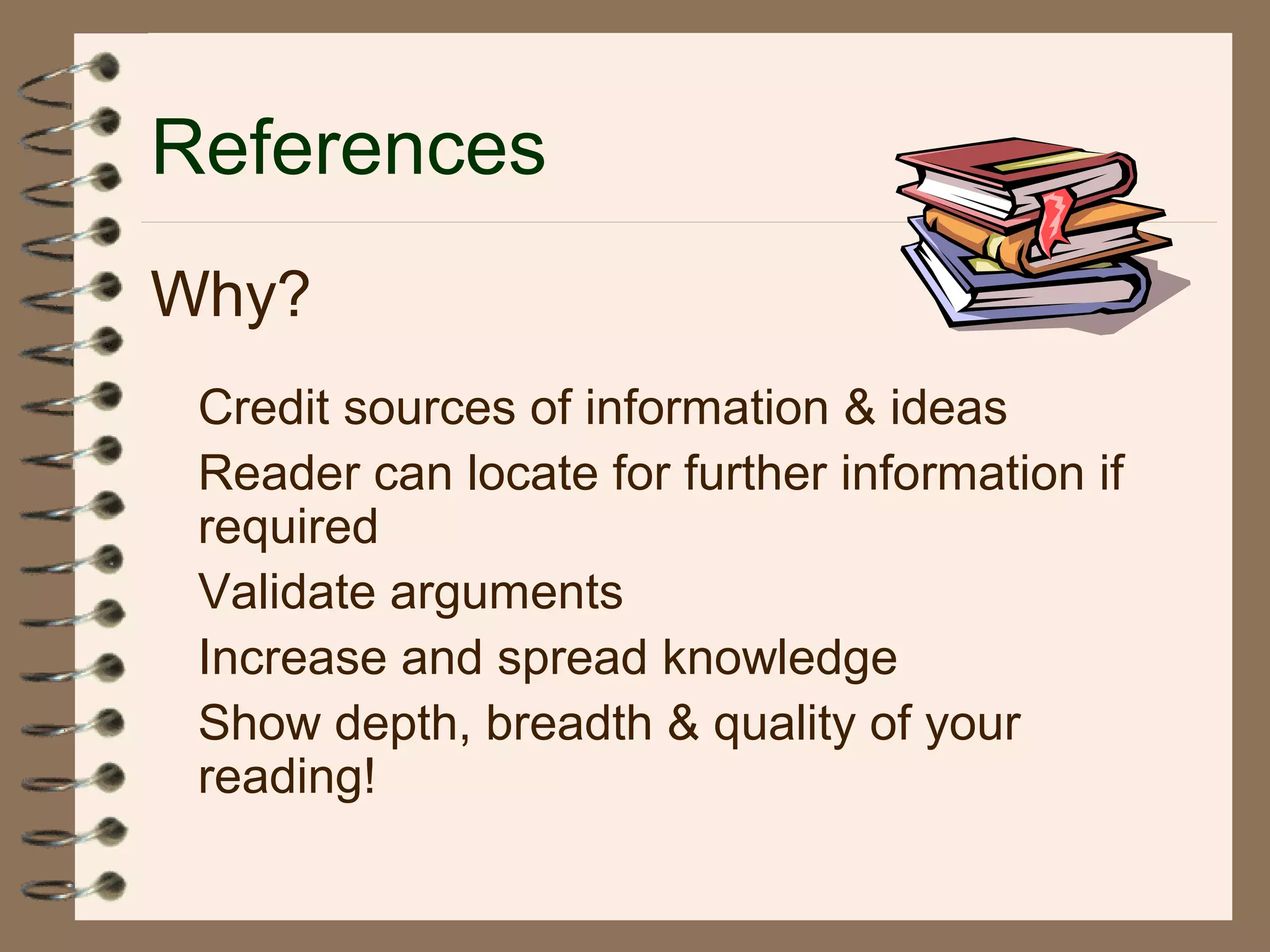
References
Why?
Credit sources of information & ideas
Reader can locate for further information if
required
Validate arguments
Increase and spread knowledge
Show depth, breadth & quality of your
reading!
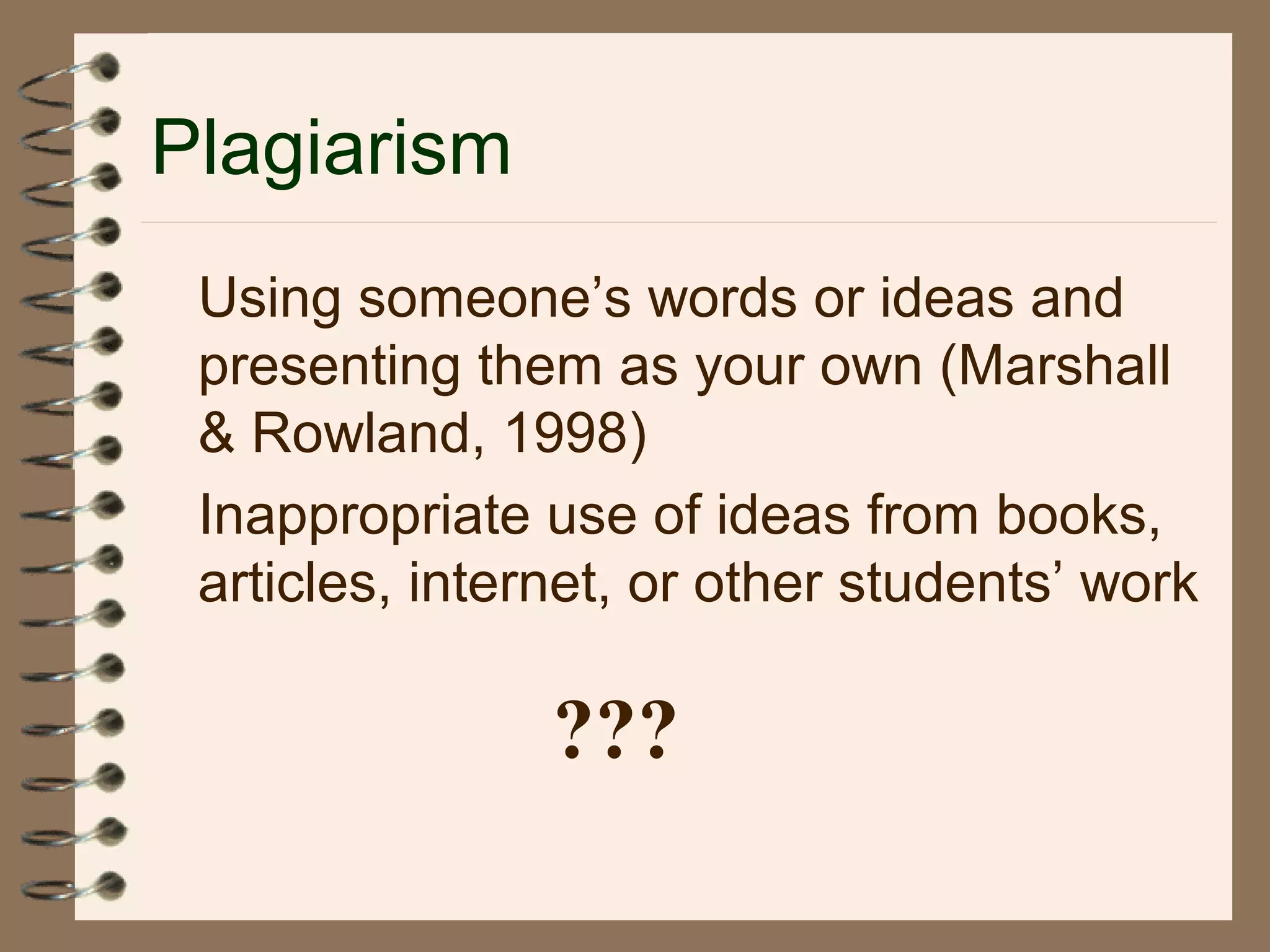
Plagiarism
Using someone’s words or ideas and
presenting them as your own (Marshall
& Rowland, 1998)
Inappropriate use of ideas from books,
articles, internet, or other students’ work
???
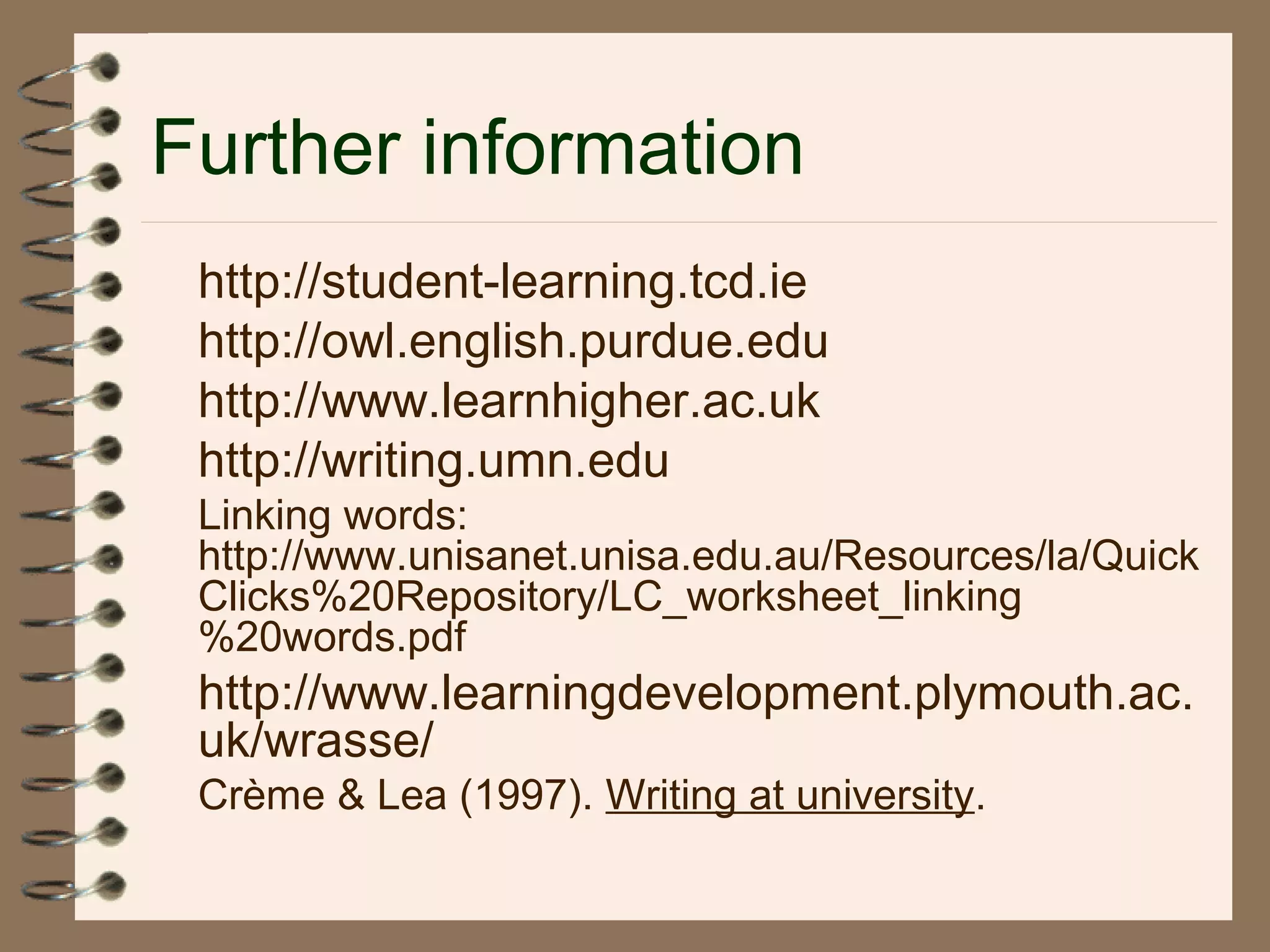
Further information
http://student-learning.tcd.ie
http://owl.english.purdue.edu
http://www.learnhigher.ac.uk
http://writing.umn.edu
Linking words:
http://www.unisanet.unisa.edu.au/Resources/la/Quick
Clicks%20Repository/LC_worksheet_linking
%20words.pdf
http://www.learningdevelopment.plymouth.ac.
uk/wrasse/
Crème & Lea (1997). Writing at university.

Writing Skills- Academic Writing, Are you up for it?

  • 1.
  • 2.
    Learning Objectives Understand whatis meant by academic writing Awareness of academic conventions and practices Learn how to develop argument in your writing Awareness of plagiarism and use appropriate use of references/citations Resources
  • 3.
    PURPOSE OF ACADEMICWRITING The word “essay” is derived from the Latin verb “exigere”, which means to: Examine Test Drive out
  • 4.
    Other purposes Discover knowledge Makea point Persuade the reader Share information Synthesize Information Analyze a topic Document your observations All of the above
  • 5.
    STEP BY STEPPROCESS Read and Research Brainstorm Ideas Develop a Working Thesis and Outline Write a Rough Draft Review for Content Revise Rough Draft Review for Grammar and Mechanics Revise Second Draft Continue Reviewing and Revising as Needed
  • 6.
    Ideas to write Readtexts related to your topic Use brainstorming techniques like: – Listing ideas – Clustering or mind mapping – Free writing Discuss the issue with others Research the topic
  • 7.
    Developing an outline Onceyou establish a thesis, use it to help you develop an outline of the paper An outline will: – Help you organize your ideas – Keep you focused – Save time For every main point, you’ll need several supporting details
  • 8.
    Paragraph Level Concern Effectiveparagraphs are: Well-developed They avoid making assumptions. Cohesive Their ideas connect to one another (transitions). Coherent They clarify the logic of the paragraph (topic sentences).
  • 9.
    Topic Sentence A topicsentence accomplishes the following tasks: Expresses a claim (not a fact) that supports the thesis Indicates the content of the paragraph (central idea) Creates a transition from the previous paragraph Maintain proper pacing (long/short sentences, etc.).  Ex: “Although previous studies of weather patterns have focused on rain and wind, this study proposes an analysis of tornado formation.”  Ex: “However, these studies have neglected the importance of tornado formation.”  Ex (Avoid): “Tornado formation is a major problem.”
  • 10.
    Transitional Words andPhrases Transitions signal relation between sentences, paragraphs Know relationship between the sentences/paragraphs! Addition (furthermore, more importantly, additionally, etc.) Contrast (however, conversely, on the other hand, etc.) Time Order (previously, subsequently, simultaneously, etc.) Avoid multiple transitions/introductory clauses “On the other hand, however, although the study…” “Furthermore, where the study subsequently did…” Avoid beginning with coordinating conjunctions (for, and, nor, but, or, yet, so)
  • 11.
    Referencing Sources Citations/references alludeto previous work or valuable sources. Know the conventions of your field. Style Guides, Published Work, Etc. Follow the guidelines for particular journals when publishing Know how and when to use references, quotations. Avoid quoting to start/end paragraph. Work quotes into your own sentences.
  • 12.
    Sentence Level Concern Effectivesentences will: Use active voice and clear, strong verbs. Build a balanced hierarchy of ideas. Use punctuation and quotes effectively. Remember: The goal is to make your reader understand (and be persuaded by) your prose.
  • 13.
    Format  Thesis  MainPoint  Supporting Point  Detail  Detail  Supporting Point  Detail  Detail  Main Point  Supporting Point  Detail  Detail  Supporting Point  Detail  Detail  Supporting Point  Detail  Detail  Conclusion
  • 14.
    Writing in anacademic way Being critical and analytical Using language in a precise & subject- specific way Adopting a position or claim - thesis Drawing on and citing a range of authors & arguments Remaining objective
  • 15.
    What is criticalwriting? Argument – Evaluate & weigh up ideas – State point of view – Consider available evidence – Possible counter arguments – Claim that is proven throughout the paper Opinion – Point of view – Lack of supporting evidence – Personal feelings and views
  • 16.
    Thesis Statements Which thesisstatement is the most effective for an argument about the need for V-chips in television sets? Parents, often too busy to watch television shows with their families, can monitor their children’s viewing habits with the aid of the V-chip. To help parents monitor their children’s viewing habits, the V-chip should be a required feature for television sets sold in the U.S. This paper will describe a V-chip and examine the uses of the V-chip in American-made television sets.
  • 17.
    Steps in constructingargument Analyse topic Write down your working thesis – Your point of view in relation to topic – Keep thesis prominent Organise your argument Develop argument Document points and claims Reference or bibliography
  • 18.
    Another useful strategyto organize information is to use the PIE formula PIE – P = Point = The main point you want to make – I = Illustration = A quote or paraphrase from the text – E = Explanation = Your explanation about what the quote or paraphrase means
  • 19.
    Use transition wordsor sentences to bridge ideas so the reader does not get confused First Second In addition Nevertheless In contrast Furthermore Therefore Etc.
  • 20.
    Re-state your thesisstatement in a different way. Make a strong closing comment. Leave the reader with a closing thought.
  • 21.
    Academic Conventions -Avoid Avoidusing personal pronouns like “I”, “We”, and “You”. Avoid not use contractions like “isn’t”, “they’re”, “wasn’t”, etc. Avoid slang Avoid a personal tone Avoid vague ideas Avoid plagiarism
  • 22.
    Academic Conventions -Do Doaddress both sides of an argument Do cite your sources Do use a formal tone Do take a stand Do use concrete details Do give yourself time to develop your paper
  • 23.
    Supporting points areexamples or pieces of evidence that support the claim you have made in your topic sentence. They can be: – Facts – Examples – Anecdotes (Stories) – Expert Testimony – Quotes – Observations – Statistics
  • 24.
    Organizing your argument Title Introduction –Thesis statement Body Paragraphs – Constructing Topic Sentences – Building Main Points – Countering the Opposition Conclusion From Purdue University Writing Lab http://owl.english.purdue.edu/
  • 25.
    Develop your argument Usebody paragraphs & topic sentences Use source material – reliable evidence Show line of reasoning – link points – central guiding line Show awareness of complexities – Counter arguments, relativism Your conclusions – based on evidence – No new claims
  • 26.
    Signposting your lineof reasoning Indicator words for claims – Therefore, thus, hence, so, as a result Indicator words for reasons – Because, since, on account of, for, in view of, for the reason that Tentative or ‘hedging’
  • 27.
    Cohesion & Flow Parallelism “Oneexplanation for increasing rates of anorexia is... Repetition of key words Given-New Prediction From Center for Writing http:writing.umn.edu
  • 28.
    References Why? Credit sources ofinformation & ideas Reader can locate for further information if required Validate arguments Increase and spread knowledge Show depth, breadth & quality of your reading!
  • 30.
    Plagiarism Using someone’s wordsor ideas and presenting them as your own (Marshall & Rowland, 1998) Inappropriate use of ideas from books, articles, internet, or other students’ work ???
  • 31.