Business Systems
Analyst Interview
Questions and
Answers
Preparing for a business systems analyst interview? Review these
common interview questions and sample answers to help you ace the
interview.
by Amit Thokal
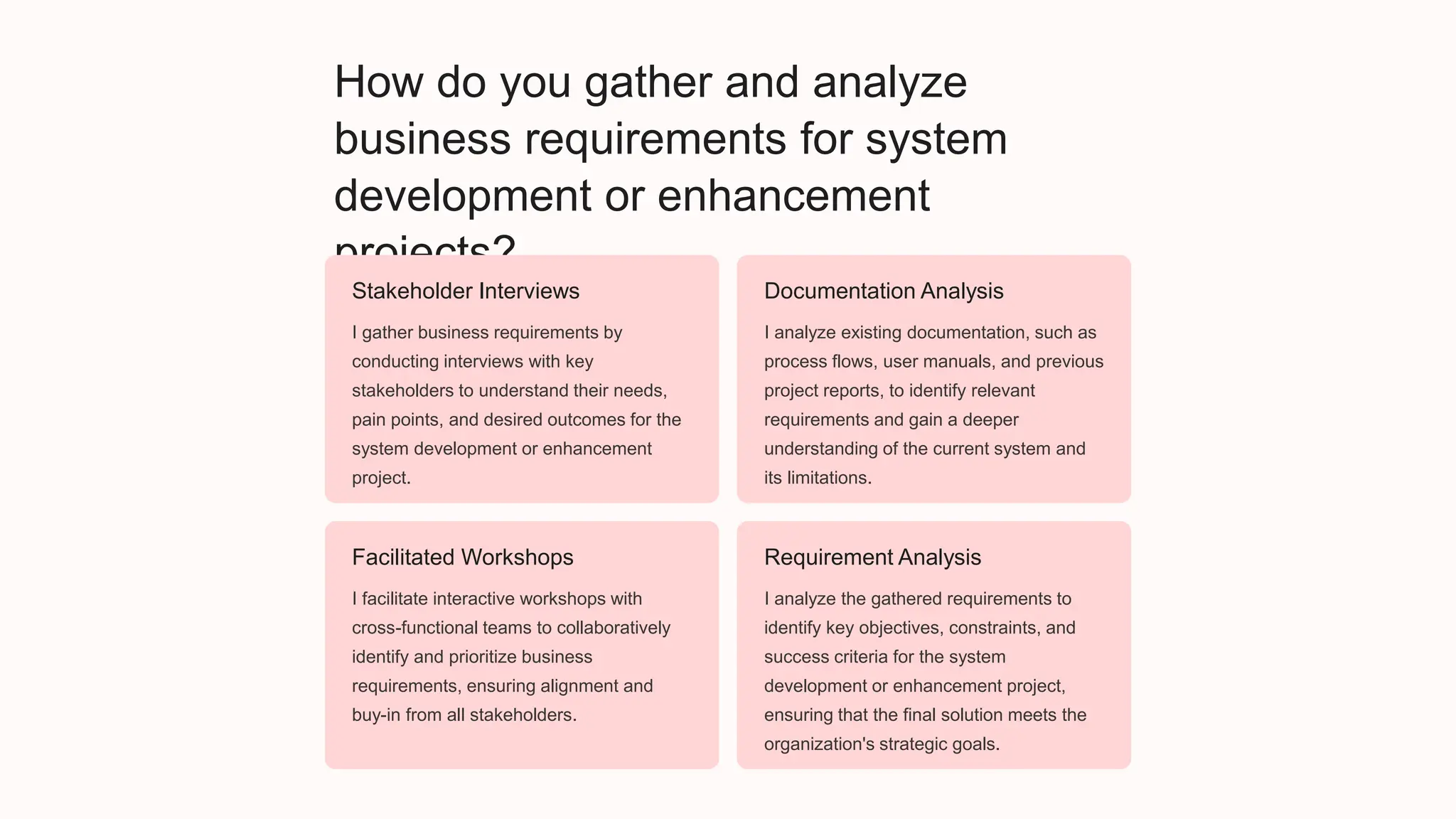
How do you gather and analyze
business requirements for system
development or enhancement
projects?
Stakeholder Interviews
I gather business requirements by
conducting interviews with key
stakeholders to understand their needs,
pain points, and desired outcomes for the
system development or enhancement
project.
Documentation Analysis
I analyze existing documentation, such as
process flows, user manuals, and previous
project reports, to identify relevant
requirements and gain a deeper
understanding of the current system and
its limitations.
Facilitated Workshops
I facilitate interactive workshops with
cross-functional teams to collaboratively
identify and prioritize business
requirements, ensuring alignment and
buy-in from all stakeholders.
Requirement Analysis
I analyze the gathered requirements to
identify key objectives, constraints, and
success criteria for the system
development or enhancement project,
ensuring that the final solution meets the
organization's strategic goals.
Can you describe your experience with
process mapping and modeling
techniques?
• BPMN (Business Process Model and Notation): I have extensive experience using this
technique to visually represent business processes and identify inefficiencies.
• UML (Unified Modeling Language): I also leverage this modeling technique to design
solutions that streamline operations and improve productivity.
• Visual Representation: By using process mapping and modeling, I can create visual
representations of business processes to better understand and optimize them.
How do you identify and document
functional and non-functional
requirements for a system?
1
Functional Requirements
I identify functional requirements
by defining the specific actions and
behaviors the system must
perform to meet user needs. I
document these requirements
using techniques such as use
cases, user stories, and
requirements traceability matrices.
2 Non-Functional Requirements
For non-functional requirements, I
identify constraints related to
performance, security, scalability,
and usability, documenting them
alongside functional requirements
to ensure comprehensive system
specifications.
3
Comprehensive
Documentation
By documenting both functional
and non-functional requirements, I
ensure that the system
How do you ensure that
business requirements are
translated accurately into
technical specifications?
I ensure accurate translation of business requirements into technical
specifications by maintaining clear communication channels between
business stakeholders and technical teams. I facilitate collaborative
sessions to review and validate requirements, address any ambiguities or
discrepancies, and ensure alignment between business objectives and
technical solutions. Additionally, I leverage tools such as prototyping and
mock-ups to visualize system functionality and validate requirements
before implementation.
Can you explain your approach to
conducting system testing and
validation?
My approach to system testing and validation
involves defining test scenarios and cases
based on system requirements, conducting
thorough testing at each stage of
development, and validating system
functionality against acceptance criteria. I
collaborate closely with developers and QA
teams to identify and resolve issues promptly,
ensuring that the system meets quality
standards and user expectations before
deployment.
How do you collaborate with
developers and testers to ensure
successful system implementation?
Provide Clear
Requirements
I collaborate with
developers and testers by
providing clear and
detailed requirements
documentation.
Facilitate
Communication
I facilitate regular
communication and
feedback sessions with
the development and
testing teams.
Participate in Meetings
I participate in sprint
planning and review
meetings to ensure
alignment and successful
implementation.
Can you provide an example of a
project where you had to manage
conflicting system requirements?
1 Prioritize
2 Analyze
3 Facilitate
In a recent project, we encountered conflicting requirements related to system performance and
user interface design. To address this, I facilitated discussions between stakeholders to prioritize
requirements based on business impact and technical feasibility. We conducted trade-off analyses
and compromise discussions to reach consensus on a solution that balanced competing priorities
and met project objectives effectively.
How do you prioritize system
enhancements or change requests
based on business impact?
I prioritize system enhancements or change requests based on their alignment with strategic
objectives, potential impact on business operations, and urgency of implementation. I collaborate
with business stakeholders to assess the value and priority of each request, considering factors
such as ROI, customer impact, regulatory requirements, and resource availability.
How do you handle scope changes
and requirements modifications during
system development?
Change
Management
Process
I handle scope
changes and
requirements
modifications by
following
established
change
management
processes. This
ensures that any
proposed changes
are properly
assessed and
approved before
implementation.
Impact
Assessment
I carefully assess
the impact of
proposed changes
on project
objectives,
timelines, and
resources. This
allows me to
understand the full
implications of the
changes and plan
accordingly.
Stakeholder
Approval
Before proceeding
with any changes,
I obtain approval
from relevant
stakeholders. This
ensures that all
impacted parties
are aligned and
supportive of the
modifications.
Communicatio
n and
Documentatio
n
I communicate
changes
effectively to all
project team
members and
adjust project
plans and
documentation to
ensure alignment
with the updated
requirements. This
maintains
transparency and
clarity throughout
the development
process.
What tools or methodologies do you
use for requirements management and
traceability?
Requirement
Management
Tools
I use a variety of
tools for
requirements
management and
traceability,
including
requirement
management tools
Version Control
Systems
I also leverage
version control
systems such as Git
to track changes
and maintain
traceability
throughout the
project lifecycle.
Traceability
Matrices
In addition, I utilize
traceability matrices
to track
requirements and
ensure alignment
with the overall
business objectives.
Agile
Methodologies
I also adhere to
industry-standard
methodologies such
as Agile, Scrum,
and Waterfall to
ensure effective
requirements
management and
traceability
How do you collaborate with
stakeholders to elicit and
document business
requirements for system
integration projects?
I collaborate with stakeholders by conducting interviews, workshops, and
focus groups to elicit business requirements, capturing their needs,
preferences, and pain points. I document these requirements using
techniques such as use cases, user stories, and process diagrams,
ensuring that they are clear, concise, and actionable for technical teams.
Can you describe your experience with
conducting feasibility studies and cost-
benefit analysis for system
enhancements or implementations?
Cost-Benefit Analysis
I assess the economic
viability of proposed projects,
considering factors such as
resource requirements and
anticipated benefits.
Feasibility Assessment
I evaluate the technical
feasibility and organizational
impact of system
enhancements or
implementations.
Stakeholder
Collaboration
I collaborate with
stakeholders to identify and
evaluate alternative
solutions, and recommend
courses of action.
How do you ensure that system
requirements are traceable and align
with the overall business objectives?
I ensure that system requirements are traceable and align with the overall business objectives by
establishing clear traceability links between business requirements, functional specifications, and
technical design documents. I use requirements management tools and traceability matrices to
track changes, dependencies, and relationships between requirements throughout the project
lifecycle.
Establishing Traceability Linking Requirements Using Tools
Connecting business
requirements to functional
specifications and
technical designs
Tracking dependencies
and relationships between
requirements
Leveraging requirements
management software and
traceability matrices
Thanks for reading!

Business Systems Analyst Interview Questions and Answers

  • 1.
    Business Systems Analyst Interview Questionsand Answers Preparing for a business systems analyst interview? Review these common interview questions and sample answers to help you ace the interview. by Amit Thokal
  • 2.
    How do yougather and analyze business requirements for system development or enhancement projects? Stakeholder Interviews I gather business requirements by conducting interviews with key stakeholders to understand their needs, pain points, and desired outcomes for the system development or enhancement project. Documentation Analysis I analyze existing documentation, such as process flows, user manuals, and previous project reports, to identify relevant requirements and gain a deeper understanding of the current system and its limitations. Facilitated Workshops I facilitate interactive workshops with cross-functional teams to collaboratively identify and prioritize business requirements, ensuring alignment and buy-in from all stakeholders. Requirement Analysis I analyze the gathered requirements to identify key objectives, constraints, and success criteria for the system development or enhancement project, ensuring that the final solution meets the organization's strategic goals.
  • 3.
    Can you describeyour experience with process mapping and modeling techniques? • BPMN (Business Process Model and Notation): I have extensive experience using this technique to visually represent business processes and identify inefficiencies. • UML (Unified Modeling Language): I also leverage this modeling technique to design solutions that streamline operations and improve productivity. • Visual Representation: By using process mapping and modeling, I can create visual representations of business processes to better understand and optimize them.
  • 4.
    How do youidentify and document functional and non-functional requirements for a system? 1 Functional Requirements I identify functional requirements by defining the specific actions and behaviors the system must perform to meet user needs. I document these requirements using techniques such as use cases, user stories, and requirements traceability matrices. 2 Non-Functional Requirements For non-functional requirements, I identify constraints related to performance, security, scalability, and usability, documenting them alongside functional requirements to ensure comprehensive system specifications. 3 Comprehensive Documentation By documenting both functional and non-functional requirements, I ensure that the system
  • 5.
    How do youensure that business requirements are translated accurately into technical specifications? I ensure accurate translation of business requirements into technical specifications by maintaining clear communication channels between business stakeholders and technical teams. I facilitate collaborative sessions to review and validate requirements, address any ambiguities or discrepancies, and ensure alignment between business objectives and technical solutions. Additionally, I leverage tools such as prototyping and mock-ups to visualize system functionality and validate requirements before implementation.
  • 6.
    Can you explainyour approach to conducting system testing and validation? My approach to system testing and validation involves defining test scenarios and cases based on system requirements, conducting thorough testing at each stage of development, and validating system functionality against acceptance criteria. I collaborate closely with developers and QA teams to identify and resolve issues promptly, ensuring that the system meets quality standards and user expectations before deployment.
  • 7.
    How do youcollaborate with developers and testers to ensure successful system implementation? Provide Clear Requirements I collaborate with developers and testers by providing clear and detailed requirements documentation. Facilitate Communication I facilitate regular communication and feedback sessions with the development and testing teams. Participate in Meetings I participate in sprint planning and review meetings to ensure alignment and successful implementation.
  • 8.
    Can you providean example of a project where you had to manage conflicting system requirements? 1 Prioritize 2 Analyze 3 Facilitate In a recent project, we encountered conflicting requirements related to system performance and user interface design. To address this, I facilitated discussions between stakeholders to prioritize requirements based on business impact and technical feasibility. We conducted trade-off analyses and compromise discussions to reach consensus on a solution that balanced competing priorities and met project objectives effectively.
  • 9.
    How do youprioritize system enhancements or change requests based on business impact? I prioritize system enhancements or change requests based on their alignment with strategic objectives, potential impact on business operations, and urgency of implementation. I collaborate with business stakeholders to assess the value and priority of each request, considering factors such as ROI, customer impact, regulatory requirements, and resource availability.
  • 10.
    How do youhandle scope changes and requirements modifications during system development? Change Management Process I handle scope changes and requirements modifications by following established change management processes. This ensures that any proposed changes are properly assessed and approved before implementation. Impact Assessment I carefully assess the impact of proposed changes on project objectives, timelines, and resources. This allows me to understand the full implications of the changes and plan accordingly. Stakeholder Approval Before proceeding with any changes, I obtain approval from relevant stakeholders. This ensures that all impacted parties are aligned and supportive of the modifications. Communicatio n and Documentatio n I communicate changes effectively to all project team members and adjust project plans and documentation to ensure alignment with the updated requirements. This maintains transparency and clarity throughout the development process.
  • 11.
    What tools ormethodologies do you use for requirements management and traceability? Requirement Management Tools I use a variety of tools for requirements management and traceability, including requirement management tools Version Control Systems I also leverage version control systems such as Git to track changes and maintain traceability throughout the project lifecycle. Traceability Matrices In addition, I utilize traceability matrices to track requirements and ensure alignment with the overall business objectives. Agile Methodologies I also adhere to industry-standard methodologies such as Agile, Scrum, and Waterfall to ensure effective requirements management and traceability
  • 12.
    How do youcollaborate with stakeholders to elicit and document business requirements for system integration projects? I collaborate with stakeholders by conducting interviews, workshops, and focus groups to elicit business requirements, capturing their needs, preferences, and pain points. I document these requirements using techniques such as use cases, user stories, and process diagrams, ensuring that they are clear, concise, and actionable for technical teams.
  • 13.
    Can you describeyour experience with conducting feasibility studies and cost- benefit analysis for system enhancements or implementations? Cost-Benefit Analysis I assess the economic viability of proposed projects, considering factors such as resource requirements and anticipated benefits. Feasibility Assessment I evaluate the technical feasibility and organizational impact of system enhancements or implementations. Stakeholder Collaboration I collaborate with stakeholders to identify and evaluate alternative solutions, and recommend courses of action.
  • 14.
    How do youensure that system requirements are traceable and align with the overall business objectives? I ensure that system requirements are traceable and align with the overall business objectives by establishing clear traceability links between business requirements, functional specifications, and technical design documents. I use requirements management tools and traceability matrices to track changes, dependencies, and relationships between requirements throughout the project lifecycle. Establishing Traceability Linking Requirements Using Tools Connecting business requirements to functional specifications and technical designs Tracking dependencies and relationships between requirements Leveraging requirements management software and traceability matrices
  • 15.