TRACKING # 2280
ASSESMENT
NAME:Quratulain
tariq
SUBJECT: sociology
TOPIC : deviance
DATE: 23 -2-2017
BZU CAMPUS VEHARI
Content
1] Introduction
2] Concepts
3] Functionalist view
4] Conflict theory
5] Strain theory
6] Labeling theory
7] Deviance and crime
8] Results of survey
9] Class activity
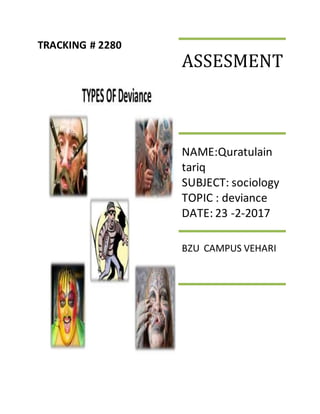
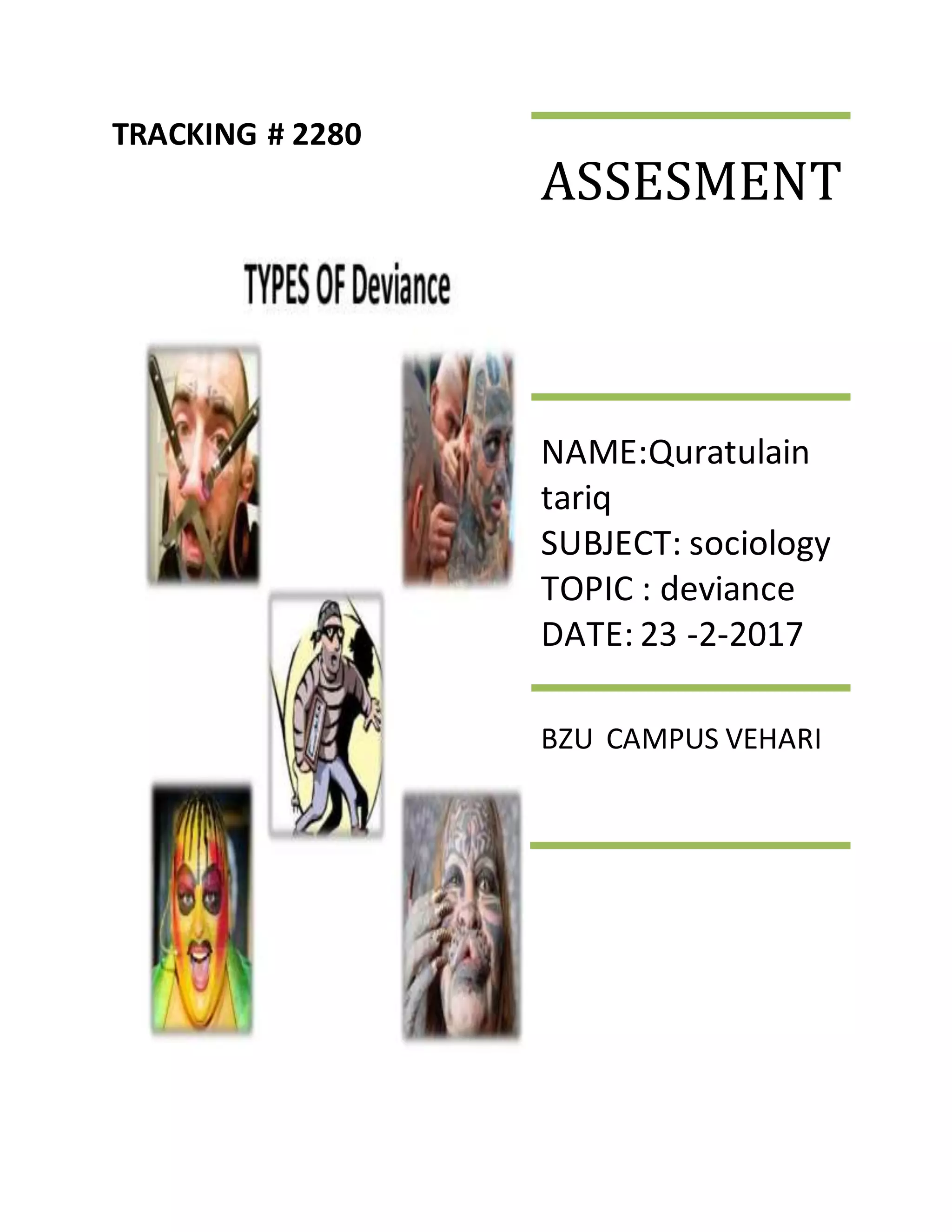
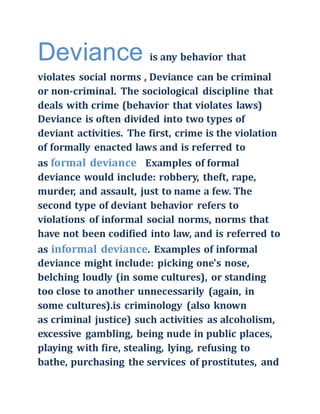
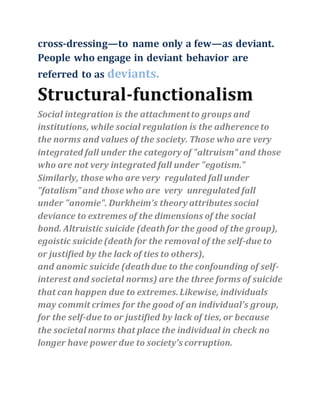
Deviance is any behavior that
violates social norms , Deviance can be criminal
or non‐criminal. The sociological discipline that
deals with crime (behavior that violates laws)
Deviance is often divided into two types of
deviant activities. The first, crime is the violation
of formally enacted laws and is referred to
as formal deviance Examples of formal
deviance would include: robbery, theft, rape,
murder, and assault, just to name a few. The
second type of deviant behavior refers to
violations of informal social norms, norms that
have not been codified into law, and is referred to
as informal deviance. Examples of informal
deviance might include: picking one's nose,
belching loudly (in some cultures), or standing
too close to another unnecessarily (again, in
some cultures).is criminology (also known
as criminal justice) such activities as alcoholism,
excessive gambling, being nude in public places,
playing with fire, stealing, lying, refusing to
bathe, purchasing the services of prostitutes, and
cross‐dressing—to name only a few—as deviant.
People who engage in deviant behavior are
referred to as deviants.
Structural-functionalism
Social integration is the attachmentto groups and
institutions, while social regulation is the adherence to
the norms and values of the society. Those who are very
integrated fall under the category of "altruism"and those
who are not very integrated fall under "egotism."
Similarly, those who are very regulated fall under
"fatalism"and those who are very unregulated fall
under "anomie". Durkheim's theory attributes social
deviance to extremes of the dimensions of the social
bond. Altruistic suicide (deathfor the good of the group),
egoistic suicide (death for the removal of the self-due to
or justified by the lack of ties to others),
and anomic suicide (deathdue to the confounding of self-
interest and societal norms) are the three forms of suicide
that can happen due to extremes.Likewise, individuals
may commit crimes for the good of an individual's group,
for the self-due to or justified by lack of ties, or because
the societal norms that place the individual in check no
longer have power due to society's corruption.
Durkheim's conceptDurkheim (1858–1917)claimed that
deviance was in fact a normal and necessary part of
social organization. When he studied deviance he stated
four important functions of deviance.
"Deviance affirms cultural values and norms. Any
definition of virtue rests on an opposing idea of vice:
There can be no good without evil and no justice without
crime
Deviance defines moral boundaries,people learn right
from wrong by defining people as deviant.
A serious form of deviance forces people to come together
and react in the same way againstit.
Deviance pushes society's moral boundaries which, in
turn leads to social change.
Social-Strain . In this case,
Merton was proposing a typology of deviance based upon
two criteria:
(1) a person's motivations or his or her adherence to
cultural goals;
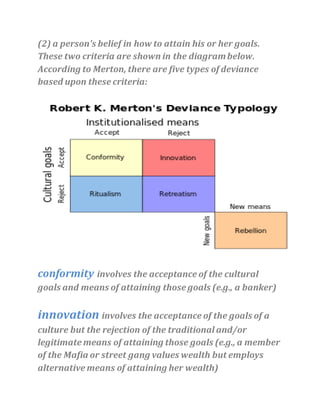
(2) a person's belief in how to attain his or her goals.
These two criteria are shown in the diagrambelow.
According to Merton, there are five types of deviance
based upon these criteria:
conformity involves the acceptance of the cultural
goals and means of attaining those goals (e.g., a banker)
innovation involves the acceptance of the goals of a
culture but the rejection of the traditional and/or
legitimate means of attaining those goals (e.g., a member
of the Mafia or street gang values wealth but employs
alternative means of attaining her wealth)
Ritualisminvolves the rejection of cultural goals but
the routinized acceptance of the means for achieving the
goals (e.g., a disillusioned bureaucrat - like Milton in the
movie Office Space, who goes to work everyday because it
is what he does,but does not share the goal of the
company of making lots of money)
Retreatisminvolves the rejection of both the cultural
goals and the traditional means of achieving those goals
(e.g., a homeless person who is homeless more by choice
than by force or circumstanceor a commune established
separately from dominant social norms)
rebellion is a special case wherein the individual
rejects both the cultural goals and traditional means of
achieving them but actively attemptsto replace both
elements of the society with different goals and means
(e.g., a communist revolution and / or social movement
activities)
Conflict Theory
Deviance and criminal behavior can also be tied to power
and resource imbalances in society.
Individuals may engage in deviant or criminal behavior
because they lack the physical resources necessary to
survive, committing property crimes like thefts or selling
drugs in order to procure such resources. The criminal
justice system is also structured to reflect differences in
power and property, as white collar crime illustrates.
A clear example of how deviance reflects power
imbalances is in the reporting and tracking of
crimes. White-collar crimes are typically committed by
individuals in higher social classes. Examples of white-
collar crimes include:
antitrust violations
computer, credit card, phone, telemarketing,bankruptcy,
healthcare, insurance, mail, and government fraud
tax evasion
insider trading
bribery and public corruption
counterfeiting
money laundering
Labeling Theory
Labeling Theory refers to the idea that individuals
become deviant when two things occur:
a deviant label is applied to them (e.g., loner, punk)
they adopt the label by exhibiting the behaviors, actions,
and attitudesassociated with the labelrimary
deviance refers to passing episodes of deviant behavior
that most people participatein. Secondary deviance is
when someone makes something out of that deviant
behavior and is given a negative social label that changes
a person's self-concept and social identity. We call this
negative label a stigma.
Theory of Differential Association
The theory of differential association is a learning
theory that focuses on the processes by which individuals
come to commit deviant or criminal acts. According to
the theory, created by Edwin H. Sutherland, criminal
behavior is learned through interactions with other
people. Through this interaction and communication,
people learn the values, attitudes, techniques, and
motives for criminal behavior.Differentialassociation
theory emphasizes the interaction people have with their
peers and others in their environment. Those who
associatewith delinquents, deviants, or criminals learn to
value deviance. The greater the frequency, duration, and
intensity of their immersion in deviant environments, the
more likely it is that they will become deviant.
survey:
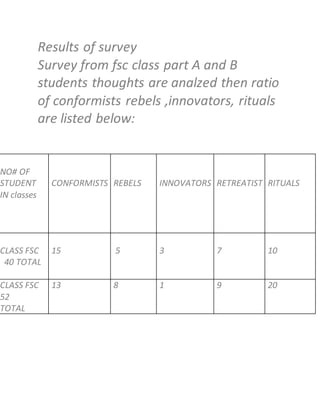
Results of survey
Survey from fsc class part A and B
students thoughts are analzed then ratio
of conformists rebels ,innovators, rituals
are listed below:
NO# OF
STUDENT
IN classes
CONFORMISTS REBELS INNOVATORS RETREATIST RITUALS
CLASS FSC
40 TOTAL
15 5 3 7 10
CLASS FSC
52
TOTAL
13 8 1 9 20
CLASS ACTIVITY:
Ask questions:
1] which theory explains deviance in better way
2] why crime create social disorder?
3] how to reduced crimes like murder ,child and
woman absue , etc is that due to mental or physical
illness?

Deviance 2

  • 1.
    TRACKING # 2280 ASSESMENT NAME:Quratulain tariq SUBJECT:sociology TOPIC : deviance DATE: 23 -2-2017 BZU CAMPUS VEHARI
  • 2.
    Content 1] Introduction 2] Concepts 3]Functionalist view 4] Conflict theory 5] Strain theory 6] Labeling theory 7] Deviance and crime 8] Results of survey 9] Class activity
  • 3.
    Deviance is anybehavior that violates social norms , Deviance can be criminal or non‐criminal. The sociological discipline that deals with crime (behavior that violates laws) Deviance is often divided into two types of deviant activities. The first, crime is the violation of formally enacted laws and is referred to as formal deviance Examples of formal deviance would include: robbery, theft, rape, murder, and assault, just to name a few. The second type of deviant behavior refers to violations of informal social norms, norms that have not been codified into law, and is referred to as informal deviance. Examples of informal deviance might include: picking one's nose, belching loudly (in some cultures), or standing too close to another unnecessarily (again, in some cultures).is criminology (also known as criminal justice) such activities as alcoholism, excessive gambling, being nude in public places, playing with fire, stealing, lying, refusing to bathe, purchasing the services of prostitutes, and
  • 4.
    cross‐dressing—to name onlya few—as deviant. People who engage in deviant behavior are referred to as deviants. Structural-functionalism Social integration is the attachmentto groups and institutions, while social regulation is the adherence to the norms and values of the society. Those who are very integrated fall under the category of "altruism"and those who are not very integrated fall under "egotism." Similarly, those who are very regulated fall under "fatalism"and those who are very unregulated fall under "anomie". Durkheim's theory attributes social deviance to extremes of the dimensions of the social bond. Altruistic suicide (deathfor the good of the group), egoistic suicide (death for the removal of the self-due to or justified by the lack of ties to others), and anomic suicide (deathdue to the confounding of self- interest and societal norms) are the three forms of suicide that can happen due to extremes.Likewise, individuals may commit crimes for the good of an individual's group, for the self-due to or justified by lack of ties, or because the societal norms that place the individual in check no longer have power due to society's corruption.
  • 5.
    Durkheim's conceptDurkheim (1858–1917)claimedthat deviance was in fact a normal and necessary part of social organization. When he studied deviance he stated four important functions of deviance. "Deviance affirms cultural values and norms. Any definition of virtue rests on an opposing idea of vice: There can be no good without evil and no justice without crime Deviance defines moral boundaries,people learn right from wrong by defining people as deviant. A serious form of deviance forces people to come together and react in the same way againstit. Deviance pushes society's moral boundaries which, in turn leads to social change. Social-Strain . In this case, Merton was proposing a typology of deviance based upon two criteria: (1) a person's motivations or his or her adherence to cultural goals;
  • 6.
    (2) a person'sbelief in how to attain his or her goals. These two criteria are shown in the diagrambelow. According to Merton, there are five types of deviance based upon these criteria: conformity involves the acceptance of the cultural goals and means of attaining those goals (e.g., a banker) innovation involves the acceptance of the goals of a culture but the rejection of the traditional and/or legitimate means of attaining those goals (e.g., a member of the Mafia or street gang values wealth but employs alternative means of attaining her wealth)
  • 7.
    Ritualisminvolves the rejectionof cultural goals but the routinized acceptance of the means for achieving the goals (e.g., a disillusioned bureaucrat - like Milton in the movie Office Space, who goes to work everyday because it is what he does,but does not share the goal of the company of making lots of money) Retreatisminvolves the rejection of both the cultural goals and the traditional means of achieving those goals (e.g., a homeless person who is homeless more by choice than by force or circumstanceor a commune established separately from dominant social norms) rebellion is a special case wherein the individual rejects both the cultural goals and traditional means of achieving them but actively attemptsto replace both elements of the society with different goals and means (e.g., a communist revolution and / or social movement activities)
  • 8.
    Conflict Theory Deviance andcriminal behavior can also be tied to power and resource imbalances in society. Individuals may engage in deviant or criminal behavior because they lack the physical resources necessary to survive, committing property crimes like thefts or selling drugs in order to procure such resources. The criminal justice system is also structured to reflect differences in power and property, as white collar crime illustrates. A clear example of how deviance reflects power imbalances is in the reporting and tracking of crimes. White-collar crimes are typically committed by individuals in higher social classes. Examples of white- collar crimes include: antitrust violations computer, credit card, phone, telemarketing,bankruptcy, healthcare, insurance, mail, and government fraud tax evasion
  • 9.
    insider trading bribery andpublic corruption counterfeiting money laundering Labeling Theory Labeling Theory refers to the idea that individuals become deviant when two things occur: a deviant label is applied to them (e.g., loner, punk) they adopt the label by exhibiting the behaviors, actions, and attitudesassociated with the labelrimary deviance refers to passing episodes of deviant behavior that most people participatein. Secondary deviance is when someone makes something out of that deviant behavior and is given a negative social label that changes a person's self-concept and social identity. We call this negative label a stigma.
  • 10.
    Theory of DifferentialAssociation The theory of differential association is a learning theory that focuses on the processes by which individuals come to commit deviant or criminal acts. According to the theory, created by Edwin H. Sutherland, criminal behavior is learned through interactions with other people. Through this interaction and communication, people learn the values, attitudes, techniques, and motives for criminal behavior.Differentialassociation theory emphasizes the interaction people have with their peers and others in their environment. Those who associatewith delinquents, deviants, or criminals learn to value deviance. The greater the frequency, duration, and intensity of their immersion in deviant environments, the more likely it is that they will become deviant. survey:
  • 11.
    Results of survey Surveyfrom fsc class part A and B students thoughts are analzed then ratio of conformists rebels ,innovators, rituals are listed below: NO# OF STUDENT IN classes CONFORMISTS REBELS INNOVATORS RETREATIST RITUALS CLASS FSC 40 TOTAL 15 5 3 7 10 CLASS FSC 52 TOTAL 13 8 1 9 20
  • 12.
    CLASS ACTIVITY: Ask questions: 1]which theory explains deviance in better way 2] why crime create social disorder? 3] how to reduced crimes like murder ,child and woman absue , etc is that due to mental or physical illness?