Reprographics
By Aedan Ross
Reprographics – The Basics

 Reprographics is how we copy
  information
 It is usually the Office or
  Administrative Support department
  that deals with this area
 There are many pieces of equipment
  used in this area
Reprographics
An example of a piece of reprographics
 equipment is a photocopier:

 A colour photocopier is used for short
  runs
 Black and white photocopiers are for
  long runs
 ‘In trays’ are used for photocopying
  requests
Reprographics
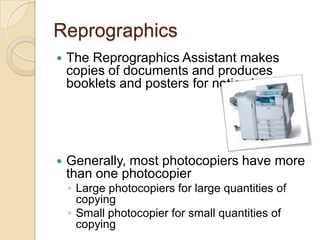
   The Reprographics Assistant makes
    copies of documents and produces
    booklets and posters for notice boards


   Generally, most photocopiers have more
    than one photocopier
    ◦ Large photocopiers for large quantities of
      copying
    ◦ Small photocopier for small quantities of
      copying
Reprographics
   Printed text, charts, graphics and
    basically anything that can be put on
    paper or thin card can be photocopied
    successfully

   Reprographics Assistants need to:
    ◦   Be able to follow instructions
    ◦   Have excellent organisational skills
    ◦   Work as a member of a team
    ◦   Meet deadlines
    ◦   Be confident using computing-related
        technology
Reprographics
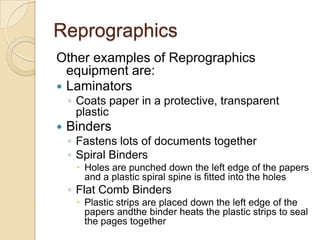
Other examples of Reprographics
  equipment are:
 Laminators
    ◦ Coats paper in a protective, transparent
      plastic
   Binders
    ◦ Fastens lots of documents together
    ◦ Spiral Binders
      Holes are punched down the left edge of the papers
       and a plastic spiral spine is fitted into the holes
    ◦ Flat Comb Binders
      Plastic strips are placed down the left edge of the
       papers andthe binder heats the plastic strips to seal
       the pages together
Reprographics

Both of these are good for producing
reports and instruction booklets
Reprographics
Training is required for reprographics
  staff:
 How to use different types of
  equipment
 How to carry out routine tasks, e.g.:
  changing toner cartridges and refilling
  paper
 Health and Safety issues related to
  the use of equipment
Reprographics
As a result of staff training, many
  considerations have to be made:
 The current skill levels of staff
 Level of training required
 Time available for training
 Cost of training
 Availability of specialist trainers
 Cost of employing temporary workers

Reprographics powerpoint

  • 1.
  • 2.
    Reprographics – TheBasics  Reprographics is how we copy information  It is usually the Office or Administrative Support department that deals with this area  There are many pieces of equipment used in this area
  • 3.
    Reprographics An example ofa piece of reprographics equipment is a photocopier:  A colour photocopier is used for short runs  Black and white photocopiers are for long runs  ‘In trays’ are used for photocopying requests
  • 4.
    Reprographics  The Reprographics Assistant makes copies of documents and produces booklets and posters for notice boards  Generally, most photocopiers have more than one photocopier ◦ Large photocopiers for large quantities of copying ◦ Small photocopier for small quantities of copying
  • 5.
    Reprographics  Printed text, charts, graphics and basically anything that can be put on paper or thin card can be photocopied successfully  Reprographics Assistants need to: ◦ Be able to follow instructions ◦ Have excellent organisational skills ◦ Work as a member of a team ◦ Meet deadlines ◦ Be confident using computing-related technology
  • 6.
    Reprographics Other examples ofReprographics equipment are:  Laminators ◦ Coats paper in a protective, transparent plastic  Binders ◦ Fastens lots of documents together ◦ Spiral Binders  Holes are punched down the left edge of the papers and a plastic spiral spine is fitted into the holes ◦ Flat Comb Binders  Plastic strips are placed down the left edge of the papers andthe binder heats the plastic strips to seal the pages together
  • 7.
    Reprographics Both of theseare good for producing reports and instruction booklets
  • 8.
    Reprographics Training is requiredfor reprographics staff:  How to use different types of equipment  How to carry out routine tasks, e.g.: changing toner cartridges and refilling paper  Health and Safety issues related to the use of equipment
  • 9.
    Reprographics As a resultof staff training, many considerations have to be made:  The current skill levels of staff  Level of training required  Time available for training  Cost of training  Availability of specialist trainers  Cost of employing temporary workers