Postmodernism in Media
Post-modernism is a set of theories which
suggests that society is undergoing a radical series
of changes where modernism is either: coming to
an end or, being rejected by people or, changing
into a new order.
Postmodernism it is general the era that
follows Modernism
Post modernism is well known since 1970 and 1980
Postmodernism itself is a wide ranging term which
applies to literature, art, economics, philosophy,
architecture as well as new and traditional media
forms.
 Interpretation is everything with the concept of reality
constantly under scrutiny and the key suggestions that
these realities are social constructs which are open to
change, everything is subjective and there is no
absolute truth.
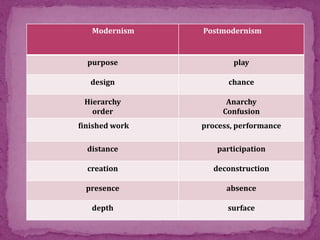
Modernism Postmodernism
purpose play
design chance
Hierarchy
order
Anarchy
Confusion
finished work process, performance
distance participation
creation deconstruction
presence absence
depth surface
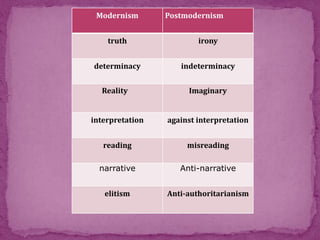
Modernism Postmodernism
truth irony
determinacy indeterminacy
Reality Imaginary
interpretation against interpretation
reading misreading
narrative Anti-narrative
elitism Anti-authoritarianism
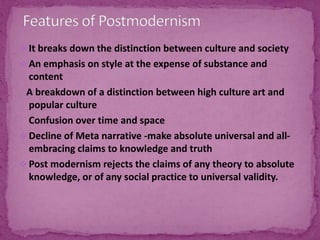
 It breaks down the distinction between culture and society
 An emphasis on style at the expense of substance and
content
A breakdown of a distinction between high culture art and
popular culture
Confusion over time and space
 Decline of Meta narrative -make absolute universal and all-
embracing claims to knowledge and truth
 Post modernism rejects the claims of any theory to absolute
knowledge, or of any social practice to universal validity.
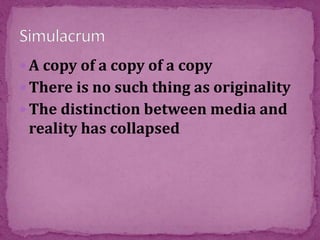
 A copy of a copy of a copy
 There is no such thing as originality
 The distinction between media and
reality has collapsed
 Intertextuality is when one media text
references another
 Intertextuality mixes genres, forms,
conventions, media: it dissolves
boundaries between high and low art,
between serious and comic.
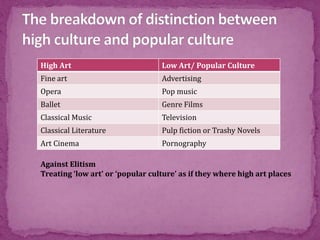
High Art Low Art/ Popular Culture
Fine art Advertising
Opera Pop music
Ballet Genre Films
Classical Music Television
Classical Literature Pulp fiction or Trashy Novels
Art Cinema Pornography
Against Elitism
Treating ‘low art’ or ‘popular culture’ as if they where high art places
 The visual and stylistic impact becomes more
important than the meaning message
Postmodernists claim that in a media-saturated world,
where we are constantly immersed in media, 24/7 – and on
the move, at work, at home – the distinction between
reality and the media representation of it becomes blurred
or even entirely invisible to us. In other words, we no
longer have any sense of the difference between real
things and images of them, or real experiences and
simulations of them. Media reality is the new reality.
The mass media…were once thought of as holding up a
mirror to, and thereby reflecting, a wider social reality.
Now that reality is only definable in terms of the surface
reflections of that mirror. It is no longer a question of
distortion since the term implies that there is a reality,
outside the surface simulations of the media, which can
be distorted, and this is basically what is at issue.
 Postmodern media rejects the idea that any media product
or text is of any greater value than another. All judgements
of value are merely taste.
The distinction between media and reality has collapsed, and
we know live in a ‘reality’ defined by images and
representations – a state of simulacrum. Images refer to each
other and represent each other as reality rather than some
‘pure’ reality that exists before the image represents it – this
is the state of hyperreality.
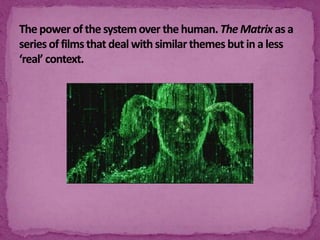
The Matrix is a 1999 science fiction-action film
Matrix Trilogy -Cyberpunk twist where the world is in fact a
simulated prison for humanity run by intelligent machine
agents
Its world full of codes, copies and representations there is no
originality.
Your imaginary world becomes the real world.
The matrix world becomes peoples real world.
The machine overpowers human.
Movies like Spiderman, Batman do represent reality yet they
make us fell that its a real
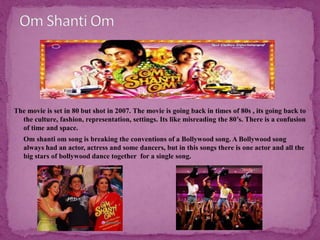
The movie is set in 80 but shot in 2007. The movie is going back in times of 80s , its going back to
the culture, fashion, representation, settings. Its like misreading the 80’s. There is a confusion
of time and space.
 Om shanti om song is breaking the conventions of a Bollywood song. A Bollywood song
always had an actor, actress and some dancers, but in this songs there is one actor and all the
big stars of bollywood dance together for a single song.
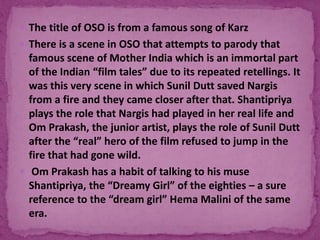
 The title of OSO is from a famous song of Karz
 There is a scene in OSO that attempts to parody that
famous scene of Mother India which is an immortal part
of the Indian “film tales” due to its repeated retellings. It
was this very scene in which Sunil Dutt saved Nargis
from a fire and they came closer after that. Shantipriya
plays the role that Nargis had played in her real life and
Om Prakash, the junior artist, plays the role of Sunil Dutt
after the “real” hero of the film refused to jump in the
fire that had gone wild.
 Om Prakash has a habit of talking to his muse
Shantipriya, the “Dreamy Girl” of the eighties – a sure
reference to the “dream girl” Hema Malini of the same
era.
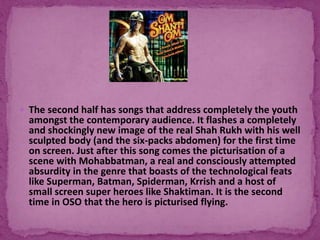
 The second half has songs that address completely the youth
amongst the contemporary audience. It flashes a completely
and shockingly new image of the real Shah Rukh with his well
sculpted body (and the six-packs abdomen) for the first time
on screen. Just after this song comes the picturisation of a
scene with Mohabbatman, a real and consciously attempted
absurdity in the genre that boasts of the technological feats
like Superman, Batman, Spiderman, Krrish and a host of
small screen super heroes like Shaktiman. It is the second
time in OSO that the hero is picturised flying.
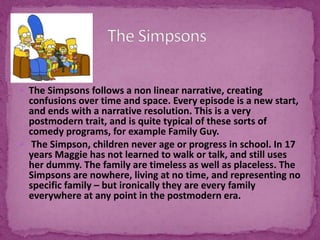
 The Simpsons follows a non linear narrative, creating
confusions over time and space. Every episode is a new start,
and ends with a narrative resolution. This is a very
postmodern trait, and is quite typical of these sorts of
comedy programs, for example Family Guy.
 The Simpson, children never age or progress in school. In 17
years Maggie has not learned to walk or talk, and still uses
her dummy. The family are timeless as well as placeless. The
Simpsons are nowhere, living at no time, and representing no
specific family – but ironically they are every family
everywhere at any point in the postmodern era.
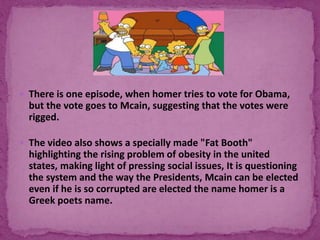
 There is one episode, when homer tries to vote for Obama,
but the vote goes to Mcain, suggesting that the votes were
rigged.
 The video also shows a specially made "Fat Booth"
highlighting the rising problem of obesity in the united
states, making light of pressing social issues, It is questioning
the system and the way the Presidents, Mcain can be elected
even if he is so corrupted are elected the name homer is a
Greek poets name.
 Overall ‘The Simpsons’ has a huge fan base and is the longest
running show in US history because it appeals to an audience
of all people regardless of age or personal beliefs. Its
postmodern context enables the viewer to take what they
want out of it and how much of it they want.
 The kids obviously want cartoon and Homer getting hurt and
some jokes that may seem socially weird. The adults on the
other hand will get the far more complex jokes that talk about
politics and such.
 Its anti-theoretical position is essentially a theoretical
stand
 The Postmodern direction to focus on the marginal is
itself an evaluative emphasis of precisely the sort that it
otherwise attacks.
By adamantly rejecting modern criteria for assessing
theory, Postmodernists cannot argue that there are no
valid criteria for judgment.

Postmodernism criticizes the inconsistency of
modernism, but refuses to be held to norms of
consistency itself.
Thank You
      

Postmodernism in media

  • 1.
  • 2.
    Post-modernism is aset of theories which suggests that society is undergoing a radical series of changes where modernism is either: coming to an end or, being rejected by people or, changing into a new order. Postmodernism it is general the era that follows Modernism Post modernism is well known since 1970 and 1980
  • 3.
    Postmodernism itself isa wide ranging term which applies to literature, art, economics, philosophy, architecture as well as new and traditional media forms.  Interpretation is everything with the concept of reality constantly under scrutiny and the key suggestions that these realities are social constructs which are open to change, everything is subjective and there is no absolute truth.
  • 4.
    Modernism Postmodernism purpose play designchance Hierarchy order Anarchy Confusion finished work process, performance distance participation creation deconstruction presence absence depth surface
  • 5.
    Modernism Postmodernism truth irony determinacyindeterminacy Reality Imaginary interpretation against interpretation reading misreading narrative Anti-narrative elitism Anti-authoritarianism
  • 6.
     It breaksdown the distinction between culture and society  An emphasis on style at the expense of substance and content A breakdown of a distinction between high culture art and popular culture Confusion over time and space  Decline of Meta narrative -make absolute universal and all- embracing claims to knowledge and truth  Post modernism rejects the claims of any theory to absolute knowledge, or of any social practice to universal validity.
  • 7.
     A copyof a copy of a copy  There is no such thing as originality  The distinction between media and reality has collapsed
  • 8.
     Intertextuality iswhen one media text references another  Intertextuality mixes genres, forms, conventions, media: it dissolves boundaries between high and low art, between serious and comic.
  • 9.
    High Art LowArt/ Popular Culture Fine art Advertising Opera Pop music Ballet Genre Films Classical Music Television Classical Literature Pulp fiction or Trashy Novels Art Cinema Pornography Against Elitism Treating ‘low art’ or ‘popular culture’ as if they where high art places
  • 10.
     The visualand stylistic impact becomes more important than the meaning message
  • 11.
    Postmodernists claim thatin a media-saturated world, where we are constantly immersed in media, 24/7 – and on the move, at work, at home – the distinction between reality and the media representation of it becomes blurred or even entirely invisible to us. In other words, we no longer have any sense of the difference between real things and images of them, or real experiences and simulations of them. Media reality is the new reality.
  • 12.
    The mass media…wereonce thought of as holding up a mirror to, and thereby reflecting, a wider social reality. Now that reality is only definable in terms of the surface reflections of that mirror. It is no longer a question of distortion since the term implies that there is a reality, outside the surface simulations of the media, which can be distorted, and this is basically what is at issue.
  • 13.
     Postmodern mediarejects the idea that any media product or text is of any greater value than another. All judgements of value are merely taste. The distinction between media and reality has collapsed, and we know live in a ‘reality’ defined by images and representations – a state of simulacrum. Images refer to each other and represent each other as reality rather than some ‘pure’ reality that exists before the image represents it – this is the state of hyperreality.
  • 14.
    The Matrix isa 1999 science fiction-action film Matrix Trilogy -Cyberpunk twist where the world is in fact a simulated prison for humanity run by intelligent machine agents Its world full of codes, copies and representations there is no originality. Your imaginary world becomes the real world. The matrix world becomes peoples real world. The machine overpowers human. Movies like Spiderman, Batman do represent reality yet they make us fell that its a real
  • 16.
    The movie isset in 80 but shot in 2007. The movie is going back in times of 80s , its going back to the culture, fashion, representation, settings. Its like misreading the 80’s. There is a confusion of time and space.  Om shanti om song is breaking the conventions of a Bollywood song. A Bollywood song always had an actor, actress and some dancers, but in this songs there is one actor and all the big stars of bollywood dance together for a single song.
  • 17.
     The titleof OSO is from a famous song of Karz  There is a scene in OSO that attempts to parody that famous scene of Mother India which is an immortal part of the Indian “film tales” due to its repeated retellings. It was this very scene in which Sunil Dutt saved Nargis from a fire and they came closer after that. Shantipriya plays the role that Nargis had played in her real life and Om Prakash, the junior artist, plays the role of Sunil Dutt after the “real” hero of the film refused to jump in the fire that had gone wild.  Om Prakash has a habit of talking to his muse Shantipriya, the “Dreamy Girl” of the eighties – a sure reference to the “dream girl” Hema Malini of the same era.
  • 18.
     The secondhalf has songs that address completely the youth amongst the contemporary audience. It flashes a completely and shockingly new image of the real Shah Rukh with his well sculpted body (and the six-packs abdomen) for the first time on screen. Just after this song comes the picturisation of a scene with Mohabbatman, a real and consciously attempted absurdity in the genre that boasts of the technological feats like Superman, Batman, Spiderman, Krrish and a host of small screen super heroes like Shaktiman. It is the second time in OSO that the hero is picturised flying.
  • 19.
     The Simpsonsfollows a non linear narrative, creating confusions over time and space. Every episode is a new start, and ends with a narrative resolution. This is a very postmodern trait, and is quite typical of these sorts of comedy programs, for example Family Guy.  The Simpson, children never age or progress in school. In 17 years Maggie has not learned to walk or talk, and still uses her dummy. The family are timeless as well as placeless. The Simpsons are nowhere, living at no time, and representing no specific family – but ironically they are every family everywhere at any point in the postmodern era.
  • 20.
     There isone episode, when homer tries to vote for Obama, but the vote goes to Mcain, suggesting that the votes were rigged.  The video also shows a specially made "Fat Booth" highlighting the rising problem of obesity in the united states, making light of pressing social issues, It is questioning the system and the way the Presidents, Mcain can be elected even if he is so corrupted are elected the name homer is a Greek poets name.
  • 21.
     Overall ‘TheSimpsons’ has a huge fan base and is the longest running show in US history because it appeals to an audience of all people regardless of age or personal beliefs. Its postmodern context enables the viewer to take what they want out of it and how much of it they want.  The kids obviously want cartoon and Homer getting hurt and some jokes that may seem socially weird. The adults on the other hand will get the far more complex jokes that talk about politics and such.
  • 22.
     Its anti-theoreticalposition is essentially a theoretical stand  The Postmodern direction to focus on the marginal is itself an evaluative emphasis of precisely the sort that it otherwise attacks. By adamantly rejecting modern criteria for assessing theory, Postmodernists cannot argue that there are no valid criteria for judgment.  Postmodernism criticizes the inconsistency of modernism, but refuses to be held to norms of consistency itself.
  • 23.
    Thank You      