PHYSICS GROUP PPT.
TOPIC:
Representation of image formed by
Spherical mirrors using ray diagram.
GROUP MEMBERS:
1. Brindha.M
2. Haritha.K
3.Karunya Devi.
4.Kowsalya.B
5.Srinidhi.N
of class 10.
Spherical Mirror:
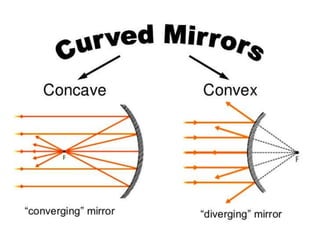
A curved mirror is a mirror with a
curved reflecting surface.
The surface may be either convex
(bulging outward) or concave (bulging
inward).
Most curved mirrors have surfaces
that are shaped like part of a sphere, but
other shapes are sometimes used in optical
devices.
Representation of image formed by
Spherical mirrors using ray diagram
:
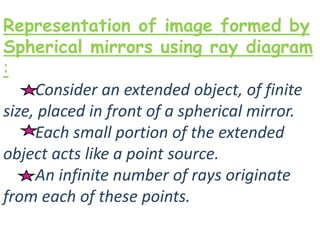
Consider an extended object, of finite
size, placed in front of a spherical mirror.
Each small portion of the extended
object acts like a point source.
An infinite number of rays originate
from each of these points.
To construct the ray diagrams, in order
to locate the image of an object, an
arbitrarily large number of rays emanating
from a point could be considered.
However, it is more convenient to
consider only two rays, for the sake of
clarity of the ray diagram.
These rays are so chosen that it is easy
to know their directions after reflection
from the mirror.
The intersection of at least two
reflected rays give the position of image of
the point object.
Any two of the following rays can be
considered for locating the image.
[Remember that in all the cases the
laws of reflection are followed. At the point
of incidence, the incident ray is reflected in
such a way that the angle of reflection
equals the angle of incidence.]
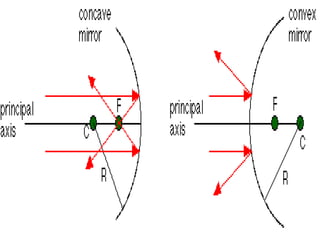
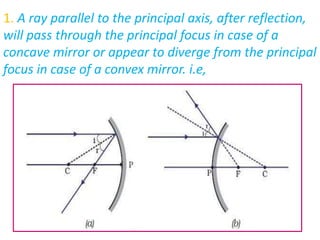
1. A ray parallel to the principal axis, after reflection,
will pass through the principal focus in case of a
concave mirror or appear to diverge from the principal
focus in case of a convex mirror. i.e,
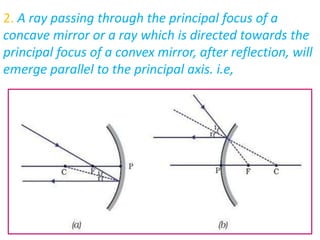
2. A ray passing through the principal focus of a
concave mirror or a ray which is directed towards the
principal focus of a convex mirror, after reflection, will
emerge parallel to the principal axis. i.e,
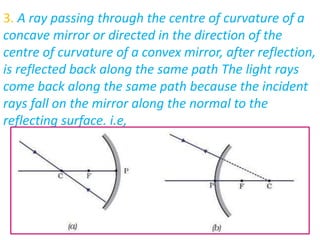
3. A ray passing through the centre of curvature of a
concave mirror or directed in the direction of the
centre of curvature of a convex mirror, after reflection,
is reflected back along the same path The light rays
come back along the same path because the incident
rays fall on the mirror along the normal to the
reflecting surface. i.e,
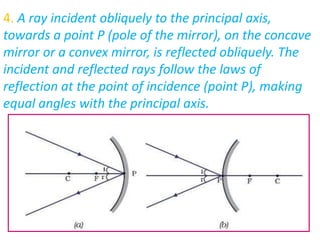
4. A ray incident obliquely to the principal axis,
towards a point P (pole of the mirror), on the concave
mirror or a convex mirror, is reflected obliquely. The
incident and reflected rays follow the laws of
reflection at the point of incidence (point P), making
equal angles with the principal axis.
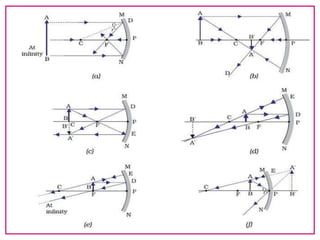
A) Image formation by Concave Mirror:
The image below illustrates the ray
diagrams for the formation of image by a
concave mirror for various positions of the
object.
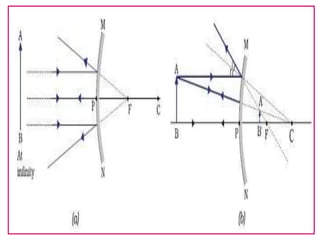
B) Image formation by a Convex Mirror:
We consider two positions of the object for
studying the image formed by a convex mirror.
First is when the object is at infinity and
the second position is when the object is at a
finite distance from the mirror.
The ray diagrams for the formation of
image by a convex mirror for these two
positions of the object are shown in the below
image.
representation of image formed

representation of image formed

  • 1.
  • 2.
    TOPIC: Representation of imageformed by Spherical mirrors using ray diagram.
  • 3.
    GROUP MEMBERS: 1. Brindha.M 2.Haritha.K 3.Karunya Devi. 4.Kowsalya.B 5.Srinidhi.N of class 10.
  • 6.
    Spherical Mirror: A curvedmirror is a mirror with a curved reflecting surface. The surface may be either convex (bulging outward) or concave (bulging inward). Most curved mirrors have surfaces that are shaped like part of a sphere, but other shapes are sometimes used in optical devices.
  • 9.
    Representation of imageformed by Spherical mirrors using ray diagram : Consider an extended object, of finite size, placed in front of a spherical mirror. Each small portion of the extended object acts like a point source. An infinite number of rays originate from each of these points.
  • 10.
    To construct theray diagrams, in order to locate the image of an object, an arbitrarily large number of rays emanating from a point could be considered. However, it is more convenient to consider only two rays, for the sake of clarity of the ray diagram. These rays are so chosen that it is easy to know their directions after reflection from the mirror.
  • 11.
    The intersection ofat least two reflected rays give the position of image of the point object. Any two of the following rays can be considered for locating the image. [Remember that in all the cases the laws of reflection are followed. At the point of incidence, the incident ray is reflected in such a way that the angle of reflection equals the angle of incidence.]
  • 12.
    1. A rayparallel to the principal axis, after reflection, will pass through the principal focus in case of a concave mirror or appear to diverge from the principal focus in case of a convex mirror. i.e,
  • 13.
    2. A raypassing through the principal focus of a concave mirror or a ray which is directed towards the principal focus of a convex mirror, after reflection, will emerge parallel to the principal axis. i.e,
  • 14.
    3. A raypassing through the centre of curvature of a concave mirror or directed in the direction of the centre of curvature of a convex mirror, after reflection, is reflected back along the same path The light rays come back along the same path because the incident rays fall on the mirror along the normal to the reflecting surface. i.e,
  • 15.
    4. A rayincident obliquely to the principal axis, towards a point P (pole of the mirror), on the concave mirror or a convex mirror, is reflected obliquely. The incident and reflected rays follow the laws of reflection at the point of incidence (point P), making equal angles with the principal axis.
  • 16.
    A) Image formationby Concave Mirror: The image below illustrates the ray diagrams for the formation of image by a concave mirror for various positions of the object.
  • 18.
    B) Image formationby a Convex Mirror: We consider two positions of the object for studying the image formed by a convex mirror. First is when the object is at infinity and the second position is when the object is at a finite distance from the mirror. The ray diagrams for the formation of image by a convex mirror for these two positions of the object are shown in the below image.